2005 SAAB 9-5 wheel
[x] Cancel search: wheelPage 227 of 276

225 Car care and technical information
Aspect ratio:
A two-digit number that indi-
cates the tire height-to-width measure-
ments. For example, if the tire size aspect
ratio is “55”, as shown in item “C” of the illus-
tration, it would mean that the tire´s sidewall
is 55% as high as it is wide.
Belt Rating: A letter code is used to indicate
the type of ply construction in the tire. The
letter “R” means radial ply construction; the
letter “D” means diagonal or bias ply cons-
truction; and the letter “B” means belted-
bias ply construction.
Rim Diameter:
Diameter of the wheel in
inches.
Load range:
The load range represents the
load carry capacity a tire is certified to carry.
Speed Rating:
The maximum speed that a
tire is certified to carry a load. Speed ratings
range from “A” to “Z”.
Tire markingsAn example of the meaning of the different
markings in a tire size is given below for a
tire size of:
215/55 R16 93 V 215 Tire section width, mm
55 Aspect ratio, i.e. the section height
is 55 % of the section width
R Radial ply
16 Wheel rim diameter 16 in at bead
seats
93 Tire load code
V Speed marking
Tire load index
91 Tire approved for max. 1355 lbs.
(615 kg)
93 Max. 1433 lbs (650 kg)
94 Max. 1477 lbs (670 kg)
Speed ratings
Q Tire approved for speeds up to 100
mph (160 km/h)
S Max. 112 mph (180 km/h)
T Max. 118 mph (190 km/h)
H Max. 130 mph (210 km/h)
V Max. 150 mph (240 km/h)
W Max. 167 mph (270 km/h)
Y Max. 186 mph (300 km/h)
TIN-codea Manufacturer´s Identification Mark
b Tire Size
c Tire Type Code
d Date of Manufacture
ProCarManuals.com
Page 230 of 276

228 Car care and technical informationSteps for Determining Correct
Load Limit1 Locate the statement “The
combined weight of occupants and
cargo should never exceed
XXX pounds” on your vehicle´s
label.
2 Determine the combined weight of
the driver and passengers that will
be riding in your vehicle.
3 Subtract the combined weight of the
driver and passengers from
XXX kilograms or XXX pounds.
4 The resulting figure equals the avail-
able amount of cargo and luggage
load capacity. For example, if the
“XXX” amount equals 1400 lbs. and
there will be five 150 lb. passengers
in your vehicle, the amount of avail-
able cargo and luggage load capac-
ity is 650 lbs. (1400–750 (5x150) =
650 lbs.).5 Determine the combined weight of
luggage and cargo being loaded on
the vehicle. That weight may not
safely exceed the available cargo
and luggage load capacity calcu-
lated in Step 4.
6 If your vehicle will be towing a trailer,
load from your trailer will be trans-
ferred to your vehicle. Consult this
manual to determine how this
reduces the available cargo and
luggage load capacity of your vehi-
cle.
Winter tiresWinter (snow) tires are recommended for
winter climates where the majority of your
driving will be done on snow and ice. Winter
tires should be fitted to all four wheels to
maintain a proper balance. Your Saab
dealer can advise you of to the correct size
tire for your car (if different from the original
size) and also supply Saab approved winter
tires pre-mounted on steel or alloy rims.
Winter tires normally use a different speed
rating compared to summer/all season tires.
Make sure not to exceed the stated speed
rating on the tires you use.
ProCarManuals.com
Page 232 of 276

230 Car care and technical informationCompact spare tireThe compact spare is light and easy to
handle when changing the tire. Its use is
only permitted when a standard tire has sus-
tained a puncture. The maximum life of the
tire is only 2000 miles (3,500 km).Do not exceed 50 mph (80 km/h) with the
compact spare fitted.The compact spare should be inflated to
60 psi (420 kPa). Carry the punctured tire in
the spare-wheel well under the luggage-
compartment floor.
Have the standard tire repaired and refitted
as soon as possible (see also page 170).The spare tire, together with the jack, front
towrope attachment eye and toolkit, is
stowed away underneath the luggage-
compartment floor.
NOTICETo avoid damaging a punctured alloy
wheel it can be placed outside up in the
spare-wheel well but
only
while driving to
the closest dealer.
A general rule is that all heavy loads must
be well secured in the luggage compart-
ment, see page 123 and 126.
IB3234
Hanging up the cover, 9-5 SportWagon
IB3233
Spare wheel (under panel in luggage
compartment)
ProCarManuals.com
Page 233 of 276

231 Car care and technical information
Changing a wheel
WARNING
Lifting a vehicle and getting under it to do
maintenance or repairs is dangerous
without the appropriate safety equipment
and training. The jack provided with your
vehicle is designed only for changing a
flat tire. If it is used for anything else, you
or others could be badly injured or killed if
the vehicle slips off the jack. Use the jack
provided with your vehicle only for chang-
ing a flat tire.
Changing a tire can be dangerous. The
vehicle can slip off the jack and roll over
or fall on you or other people. You and
they could be badly injured or even killed.
Find a level place to change your tire. To
help prevent the vehicle from moving:
1 Set the parking brake firmly.
2 If you have an automatic transmis-
sion, put the shift lever in PARK (P).
For a manual transmission, leave the
car in gear (1st or REVERSE (R)).
3 Turn off the engine and do not restart
while the vehicle is raised.
4 Do not allow passengers to remain in
the vehicle.
To be even more certain the vehicle won't
move, you should put blocks at the front
and rear of the tire farthest away from the
one being changed. That would be the
tire, on the other side, at the opposite end
of the vehicle.
The car jack is designed solely for use
in changing a wheel or fitting snow
chains.
It must not be used to
support the car during repair work
or servicing.
Never
crawl under a car that is
supported only by a jack.
Raising your vehicle too high or with
the jack improperly positioned can
damage the vehicle and even make
the vehicle fall. To help avoid personal
injury and vehicle damage, be sure to
fit the jack lift head into the proper
location before raising the vehicle, and
raise the vehicle only far enough off
the ground so there is enough room for
the spare tire to fit (no more than 25
mm or 1 inch clearance between the
ground and the bottom of the tire).
Switch on the hazard warning lights if
the car is on a road.
The jack should be stored correctly
under the carpeting in the trunk. If it
lies loose in the car, it could thrown
forward and cause personal injury in
the event of a crash or if the car rolls
over.
Grit, salt and rust can clog the inner
threads of the wheel bolts if the car has
been driven for several years exclu-
sively with alloy wheels.
If steel wheels are being installed, the
bolt hole threads in the brake hubs
should be cleaned before the thinner
steel wheels are fitted. It may other-
wise not be possible to achieve the
correct clamping force, despite tight-
ening the wheel bolts to the correct
torque.
ProCarManuals.com
Page 234 of 276

232 Car care and technical informationTo jack up the car, apply the jack to one of
the special jacking points under the sills.
If a floor jack is used, it can be applied to the
standard jacking points used by the dealer.
A floor jack can lift both front wheels or both
rear wheels off the ground simultaneously.
A jack stand must then be applied underne-
ath the front of the engine subframe (at the
fixing point for the towrope-attachment eye)
or to the rear towrope-attachment eye (or
under the trailer hitch, if fitted).1 Put the car in 1st gear (automatic trans-
mission: move selector to the P position)
and apply the parking brake.2 Wind the jack up to a suitable height
before placing it under the recess in the
sill.
Make sure that the jack fully engages
the recess in the sill and that the base of
the jack is steady and flat on the ground.
3 Remove the wheel cover (where appli-
cable).
Loosen the wheel bolts by half a turn.
4 Wind the jack to raise the wheel clear of
the ground. Remove the wheel bolts and
lift off the wheel.
5 Clean any rust or dirt from the contact
surfaces between the wheel and brake
disc. Do not wipe away the grease in the
hub.
6 Fit the wheel and screw in the bolts in the
sequence shown (opposite pairs) - see
page 234.
NOTICEApply the jack only to the jacking points
indicated on the body.Position for jack
IB1838
IB1553
Positioning the jack
ProCarManuals.com
Page 235 of 276
233 Car care and technical information
Tighten the bolts enough for the bolts
and wheel to be seated correctly.
7 Lower the car and tighten the wheel
bolts to the correct torque in the
sequence shown (opposite pairs).Tightening torqueLight-alloy wheels: 80 ft.lbs. (110 Nm)
Steel wheels: 80 ft.lbs. (110 Nm).
8 Check-tighten the wheel bolts after a few
miles.Tightening torqueLight-alloy wheels: 80 ft.lbs. (110 Nm)
Steel wheels: 80 ft.lbs. (110 Nm)
NOTICE When refitting wheel covers (where
applicable), make sure that the valve
protrudes through the marked hole in
the wheel cover.
Do not overtighten the bolts using an
impact wrench: not only can this
damage the wheels but it can also
make it impossible to undo the bolts
using the wheel wrench in the car’s
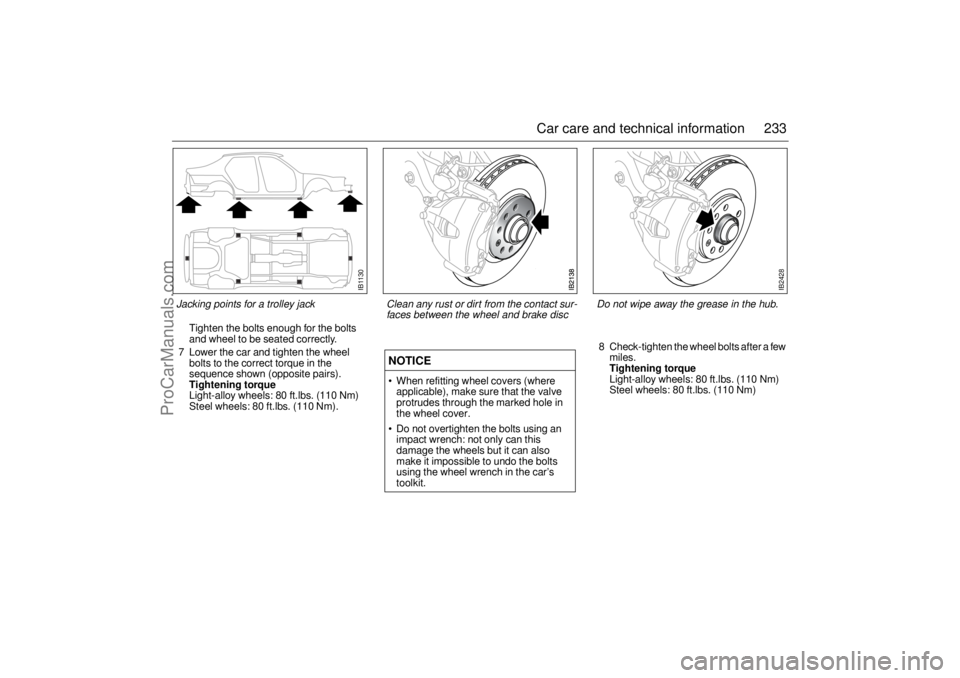
toolkit. Clean any rust or dirt from the contact sur-
faces between the wheel and brake disc
IB2428
Do not wipe away the grease in the hub.
IB1130
Jacking points for a trolley jack
ProCarManuals.com
Page 236 of 276

234 Car care and technical information
Air conditioning
(ACC)
WARNING
All repairs and adjustments on the A/C
system must be carried out by a Saab
dealer authorized for this kind of work.
The A/C system is pressurized. Do not
break any connections or undo A/C
system components.
Escaping refrigerant gas can cause
visual impairment or other injury.NOTICE The A/C system is designed for use
with R134a refrigerant.
Refrigerant handling requires special
equipment and special procedures for
charging and draining the system.
Never mix R134a and R12 refriger-
ants.
IB1800IB1800
Removing the wheel cover
IB539
Tightening sequence, wheel bolts
ProCarManuals.com
Page 242 of 276

240 Car care and technical informationAnti-corrosion
treatmentThe entire car is corrosion-protected at the
factory in different stages by an electrolytic
immersion coating and a PVC-based pro-
tective coating to protect against corrosion
caused by stones flung up by the wheels. A
thin penetrating anti-rust oil is also applied
in cavities and body members.
In addition to conventional anti-corrosion
treatment like painting, underbody treat-
ment and cavity treatment, most of the body
panel surfaces are galvanized. These
include the hood, the doors and the under-
body.
The anti-corrosion treatment on the under-
side of the car and inside the wheel arches
is particularly exposed to constant wear and
possible damage, the degree of which will
obviously depend on driving conditions.
What causes rust?Steel body panels of automobiles are sub-
ject to rusting whenever air and moisture
manage to penetrate the protective finish,
and body panels may rust through if the pro-
cess is unchecked. Rusting can occur
wherever water is trapped or where the
car’s panels are continuously damp.
Damage to paint and undercoating by sto-
nes, gravel and minor crashes immediately
exposes metal to air and moisture. Road
salts used for de-icing will collect on the
bottom of the car and promote rusting.
Areas of the country with high humidity have
great potential for rust problems, especially
where salt is used on roads or there is moist
sea air. Industrial pollution (fallout) may also
damage paint and promote rusting.
Preventive maintenanceThe following procedures are necessary to
help protect against rusting. Refer also to
the terms and conditions of the Sheet Metal
Coverage described in the warranty
booklet.
1
Wash the car frequently, and wax at
least twice a year.
Under adverse con-
ditions, where there is a rapid buildup of
dirt, sand or road salt, wash your car at
least once a week. After extreme expo-
sure to salted snow or slush, evidenced
by a white film on the car, wash the car
immediately. Frequent washing will pre-
vent paint damage from acid rain and
other airborne contaminants such as
tree sap and bird droppings. If any of
these contaminants are noticed on the
car the finish should be washed immedi-
ately.
Begin washing by rinsing the entire car
with water to loosen and flush off heavy
concentrations of dirt (include the
underbody).
Sponge the car with a solution of either
a good quality car soap or mild general
purpose (dish washing) detergent and
water.
Rinse car thoroughly with clean water.
After washing, check and clear all
drains in doors and body panels.
Wipe the car dry, preferably using a
chamois.
ProCarManuals.com