2005 SAAB 9-5 instrument panel
[x] Cancel search: instrument panelPage 181 of 276
179 Starting and driving
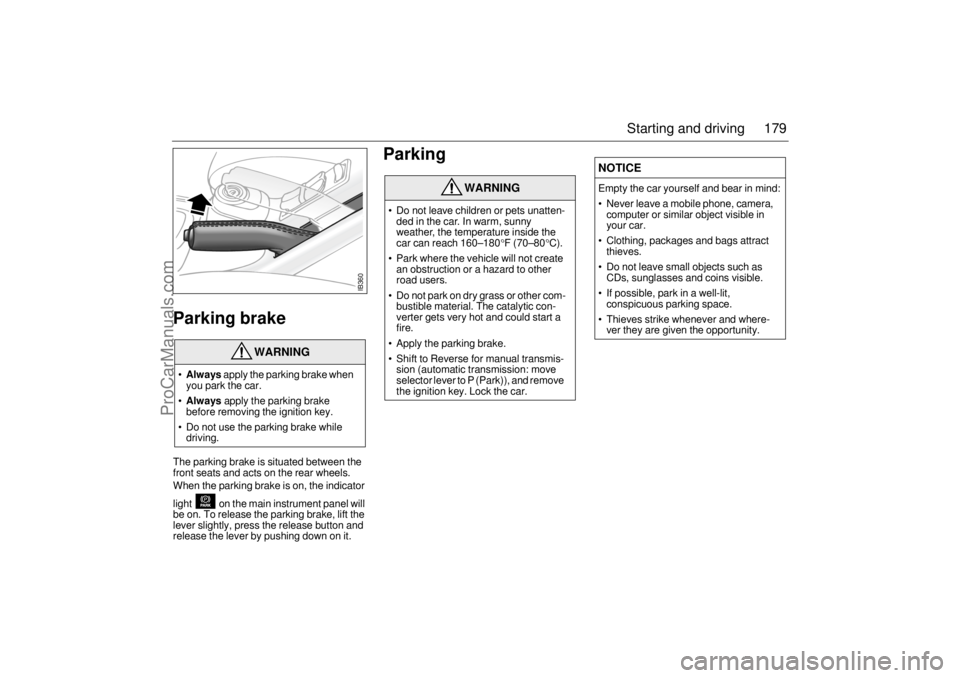
Parking brake
The parking brake is situated between the
front seats and acts on the rear wheels.
When the parking brake is on, the indicator
light on the main instrument panel will
be on. To release the parking brake, lift the
lever slightly, press the release button and
release the lever by pushing down on it.
Parking
WARNING
Always
apply the parking brake when
you park the car.
Always
apply the parking brake
before removing the ignition key.
Do not use the parking brake while
driving.
WARNING
Do not leave children or pets unatten-
ded in the car. In warm, sunny
weather, the temperature inside the
car can reach 160–180°F (70–80°C).
Park where the vehicle will not create
an obstruction or a hazard to other
road users.
Do not park on dry grass or other com-
bustible material. The catalytic con-
verter gets very hot and could start a
fire.
Apply the parking brake.
Shift to Reverse for manual transmis-
sion (automatic transmission: move
selector lever to P (Park)), and remove
the ignition key. Lock the car.
NOTICEEmpty the car yourself and bear in mind:
Never leave a mobile phone, camera,
computer or similar object visible in
your car.
Clothing, packages and bags attract
thieves.
Do not leave small objects such as
CDs, sunglasses and coins visible.
If possible, park in a well-lit,
conspicuous parking space.
Thieves strike whenever and where-
ver they are given the opportunity.
IB360
ProCarManuals.com
Page 184 of 276

182 Car care and technical informationHood The hood release handle is located under-
neath the instrument panel. To open the
hood:
1 Pull the release handle.
2 The front of the hood will now spring up,
providing access to the secondary
safety catch.
3 Push the catch upwards, pushing the
hood downward a little bit at the same
time. The hood can now be lifted right
up.
To close the hood, release it from a height
of about 8 in (20 cm).
Do not
press down
on it.
In cold weather, when the mechanism is
stiff, the hood might need to be released
from twice the height to lock properly.
Check that the hood is now closed securely.
WARNING
Never hold your fingers between the hood
and safety catch if lowering but not clos-
ing the hood.
IB487
IB486
Hood release handle Hood secondary safety catch
ProCarManuals.com
Page 213 of 276

211 Car care and technical information
Fuses
The fuses are housed in two fuse panels:
one at the end of the instrument panel on the
driver’s side, and one under the hood.
To check if a fuse has blown, first remove it
from the panel (see below). If the filament is
broken, the fuse has blown.
A special tool for removing fuses is provided
at the bottom of the fuse panel. Simply push
the tool onto the fuse, squeeze and remove
the fuse.
WARNING
To avoid the risk of short-circuiting and/or
fire breaking out in the electrical system,
the following advice should be heeded:
Always consult an authorized Saab
dealer before modifying or adding any
electrical equipment. Failure to do so
can result in the electrical system
being damaged.
Never replace a fuse with one having
a higher/lower rating than specified
(see page 213). The color of the fuse
indicates its amperage.
If the same fuse blows repeatedly,
have the electrical system checked by
an authorized Saab dealer.
If a MAXI fuse blows, it means that
there is a major fault in the electrical
system. Have the car checked by an
authorized Saab dealer.
IB527
Fuse panel in instrument panel
IB1794
Fuse box under the hood
IB144
Sound fuse / Blown fuse
ProCarManuals.com
Page 214 of 276

212 Car care and technical informationMaxi fusesThe Maxi fuses are housed in the fuse box
under the hood. These fuses can be
checked in the same way as the other fuses.
The Maxi fuses are designed to protect the
car’s electrical system from being dama-
ged. Each Maxi fuse protects a number of
electrical circuits and functions and there-
fore has a higher rating (amperage) than the
standard fuses. No spare Maxi fuses are
supplied with the car.
DICE / TWICEDICE = Dashboard Integrated Central Elec-
tronics
TWICE = Theft-Warning Central Electronics
DICE and TWICE are electronic control
modules that monitor and control a variety
of functions, including:
DICE controls (among other things):
Front lights and interior lighting
Instrument illumination
Intermittent wiper operation
Electric heating of rear window and door
mirrors
Cooling fans
TWICE controls (among other things):
Central locking.
Car alarm (Anti-theft system)
Engine immobilizer
Autochecking of lights.
Electric heating of rear seat
Safety belt reminder
Electrically adjustable passenger seatThe DICE and TWICE control modules are
linked to a data bus, which is basically an
information carrier that allows information to
be exchanged between all the control
modules and components connected to the
bus.
If a fault occurs in any of these components,
diagnostic faults codes are set in the rele-
vant control module, which facilitates fault
diagnosis at the Saab dealer.
The scan tool connector for fault diagnosis
is located under the instrument panel on the
drivers side.
NOTICEIf a Maxi fuse blows, it means that there is
a major fault in the electrical system.
Have the car checked without delay by an
authorized Saab dealer.
IB1795
Maxi fuses under the hood
ProCarManuals.com
Page 215 of 276

213 Car care and technical information
Fuse panel in instrument panel
# Amp Function A 30 Trailer lights
B 10 Automatic transmission
C 7.5 Electric door mirrors; DICE: manual beam length
adjustment
115Brake lights
2 15 Reversing lights
3 10 Parking lights and taillights, left
4 10 Parking lights and taillights, right
5 7.5 DICE / TWICE
6 30 Electric windows, right; trailer charging
6B 7.5 Brake lights, trailer
7 10 Engine injectors
8 15 Trunk lighting; trunk lock; door lighting, circulation
pump; parking assistant; SID
9 15 Audio System; CD changer
10 15 Heating, rear seat; sunroof, remote control receiver
11 30 Electrically adjusted passenger seat
12 7.5 Automatic transmission
13 20 Audio System, amplifier
14 30 Ignition system, engine
15 20 Fuel pump
16 20 DICE (direction indicators)
16B – OnStar (if equipped)
17 20 Engine-management system; main instrument;
DICE/TWICE
18 40 Door-mirror heating; rear-window heating
19 10 OnStar; Telematics (if equipped)
20 15 ACC; interior lighting; rear fog light; high beam flasher
21 10 Audio System; rear-view mirror; load angle sensor
(cars with xenon); navigation (accessory); Cruise
Control
22 40 Interior fan
23 15 Central locking; navigation (accessory); door mirror
memory
24 – –
25 30 Electrically adjustable driver’s seat
26 7,5 Driver seat memory; mirrors memory; sunroof; par-
king assistant; seatbelt reminder
IB2439
BC123456 A
14
121110987
13
6B
1516
2324
222120191817
16B25262728293031
3635343332
393837
ProCarManuals.com
Page 216 of 276
214 Car care and technical information
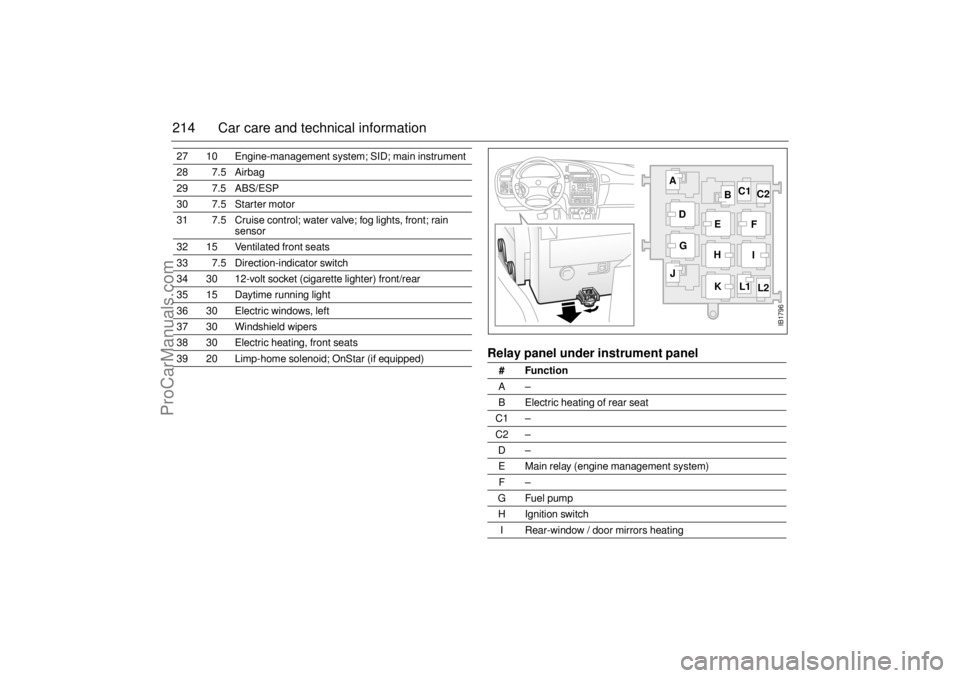
Relay panel under instrument panel
27 10 Engine-management system; SID; main instrument
28 7.5 Airbag
29 7.5 ABS/ESP
30 7.5 Starter motor
31 7.5 Cruise control; water valve; fog lights, front; rain
sensor
32 15 Ventilated front seats
33 7.5 Direction-indicator switch
34 30 12-volt socket (cigarette lighter) front/rear
35 15 Daytime running light
36 30 Electric windows, left
37 30 Windshield wipers
38 30 Electric heating, front seats
39 20 Limp-home solenoid; OnStar (if equipped)
# Function A –
B Electric heating of rear seat
C1 –
C2 –
D–
E Main relay (engine management system)
F–
G Fuel pump
H Ignition switch
I Rear-window / door mirrors heating
IB1796
A
BC1
C2
L2 L1 D
GE
F
H
I
K J
ProCarManuals.com
Page 269 of 276

267 Index
IIf a tire goes flat
________________ 223
Ignition switch
__________________ 132
Immobilizer
_____________________ 43
Indicator and warning lights
________ 52
Indicator lights
___________________ 52
Instrument illumination
____________ 69
Instruments and controls __________ 51
Interior equipment
_______________ 105
Interior lighting
_________________ 116
Interior rearview mirror
___________ 107
JJack
_________________________ 232
KKey
___________________________ 38
Key to chassis number
___________ 263
Key, remove
___________________ 132
LLATCH (child safety)
______________ 22
Labeling, tire sidewall ____________ 224
Labels
__________________________ 7Leather upholstery, care of
________ 236
Light horn
______________________ 67
Light switches ___________________ 67
Loading your vehicle
_____________ 226
Luggage-compartment lighting
_____ 116
MMain instrument panel
_____________ 52
Main/dipped beam
_______________ 67
Maintenance schedule ___________ 246
Maintenance, A/C-system _________ 234
Manual gearbox, technical data
____ 258
Maxi fuses
_____________________ 212
Milometer ______________________ 58
Motoring abroad
________________ 241
NNew tires, buying
_______________ 219
Night Panel
_____________________ 65
OOil capacity, engine
______________ 254
Oil change, engine ______________ 187
Oil specification
_________________ 254
Outdoor temperature
______________ 61
Owner assistance
_______________ 247
PPaintwork, touching-in
____________ 238
Parking Assistance
______________ 177
Parking lights
____________________ 67
Plates and labels
________________ 262
Poly-V-belt
_____________________ 194
Power steering
_________________ 191
Power-steering fluid
______________ 191
Pressure gauge
__________________ 60
Programming I, ACC
______________ 79
Programming II, ACC _____________ 80
Programming the ACC ____________ 79
QQuality grading, tires
_____________ 221
Questions on function of airbag
______ 35
Quick guide, Audio System
_________ 85
RRadiator fan
____________________ 194
Radio
__________________________ 88
Rain sensor
_____________________ 71
Rear fog light ____________________ 68
Rear seat, 9-5 Sedan, folding
______ 121
Rear seat, 9-5 SportWagon, folding
_ 124
Rear-seat head restraints
__________ 16
Rear-view mirror, auto-dimming
____ 111
ProCarManuals.com