2005 SAAB 9-5 roof
[x] Cancel search: roofPage 117 of 276
115 Interior equipment and trunk
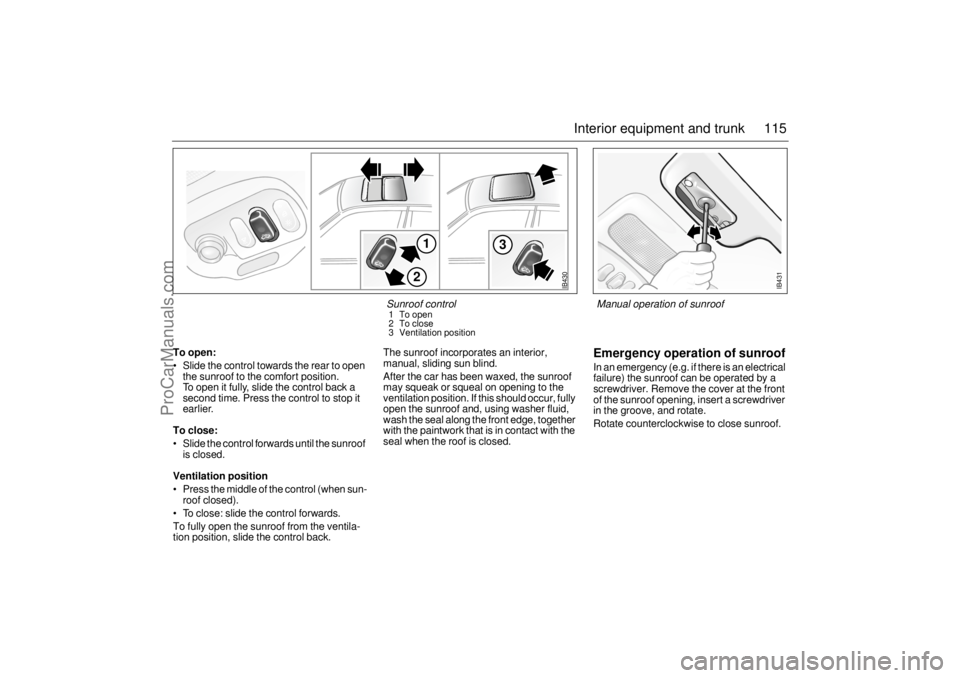
To open: Slide the control towards the rear to open
the sunroof to the comfort position.
To open it fully, slide the control back a
second time. Press the control to stop it
earlier. To close: Slide the control forwards until the sunroof
is closed. Ventilation position Press the middle of the control (when sun-
roof closed).
To close: slide the control forwards.
To fully open the sunroof from the ventila-
tion position, slide the control back. The sunroof incorporates an interior,
manual, sliding sun blind.
After the car has been waxed, the sunroof
may squeak or squeal on opening to the
ventilation position. If this should occur, fully
open the sunroof and, using washer fluid,
wash the seal along the front edge, together
with the paintwork that is in contact with the
seal when the roof is closed.
Emergency operation of sunroofIn an emergency (e.g. if there is an electrical
failure) the sunroof can be operated by a
screwdriver. Remove the cover at the front
of the sunroof opening, insert a screwdriver
in the groove, and rotate.
Rotate counterclockwise to close sunroof.
IB430
1
3
2
Sunroof control 1 To open
2 To close
3 Ventilation position
IB431
Manual operation of sunroof
ProCarManuals.com
Page 130 of 276

128 Interior equipment and trunkCargo net(option)Install the net behind the rear seat backrest.
1 Remove the rearmost covers from the
roof.
2 Fasten the attachments at the top of the
net to the two attachment points in the
roof.
3 Secure a lashing eye furthest forward on
each of the CargoTracks (see previous
page). Attach the hooks on the net to
these eyes. Tension the straps.You can also install the cargo net directly
behind the front seats when the rear seats
are folded.
1 Remove the front covers from the roof.
2 Fasten the attachments at the top of the
net to the two attachment points in the
roof.
3 Wrap each strap around the tube run-
ning under the rear edge of each front
seat and attach the hook to the eye on
the strap.
WARNING
The cargo in the luggage compartment
must be anchored properly, even if the
cargo net is correctly in position. The only
purpose of the net is to prevent light
objects from being thrown about in the
cabin during heavy braking or in the event
of a crash.
IB1217
Cover over the fixing point for the cargo
net
IB1218
Attaching the cargo net to the roof
IB3724
Hook attached to a lashing eye
ProCarManuals.com
Page 133 of 276

131 Starting and driving
IB1754
Starting and driving
Ignition switch ________ 132
Starting the engine ____ 133
Important considerations
for driving___________ 136
Refueling ____________ 138
Engine Break-In Period_ 142
Gear changing ________ 142
Cruise control ________ 151
Braking ______________ 152
Electronic Stability
Program (ESP) _______ 155
Economical motoring __ 157
Driving in cold weather_ 159
Driving in hot weather _ 160
Towing a trailer _______ 161 Driving with a roof rack
load_________________ 166
Driving at night ________ 168
Driving with a load _____ 168
Driving considerations
with compact spare
wheel/tire fitted _______ 170
Spare wheel and tools __ 170
Driving with the trunk
lid/tailgate open _______ 171
Driving in deep water ___ 171
Towing the car_________ 171
Jump starting _________ 174
Saab Parking Assistance 177
Parking brake _________ 179
Parking _______________ 179
ProCarManuals.com
Page 160 of 276

158 Starting and drivingDriving technique To obtain the best running economy, not
only regarding fuel consumption but
general wear also, regular service is
required.
High speed, unnecessary acceleration,
heavy braking and much low gear work all
gives rise to higher fuel consumption.
Frequent gear changing in traffic, starting
in cold weather, the use of studded tires
and roof racks, and towing a trailer all
increase fuel consumption.
Do not run the engine when the car is sta-
tionary.
If idling, it will take much longer before the
engine becomes hot. Engine wear is gre-
atest during this warming-up phase. The-
refore drive away as soon as possible
after the engine is started and avoid high
revving. Driving in a low gear results in higher fuel
consumption than in a high gear because
of the higher engine speed for a given
road speed. Always change up to a higher
gear as soon as traffic conditions allow
and use the highest gear as much as pos-
sible.
Check the air pressure in the tires once a
month. Incorrect pressures increase tire
wear. It is better to have slightly higher
pressure than lower.
Check fuel consumption regularly.
Increased consumption can indicate that
something is wrong and that the car
needs to be checked by an authorized
Saab dealer.
Practical trials on the roads have demon-
strated that substantial savings in fuel con-
sumption can be made if the above advice
is heeded.
Road conditionsWet roads increase fuel consumption, as do
unpaved roads and driving in hilly country
(the amount of fuel saved driving downhill is
less than the additional amount required to
climb the hill).
WARNING
Never switch the engine off while driving
as the effect of the brakes and power ste-
ering will be greatly reduced.
ProCarManuals.com
Page 168 of 276

166 Starting and drivingDriving with a roof rack
loadThe maximum permissible roof load is
220 lbs. (100 kg).
Note that the roof load is included in the
car’s maximum permissible load (see
page 252).
Strong, sturdy roof carriers designed spe-
cially for the car are available from your
Saab dealer. Always secure the roof load
safely.
Fitting the roof carriers,
9-5 Sedan and 9-5 Wagon
without roof rails(accessory)The carrier feet are marked with a top view
of the car and arrow indicating their posi-
tions.
1 Slip the plastic cover onto the adjustable
foot of the carrier (foot with knob for tigh-
tening) to protect the paintwork during
assembly.
2 Open all the doors.
Fold back the rubber strip and find the
fixing holes. 3 Start on the left-hand side of the car.
Rest the carrier carefully across the roof,
with the rigid foot towards you. Hold the
foot clear of the roof to avoid damaging
the paintwork.
Fold back the rubber strip and insert the
pins on the foot into the fixing holes.
Make sure that the rubber strip comes
inside the plastic cover on the carrier.
Repeat the procedure with the other
carrier.
WARNING
A roof load will affect the car’s center
of gravity and aerodynamics. Be
aware of this when cornering and dri-
ving in crosswinds.
Suit your speed to the prevailing con-
ditions.
Due to higher aerodynamic drag, fuel
economy may suffer when driving with
a roof rack.
IB480
IB481
ProCarManuals.com
Page 169 of 276

167 Starting and driving
4 Close the doors on the left-hand side of
the car gently, to hold the carrier feet in
place.
5 Now go around to the other side of the
car and remove the plastic cover from
the carrier’s adjustable foot. Fold back
the rubber strip and insert the pins on
the foot into the fixing holes. Do the
same with the other carrier and close the
doors gently.
6 Tighten each carrier by turning the knob
clockwise (by hand). Tighten just
enough to bring the foot up against the
edges of the fixing holes.
Remove the carriers when not in use, as
they increase fuel consumption.
The instructions that accompany the carri-
ers also include advice on driving with a roof
load – we strongly recommend that you
read them carefully.
Fitting the roof carriers,
9-5 Wagon with roof rails(accessory)1 Clean the car’s roof rails.
2 Check the markings on the cross mem-
bers to see which is the front and which
is the rear roof carrier.
3 Place the cross members on the roof
rails, on their respective sides of the
center supports. The cross members
must not be placed beyond the front or
rear joint on the rail. Ensure that the dis-
tance between the cross members is at
least 28 inches (700 mm).
If a roof box is to be fitted, the cross
members must be positioned so that the
tailgate can be opened fully without hit-
ting the roof box.
4 Using your thumb, press the bracket so
that it lies snugly against the outside of
the roof rail. Make sure that the roof car-
riers are seated centrally on the rubber
spacers and that these sit correctly on
the roof rail. Pull the spacers down
slightly on the inside of the roof rail.
5 Center the roof carriers so that they
protrude equally on both sides.
6 Tighten the roof carriers by hand.
Ensure that the tightening knobs are
upright once the roof carriers have been
tightened.
7 Make sure the roof carriers are securely
in place.
IB1294
ProCarManuals.com
Page 170 of 276

168 Starting and driving
Driving at nightBear in mind the following points when
driving at night:
Nighttime driving requires your full con-
centration.
Do not rush. Count on your journey taking
slightly longer.
The number of drivers under the influence
of drugs is likely to be greater at night than
during the day.
Do not stare at the headlights of onco-
ming vehicles.
Avoid driving at night if you have poor eye-
sight. Night vision deteriorates with age.
Keep your car's headlights, windows and
mirrors clean. Also, if you wear glasses,
make sure they are clean.
Make sure you are well rested before star-
ting a long journey. Take a break every
other hour.
Only eat light meals. Heavy meals have a
tendency to induce tiredness.
Driving with a loadThe driving characteristics of the car are
affected by the way it is loaded.
Place heavy loads as far forward and as
low as possible in the trunk.
Secure the load to the tie downs, see
page 123.
The load should be such that the car´s
total weight or axle weight are not
exceeded, see page 252.
Heavy loads mean that the car’s center of
gravity is further back. As a result, the car
will sway more during evasive steering.
Never exceed the permissible load in the
roof box, even if there is room for more.
Ensure that the tire pressure is correct –
slight overinflation is preferable to under-
inflation.
The braking distance of a loaded car is
always greater. Keep your distance from
the vehicle in front.
Roof loads can negatively affect tele-
communication.Tire pressure, see page 262 and back
cover.
IB1295
ProCarManuals.com
Page 173 of 276

171 Starting and driving
Driving with the trunk
lid/tailgate openAvoid driving with the trunk lid/tailgate partly
or fully open, since exhaust fumes can be
drawn into the cabin.
If you must drive with the trunk lid/tailgate
open, all windows and the sunroof (if fitted)
must be closed and the cabin fan on at its
highest speed setting.
Driving in deep water Towing the carNOTICEDo not drive in water deeper than
12 inches (30 cm) and do not drive faster
than 3–4 mph. Water can otherwise be
sucked into the engine. The engine will be
seriously damaged if water enters the
intake system.
WARNING
Remember that the brake servo does
not operate when the engine is off.
Much greater pressure than normal
will therefore be required to operate
the brake pedal.
Nor does the steering servo operate
when the engine is off. The steering
will therefore be much heavier than
usual.
The towing vehicle should always be
heavier than the vehicle on tow.
Never allow passengers to ride in the
car being towed.
Always seek professional help if the
car needs to be towed.
ProCarManuals.com