Page 171 of 250
Downloaded from www.Manualslib.com manuals search engine
1
2
1
1
1
NU761_2_G3-FRA.qxd 4/11/05 10:52 Page 3.33
3.33
STORAGE COMPARTMENTS/LUGGAGE COMPARTMENT FITTINGS
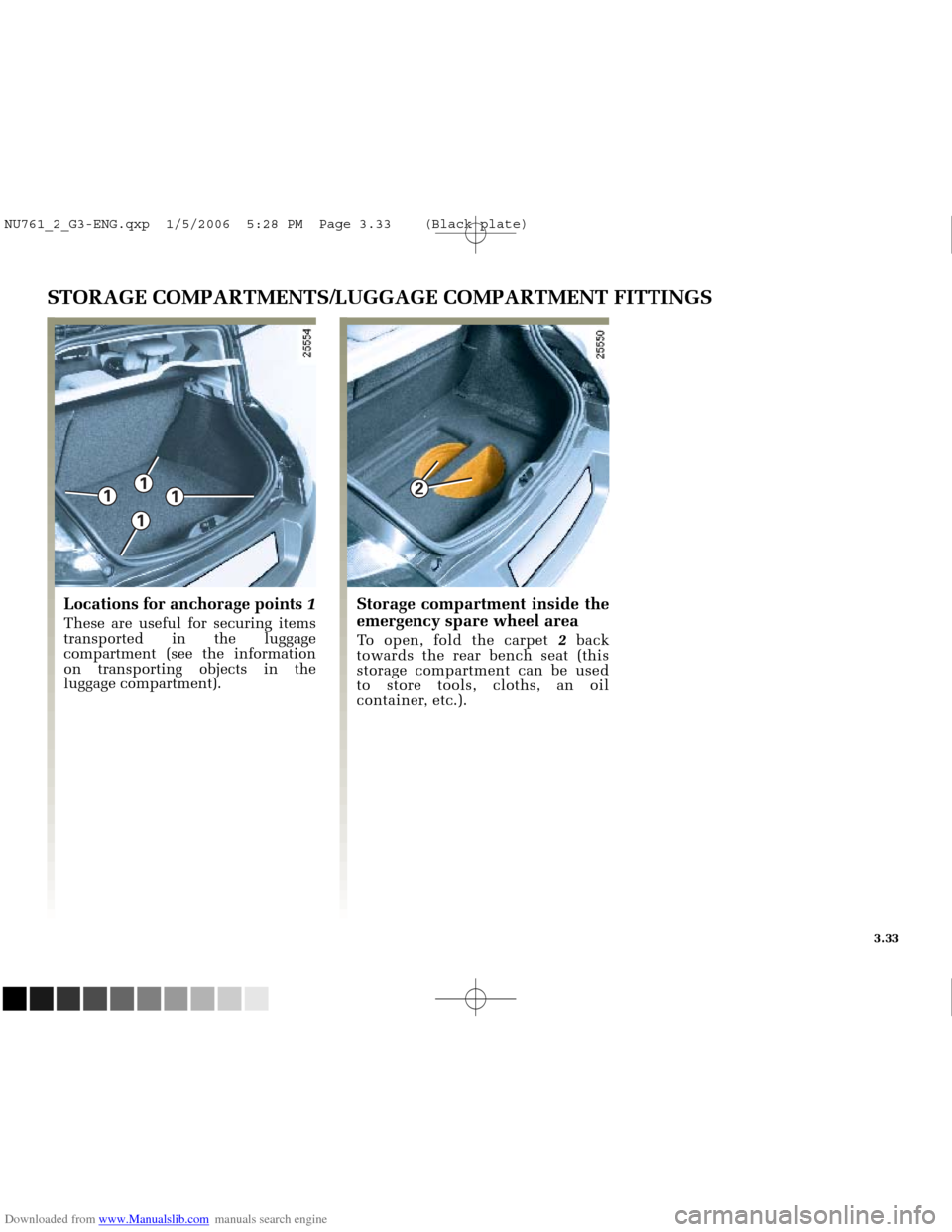
Locations for anchorage points 1
These are useful for securing items
transported in the luggage
compartment (see the information
on transporting objects in the
luggage compartment).
Storage compartment inside the
emergency spare wheel area
To open, fold the carpet 2back
towards the rear bench seat (this
storage compartment can be used
to store tools, cloths, an oil
container, etc.).
NU761_2_G3-ENG.qxp 1/5/2006 5:28 PM Page 3.33 (Black plate)
Page 181 of 250
Downloaded from www.Manualslib.com manuals search engine
1
2.0 dCi
1
NU761_2_G4-FRA.qxd 14/11/05 10:11 Page 4.07
4.07
ENGINE OIL LEVEL (continued)/OIL CHANGE
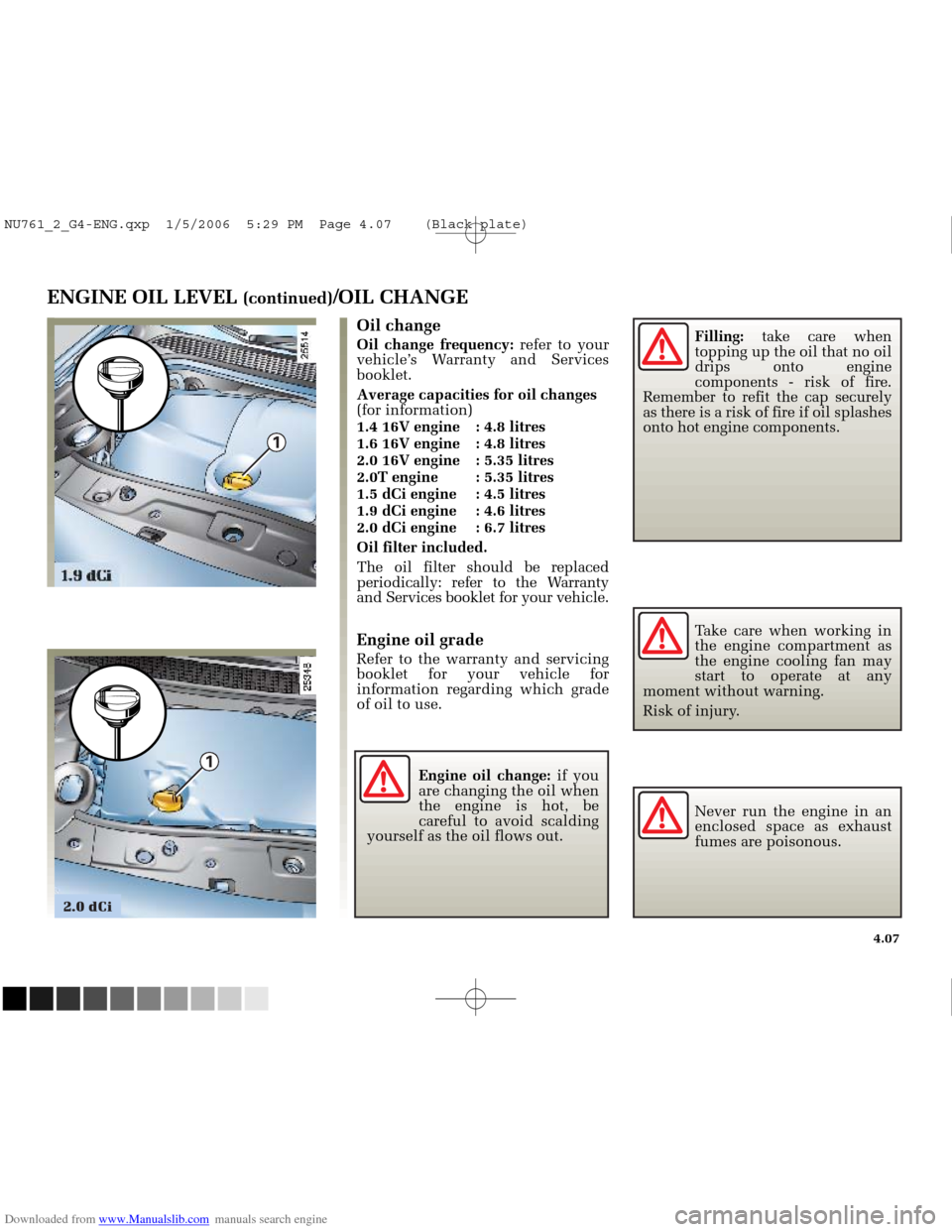
Oil change
Oil change frequency: refer to your
vehicle’s Warranty and Services
booklet.
Average capacities for oil changes
(for information)
1.4 16V engine : 4.8 litres
1.6 16V engine : 4.8 litres
2.0 16V engine : 5.35 litres
2.0T engine : 5.35 litres
1.5 dCi engine : 4.5 litres
1.9 dCi engine : 4.6 litres
2.0 dCi engine : 6.7 litres
Oil filter included.
The oil filter should be replaced
periodically: refer to the Warranty
and Services booklet for your vehicle.
Engine oil grade
Refer to the warranty and servicing
booklet for your vehicle for
information regarding which grade
of oil to use.
Engine oil change: if you
are changing the oil when
the engine is hot, be
careful to avoid scalding
yourself as the oil flows out. Never run the engine in an
enclosed space as exhaust
fumes are poisonous. Take care when working in
the engine compartment as
the engine cooling fan may
start to operate at any
moment without warning.
Risk of injury. Filling:
take care when
topping up the oil that no oil
drips onto engine
components - risk of fire.
Remember to refit the cap securely
as there is a risk of fire if oil splashes
onto hot engine components.
NU761_2_G4-ENG.qxp 1/5/2006 5:29 PM Page 4.07 (Black plate)
Page 210 of 250
Downloaded from www.Manualslib.com manuals search engine
4
1
A
2
3
B
NU761_2_G5-FRA.qxd 4/11/05 11:09 Page 5.22
5.22
BATTERY: troubleshooting (continued)
Starting the vehicle using the
battery from another vehicle
Proceed as follows when starting
your vehicle from another vehicle’s
battery:
Obtain suitable jump leads (with a
large cross section) from a
RENAULT Dealer or, if you already
have jump leads, ensure that they
are in perfect condition.
The two batteries must have an
identical voltage: 12 volts. The
battery supplying the current should
have a capacity (amp-hours, Ah)
which is at least the same as that of
the discharged battery.
Ensure that there is no risk of
contact between the two vehicles
(risk of short circuiting when the
positive terminals are connected)
and that the discharged battery is
properly connected. Switch off your
vehicle ignition.
Start the engine of the vehicle
supplying the current and run it at
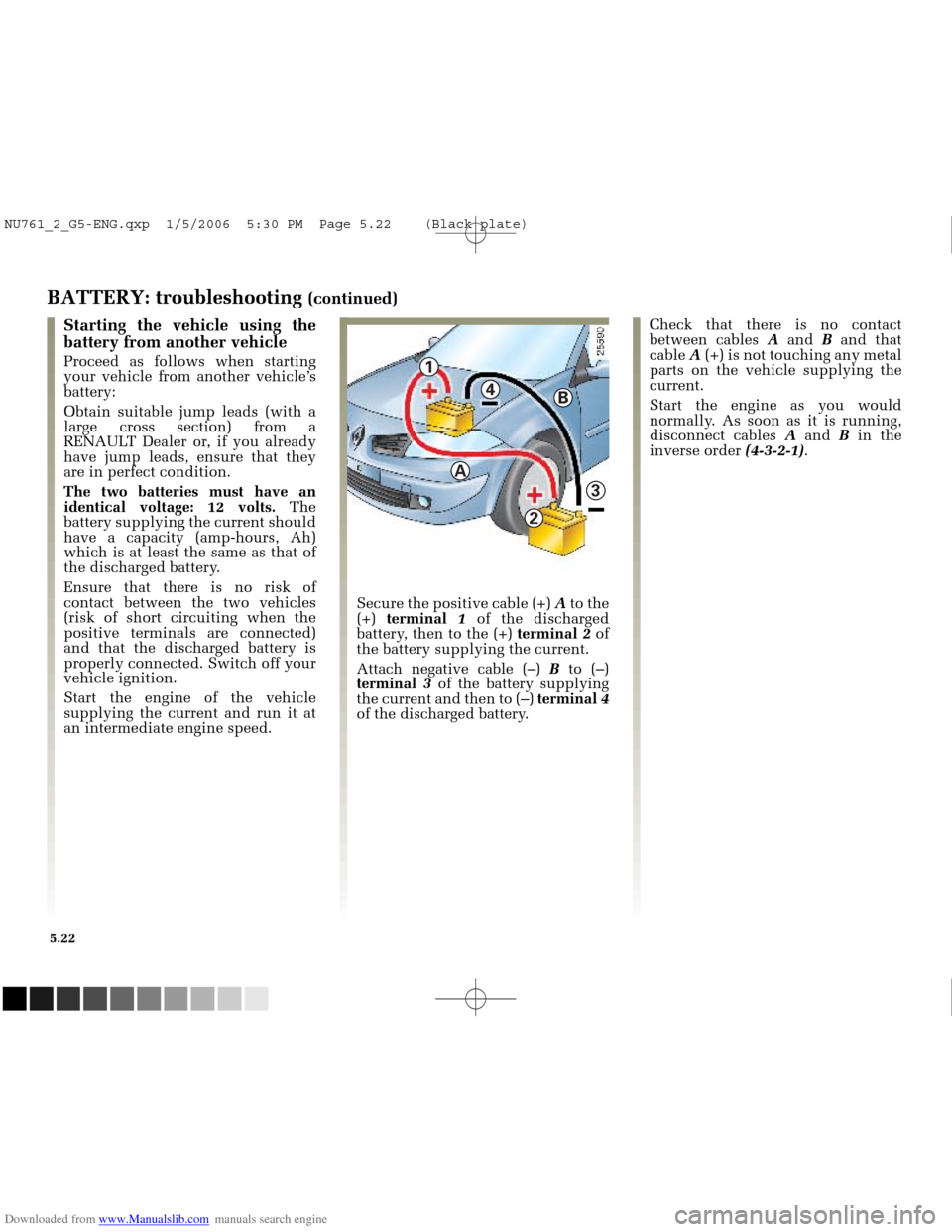
an intermediate engine speed. Check that there is no contact
between cables
Aand Band that
cable A(+) is not touching any metal
parts on the vehicle supplying the
current.
Start the engine as you would
normally. As soon as it is running,
disconnect cables A and B in the
inverse order (4-3-2-1).
Secure the positive cable (+) Ato the
(+) terminal 1 of the discharged
battery, then to the (+) terminal2 of
the battery supplying the current.
Attach negative cable (–) B to (–)
terminal 3 of the battery supplying
the current and then to (–) terminal4
of the discharged battery.
NU761_2_G5-ENG.qxp 1/5/2006 5:30 PM Page 5.22 (Black plate)