2005 PORSCHE 911 CARRERA key
[x] Cancel search: keyPage 48 of 282
48
Controls, Instruments
LATCH SystemChild seat bracket on the passenger’s
seatUse only child restraint systems with the LATCH
system recommended by Porsche.
These systems have been tested and adjusted to
the interior of your Porsche and the appropriate
child age groups. Other systems have not been
tested and could entail an increased risk of injury.
You can obtain child seats that are
LATCH compatible at your authorized Porsche
dealer.
fAlways observe the separate installation in-
structions for your child seat.
Note
The LATCH attachment bracket is not installed at
the factory. It can be retrofitted at your authorized
Porsche dealer.
Danger!
The use of a child restraint system in the
passenger seat without airbag deactivation
can result in serious personal injury or death
to the child from an airbag deployment.
fFor children up to a weight of 59 lbs. (27 kg),
the passenger’s airbag must be switched off if
a child restraint system is used on the
passenger’s seat.
The passenger’s airbag must be switched on
for children weighing over 59 lbs. (27 kg).
fPlease see your authorized Porsche dealer for
correct Porsche Child Seat availability.
fPorsche recommends the use of a Porsche
Child Seat with Lower Anchorage and Tether
for Children system (LATCH)
fPlease observe the chapter “CHILD RESTRAINT SYSTEMS” on Page 46.
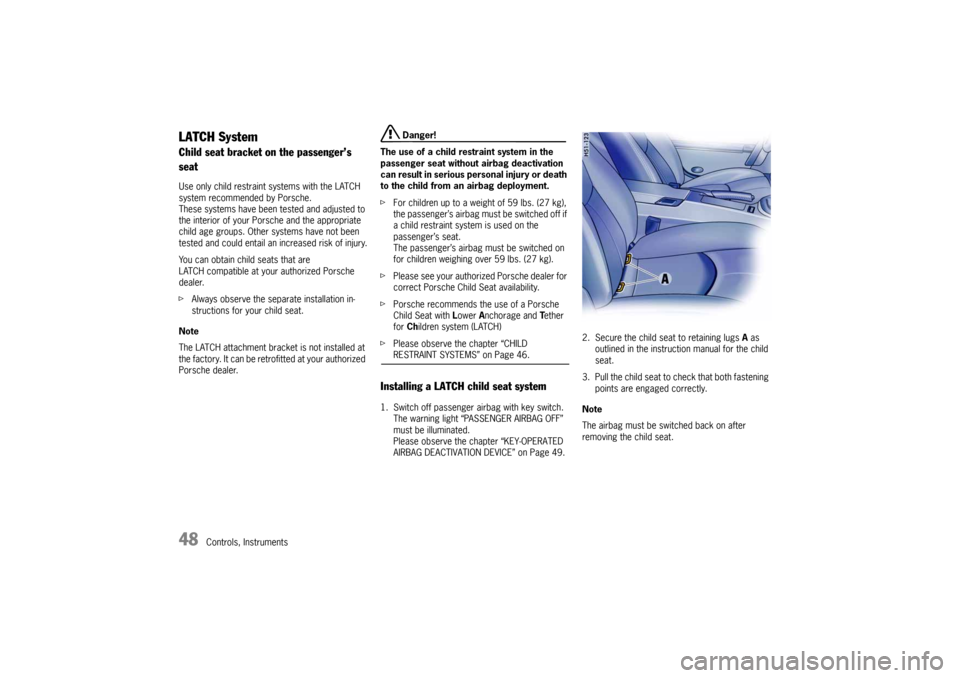
Installing a LATCH child seat system1. Switch off passenger airbag with key switch.
The warning light “PASSENGER AIRBAG OFF”
must be illuminated.
Please observe the chapter “KEY-OPERATED
AIRBAG DEACTIVATION DEVICE” on Page 49.2. Secure the child seat to retaining lugs A as
outlined in the instruction manual for the child
seat.
3. Pull the child seat to check that both fastening
points are engaged correctly.
Note
The airbag must be switched back on after
removing the child seat.
Page 49 of 282

Controls, Instruments
49
Key-operated airbag deactivation
deviceSwitching passenger’s airbag on and offfSwitch off the passenger airbag on the key
switch using the vehicle key.
A - Switch position ON – airbag is active
B - Switch position OFF – airbag is switched off
Danger!
Risk of serious personal injury or death for
passenger if passenger airbag remains
switched off after the child restraint system
is removed.
fThe passenger airbag must be switched on
again once the child seat has been removed, in
order to provide protection to the adult occupants.
Warning light “PASSENGER AIRBAG OFF”If the airbag on the passenger’s side is switched
off:
– Warning light “PASSENGER AIRBAG OFF” is
continuously lit when the ignition is switched on
fPlease observe the chapter “WARNINGS ON
THE INSTRUMENT PANEL AND THE ON-
BOARD COMPUTER” on Page 105.
Danger!
Risk of serious personal injury or death from
the passenger’s airbag.
If the “PASSENGER AIRBAG OFF” warning
light is not lit when the ignition is switched on
and the Airbag OFF switch is switched off,
this could indicate a fault in the system.
fDo not install a child restraint system on the
passenger’s seat.
fHave the fault remedied immediately. Please see your authorized Porsche dealer.
Note
The key switch and the warning light “PASSENGER
AIRBAG OFF” are not installed at the factory.
They can be retrofitted at your authorized Porsche
dealer.
Page 51 of 282

Controls, Instruments
51
fDo not add any additional coverings or stickers
to the steering wheel or in the area of the pas-
senger airbag, side airbags and head airbags.
Doing so may adversely affect the functioning
of the airbag system or cause harm to the oc-
cupants if the airbag system should deploy.
fDo not undertake any wiring for electrical ac-
cessory equipment in the vicinity of the airbag
wiring harnesses. Doing so may disable the
airbag system or cause inflation.
fIf the warning light comes on, the airbag sys-
tem should be repaired immediately by your
authorized Porsche dealer.
Note
Airbag components (e.g. steering wheel, door
trim, seats) may be disassembled only by an au-
thorized Porsche dealer.
When disposing of a used airbag unit, our safety
instructions must be followed. These instructions
can be obtained at any authorized Porsche dealer. Faults are indicated by a warning light in the instru-
ment panel and a message on the on-board com-
puter.
fIn the following cases you should immedi-
ately consult an authorized Porsche deal-
er in order to assure the airbag system is
functioning properly:
– If the warning light does not light up when the
ignition is switched on or
– If the warning light does not go out once the
engine is running or
– If the warning light appears while driving.
fPlease observe the chapter “WARNINGS ON
THE INSTRUMENT PANEL AND THE ON-
BOARD COMPUTER” on Page 105.
Warning light “PASSENGER AIRBAG OFF”fPlease observe the chapter “KEY-OPERATED
AIRBAG DEACTIVATION DEVICE” on Page 49.
Airbag maintenanceIn order to ensure long-term functioning, the air-
bag system must be inspected by an authorized
Porsche dealer at the intervals recommended in
your Maintenance booklet.
Important information
If you sell your Porsche, notify the purchaser that
the vehicle is equipped with airbags, and refer
them to the chapter, “Airbag Systems”, in the own-
er’s manual (safety and disposal rules).
Further information on the airbag system can be
found on labels on the sun visors, as well as on all
airbag components.
fFor special recommendations on the use of
child restraints:
Please observe the chapter “CHILD RES-
TRAINT SYSTEMS” on Page 46.
Warning light and warning
message
Page 69 of 282

Controls, Instruments
69
A, C - Switch for reading light on driver/passenger side
B- Switch for interior light and footwell lights
D- Orientation lightInterior LightsfPlease observe the chapter “LOAD SWITCH-
OFF AFTER 2 HOURS OR 7 DAYS” on
Page 233.
For vehicles with automatic anti-dazzle
mirrors
fSwitch off the automatic anti-dazzle operation
of the mirrors before you switch on the interior
light.
Otherwise the mirrors may accidentally swivel
into the anti-dazzle position.
Interior lights, reading lightsSwitching off
fPress left half of switch.
Switching to continuous illumination
fPress right half of switch.
Switching on and off automatically
fMove switch to center position.
The interior and footwell lights are switched
on when a door is unlocked or opened or when
the ignition key is withdrawn from the ignition
lock.
The lights are switched off with a delay of
approx. 2 minutes after the doors are closed.
The light goes out immediately as soon as the
ignition is switched on or the vehicle is locked.
Orientation lightA light-emitting diode at the bottom of the interior
mirror improves orientation in the passenger com-
partment when it is dark.
Note on operation
On vehicles with the Sport Chrono package, the
brightness of the orientation light can be changed
in PCM.
Please observe the chapter “Individual Memory” in
the separate PCM operating instructions.
Page 72 of 282

72
Controls, Instruments
Ignition/Starter Switch with anti-
theft Steering LockThe ignition lock has a total of four ignition lock po-
sitions.
The ignition key rebounds to the initial position
from every ignition lock position.
fFor your safety, fasten safety belts.
fPlease observe the chapter “IMMOBILIZER” on
Page 19.
fPlease observe the chapter “KEY WITH RADIO
REMOTE CONTROL” on Page 20.
Before starting the enginefApply the footbrake.
fManual transmission:
Move the gearshift lever into neutral.
The clutch pedal must be depressed fully
before the starter will engage.
fTiptronic:
Move the selector lever to P or N.Switch position 0 Initial position
The ignition key cannot be withdrawn when the
ignition is switched on or when the engine has
been started.
To withdraw the ignition key:
fStop the vehicle.
fOn vehicles with Tiptronic S:
Move selector lever to position P.
fSwitch ignition off.
fRemove ignition key.
Switch position 1 Ignition on
fTurn ignition key to position 1.
Ignition is switched on.
Note on operation
All electrical equipment can be switched on.
fPlease observe the chapter “WARNINGS ON
THE INSTRUMENT PANEL AND THE ON-
BOARD COMPUTER” on Page 105.
Page 73 of 282

Controls, Instruments
73
Switch position 2Start engine
fTurn ignition key to ignition lock position 2.
fPlease observe the chapter “STARTING PRO-
CEDURES” on Page 74.Switch position 3Ignition off
fTurn ignition key to ignition lock position 3.
Locking the steering columnAutomatic locking
The steering column is automatically locked when
the ignition key is withdrawn from the ignition lock.
Warning!
Risk of an accident.
The steering wheel will lock and will cause
loss of steering.
fNever remove key from the ignition lock or turn
the key off while the vehicle is moving.
fAlways withdraw the ignition key when leav-ing the vehicle.Automatic unlocking
The steering column is automatically unlocked
when the ignition key is inserted into the ignition
lock.
Note
fTo avoid battery run-down, always remove the
ignition key from the ignition lock.
Please observe the chapter “BATTERY” on
Page 236.
Gong If you leave the key in the ignition/steering lock, a
gong will sound when the driver’s door is opened.
This is a reminder to remove the key.
Page 74 of 282

74
Controls, Instruments
Starting Procedures fPlease observe the chapter “IMMOBILIZER” on
Page 19.
fPlease observe the chapter “EMISSION CONT-
ROL SYSTEM” on Page 191.
Warning!
Serious injury may result if you are involved
in a collision without having fastened the
safety belts.
fFasten safety belts before driving away. Before starting the engine fApply the footbrake.
fManual transmission:
Move the gearshift lever into neutral.
The clutch pedal must be depressed fully
before the starter will engage.
fTiptronic:
Move the selector lever to P or N.
Temperature sensors on the engine automatically
provide the correct fuel/air mixture required for
starting.
Therefore, it is not necessary to depress the
accelerator pedal while starting a cold or a
warm engine.
Starting the enginefTurn ignition key to ignition lock position 2.
fAs soon as the engine starts, release the igni-
tion key.
The first operation of the starter is ended automat-
ically when the engine starts.
If the engine does not start, subsequent starter
operations will not be ended automatically.
If the engine fails to start after 10 or 15 seconds
of cranking:
fWait about 10 seconds before engaging the
starter again.
fWhen starting the engine, be ready to drive
immediately.
Drive vehicle at moderate speeds and avoid
engine speeds above 4,200 rpm during the
first 5 minutes.
fDo not let the engine idle to warm up.
Danger!
Engine exhaust fumes have many compo-
nents which you can smell. They also contain
carbon monoxide (CO), which is a colorless
and odorless gas.
Carbon monoxide can cause unconscious-
ness and even death if inhaled.
fNever start or let the engine run in an en-
closed, unventilated area.
It is not recommended to sit in your car for pro-
longed periods with the engine on and the car
not moving.
An unattended vehicle with a running engine
is potentially hazardous.
If warning lights should come on to indicate
improper operation, they would go unno-
ticed.
fNever leave the engine idling unattended.
Danger of fire.
fDo not park or operate the vehicle in areas
where the hot exhaust system may come in
contact with dry grass, brush, fuel spill or oth-
er flammable material.
fIf your car catches on fire for any reason, call
the fire department.
Do not endanger your life by attempting to put out the fire.
Page 75 of 282

Controls, Instruments
75
Stopping Engine fTurn key back to position 3.
fDo not stop engine immediately after hard or
extended driving.
Keep engine running at increased idle for
about two minutes to prevent excessive heat
build-up before turning off engine.
fTo avoid battery run-down, always remove the
ignition key from the ignition lock.
fMake sure that when you leave the car, even
briefly, you have withdrawn the ignition key.
fEngage the steering lock by moving the steer-
ing wheel to the left or right.
Turn the steering wheel to the locking position
before you switch off the engine so that you
don’t have to exert yourself when locking or
unlocking the steering.
Warning!
Danger of injury. Hot engine compartment
components can burn skin on contact.
fBefore working on any part in the engine com-
partment, turn the engine off and let it cool down sufficiently.
Engine-compartment blower,
radiator fan The radiator and radiator fans are in the front of
the car.
The engine-compartment blower is mounted on
the engine compartment lid.
Warning!
Risk of injury.
After the engine is switched off, the engine-
compartment temperature is monitored for
approx. 30 minutes.
During this period, and depending on tem-
perature, the engine-compartment blower
may continue to run or start to run.
fCarry out work in these areas only with the en-
gine off, the ignition off, and exercise extreme
caution.
Risk of injury. The radiator fans in the front
end of the car may be operating or
unexpectedly start operating when the
engine is switched on.
fCarry out work in these areas only with the en-gine switched off.
Automatic garage door The ignition system in your Porsche may interfere
with your electronically operated garage door.
fTo check this, drive your Porsche close to the
garage door. Make sure not to interfere with
the operating range of the door.
fRun the engine at different speeds.
If the garage door opens or closes without you op-
erating the garage door unit in your car, contact
the dealer who installed the automatic garage
door to have the frequency and/or coding of the
garage door signal changed or modified.