2005 PONTIAC GTO lock
[x] Cancel search: lockPage 188 of 318
Tire Chains..................................................5-67
If a Tire Goes Flat........................................5-68
Changing a Flat Tire.....................................5-68
Removing the Spare Tire and Tools................5-70
Removing the Flat Tire and Installing
the Spare Tire..........................................5-71
Storing a Flat or Spare Tire and Tools............5-75
Compact Spare Tire......................................5-76
Appearance Care............................................5-76
Fabric/Carpet...............................................5-77
Vinyl...........................................................5-78
Leather.......................................................5-79
Instrument Panel..........................................5-79
Interior Plastic Components............................5-79
Glass Surfaces.............................................5-79
Care of Safety Belts......................................5-79
Weatherstrips...............................................5-80
Washing Your Vehicle...................................5-80
Cleaning Exterior Lamps/Lenses.....................5-80Finish Care..................................................5-80
Windshield and Wiper Blades.........................5-81
Aluminum Wheels.........................................5-81
Tires...........................................................5-82
Sheet Metal Damage.....................................5-82
Finish Damage.............................................5-82
Underbody Maintenance................................5-83
Chemical Paint Spotting.................................5-83
Vehicle Care/Appearance Materials..................5-84
Vehicle Identication......................................5-85
Vehicle Identification Number (VIN).................5-85
Service Parts Identification Label.....................5-85
Electrical System............................................5-85
Add-On Electrical Equipment..........................5-85
Fuses and Circuit Breakers............................5-86
Instrument Panel Fuse Block..........................5-86
Engine Compartment Fuse Block....................5-88
Capacities and Specications..........................5-90
Section 5 Service and Appearance Care
5-2
Page 195 of 318

To remove the fuel cap, turn it slowly counterclockwise.
The fuel cap has a spring in it; if the cap is released
too soon, it will spring back to the right.
{CAUTION:
If you spill fuel and then something ignites it,
you could be badly burned. Fuel can spray out
on you if you open the fuel cap too quickly.
This spray can happen if your tank is nearly
full, and is more likely in hot weather. Open
the fuel cap slowly and wait for any hiss noise
to stop. Then unscrew the cap all the way.
Be careful not to spill fuel. Do not top off or overfill the
tank and wait a few seconds after you have finished
pumping before removing the nozzle. Clean fuel
from painted surfaces as soon as possible. See
Washing Your Vehicle on page 5-80.When replacing the fuel cap, turn it clockwise until it
clicks. Make sure the cap is fully installed. The
diagnostic system can determine if the fuel cap has
been left off or improperly installed. This would allow fuel
to evaporate into the atmosphere. SeeMalfunction
Indicator Lamp on page 3-28.{CAUTION:
If a re starts while you are refueling, do not
remove the nozzle. Shut off the ow of fuel by
shutting off the pump or by notifying the
station attendant. Leave the area immediately.
Notice:If you need a new fuel cap, be sure to get
the right type. Your dealer can get one for you.
If you get the wrong type, it may not t properly.
This may cause your malfunction indicator lamp to
light and may damage your fuel tank and emissions
system. SeeMalfunction Indicator Lamp on
page 3-28.
5-9
Page 199 of 318
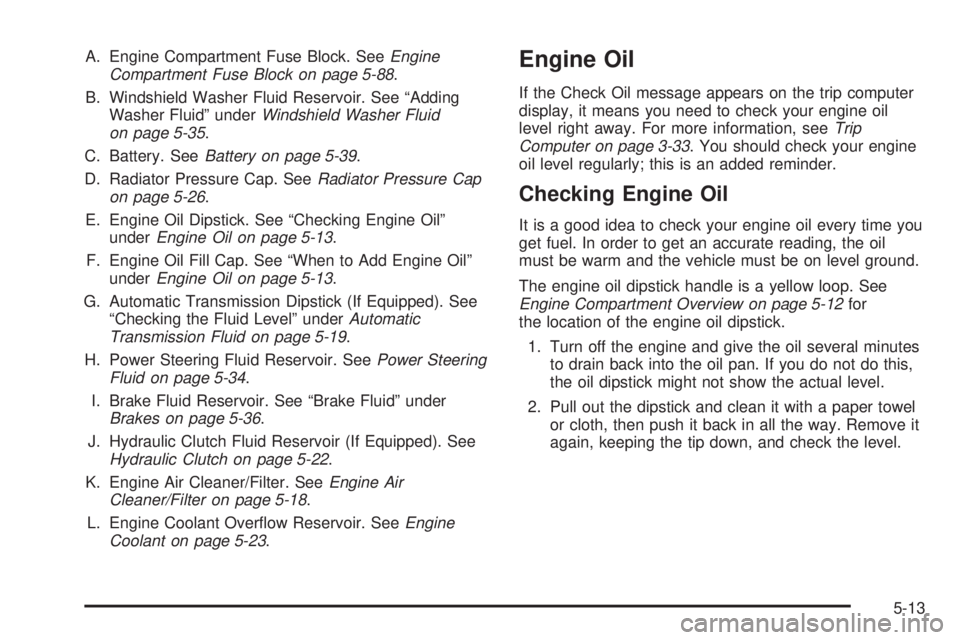
A. Engine Compartment Fuse Block. SeeEngine
Compartment Fuse Block on page 5-88.
B. Windshield Washer Fluid Reservoir. See “Adding
Washer Fluid” underWindshield Washer Fluid
on page 5-35.
C. Battery. SeeBattery on page 5-39.
D. Radiator Pressure Cap. SeeRadiator Pressure Cap
on page 5-26.
E. Engine Oil Dipstick. See “Checking Engine Oil”
underEngine Oil on page 5-13.
F. Engine Oil Fill Cap. See “When to Add Engine Oil”
underEngine Oil on page 5-13.
G. Automatic Transmission Dipstick (If Equipped). See
“Checking the Fluid Level” underAutomatic
Transmission Fluid on page 5-19.
H. Power Steering Fluid Reservoir. SeePower Steering
Fluid on page 5-34.
I. Brake Fluid Reservoir. See “Brake Fluid” under
Brakes on page 5-36.
J. Hydraulic Clutch Fluid Reservoir (If Equipped). See
Hydraulic Clutch on page 5-22.
K. Engine Air Cleaner/Filter. SeeEngine Air
Cleaner/Filter on page 5-18.
L. Engine Coolant Overflow Reservoir. SeeEngine
Coolant on page 5-23.Engine Oil
If the Check Oil message appears on the trip computer
display, it means you need to check your engine oil
level right away. For more information, seeTrip
Computer on page 3-33. You should check your engine
oil level regularly; this is an added reminder.
Checking Engine Oil
It is a good idea to check your engine oil every time you
get fuel. In order to get an accurate reading, the oil
must be warm and the vehicle must be on level ground.
The engine oil dipstick handle is a yellow loop. See
Engine Compartment Overview on page 5-12for
the location of the engine oil dipstick.
1. Turn off the engine and give the oil several minutes
to drain back into the oil pan. If you do not do this,
the oil dipstick might not show the actual level.
2. Pull out the dipstick and clean it with a paper towel
or cloth, then push it back in all the way. Remove it
again, keeping the tip down, and check the level.
5-13
Page 203 of 318

If the system is ever reset accidentally, you must
change the oil at 3,000 miles (5 000 km) since your last
oil change. Remember to reset the oil life system
whenever the oil is changed.
After changing the engine oil, reset the system by
performing the following steps:
How to Reset the Engine Oil Life
System
The Engine Oil Life System calculates when to change
the engine oil and filter based on vehicle use. Anytime
engine oil is changed, reset the system so it can
calculate when the next oil change is required. If a
situation occurs where you change your oil prior to
the Service Engine Oil light being turned on, reset
the system.
1. With the engine off, turn the ignition key to ON.
2. Fully press and release the accelerator pedal slowly
two times within five seconds.
3. Turn the key to LOCK.
If the Service Engine Oil light comes back on when
you start your vehicle, the engine oil life system
has not reset. Repeat the procedure.
What to Do with Used Oil
Used engine oil contains certain elements that may be
unhealthy for your skin and could even cause cancer.
Do not let used oil stay on your skin for very long. Clean
your skin and nails with soap and water, or a good
hand cleaner. Wash or properly dispose of clothing or
rags containing used engine oil. See the manufacturer’s
warnings about the use and disposal of oil products.
Used oil can be a threat to the environment. If you
change your own oil, be sure to drain all the oil from the
filter before disposal. Never dispose of oil by putting it
in the trash, pouring it on the ground, into sewers, or into
streams or bodies of water. Instead, recycle it by
taking it to a place that collects used oil. If you have a
problem properly disposing of used oil, ask your
dealer, a service station, or a local recycling center
for help.
5-17
Page 206 of 318
Get the vehicle warmed up by driving about 15 miles
(24 km) when outside temperatures are above 50°F
(10°C). If it is colder than 50°F (10°C), drive the vehicle
in DRIVE (D) until the engine temperature gage
moves and then remains steady for 10 minutes.
A cold fluid check can be made after the vehicle has
been sitting for eight hours or more with the engine off,
but this is used only as a reference. Let the engine
run at idle for five minutes if outside temperatures are
50°F (10°C) or more. If it is colder than 50°F (10°C), you
may have to idle the engine longer. Should the fluid
level be low during this cold check, you must check the
fluid hot before adding fluid. Checking the fluid hot
will give you a more accurate reading of the fluid level.
Checking the Fluid Level
Prepare your vehicle as follows:
•Park your vehicle on a level place. Keep the
engine running.
•With the parking brake applied, place the shift lever
in PARK (P).
•With your foot on the brake pedal, move the shift
lever through each gear range, pausing for about
three seconds in each range. Then, position the shift
lever in PARK (P).
•Let the engine run at idle for three minutes or more.Then, without shutting off the engine, follow
these steps:
The automatic transmission dipstick is located at the
rear of the engine compartment, on the passenger’s side
of the vehicle. SeeEngine Compartment Overview on
page 5-12for more information on location.
1. Unclip the handle and remove the dipstick; wipe it
clean with a clean rag or paper towel and re-insert
it fully. Remove it again and read the fluid level.
2. Check both sides of the dipstick, and read the lower
level. The fluid level must be in the COLD area for
a cold check or in the cross-hatched HOT area
for a hot check.
3. If the fluid level is in the acceptable range, push the
dipstick back in all the way.
Remember to always replace the dipstick and lock
the handle down.
How to Add Fluid
Refer to the Maintenance Schedule to determine what
kind of transmission fluid to use. SeeRecommended
Fluids and Lubricants on page 6-12.
Add fluid only after checking the transmission fluid while
it is hot. A cold check is used only as a reference. If
the fluid level is low, add only enough of the proper fluid
to bring the level up to the HOT area for a hot check.
5-20
Page 207 of 318
The level should never read over the HOT mark, so be
careful not to add too much. It does not take much
fluid, generally less than 0.6 pints (0.3 L). Do not overfill.
Notice:Use of the incorrect automatic transmission
uid may damage your vehicle, and the damages
may not be covered by your warranty. Always
use the automatic transmission uid listed in
Recommended Fluids and Lubricants on page 6-12.
•After adding fluid, recheck the fluid level as
described under “How to Check,” earlier in
this section.
•When the correct fluid level is obtained, push the
dipstick back in all the way.
Remember to always replace the dipstick and lock
the handle down.
•If fluid has to be added often, there may be a
problem or leak and you should see your dealer.
Manual Transmission Fluid
When to Check
A good time to have your manual transmission fluid
checked is when the engine oil is changed. However,
the fluid in your manual transmission does not
require changing.
How to Check
Because this operation can be difficult, you may choose
to have this done at your dealership service department.
If you do it yourself, be sure to follow all the instructions
here, or you could get a false reading.
Notice:Too much or too little uid can damage
your transmission. Too much can mean that some
of the uid could come out and fall on hot engine
part or exhaust system parts, starting a re.
Too little uid could cause the transmission to
overheat. Be sure to get an accurate reading if you
check your transmission uid.
Check the fluid level only when your engine is off, the
vehicle is parked on a level place and the transmission
is cool enough for you to rest your fingers on the
transmission case.
Then, follow these steps:
1. Remove the reverse light switch.
2. Check that the lubricant level is up to the bottom of
the switch hole.
3. If the fluid level is good, install the switch and be
sure it is fully seated. If the fluid level is low, add
more fluid as described in the next steps.
5-21
Page 211 of 318

The coolant level should be checked at each fuel fill, by
looking at the dipstick in the coolant overflow reservoir.
To remove the dipstick, push down on the coolant
reservoir cap while turning it counterclockwise.
When your engine is cold, the coolant level should be at
or above the bottom arrow on the dipstick. After the
vehicle has been driven and the engine is at normal
operating temperature, the level should be somewhere
between the two arrows on the dipstick.
If the coolant level is correct, replace the dipstick then
push down on the coolant reservoir cap while turning
it clockwise until it stops, to lock it into position.
Adding Coolant
If you need more coolant, add the proper DEX-COOL®
coolant mixture at the coolant overflow reservoir, but
be careful not to spill it. Check the level with the dipstick
and keep adding fluid until the level is correct.
{CAUTION:
You can be burned if you spill coolant on hot
engine parts. Coolant contains ethylene glycol,
and it will burn if the engine parts are hot
enough. Do not spill coolant on a hot engine.
When the level is correct, replace the dipstick then push
down on the coolant reservoir cap while turning it
clockwise until it stops, to lock it into position.
5-25
Page 218 of 318

To add coolant to the overflow reservoir, do the
following:
1. Remove the coolant overflow reservoir cap when
the cooling system is no longer hot.
2. Fill the coolant overflow reservoir with the proper
mixture, until it reaches the bottom arrow on the
dipstick.
3. Replace the dipstick, then press down on the
coolant reservoir cap while turning it clockwise until
it stops, to lock it into position.If there is still no coolant visible on the dipstick, there is
one more thing you can try. You can add the proper
coolant mixture directly to the radiator, but be sure the
system is cool before you do it.
{CAUTION:
Steam and scalding liquids from a hot cooling
system can blow out and burn you badly. They
are under pressure, and if you turn the radiator
pressure cap — even a little — they can come
out at high speed. Never turn the cap when the
cooling system, including the radiator pressure
cap, is hot. Wait for the cooling system and
radiator pressure cap to cool if you ever have
to turn the pressure cap.
5-32