2005 PONTIAC GTO light
[x] Cancel search: lightPage 63 of 318

Remote Keyless Entry System
Operation
The buttons on your key
allow you to lock and
unlock your doors
or unlock your trunk.
When pressing the key buttons, ensure that other keys
on the key ring are not between the main key and
the vehicle. Other keys can obscure the signal being
transmitted to the vehicle.When a button on the key is pressed, it sends a signal
to the vehicle. The receiver of the signal is a small
rectangle centered on top of the dashboard.
The receiver is also used to measure sunlight. It is
important that the receiver is clean, not covered, and
that there are no metal objects close by, as this
may block the signals.
LOCK:Press this button on the key to lock all the
doors, disable the engine, and set the alarm. The
vehicle’s turn signals will briefly flash.
If you prefer to have the turn signals flash accompanied
by the horn sounding, the LOCK feature can be
changed. SeeVehicle Personalization on page 2-30.
The LOCK button on the key will not work if the ignition
is turned on, or if the driver’s and/or passenger’s
door is open.
Prior to locking your vehicle, make sure all the doors are
closed completely. If the LOCK button is pressed when a
door is open, the horn will sound three times to indicate
that a door has not locked. Close the open door and reset
the remote system by first pressing the UNLOCK button
and then the LOCK button on the key.
2-5
Page 64 of 318

UNLOCK:Press this button on the key to unlock the
doors. The turn signal lamps will flash twice, and
the horn will chirp twice, if this unlocking option is
selected through vehicle personalization. The interior
light will also turn on for a short time. If UNLOCK
is pressed once, the driver’s door will unlock. If UNLOCK
is pressed a second time, or is held down for more
than half a second, all the doors will unlock. If you prefer
to have all the doors unlock with a single press, the
unlock feature can be changed to unlock all doors.
See “Two Stage Unlock” underVehicle Personalization
on page 2-30.
If the lock system is overloaded as a result of repeated
use in a short time interval, the power supply is cut
off for about 30 seconds. The door lock system
has been designed to make the vehicle horn chirp
rapidly five times if it detects a fault in the lock system
when the LOCK button is pressed. You should check to
see that the doors have locked.
V(Trunk):Press the button with the opened trunk
symbol to release the trunk lid.
The trunk button on the key will not work if you are
travelling over 12 mph (20 km/h).
Battery
The key has a non-removable battery. Under normal
use, the battery in your key should last about five years.
You can tell the battery is weak if the key will not
work at the normal range in any location. If you have to
get close to your vehicle before the key buttons work,
it is probably time for a replacement key. See your
dealership to purchase a replacement key.
If the buttons on the key are not working at the normal
range in any location, insert the key into the ignition
and turn it ON and then OFF. Remove the key from the
ignition and try pressing the LOCK and UNLOCK
buttons again. If it still does not work a replacement key
may be needed. You will have to go to the dealership
to purchase a replacement key.
2-6
Page 68 of 318
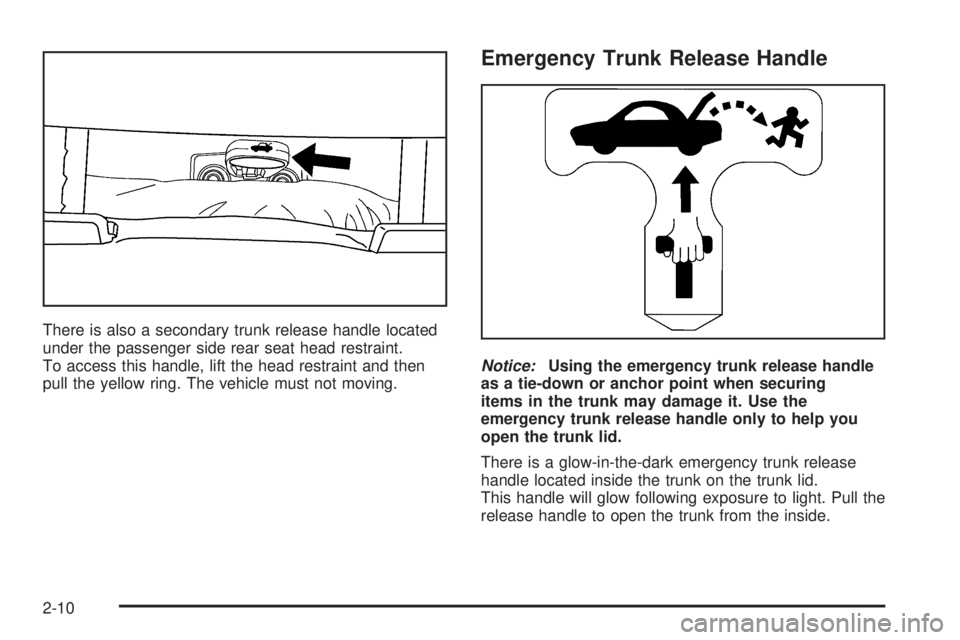
There is also a secondary trunk release handle located
under the passenger side rear seat head restraint.
To access this handle, lift the head restraint and then
pull the yellow ring. The vehicle must not moving.
Emergency Trunk Release Handle
Notice:Using the emergency trunk release handle
as a tie-down or anchor point when securing
items in the trunk may damage it. Use the
emergency trunk release handle only to help you
open the trunk lid.
There is a glow-in-the-dark emergency trunk release
handle located inside the trunk on the trunk lid.
This handle will glow following exposure to light. Pull the
release handle to open the trunk from the inside.
2-10
Page 70 of 318
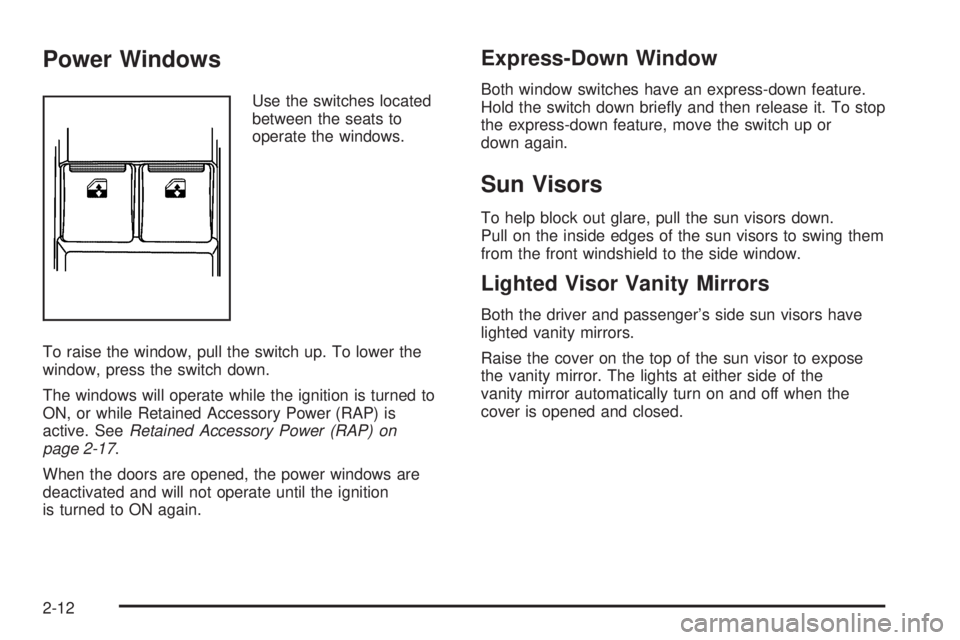
Power Windows
Use the switches located
between the seats to
operate the windows.
To raise the window, pull the switch up. To lower the
window, press the switch down.
The windows will operate while the ignition is turned to
ON, or while Retained Accessory Power (RAP) is
active. SeeRetained Accessory Power (RAP) on
page 2-17.
When the doors are opened, the power windows are
deactivated and will not operate until the ignition
is turned to ON again.
Express-Down Window
Both window switches have an express-down feature.
Hold the switch down briefly and then release it. To stop
the express-down feature, move the switch up or
down again.
Sun Visors
To help block out glare, pull the sun visors down.
Pull on the inside edges of the sun visors to swing them
from the front windshield to the side window.
Lighted Visor Vanity Mirrors
Both the driver and passenger’s side sun visors have
lighted vanity mirrors.
Raise the cover on the top of the sun visor to expose
the vanity mirror. The lights at either side of the
vanity mirror automatically turn on and off when the
cover is opened and closed.
2-12
Page 71 of 318

Theft-Deterrent Systems
Vehicle theft is big business, especially in some cities.
Although your vehicle has a number of theft-deterrent
features, we know that nothing we put on it can make it
impossible to steal.
Immobilizer
This device complies with Part 15 of the FCC Rules.
Operation is subject to the following two conditions:
1. This device may not cause interference.
2. This device must accept any interference
received, including interference that may cause
undesired operation.
Changes or modifications to this system by other than
an authorized service facility could void authorization to
use this equipment.
Immobilizer Operation
Your vehicle may have a passive theft-deterrent system.
The system is an electronic engine immobilizer,
which disables the car, when the key is removed from
the ignition.
The system works when you turn the key to ON. The
key uses a transponder that matches an immobilizer
control unit in your vehicle. The correct key will start
the vehicle.
Your vehicle has a special key that works with the
theft-deterrent system. There is a transponder in the key
head. If the key is ever damaged, you may not be
able to start your vehicle.
When trying to start the vehicle, if the engine does not
start and the security light comes on, the key may
have a damaged transponder. Turn the ignition off and
try again.
2-13
Page 72 of 318
If the engine still does not start, and the key appears to
be undamaged, try another ignition key. At this time,
you may also want to check the fuse. SeeFuses
and Circuit Breakers on page 5-86for more information
on fuses. If the engine still does not start with the
other key, your vehicle needs service. If your vehicle
does start, the first key may be faulty. See your dealer
who can service the theft-deterrent system to have
a new key made.
If you are ever driving and the security light comes on
and stays on, you will be able to restart your engine
if you turn it off. The theft-deterrent system, however, is
not working properly and must be serviced by your
dealer. Your vehicle is not protected by the
theft-deterrent system at this time.
In an emergency, contact Roadside Assistance.
SeeRoadside Assistance Program on page 7-6.Content Theft-Deterrent
Your vehicle has a theft-deterrent alarm system.
Arming the System
The alarm system is turned on when the LOCK button
on the key is pressed. Therefore, locking the doors
by pressing LOCK not only locks all the doors but, after
a short delay, also sets the alarm system. When the
system is armed, the alarm is triggered when any of the
doors, hood or trunk are opened or a hot-wire
attempted. The alarm system thinks a break-in has
occurred. An alarm sounds and the turn signals
and dome light will flash.
When the alarm system is turned on, you may open the
trunk by pressing the trunk symbol button on the key.
This does not set off the alarm, but leaves the alarm
system on and undisturbed. Closing the trunk re-arms
the trunk alarm after a short delay.
The LOCK button on the key will not function when the
ignition is turned ON or the driver’s door is open.
Disarming the System
To disarm the system, press UNLOCK on the key or
turn the ignition to ON.
2-14
Page 74 of 318

Ignition Positions
The key can be turned to
one of three positions
while in the ignition switch.
A (LOCK):This is the only position from which you can
insert or remove the key. When the key is inserted
and is in this position, the radio, wipers, and accessory
power outlet will continue to work until the key is
removed. Once the key is removed these accessories
will turn off. By selecting the ON switch on the radio
these accessories will continue to work for one hour or
until either door is opened. If the key is left inserted
in this position, a chime will sound when the driver’s
door is opened to remind you the key has been left in
the ignition. If the key is left in the ignition, it can
drain the battery. Make sure to remove the key when
leaving the vehicle.The key can only be turned to this position if the
vehicle’s automatic transmission is in PARK (P).
To help guard against theft, your vehicle’s engine is
automatically disabled shortly after turning the key to this
position. A flashing padlock symbol on the bottom left
corner of the instrument panel indicates this.
The steering column is automatically locked when the
key is removed. To release the steering wheel, insert the
key again and turn it towards the front of the vehicle.
Notice:Using a tool to force the key from the
ignition switch could cause damage or break the
key. Use the correct key and turn the key only with
your hand. Make sure the key is all the way in.
If it is, turn the steering wheel left and right while
you turn the key hard. If none of this works,
then your vehicle needs service.
B (ON):This position is where the key returns to after
you start your engine and release the key. The ignition
switch stays in ON when the engine is running. But even
when the engine is not running, you can use ON to
operate your electrical accessories and to display some
instrument panel warning lights.
C (START):This position starts the engine. When the
engine starts, release the key. The ignition switch
will return to ON for normal driving.
2-16
Page 80 of 318

Shift Speeds
{CAUTION:
If you skip a gear when you downshift, you
could lose control of your vehicle. You could
injure yourself or others. Do not shift down
more than one gear at a time when you
downshift.
This chart shows when to shift to the next gear for the
best fuel economy.
Manual Transmission Recommended
Shift Speeds
1to2 2to3 3to4 4to5 5to6
16 mph
(25 km/h)22 mph
(35 km/h)30 mph
(48 km/h)40 mph
(65 km/h)50 mph
(80 km/h)
If your speed drops below 20 mph (32 km/h), or if the
engine is not running smoothly, you should downshift to
the next lower gear.
One to Four Shift Light
(Manual Transmission)
When this light comes on, you can only shift from
FIRST (1) to FOURTH (4) instead of FIRST (1) to
SECOND (2). The light will be displayed on the
instrument panel cluster and a message will be
displayed on the trip computer.
You must complete the shift into FOURTH (4) to turn
off this feature. This helps you get the best possible
fuel economy.Instrument Panel
Cluster
Trip Computer
2-22