Page 287 of 474

285 Operation
At the gas station
Windshield washer system and head-
lamp cleaning system*
For more information on refilling the wash-
er reservoir, see “Windshield washer sys-
tem and headlamp cleaning system*”
(�page 295).
Coolant
For more information on coolant, see
“Coolant level” (
�page 292) and see “Fu-
els, coolants, lubricants, etc.”
(
�page 429).Brake fluid
For information on brake fluid, see “Brake
fluid” (
�page 431)Engine oil level
For more information on engine oil, see
“Engine oil” (
�page 287).
Vehicle lighting
Check function and cleanliness. For more
information on replacing light bulbs, see
“Replacing bulbs” (
�page 389).
For more information, see “Switching on
headlamps” (
�page 50).
Tire inflation pressure
For information on tire inflation pressure,
see “Checking tire inflation pressure”
(
�page 307).
!If you find that the brake fluid in the
brake fluid reservoir has fallen to the
minimum mark or below, have the
brake system checked for brake pad
thickness and leaks immediately.
Notify an authorized Mercedes-Benz
Center immediately. Do not add brake
fluid as this will not solve the problem.
For more information, see “Practical
hints” (
�page 339).
Page 291 of 474

289 Operation
Engine compartment
Other display messages
If the SmartKey or KEYLESS-GO*
start/stop button (
�page 35) is not in po-
sition 2, the following message will appear:
FOR ENGINE OIL LEVEL
SWITCH IGNITION ON�
Switch on ignition (
�page 34).
If you see the message:
PERF. SERV. ON TIME�
If engine is at operating temperature,
wait five minutes before repeating
check procedure.
�
If engine is not at operating tempera-
ture yet, wait 30 minutes before re-
peating check procedure.If you see the message:
ENGINE OIL LEVEL
NOT WHEN ENGINE ON�
Turn off the engine.
�
If the engine is at operating tempera-
ture, wait five minutes before checking
oil.
�
If the engine is not at operating temper-
ature yet, you must wait 30 minutes be-
fore checking oil.
If there is excess engine oil with the engine
at normal operating temperature, the fol-
lowing message will appear:
ENGINE OIL LEVEL
REDUCE OIL LEVEL�
Have excess oil siphoned or drained
off. Contact an authorized
Mercedes-Benz Center.For more information on messages in the
multifunction display concerning engine
oil, see the “Practical hints” section
(
�page 362). !Excess oil must be siphoned or drained
off. It could cause damage to the en-
gine and catalytic converter not cov-
ered by the Mercedes-Benz Limited
Warranty.iPerform the engine oil level check with
the dipstick (S 430, S 500, and
S 55 AMG only) if it cannot be complet-
ed with the control system.
In this case we recommend that you
have the system checked at a
Mercedes-Benz Center.
Page 292 of 474

290 OperationEngine compartmentChecking the engine oil level with the
oil dipstick (S 430, S 500, and
S55AMG only)
When checking the oil level�
the vehicle must be parked on level
ground
�
with the engine at operating tempera-
ture, the vehicle must have been sta-
tionary for at least five minutes with the
engine turned off
To check the engine oil level with the oil
dipstick, do the following:
�
Open the hood (
�page 286).
�
Pull out oil dipstick1 (
�page 291).
�
Wipe oil dipstick1 clean.
�
Fully insert oil dipstick1 into the dip-
stick guide tube.
�
Pull out oil dipstick1 again after ap-
proximately three seconds to obtain
accurate reading.
Oil dipstickThe oil level is correct when it is between
the lower (min) and upper (max) mark of
the oil dipstick.
�
If necessary, add engine oil.
For adding engine oil, see (
�page 291).
For more information on engine, see the
“Technical data” section (
�page 429) and
(
�page 431).
For more information on messages in the
multifunction display concerning engine
oil, see the “Practical hints” section
(�page 362).
iThe engine oil level can be checked by
either the oil dipstick or via the multi-
function display in the instrument clus-
ter (
�page 288). The amount of engine
oil needed is shown more precisely in
the multifunction display.
iThe filling quantity between the upper
and lower marks on the oil dipstick is
approximately 2.1 US qt. (2.0 l).
Page 327 of 474

325 Operation
Tires and wheels
Rotating tires
Tire rotation can be performed on vehicles
with tires of the same dimension all
around. If your vehicle is equipped with
tires of the same dimension all around,
tires can be rotated, observing a a
front-to-rear rotation pattern that will
maintain the intended rotation (spinning)
direction of the tire (
�page 299).
In some cases, such as when your vehicle
is equipped with mixed-size tires (different
tire dimension front vs. rear), tire rotation
is not possible.If applicable to your vehicle's tire configu-
ration, tires can be rotated according to
the tire manufacturer's recommended in-
tervals in the tire manufacturer's warranty
pamphlet located in your vehicle literature
portfolio. If none is available, tires should
be rotated every 3 000 to 6 000 miles
(5 000 to 10 000 km), or sooner if neces-
sary, according to the degree of tire wear.
The same rotation (spinning) direction
must be maintained (
�page 299).
Rotate tires before the characteristic tire
wear pattern becomes visible (shoulder
wear on front tires and tread center wear
on rear tires).
Thoroughly clean the mounting face of
wheels and brake disks, i.e. the inner side
of the wheels/tires, during each rotation.
Check for and ensure proper tire inflation
pressure.For information on wheel change, see the
“Practical hints” section (
�page 398).
Warning!
G
Rotate front and rear wheels only if the tires
are of the same dimension.
If your vehicle is equipped with mixed-size
tires (different tire dimensions front vs.
rear), tire rotation is not possible.
Warning!
G
Have the tightening torque checked after
changing a wheel. Wheels could become
loose if not tightened with a torque of
110 lb-ft (150 Nm).
Only use genuine Mercedes-Benz wheel
bolts specified for your vehicle's rims.
Page 339 of 474
337 Practical hints
What to do if …?
Where will I find ...?
Unlocking/locking in an emergency
Opening/closing in an emergency
Replacing SmartKey batteries
Replacing bulbs
Replacing wiper blades
Flat tire
Battery
Jump starting
Towing the vehicle
Fuses
Page 340 of 474

338 Practical hintsWhat to do if …?Lamps in instrument cluster
General information:If any of the following lamps in the instru-
ment cluster fails to come on during the
bulb self-check when switching on theignition, have the respective bulb checked
and replaced if necessary.Problem
Possible cause
Suggested solution
-
The yellow ABS malfunction in-
dicator lamp comes on while
driving.
The ABS has detected a malfunction and
has switched off. The BAS and the ESP are
also switched off (see messages in multi-
function display).
The brake system is still functioning nor-
mally but without the ABS available.
If the ABS control unit is malfunctioning,
other systems such as Parktronic*,
Distronic*, and the automatic transmission
may also be malfunctioning.
�
Continue driving with added caution.
Wheels may lock during hard braking,
reducing steering capability.
�
Read and observe messages in the mul-
tifunction display (
�page 347).
�
Have the system checked at an autho-
rized Mercedes-Benz Center as soon as
possible.
Failure to follow these instructions increas-
es the risk of an accident.
The charging voltage has fallen below
10 volts and the ABS has switched off.
The battery may not be charged sufficiently.
�
Switch off electrical consumers that are
currently not needed, e.g. seat heat-
ing*.
�
If necessary, have the generator
(alternator) and battery checked.
When the voltage is above this value again,
the ABS is operational again.
Page 341 of 474
339 Practical hints
What to do if …?
Problem
Possible cause
Suggested solution
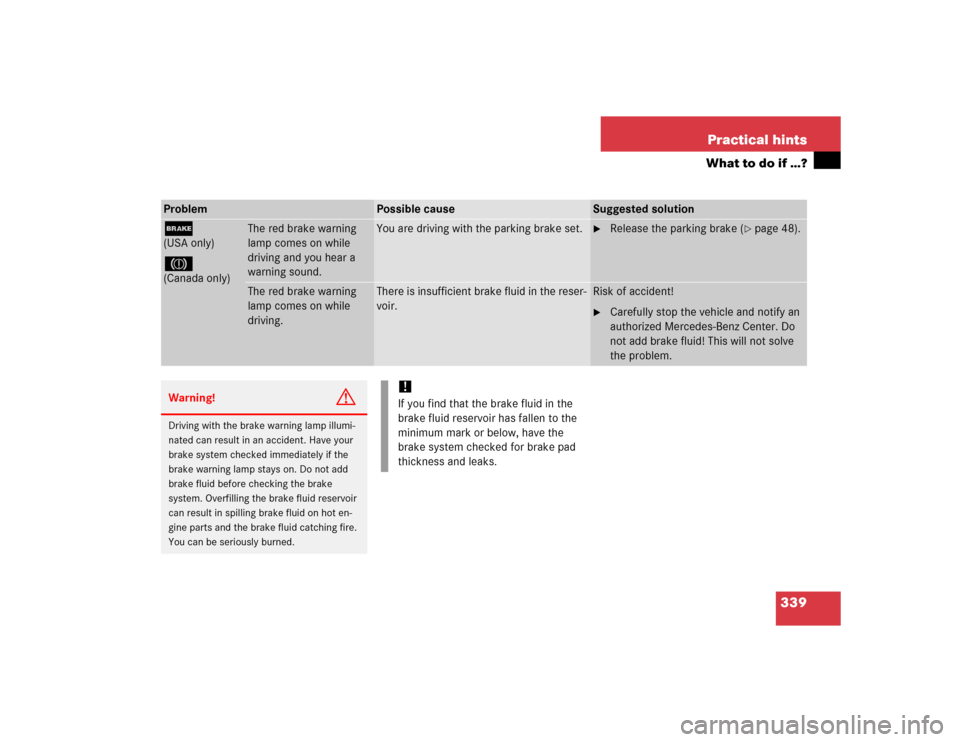
;(USA only)3(Canada only)
The red brake warning
lamp comes on while
driving and you hear a
warning sound.
You are driving with the parking brake set.
�
Release the parking brake (
�page 48).
The red brake warning
lamp comes on while
driving.
There is insufficient brake fluid in the reser-
voir.
Risk of accident!�
Carefully stop the vehicle and notify an
authorized Mercedes-Benz Center. Do
not add brake fluid! This will not solve
the problem.
Warning!
G
Driving with the brake warning lamp illumi-
nated can result in an accident. Have your
brake system checked immediately if the
brake warning lamp stays on. Do not add
brake fluid before checking the brake
system. Overfilling the brake fluid reservoir
can result in spilling brake fluid on hot en-
gine parts and the brake fluid catching fire.
You can be seriously burned.
!If you find that the brake fluid in the
brake fluid reservoir has fallen to the
minimum mark or below, have the
brake system checked for brake pad
thickness and leaks.
Page 342 of 474
340 Practical hintsWhat to do if …?Problem
Possible cause
Suggested solution
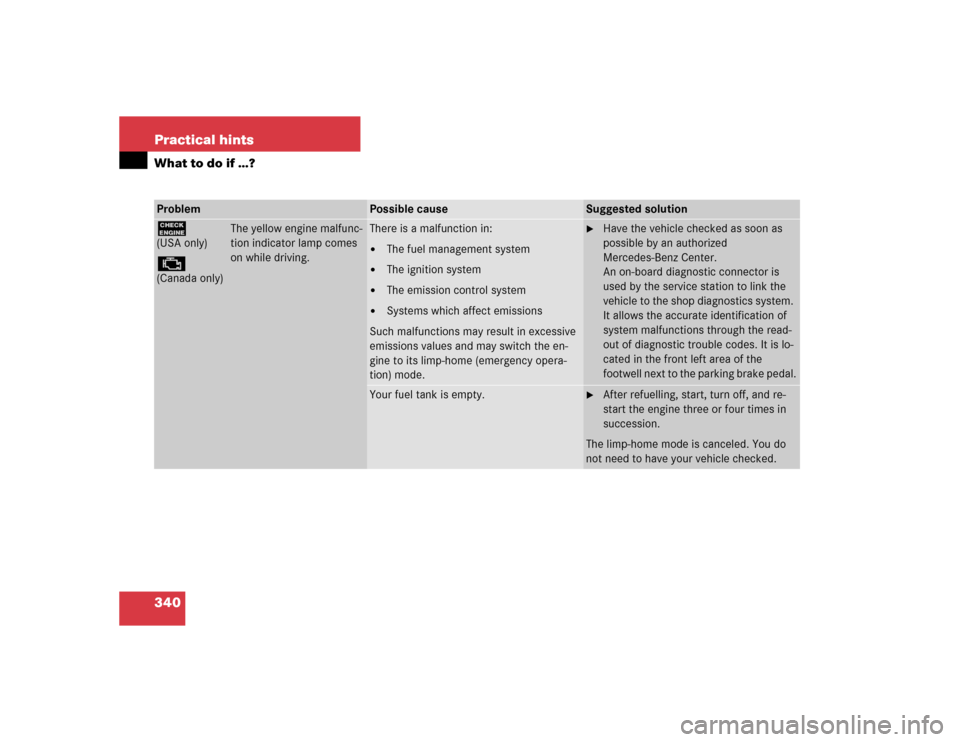
?(USA only)±(Canada only)
The yellow engine malfunc-
tion indicator lamp comes
on while driving.
There is a malfunction in:�
The fuel management system
�
The ignition system
�
The emission control system
�
Systems which affect emissions
Such malfunctions may result in excessive
emissions values and may switch the en-
gine to its limp-home (emergency opera-
tion) mode.
�
Have the vehicle checked as soon as
possible by an authorized
Mercedes-Benz Center.
An on-board diagnostic connector is
used by the service station to link the
vehicle to the shop diagnostics system.
It allows the accurate identification of
system malfunctions through the read-
out of diagnostic trouble codes. It is lo-
cated in the front left area of the
footwell next to the parking brake pedal.
Your fuel tank is empty.
�
After refuelling, start, turn off, and re-
start the engine three or four times in
succession.
The limp-home mode is canceled. You do
not need to have your vehicle checked.