Page 313 of 474
312 OperationTires and wheels�
Install the valve cap.
�
Repeat this procedure for each tire.Potential problems associated with
underinflated and overinflated tires
Underinflated tire inflation pressure
Underinflated tires can:
�
cause excessive and uneven tire wear
�
adversely affect fuel economy
�
lead to tire failure from being
overheated
�
adversely affect handling
characteristics
iIf you have overfilled the tire, release
tire inflation pressure by pushing the
metal stem of the valve with e.g. a tip of
a pen. Then recheck the tire inflation
pressure with the tire gauge.
Warning!
G
Follow recommended tire inflation pres-
sures.
Do not underinflate tires. Underinflated tires
wear excessively and / or unevenly,
adversely affect handling and fuel economy,
and are more likely to fail from being over-
heated.
Do not overinflate tires. Overinflated tires
can adversely affect handling and ride
comfort, wear unevenly, increase stopping
distance, and result in sudden deflation
(blowout) because they are more likely to
become punctured or damaged by road
debris, potholes etc.
Do not overload the tires by exceeding the
specified load limit or vehicle capacity
weight as indicated on the placard on the
driver’s door B-pillar. Overloading the tires
can overheat them, possibly causing a
blowout.
Warning!
G
Follow recommended tire inflation pres-
sures.
Do not underinflate tires. Underinflated tires
wear excessively and / or unevenly,
adversely affect handling and fuel economy,
and are more likely to fail from being
overheated.
��
Page 380 of 474
379 Practical hints
Unlocking/locking in an emergency
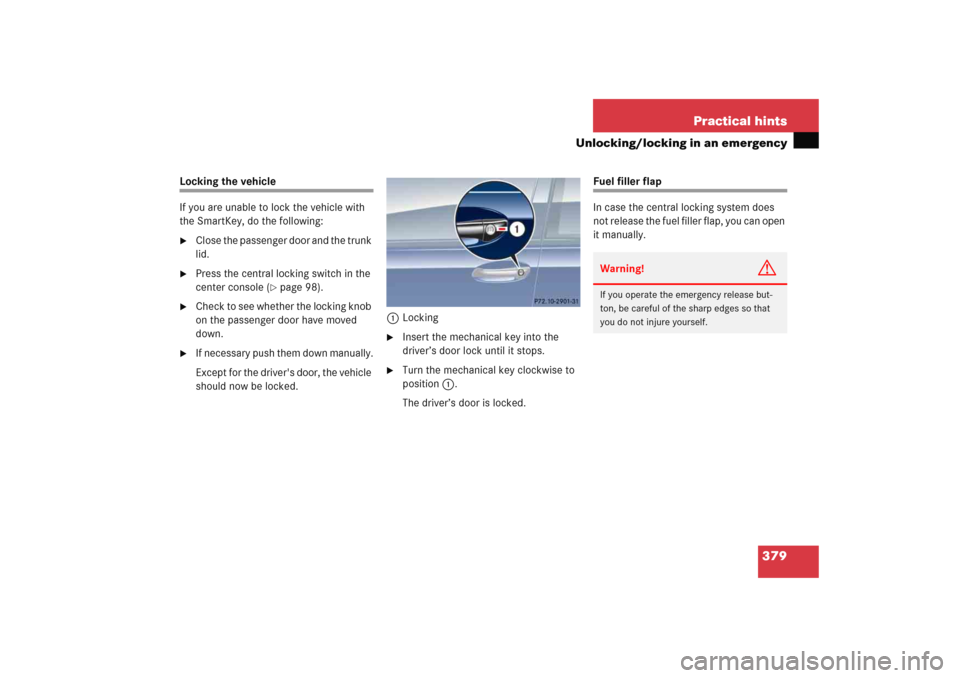
Locking the vehicle
If you are unable to lock the vehicle with
the SmartKey, do the following:�
Close the passenger door and the trunk
lid.
�
Press the central locking switch in the
center console (
�page 98).
�
Check to see whether the locking knob
on the passenger door have moved
down.
�
If necessary push them down manually.
Except for the driver's door, the vehicle
should now be locked.1Locking
�
Insert the mechanical key into the
driver’s door lock until it stops.
�
Turn the mechanical key clockwise to
position1.
The driver’s door is locked.
Fuel filler flap
In case the central locking system does
not release the fuel filler flap, you can open
it manually.Warning!
G
If you operate the emergency release but-
ton, be careful of the sharp edges so that
you do not injure yourself.
Page 467 of 474

466 IndexTracking services
For stolen vehicle 269
Traction 164, 325
Transmission gear selector lever
Unlocking manually 380
Transmission see Automatic
transmission* 296
Tread 325
Tread depth 302
Tread depth (tires) 328
Treadwear indicators 325
Trim panel
Opening 412
Trip computer 151
Trip odometer
Resetting 121
Trunk
Closing the lid 95
Fuse box 412Trunk lid
Closing 95
Emergency release 96
Message in display 372
Opening from inside vehicle 95
Turn signal lamps
Replacing bulbs 385
Turn signals 52
Additional in mirrors 385
Cleaning lenses 335
Front bulbs 385, 388, 389
Rear bulbs 385, 391
Turning off
Engine 58
U
Uniform Tire Quality Grading
Standards 326
Units
Setting speedometer units 137
Setting temperature units 137Unlocking 32, 90
Centrally from inside 98
Driver’s door in an emergency 377
Fuel filler flap 288
Global 92
In an emergency 377
Selective settings 92
Transmission gear selector lever
manually 380
Trunk lid in an emergency 378
Vehicle in an emergency 268
With the SmartKey 32
Upgrade signals
Tele Aid* 267
Uphill driving
Cruise control 248
Upholstery
Cleaning 338
Upshifting 160