Page 125 of 205

5) Determine the combined weight of luggage and cargo being loaded on the car. That weight may not safely exceed the available cargo and luggage load capacity
calculated in Step 4.
6) Your Elise should never be used to tow a trailer
In the case of the Elise:
• The combined cargo and luggage load capacity is 551
lb (250 kg).
• The maximum load in the luggage compartment is 110
lb (50 kg).
• The maximum combined weight of the driver and pas
-
senger is 441 lb (200 kg).
WARNING: Exceeding any of the above loadings may cause
unstable handling or car or tire damage which could cause a crash in which you or others could be seri
-
ously injured or killed.
Tire Markings Designation:Example; Yokohama Advan A048 195/50 R16 84W
Yokohama = manufacturer. Advan A048 = tire model. 195 = nominal section width in mm. 50 = height of tire cross-section expressed as percentage of width. R =
radial construction. 16 = rim diameter in inches. 84 =
load capacity index, indicating the load in kg the tire can carry at the speed corresponding to the speed rating. W
= speed rating indicating the speed (in this case 168 mph) at which the tire can carry the load corresponding to the load capacity index.
Tire Identification Number: On the left hand sidewall as fitted to the car. Commences with DOT (Department of
Transpor tation) followed by a two digit manufacturing plant code, a two digit tire size code, a three digit tire construction code, and a four digit date code for the week
and year of production.
‘LTS’
: Indicates Lotus specific construction.
Tires & Wheels
123
oh_croft_InD.indd 12320/05/2004 07:59:11ProCarManuals.com
Page 128 of 205

WheelsEnsure that only original equipment, or Lotus approved wheel
and tire combinations are fitted. After the car has been used
on track, or in competition conditions, the wheels should be removed and thoroughly inspected for damage.
WARNING: After striking a pothole or kerb, the wheels should be
removed and the wheel and tire thoroughly inspected for
damage. Renew the wheel and /or tire if necessary. Safety
considerations should always be paramount and new parts
fitted in any cases of doubt.
Wheel Bolts The wheel bolts used on the Elise are of a special design to
suit the small diameter fixing tunnels in the wheel centres. The bolts have a 10 spline socket head, for which a special extension
tool is supplied with the car. A 17mm a/f deep socket and 1/2
inch square drive wrench should be applied to the extension tool,
with a tightening torque of 77 lbf.ft (105 Nm) required. To protect against wheel theft, one of the four bolts securing
each wheel is key coded, and requires a corresponding coded
socket wrench and 1/2 inch square drive extension. Rotate the coded socket until full engagement with the bolt head is ensured and take care to maintain the extension tool perpendicular to
the wheel face before applying release torque.
NOTICE: It is not recommended to use hammer action air tools on the coded bolts - use only manual tools.
Both the standard extension and coded socket tools are
stowed in the car tool kit, and should remain with the car at all
times to ensure that servicing may be performed. The key code
included in the tool kit should be recorded and kept safely with
the car documents, in case a replacement socket tool needs
to be ordered.
Wheel Alignment and Tire Balance The wheels on your car were aligned and balanced carefully
during the manufacture of your car to give you the longest tire
life and best overall performance.
Tires & Wheels
126
oh_croft_InD.indd 12620/05/2004 07:59:12ProCarManuals.com
Page 140 of 205
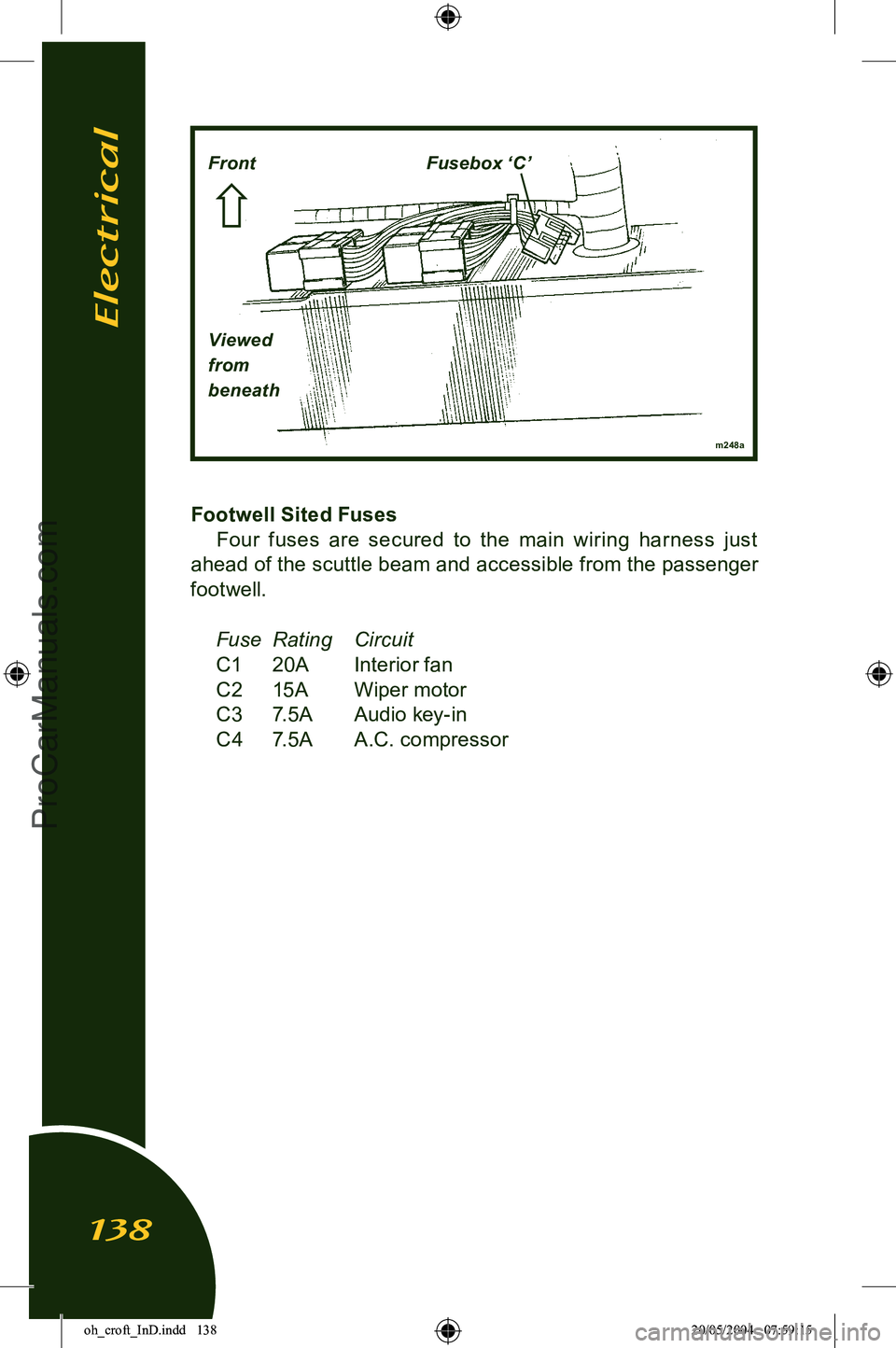
Footwell Sited Fuses Four fuses are secured to the main wiring harness just
ahead of the scuttle beam and accessible from the passenger
footwell.
Fuse Rating CircuitC1 20A Interior fan
C2 15A Wiper motor
C3 7.5A Audio key-in
C4 7.5A A.C. compressor
m248a
Front
Viewed
from
beneath Fusebox ‘C’Electrical
138
oh_croft_InD.indd 13820/05/2004 07:59:15ProCarManuals.com
Page 145 of 205

High beam bulb: Disconnect the two cables from the bulb, re-
lease the spring wire clip, and withdraw the 55W H7 bulb. On re
-
fitting, note that the bulb is keyed to allow only one orientation.
Parking lamp: Twist the bulb holder counterclockwise to release
from the main beam lamp, and withdraw the bayonet fitting T4
W bulb.
Front Turn Indicator Lamp Bulbs For access to the front turn indicator bulb, the lamp unit must
be released from the body. Using a suitable stiff rod or screw
-
driver blade inserted through the access hole in the outer top
corner of the air intake aperture, press back the lamp retaining
clip at the front end of the lamp, and withdraw the lamp from the body. Twist the bulb holder counterclockwise to release from the
lamp, and replace the bayonet fitting amber bulb. After replacing the bulb and holder, ensure the rubber seal
is correctly positioned around the lamp. Engage the tongue at
the rear end of the lamp unit with the body flange, and press the
front end of the lamp firmly down until a distinct ‘click’ is heard, indicating engagement of the retaining clip. Pull up on the front
end of the lamp to check security.
Side Repeater Lamp Bulbs The side mar ker lamps mounted on the front and rear
wheelarch lips, each use four longlife LEDs which are not serv
-
iceable. In case of failure, the lamp unit should be replaced by
your dealer.
ohs149
RELEASING FRONT TURN LAMP
Electrical
143
oh_croft_InD.indd 14320/05/2004 07:59:16ProCarManuals.com
Page 161 of 205

Spark plugs NGK IFR6A11
DensoSK20R11
Spark plug gap 1.1 mm
Max. continuous engine speed 8000 rpm (8500 transient)
Fuel requirement Unleaded
Minimum octane 91 (RON+MON)/2
Fuel system Multi-point fully sequential
fuel injection with Lotus T4
controller.
Peak power (SAE DIN 70020) 190 bhp (141.7 kW) @
7,800 rpm
Peak torque (SAE DIN 70020) 138 lbf.ft (187 Nm) @
6,800 rpm
Transmission
Type 6 speed manual transaxle.
Bevel gear differential.
Gear Ratio Final Drive mph/1000 rpm First 3.17:1 ) 5.1
Second 2.05:1 ) 7.7
Third 1.48:1 ) 4.53:1 10.7
Fourth 1.17:1 ) 13.6
Fifth 0.92:1 ) 17.3
Sixth 0.81:1 ) 19.4
Reverse 3.25:1 )
Brakes
Type Front and rear discs with
curved vane ventilation
and cross drilling.
AP Racing aluminium op
posed piston front calipers.
Single piston sliding rear
calipers.
Disc Size - front and rear 288mm
Operation Tandem master cylinder
with vacuum servo and
ABS
Parking Brake Cable operation of rear
calipers, self adjusting for
pad wear.
Technical Data
159
oh_croft_InD.indd 15920/05/2004 07:59:20ProCarManuals.com