Page 223 of 320

The above calculations also assume that the loads are positioned in your
vehicle in a manner that does not overload the Front or the Rear Gross
Axle Weight Rating specified for your vehicle on the Certification label
found on the driver’s door.
Calculating the load your vehicle can carry/tow
1. Use the appropriate maximum GCWR chart (in theTrailer towing
section in this chapter) for your type of engine and rear axle ratio.
2. Weigh your vehicle without cargo. To obtain correct weights, take your
vehicle to a shipping company or an inspection station for trucks.
3. Subtract your loaded weight from the maximum GCWR in the chart.
This is the maximum trailer weight your vehicle can tow. It must be
below the maximum trailer weight shown in the chart.
TRAILER TOWING
Your vehicle is not equipped to tow. No towing packages are available
through Ford or Lincoln/Mercury dealers.
RECREATIONAL TOWING (ALL WHEELS ON THE GROUND)
Follow these guidelines for your specific powertrain combination to tow
your vehicle with all four wheels on the ground (such as behind a
recreational vehicle).
These guidelines are designed to ensure that your transmission is not
damaged due to insufficient lubrication.
All Rear Wheel Drive (RWD) vehicles:
This applies to all cars and 4x2 trucks/sport utilities with rear wheel
drive capability.
•Place the transmission in N (Neutral)
•Maximum speed is 35 mph (56 km/h)
•Maximum distance is 50 miles (80 km)
If a distance of 50 miles (80 km) or a speed of 35 mph (56 km/h) must
be exceeded, you must disconnect the driveshaft.
Ford recommends the driveshaft be removed/installed only by a
qualified technician. Improper removal/installation of the
driveshaft may cause damage to the driveshaft and internal
transmission components.See your local dealer for driveshaft
removal/installation.
REVIEW COPY
2005 Lincoln LS(dew), Owners Guide (post-2002-fmt)(own2002),
Market:USA_English(fus)
Tires, Wheels and Loading
223
Page 240 of 320
To help avoid personal injury, always use caution when in R
(Reverse) and when using the rear park assist.
This system is not designed to prevent contact with small or
moving objects. The system is designed to provide a warning to
assist the driver in detecting objects to avoid damaging the vehicle.
The system may not detect smaller objects, particularly those close to
the ground.
Certain add-on devices such as large trailer hitches, bike or
surfboard racks and any device that may block the normal
detection zone of the Rear Park Assist system may create false beeps.
The system will assist the driver in detecting certain objects while the
vehicle slowly moves in reverse at speeds less than 6 mph (10 km/h).
The system is not effective at speeds greater than 6 mph (10 km/h) and
may not detect certain angular or moving objects.
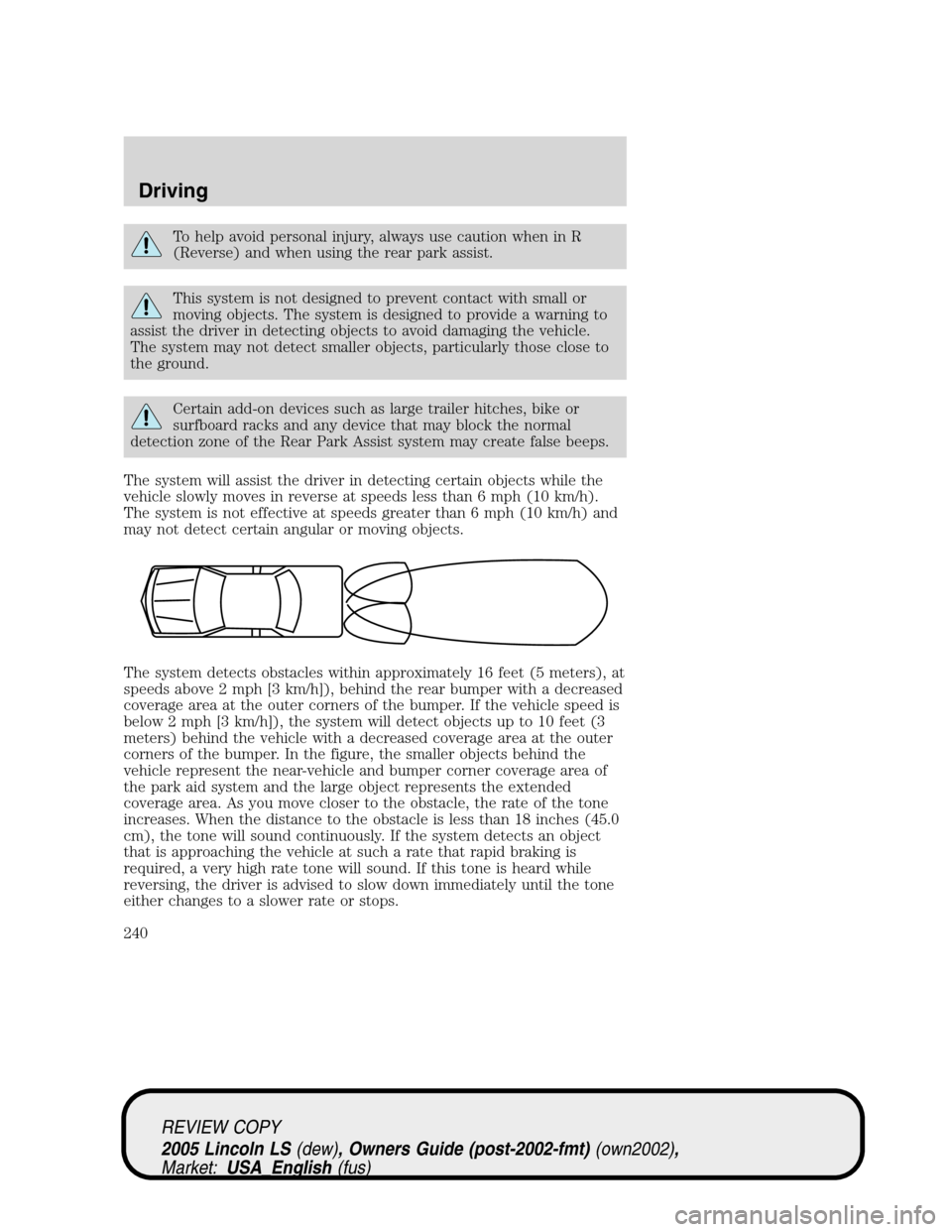
The system detects obstacles within approximately 16 feet (5 meters), at
speeds above 2 mph [3 km/h]), behind the rear bumper with a decreased
coverage area at the outer corners of the bumper. If the vehicle speed is
below 2 mph [3 km/h]), the system will detect objects up to 10 feet (3
meters) behind the vehicle with a decreased coverage area at the outer
corners of the bumper. In the figure, the smaller objects behind the
vehicle represent the near-vehicle and bumper corner coverage area of
the park aid system and the large object represents the extended
coverage area. As you move closer to the obstacle, the rate of the tone
increases. When the distance to the obstacle is less than 18 inches (45.0
cm), the tone will sound continuously. If the system detects an object
that is approaching the vehicle at such a rate that rapid braking is
required, a very high rate tone will sound. If this tone is heard while
reversing, the driver is advised to slow down immediately until the tone
either changes to a slower rate or stops.
REVIEW COPY
2005 Lincoln LS(dew), Owners Guide (post-2002-fmt)(own2002),
Market:USA_English(fus)
Driving
240
Page 318 of 320

safety practices .......................215
sidewall information ...............209
snow tires and chains ............218
spare tire .........................204–205
terminology .............................200
tire grades ...............................200
treadwear ........................199, 214
Towing .......................................223
recreational towing .................223
trailer towing ..........................223
wrecker ....................................260
Traction control ........................230
Transmission .............................234
brake-shift interlock (BSI) ....234
fluid, checking and adding
(automatic) .............................301
fluid, refill capacities ..............304
lubricant specifications ..306–307
Trunk .........................................144
remote release ................138, 148
Turn signal ................................101V
Vehicle dimensions ...................308
Vehicle Identification Number
(VIN) ..........................................309
Vehicle loading ..........................219
Ventilating your vehicle ...........227
W
Warning lights (see Lights) .......10
Washer fluid ..............................279
Water, Driving through .............241
Windows
power .......................................111
Windshield washer fluid and
wipers ........................................107
checking and adding fluid .....279
replacing wiper blades ...........107
Wrecker towing .........................260
REVIEW COPY
2005 Lincoln LS(dew), Owners Guide (post-2002-fmt)(own2002),
Market:USA_English(fus)
Index
318