Page 237 of 320

•Selecting 2 (Second) at higher speeds will cause the transmission to
downshift to second gear at the appropriate vehicle speed.
1 (First)
This position allows for first gear only.
•Provides maximum engine braking.
•Will not downshift into first gear at high speeds; will cause the
transmission to downshift to a lower gear, then allows for first gear
when the vehicle reaches slower speeds.
Forced downshifts
•Allowed in Overdrive or Drive.
•Depress the accelerator to the floor.
•Allows transmission to select an appropriate gear.
Driving with a 5–speed automatic transmission with the Select
Shift Transmission (SST) shifter (if equipped)
Understanding gearshift positions
The Select Shift Transmission (SST) shifter allows the driver to select
between the transmission’s automatic shift mode or the manually
selected shift mode.
Automatic shift mode
Operates like a normal automatic
transmission for P (Park), R
(Reverse), N (Neutral), D5 and D4.
Refer toDriving with a 5–speed
automatic transmissionin this
chapter for P (Park), R (Reverse),
N (Neutral), D5 and D4 information.
REVIEW COPY
2005 Lincoln LS(dew), Owners Guide (post-2002-fmt)(own2002),
Market:USA_English(fus)
Driving
237
Page 238 of 320

Manual shift mode
With the gearshift lever in D5
(Overdrive), the gearshift lever can
be moved to the right and into the
manual shift mode. The transmission
will remain in the manual shift mode
until the gearshift lever is moved
back to D5 (Overdrive).
+ and - position operation
These positions allow the driver to
manually select the appropriate
upshift (+) or downshift (-) and
gear range.
•Can only be entered from the D5
position.
•Gear ranges 1–5 provide the same
function and ratio as found in the
D5 or D4 automatic mode
positions.
•Transmission will not upshift or downshift unless the selector lever is
moved forward or rearward.
•One tap forward (+) willcommandthe transmission to upshift one
gear range.
•One tap rearward (-) willcommandthe transmission to downshift one
gear range.
•Upshifts are allowed at any vehicle speed, with the exception of 4th
and 5th gear. The transmission will not do a 4th or 5th gear start.
Ensure that the transmission is returned to 1st gear once the vehicle
is stopped. If this is not done, and the transmission is in 2nd or 3rd
gear, the vehicle will remain in that gear. However, if the transmission
is in 4th or 5th gear, the transmission will automatically return to 1st
gear.
•When downshifting at normal road speeds, the transmission will only
allow a downshift into thenext lowergear.
REVIEW COPY
2005 Lincoln LS(dew), Owners Guide (post-2002-fmt)(own2002),
Market:USA_English(fus)
Driving
238
Page 239 of 320

•If shifter (-) is tapped more than once in rapid succession, the
transmission will downshift only into the next lower gear, then when
the vehicle reaches a speed below a calibrated entry speed, the
transmission will allow a downshift into the next lower gear if again
selected by the driver. This is to prevent engine and transmission
damage and to keep the engine and transmission within allowable
RPM ranges.
•An electronic indicator on the instrument cluster will display the
selected gear.
Recommended shift speeds
Upshift according to the following chart:
Recommended upshift schedule
Shift from:
1 - 2 15 mph (24 km/h)
2 - 3 25 mph (40 km/h)
3 - 4 40 mph (64 km/h)
4 - 5 45 mph (72 km/h)
If your vehicle gets stuck in mud or snow
If your vehicle gets stuck in mud or snow, it may be rocked out by
shifting between forward and reverse gears, stopping between shifts in a
steady pattern. Press lightly on the accelerator in each gear.
Do not rock the vehicle if the engine is not at normal operating
temperature or damage to the transmission may occur.
Do not rock the vehicle for more than a minute or damage to the
transmission and tires may occur, or the engine may overheat.
REAR PARK ASSIST (IF EQUIPPED)
The rear park assist system sounds a tone to warn the driver of obstacles
near the rear bumper when the R (Reverse) gear is selected.
To help avoid personal injury, please read and understand the
limitations of the rear park assist system as contained in this
section. The park assist is only an aid for some (generally large and
fixed) objects when moving in reverse on a flat surface at“parking
speeds”. Inclement weather may also affect the function of the system;
this may include reduced performance or a false activation.
REVIEW COPY
2005 Lincoln LS(dew), Owners Guide (post-2002-fmt)(own2002),
Market:USA_English(fus)
Driving
239
Page 240 of 320
To help avoid personal injury, always use caution when in R
(Reverse) and when using the rear park assist.
This system is not designed to prevent contact with small or
moving objects. The system is designed to provide a warning to
assist the driver in detecting objects to avoid damaging the vehicle.
The system may not detect smaller objects, particularly those close to
the ground.
Certain add-on devices such as large trailer hitches, bike or
surfboard racks and any device that may block the normal
detection zone of the Rear Park Assist system may create false beeps.
The system will assist the driver in detecting certain objects while the
vehicle slowly moves in reverse at speeds less than 6 mph (10 km/h).
The system is not effective at speeds greater than 6 mph (10 km/h) and
may not detect certain angular or moving objects.
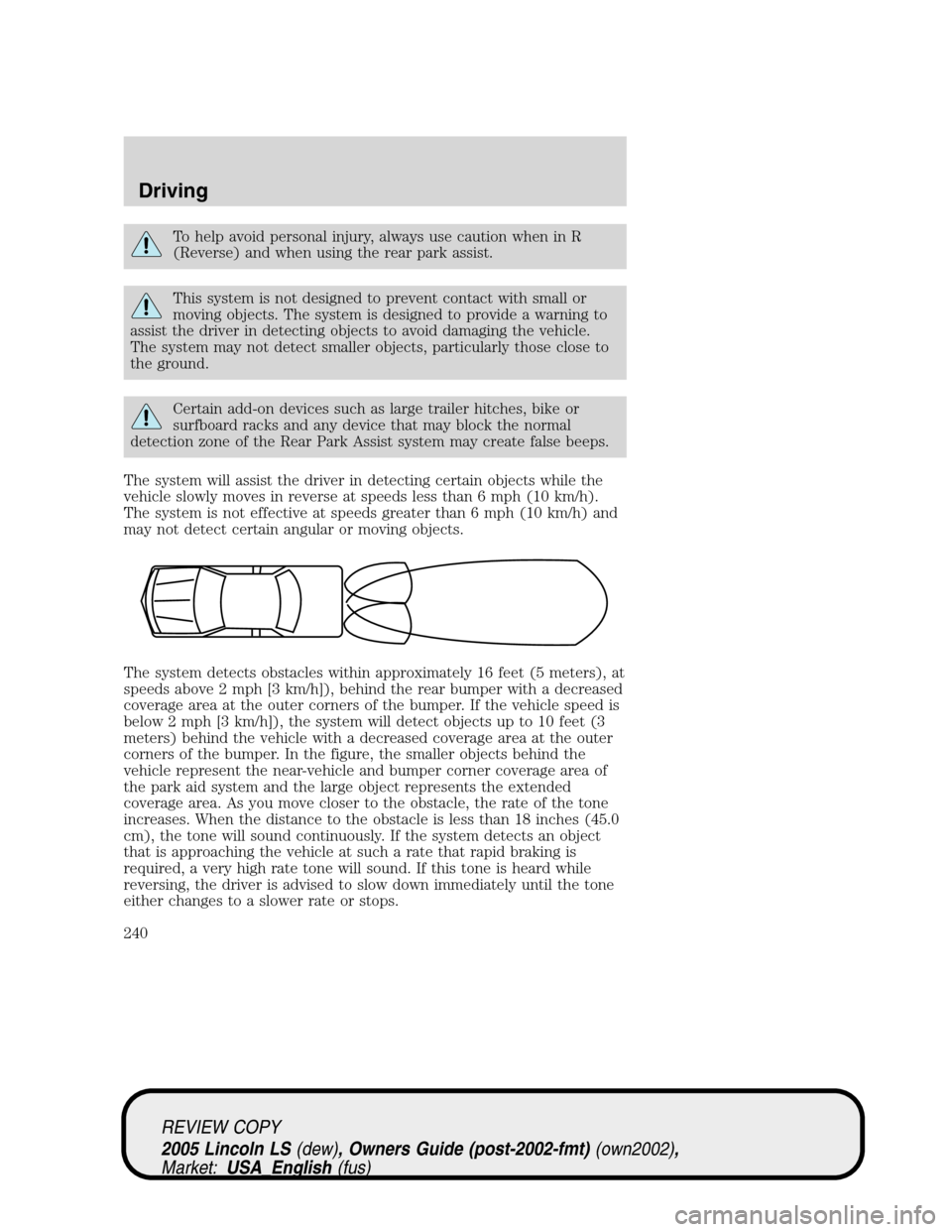
The system detects obstacles within approximately 16 feet (5 meters), at
speeds above 2 mph [3 km/h]), behind the rear bumper with a decreased
coverage area at the outer corners of the bumper. If the vehicle speed is
below 2 mph [3 km/h]), the system will detect objects up to 10 feet (3
meters) behind the vehicle with a decreased coverage area at the outer
corners of the bumper. In the figure, the smaller objects behind the
vehicle represent the near-vehicle and bumper corner coverage area of
the park aid system and the large object represents the extended
coverage area. As you move closer to the obstacle, the rate of the tone
increases. When the distance to the obstacle is less than 18 inches (45.0
cm), the tone will sound continuously. If the system detects an object
that is approaching the vehicle at such a rate that rapid braking is
required, a very high rate tone will sound. If this tone is heard while
reversing, the driver is advised to slow down immediately until the tone
either changes to a slower rate or stops.
REVIEW COPY
2005 Lincoln LS(dew), Owners Guide (post-2002-fmt)(own2002),
Market:USA_English(fus)
Driving
240
Page 241 of 320

The rear park assist is automatically
enabled when the gear selector is
placed in R (Reverse) and the
ignition is ON. A park assist control
allows the driver to disable the
system only when the ignition is
ON, and the gear selector is in R
(Reverse).
The OFF indicator remains
illuminated when the system is
disabled. Press the control to
disable or enable the system. Once disabled, the system will remain
disabled until the control is pressed or until the next ignition cycle.
The indicator will remain illuminated to indicate a failure of the rear park
assist.
Always keep the sensors (located on the rear bumper/fascia) free
from snow, ice and large accumulations of dirt (do not clean the
sensors with sharp objects). These elements may cause the
system to operate inaccurately.
If the vehicle sustains damage to the rear bumper/fascia, leaving
it misaligned or bent, the sensing zone may be altered causing
inaccurate measurement of obstacles or false alarms.
DRIVING THROUGH WATER
If driving through deep or standing water is unavoidable, proceed very
slowly especially when the depth is not known. Never drive through
water that is higher than the bottom of the hubs (for trucks) or the
bottom of the wheel rims (for cars). When driving through water,
traction or brake capability may be limited. Also, water may enter your
engine’s air intake and severely damage your engine or your vehicle may
stall.Driving through deep water where the transmission vent
tube is submerged may allow water into the transmission and
cause internal transmission damage.
Once through the water, always dry the brakes by moving your
vehicle slowly while applying light pressure on the brake pedal.
Wet brakes do not stop the vehicle as quickly as dry brakes.
REVIEW COPY
2005 Lincoln LS(dew), Owners Guide (post-2002-fmt)(own2002),
Market:USA_English(fus)
Driving
241
Page 244 of 320
This switch is located in the driver’s
footwell, behind the kick panel.
To reset the switch:
1. Turn the ignition OFF.
2. Check the fuel system for leaks.
3. If no leaks are apparent, reset the
switch by pushing in on the reset
button.
4. Turn the ignition ON.
5. Wait a few seconds and return
the key to OFF.
6. Make another check for leaks.
FUSES AND RELAYS
Fuses
If electrical components in the
vehicle are not working, a fuse may
have blown. Blown fuses are
identified by a broken wire within
the fuse. Check the appropriate
fuses before replacing any electrical
components.
Note:Always replace a fuse with one that has the specified amperage
rating. Using a fuse with a higher amperage rating can cause severe wire
damage and could start a fire.
15
REVIEW COPY
2005 Lincoln LS(dew), Owners Guide (post-2002-fmt)(own2002),
Market:USA_English(fus)
Roadside Emergencies
244
Page 247 of 320
Fuse/Relay
LocationFuse Amp
RatingPassenger Compartment Fuse
Panel Description
10 5A Left front turn, Left front sidemarker,
Left front park lamps
11 10A Left front high beam
12 5A Electrochromic mirror
13 5A Cluster
14 5A DATC
15 5A O/D cancel, ABS/Traction-Assist
switch
16 5A Heated seat controls, Climate control
seat module
17 5A RCM, Alternator warning lamp
18 20A Radio, CIA, Navigation unit
19 15A Tilt/Tele motors
20 10A FEM, DATC, Cluster, REM
21 7.5A Not used (spare)
22 10A DDM, Driver door mirror
23 10A Right front high beam
24 5A PATS
25 15A Left front low beam/HID
26 5A Wiper module
27 10A Radio, Navigation unit
28 5A Not Used (spare)
29 5A FEM, Reverse park assist
30 5A FEM, Passenger power mirror
31—Not used
32 20A Cigar lighter
33 10A Switch backlighting, FEM
34 10A Not used (spare)
35 5A Stop lamp signal
REVIEW COPY
2005 Lincoln LS(dew), Owners Guide (post-2002-fmt)(own2002),
Market:USA_English(fus)
Roadside Emergencies
247
Page 253 of 320
Fuse/Relay
LocationFuse Amp
RatingPower Distribution Box
Description
17 15A* Fuel pump motor
18 20A* Subwoofer amp
30A* THX amp, Subwoofer amp
19 20A** REM - Left rear window
20 30A** Front window motors
21 20A** Driver lumbar, Power seats
22 20A** Ignition switch
23 30A** SSP4
24 30A** SSP3
25 40A** P-J/B
26 30A** Climate control seat module
27 30A** SSP1
28 20A** Passenger lumbar, Power seats
29 40A** Rear defroster
30 20A** REM - Right rear window
31 30A** Powertrain main power
32 30A** SSP2
Relay 001—SSP1
Relay 002—SSP4
Relay 003—Rear defroster
Relay 004—SSP3
Relay 005—SSP2
Relay 006—Not used
Relay 007—Fuel pump motor
Diode 01—Not used
Diode 02—Fuel pump motor
*Mini fuses **Maxi fuses
REVIEW COPY
2005 Lincoln LS(dew), Owners Guide (post-2002-fmt)(own2002),
Market:USA_English(fus)
Roadside Emergencies
253


