2005 LINCOLN AVIATOR clock
[x] Cancel search: clockPage 261 of 368
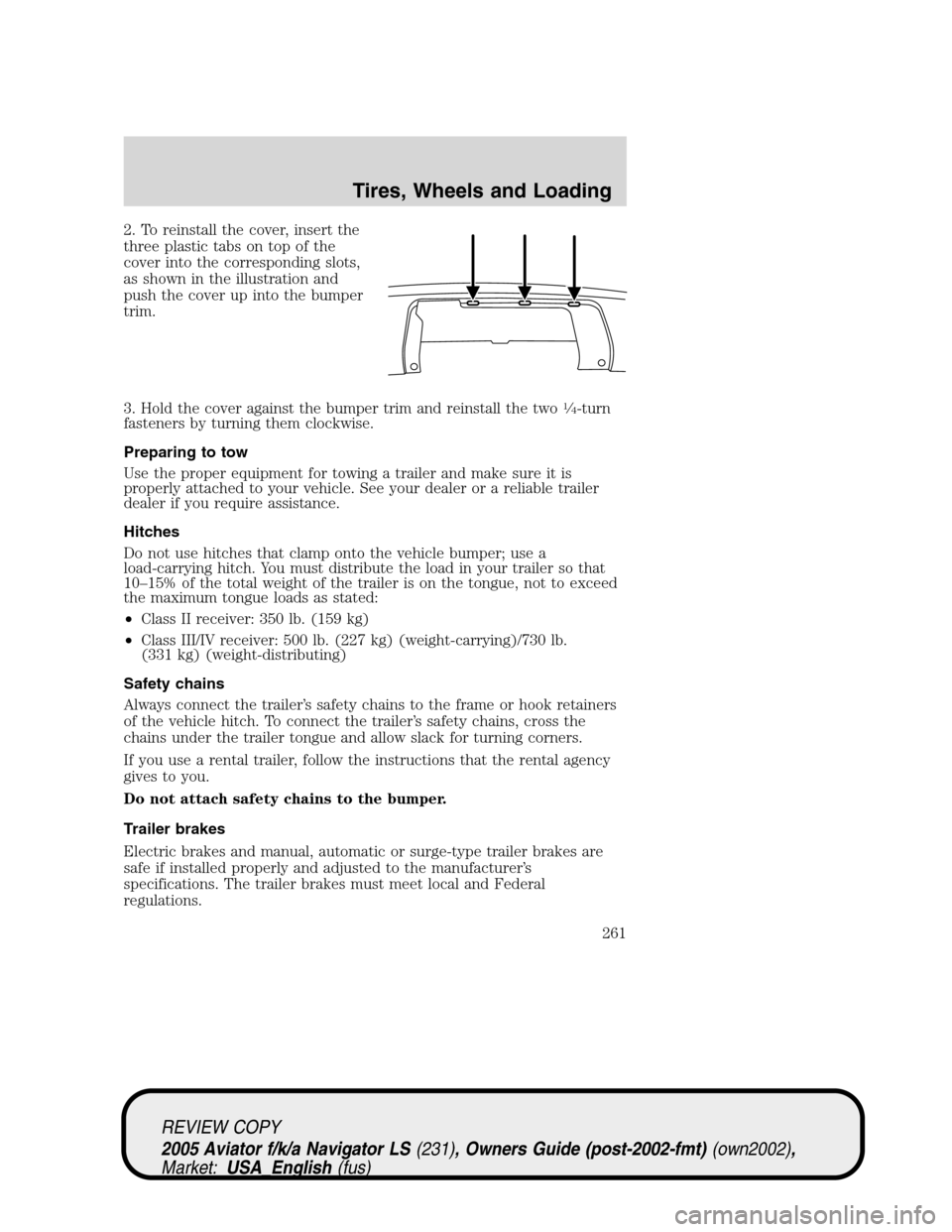
2. To reinstall the cover, insert the
three plastic tabs on top of the
cover into the corresponding slots,
as shown in the illustration and
push the cover up into the bumper
trim.
3. Hold the cover against the bumper trim and reinstall the two
14-turn
fasteners by turning them clockwise.
Preparing to tow
Use the proper equipment for towing a trailer and make sure it is
properly attached to your vehicle. See your dealer or a reliable trailer
dealer if you require assistance.
Hitches
Do not use hitches that clamp onto the vehicle bumper; use a
load-carrying hitch. You must distribute the load in your trailer so that
10–15% of the total weight of the trailer is on the tongue, not to exceed
the maximum tongue loads as stated:
•Class II receiver: 350 lb. (159 kg)
•Class III/IV receiver: 500 lb. (227 kg) (weight-carrying)/730 lb.
(331 kg) (weight-distributing)
Safety chains
Always connect the trailer’s safety chains to the frame or hook retainers
of the vehicle hitch. To connect the trailer’s safety chains, cross the
chains under the trailer tongue and allow slack for turning corners.
If you use a rental trailer, follow the instructions that the rental agency
gives to you.
Do not attach safety chains to the bumper.
Trailer brakes
Electric brakes and manual, automatic or surge-type trailer brakes are
safe if installed properly and adjusted to the manufacturer’s
specifications. The trailer brakes must meet local and Federal
regulations.
REVIEW COPY
2005 Aviator f/k/a Navigator LS(231), Owners Guide (post-2002-fmt)(own2002),
Market:USA_English(fus)
Tires, Wheels and Loading
261
Page 297 of 368

Fuse/Relay
LocationFuse Amp
RatingPassenger Compartment Fuse
Panel Description
6 5A Electronic Hidden Antenna
Module (EHAM) (antenna
amplifier), Radio, Moonroof motor,
Driver window motor, Navigation
module and microphone
7 15A Heated mirrors, DEATC module
8 5A Daytime Running Lamps (DRL)
module, Heated PCV valve
9 10A Back-up lamps (DTRS),
Electrochromatic mirror
10 10A Heated backlight relay coil,
Climate seat modules, Auxiliary
A/C temperature blend/mode
actuator, A/C clutch relay contact
11 20A Not used (spare)
12 15A Restraints module
13 10A Brake shift interlock
14 5A Not used (spare)
15 5A Instrument cluster, Rear wiper
module, TPMS
16 15A OBD II
17 15A Delayed accessory relay coil,
Battery saver relay coil and
contact
18 5A Not used (spare)
19 15A Washer pump
20 5A Shifter, Clock, Power mirror
switch, DVD
21 10A Brake pressure switch (ABS),
RSC switch, Flasher relay
22 10A ABS/RSC module
REVIEW COPY
2005 Aviator f/k/a Navigator LS(231), Owners Guide (post-2002-fmt)(own2002),
Market:USA_English(fus)
Roadside Emergencies
297
Page 330 of 368

•If the oil level is below the MIN
mark, add enough oil to raise the
level within the MIN-MAX range.
•Oil levels above the MAX mark may cause engine damage. Some oil
must be removed from the engine by a service technician.
7. Put the indicator back in and ensure it is fully seated.
Adding engine oil
1. Check the engine oil. For instructions, refer toChecking the engine
oilin this chapter.
2. If the engine oil level is not within the normal range, add only certified
engine oil of the recommended viscosity. Remove the engine oil filler cap
and use a funnel to pour the engine oil into the opening.
3. Recheck the engine oil level. Make sure the oil level is not above the
MAX mark on the engine oil level indicator (dipstick).
4. Install the indicator and ensure it is fully seated.
5. Fully install the engine oil filler cap by turning the filler cap clockwise
1/4 of a turn until three clicks are heard or until the cap is fully seated.
To avoid possible oil loss, DO NOT operate the vehicle with the
engine oil level indicator and/or the engine oil filler cap removed.
REVIEW COPY
2005 Aviator f/k/a Navigator LS(231), Owners Guide (post-2002-fmt)(own2002),
Market:USA_English(fus)
Maintenance and Specifications
330
Page 334 of 368

If the battery has been disconnected or a new battery has been installed,
the clock and the preset radio stations must be reset once the battery is
reconnected.
•Always dispose of automotive
batteries in a responsible manner.
Follow your local authorized
standards for disposal. Call your
local authorized recycling center
to find out more about recycling
automotive batteries.
ENGINE COOLANT
Checking engine coolant
The concentration and level of engine coolant should be checked at the
mileage intervals listed in theScheduled Maintenance Guide. The
coolant concentration should be maintained at 50/50 coolant and distilled
water, which equates to a freeze point of -34°F (-36°C). Coolant
concentration testing is possible with a hydrometer or antifreeze tester
(such as the Rotunda Battery and Antifreeze Tester, 014–R1060). The
level of coolant should be maintained at the“FULL COLD”level or
within the“COLD FILL RANGE”in the coolant reservoir. If the level falls
below, refer to instructions in theAdding engine coolantsection.
Your vehicle was factory-filled with a 50/50 engine coolant and water
concentration. If the concentration of coolant falls below 40% or above
60%, the engine parts could become damaged or not work properly.A
50–50 mixture of coolant and water provides the following:
•Freeze protection down to -34°F (-36°C).
•Boiling protection up to 265°F (129°C).
•Protection against rust and other forms of corrosion.
•Enables calibrated gauges to work properly.
LEAD
RETURN
RECYCLE
REVIEW COPY
2005 Aviator f/k/a Navigator LS(231), Owners Guide (post-2002-fmt)(own2002),
Market:USA_English(fus)
Maintenance and Specifications
334
Page 340 of 368
•Fuels can also be harmful if absorbed through the skin. If fuel is
splashed on the skin and/or clothing, promptly remove contaminated
clothing and wash skin thoroughly with soap and water. Repeated or
prolonged skin contact with fuel liquid or vapor causes skin irritation.
•Be particularly careful if you are taking“Antabuse”or other forms of
disulfiram for the treatment of alcoholism. Breathing gasoline vapors,
or skin contact could cause an adverse reaction. In sensitive
individuals, serious personal injury or sickness may result. If fuel is
splashed on the skin, promptly wash skin thoroughly with soap and
water. Consult a physician immediately if you experience an adverse
reaction.
When refueling always shut the engine off and never allow
sparks or open flames near the filler neck. Never smoke while
refueling. Fuel vapor is extremely hazardous under certain conditions.
Care should be taken to avoid inhaling excess fumes.
The flow of fuel through a fuel pump nozzle can produce static
electricity, which can cause a fire if fuel is pumped into an
ungrounded fuel container.
Use the following guidelines to avoid static build-up when filling an
ungrounded fuel container:
•Place approved fuel container on the ground.
•DO NOT fill a fuel container while it is in the vehicle (including the
cargo area).
•Keep the fuel pump nozzle in contact with the fuel container while
filling.
•DO NOT use a device that would hold the fuel pump handle in the fill
position.
Fuel Filler Cap
Your fuel tank filler cap has an indexed design with a 1/8 turn on/off
feature.
When fueling your vehicle:
1. Turn the engine off.
2. Carefully turn the filler cap counterclockwise 1/8 turn of a turn until it
stops.
REVIEW COPY
2005 Aviator f/k/a Navigator LS(231), Owners Guide (post-2002-fmt)(own2002),
Market:USA_English(fus)
Maintenance and Specifications
340
Page 341 of 368

3. Pull to remove the cap from the fuel filler pipe.
4. To install the cap, align the tabs on the cap with the notches on the
filler pipe.
5. Turn the filler cap clockwise 1/8 turn until it stops.
“CHECK/TIGHTEN FUEL CAP”will display in the message center when
the fuel filler cap is not properly installed. Proper fuel filler cap
installation is checked automatically as the vehicle is driven, but not until
after some fuel is used (fuel gauge drops below full). Once the fuel filler
cap is properly secured,“CHECK/TIGHTEN FUEL CAP”will turn off
after a short period of driving.
If you must replace the fuel filler cap, replace it with a fuel filler
cap that is designed for your vehicle. The customer warranty may
be void for any damage to the fuel tank or fuel system if the
correct genuine Ford or Motorcraft fuel filler cap is not used.
The fuel system may be under pressure. If the fuel filler cap is
venting vapor or if you hear a hissing sound, wait until it stops
before completely removing the fuel filler cap. Otherwise, fuel may
spray out and injure you or others.
If you do not use the proper fuel filler cap, excessive pressure or
vacuum in the fuel tank may damage the fuel system or cause
the fuel cap to disengage in a collision, which may result in possible
personal injury.
Choosing the right fuel
Use only UNLEADED FUEL. The use of leaded fuel is prohibited by law
and could damage your vehicle.
Your vehicle was not designed to use fuel or fuel additives with metallic
compounds, including manganese-based additives. Studies indicate that
these additives can cause your vehicle’s emission control system to
deteriorate more rapidly.
Do not use fuel containing methanol. It can damage critical fuel system
components.
Repairs to correct the effects of using a fuel for which your vehicle was
not designed may not be covered by your warranty.
REVIEW COPY
2005 Aviator f/k/a Navigator LS(231), Owners Guide (post-2002-fmt)(own2002),
Market:USA_English(fus)
Maintenance and Specifications
341
Page 363 of 368
interior .............................322–323
interior trim ............................323
plastic parts ............................321
washing ....................................319
waxing .....................................319
wheels ......................................320
wiper blades ............................321
Clock ..........................................124
Clock adjust
6-CD in dash .......................22, 32
AM/FM/Tape/CD .......................18
Compass, electronic
set zone adjustment ...............142
Console ......................................154
overhead ..........................122–123
rear ..........................................154
Controls
power seat ...............................177
steering column ......................134
Coolant
checking and adding ..............334
refill capacities ................337, 352
specifications ..................354, 356
Cruise control
(see Speed control) ..................131
Customer Assistance ................292
Ford accessories for your
vehicle .....................................324
Ford Extended Service
Plan ..........................................316
Getting assistance outside the
U.S. and Canada .....................317
Getting roadside assistance ...292
Getting the service you
need .........................................310
Ordering additional owner’s
literature .................................317
The Dispute Settlement
Board .......................................312Utilizing the
Mediation/Arbitration
Program ...................................315
D
Daytime running lamps
(see Lamps) ..............................106
Defrost
rear window ............................103
Dipstick
automatic transmission
fluid ..........................................350
engine oil .................................328
Doors
lubricant specifications ..........354
Driving under special
conditions ..........................286, 289
sand .........................................288
snow and ice ...........................290
through water .................288, 291
DVD system .................................34
E
Electronic message center .......141
Emergencies, roadside
jump-starting ..........................304
Emission control system ..........346
Engine ........................................356
cleaning ...................................320
coolant .....................................334
fail-safe coolant ......................337
idle speed control ...................332
lubrication
specifications ..................354, 356
refill capacities ........................352
service points ..........................327
starting after a collision .........293
Engine block heater .................268
REVIEW COPY
2005 Aviator f/k/a Navigator LS(231), Owners Guide (post-2002-fmt)(own2002),
Market:USA_English(fus)
Index
363
Page 366 of 368

Parking brake ............................270
Parts (see Motorcraft parts) ....351
Pedals (see Power adjustable
foot pedals) ...............................131
Power adjustable foot pedals ...131
Power distribution box
(see Fuses) ...............................299
Power door locks ......................158
Power mirrors ...........................129
Power point ...............................124
Power steering ..................274–275
fluid, checking and adding ....348
fluid, refill capacity ................352
fluid, specifications .........354, 356
Power Windows .........................125
Preparing to drive your
vehicle ........................................275
R
Radio ..........................16, 20, 25, 30
Rear Park Assist .......................281
Rear window defroster .............103
Relays ................................294, 303
Remote entry system .......159, 161
illuminated entry ....................165
locking/unlocking
doors ................................160–161
opening the trunk ...................161
panic alarm .............................161
replacement/additional
transmitters .............................164
Roadside assistance ..................292
Roof rack ...................................156
S
Safety Belt Maintenance ..........200Safety belts (see Safety
restraints) ..........188, 191–194, 196
Safety Canopy ...................205–206
Safety defects, reporting ..........318
Safety restraints ........188, 191–196
belt minder .............................197
extension assembly ................200
for adults .........................192–194
for children .....................208–209
safety belt maintenance .........200
warning light and chime ........196
Safety seats for children ..........211
Seat belts
(see Safety restraints) .............188
Seats ..........................................176
child safety seats ....................211
climate control ........................180
easy access/easyout feature ..179
memory seat ...................162, 179
SecuriLock passive anti-theft
system ................................169–171
Servicing your vehicle ..............325
Setting the clock
AM/FM/In-dash 6 CD ..........22, 32
AM/FM/Tape/CD .......................18
Snowplowing .................................7
Spark plugs,
specifications .....................351, 356
Special notice
ambulance conversions ..............7
utility-type vehicles ....................7
Specification chart,
lubricants ...........................354, 356
Speed control ............................131
Starting your vehicle ........265–267
jump starting ..........................304
REVIEW COPY
2005 Aviator f/k/a Navigator LS(231), Owners Guide (post-2002-fmt)(own2002),
Market:USA_English(fus)
Index
366