Page 439 of 539
IN CASE OF AN EMERGENCY
420
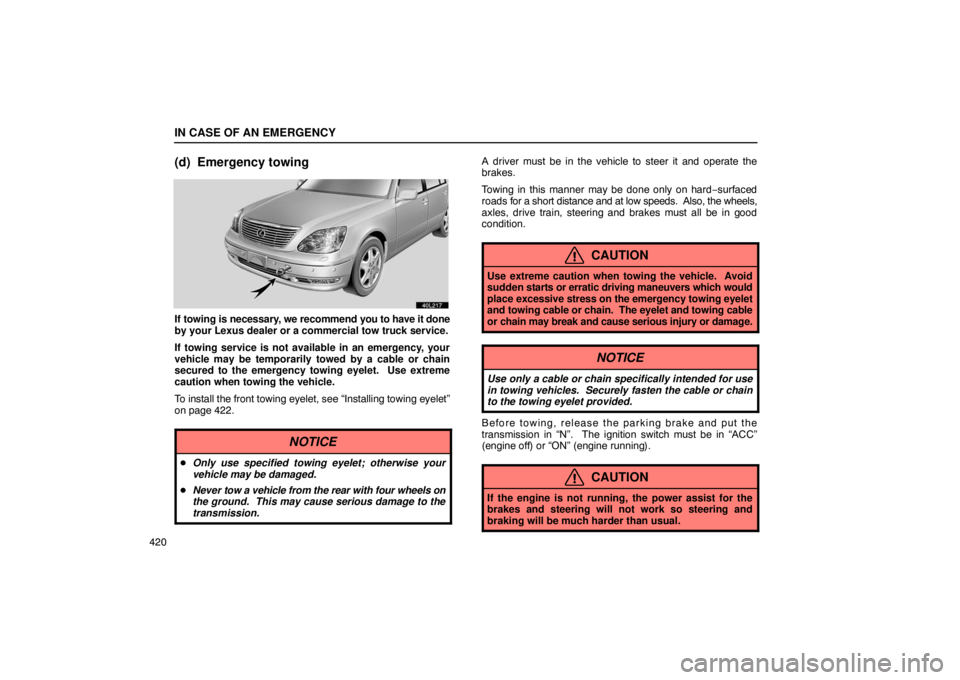
(d) Emergency towing
40L217
If towing is necessary, we recommend you to have it done
by your Lexus dealer or a commercial tow truck service.
If towing service is not available in an emergency, your
vehicle may be temporarily towed by a cable or chain
secured to the emergency towing eyelet. Use extreme
caution when towing the vehicle.
To install the front towing eyelet, see “Installing towing eyelet”
on page 422.
NOTICE
� Only use specified towing eyelet; otherwise your
vehicle may be damaged.
� Never tow a vehicle from the rear with four wheels on
the ground. This may cause serious damage to the
transmission.
A driver must be in the vehicle to steer it and operate the
brakes.
Towing in this manner may be done only on hard −surfaced
roads for a short distance and at low speeds. Also, the wheels,
axles, drive train, steering and brakes must all be in good
condition.
CAUTION
Use extreme caution when towing the vehicle. Avoid
sudden starts or erratic driving maneuvers which would
place excessive stress on the emergency towing eyelet
and towing cable or chain. The eyelet and towing cable
or chain may break and cause serious injury or damage.
NOTICE
Use only a cable or chain specifically intended for use
in towing vehicles. Securely fasten the cable or chain
to the towing eyelet provided.
Before towing, release the parking brake and put the
transmission in “N”. The ignition switch must be in “ACC”
(engine off) or “ON” (engine running).
CAUTION
If the engine is not running, the power assist for the
brakes and steering will not work so steering and
braking will be much harder than usual.
Page 448 of 539

MAINTENANCE
429
Accelerator pedal
Check
the pedal for smooth operation and uneven pedal ef fort
or catching.
Brake pedal
Check the pedal for smooth operation and the proper
clearance and free play. Check the brake booster function.
Brakes
In a safe place, check that the brakes do not pull to one side
when applied.
Parking brake
Check that the pedal has the proper travel and that, on a safe
incline, your vehicle is held securely with only the parking
brake applied.
Automatic transmission “Park” mechanism
On a safe incline, check that your vehicle is held securely with
the selector lever in “P” position and all brakes released.
Vehicle exterior
Items listed below should be performed from time to time,
unless otherwise specified.
Fluid leaks
Check underneath for leaking fuel, oil, water or other fluid after
the vehicle has been parked for a while. If you smell fuel fumes
or notice any leak, have the cause found and corrected
immediately.
Doors and engine hood
Check that all doors, including trunk lid, operate smoothly and
all latches lock securely. Make sure the engine hood
secondary latch secures the hood when the primary latch is
released.
Wheel nuts
When checking the tires, make sure to check the nuts for
looseness. Tighten them if necessary.
Tire inflation pressure
Check the pressure with a gauge every two weeks, or at
least once a month and adjust as shown on the tire
loading and information label. See page 468 for
additional information.
Tire surface
Check the tires carefully for cuts, damage or excessive
wear. See page 481 for additional information.
Page 481 of 539
CHASSIS
462– BRAKES
Pedal clearance
70 mm (2.8 in.) Min. *1
Pedal free play1 − 6 mm (0.04 − 0.24 in.)
Brake pad wear limit1.0 mm (0.04 in.)
Parking brake lining wear limit1.0 mm (0.04 in.)
Parking brake adjustment5 − 7 clicks *2
Fluid typeSAE J1703 or FMVSS No. 116 DOT 3
*1Minimum pedal clearance when depressed with the pressure of 490 N (50 k\
gf, 110 lbf.) with the engine running
*
2Parking brake adjustment when depressed with the pressure of 294 N (30 \
kgf, 66.1 lbf.)
– STEERING
Free play
Less than 30 mm (1.2 in.)
Power steering fluidAutomatic transmission fluid DEXRON\bII or III
Page 495 of 539

CHASSIS
476
Glossary of tire terminology
Tire related termMeaning
Cold tire inflation
pressuretire pressure when the vehicle has been parked for at least 3 hours or m\
ore, or it
has not been driven more than 1.5 km or 1 mile under that condition
Maximum inflation
pressurethe maximum cold inflation pressure to which a tire may be inflated and \
it is shown
on the sidewall of the tire
Recommended inflation
pressurecold tire inflation pressure recommended by a manufacturer
Accessory weight
the combined weight (in excess of those standard items which may be rep\
laced) of
automatic transmission, power steering, power brakes, power windows, pow\
er
seats, radio, and heater, to the extent that these items are available as
factory−installed equipment (whether installed or not)
Curb weight
the weight of a motor vehicle with standard equipment including the maxi\
mum
capacity of fuel, oil, and coolant, and, if so equipped, air conditionin\
g and
additional weight optional engine
Maximum loaded vehicle
weight
the sum of —
(a) curb weight;
(b) accessory weight;
(c) vehicle capacity weight; and
(d) production options weight
Page:
< prev 1-8 9-16 17-24
