Page 82 of 354
371
1
2
3
4
5
6
7
8
9
Knowing your vehicle
If the curtain airbag deploys, it
remains inflated for approximately
3 seconds. The curtain airbag
deployment occurs only on the
side of the vehicle affected by the
impact.
The side airbags (side and curtain
airbags) are not designed to
deploy during collisions from the
front or rear of the vehicle or in
most rollover situations.
The curtain airbags are designed
to deploy only during certain side-
impact collisions, depending on the
crash severity, angle, speed and
impact. The curtain airbags are not
designed to deploy in all side
impact situations.
WARNING
In order for side airbags (side
and curtain airbags) to pro-
vide its best protection, both
front seat occupants and both
outboard rear occupants
should sit in an upright posi-
tion with the seat belts proper-
ly fastened. Importantly, chil-
dren should sit in a proper
child restraint system in the
rear seat.
When children are seated in
the rear outboard seats, they
must be seated in the proper
child restraint system. Make
sure to put the child restraint
system as far away from the
door side as possible, and
secure the child restraint sys-
tem in a locked position.
(Continued)
(Continued)
Do not allow the passengers
to lean their heads or bodies
onto doors, put their arms on
the doors, stretch their arms
out of the window, or place
objects between the doors
and passengers when they are
seated on seats equipped with
side airbags.
Never try to open or repair any
components of the side cur-
tain airbag system. This
should only be done by an
authorized Kia dealer.
Failure to follow the above men-
tioned instructions can result in
injury or death to the vehicle
occupants in an accident.
KM CAN (ENG) 3 (~112).qxd 9/13/2004 4:50 PM Page 71
Page 90 of 354
379
1
2
3
4
5
6
7
8
9
Knowing your vehicle
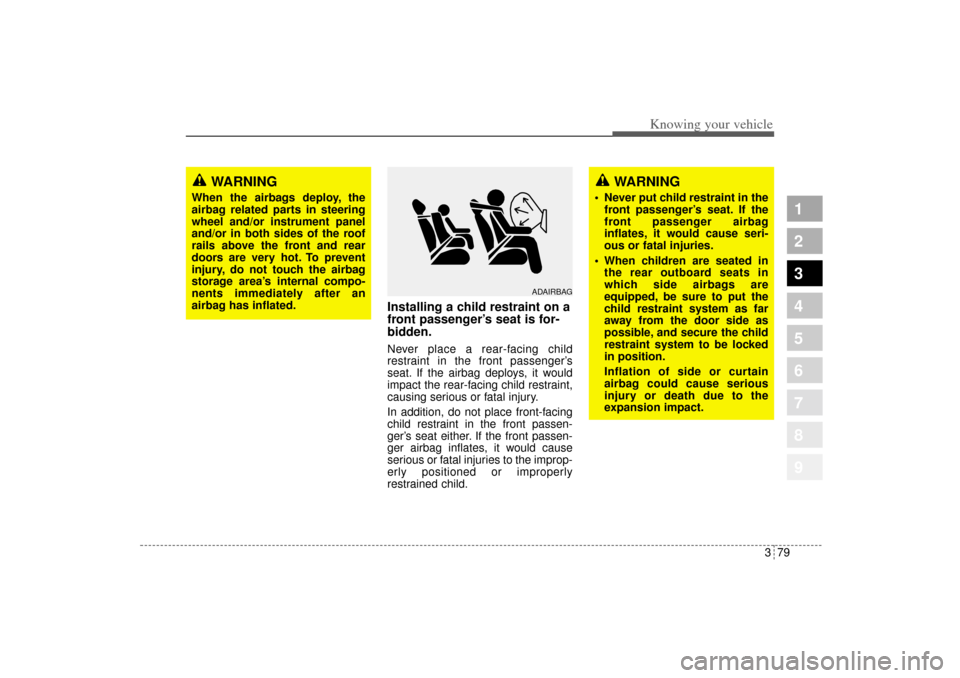
Installing a child restraint on a
front passenger’s seat is for-
bidden.Never place a rear-facing child
restraint in the front passenger’s
seat. If the airbag deploys, it would
impact the rear-facing child restraint,
causing serious or fatal injury.
In addition, do not place front-facing
child restraint in the front passen-
ger’s seat either. If the front passen-
ger airbag inflates, it would cause
serious or fatal injuries to the improp-
erly positioned or improperly
restrained child.
WARNING
Never put child restraint in the
front passenger’s seat. If the
front passenger airbag
inflates, it would cause seri-
ous or fatal injuries.
When children are seated in
the rear outboard seats in
which side airbags are
equipped, be sure to put the
child restraint system as far
away from the door side as
possible, and secure the child
restraint system to be locked
in position.
Inflation of side or curtain
airbag could cause serious
injury or death due to the
expansion impact.
WARNING
When the airbags deploy, the
airbag related parts in steering
wheel and/or instrument panel
and/or in both sides of the roof
rails above the front and rear
doors are very hot. To prevent
injury, do not touch the airbag
storage area’s internal compo-
nents immediately after an
airbag has inflated.
ADAIRBAG
KM CAN (ENG) 3 (~112).qxd 9/13/2004 4:50 PM Page 79
Page 96 of 354
385
1
2
3
4
5
6
7
8
9
Knowing your vehicle
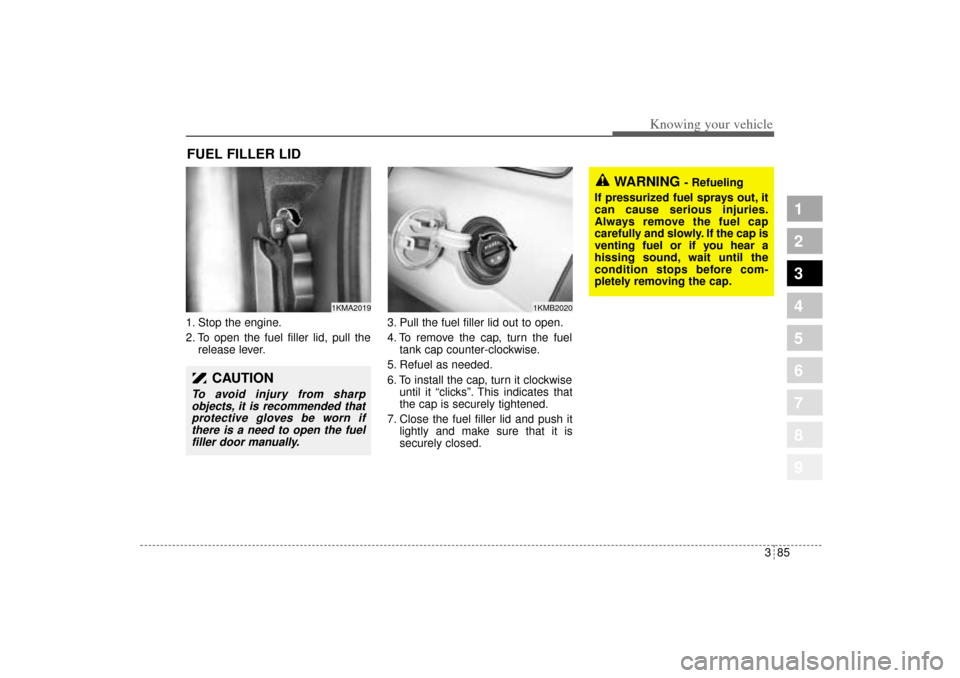
1. Stop the engine.
2. To open the fuel filler lid, pull the
release lever.3. Pull the fuel filler lid out to open.
4. To remove the cap, turn the fuel
tank cap counter-clockwise.
5. Refuel as needed.
6. To install the cap, turn it clockwise
until it “clicks”. This indicates that
the cap is securely tightened.
7. Close the fuel filler lid and push it
lightly and make sure that it is
securely closed.FUEL FILLER LID
1KMA2019
1KMB2020
WARNING
- Refueling
If pressurized fuel sprays out, it
can cause serious injuries.
Always remove the fuel cap
carefully and slowly. If the cap is
venting fuel or if you hear a
hissing sound, wait until the
condition stops before com-
pletely removing the cap.
CAUTION
To avoid injury from sharp
objects, it is recommended that
protective gloves be worn if
there is a need to open the fuel
filler door manually.
KM CAN (ENG) 3 (~112).qxd 9/13/2004 4:50 PM Page 85
Page 103 of 354
Knowing your vehicle92 3
1
2
3
4
5
6
7
8
9
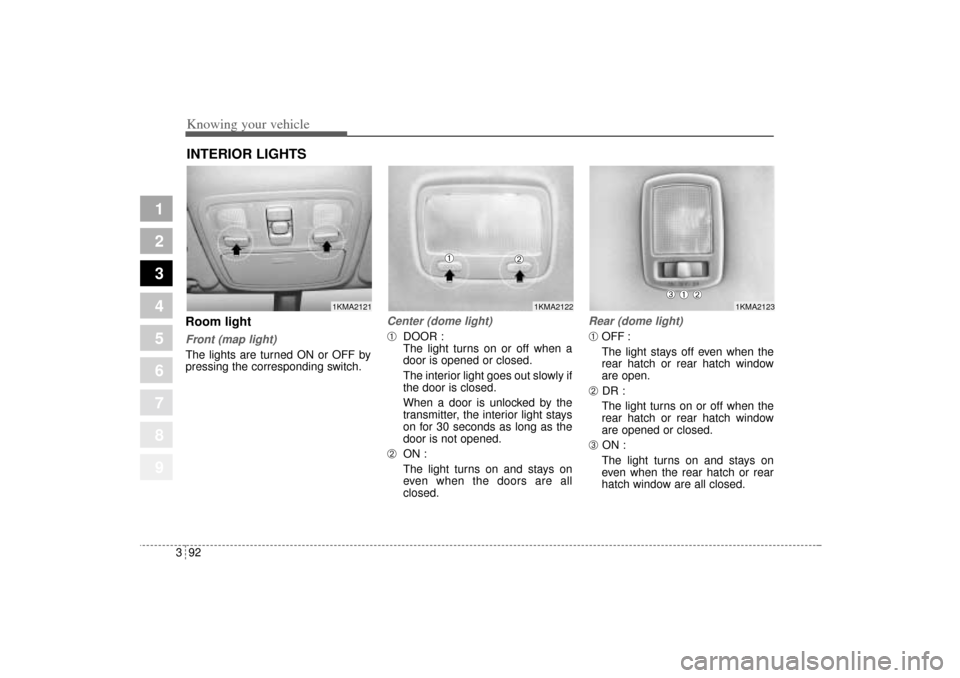
Room lightFront (map light)The lights are turned ON or OFF by
pressing the corresponding switch.
Center (dome light)➀
DOOR :
The light turns on or off when a
door is opened or closed.
The interior light goes out slowly if
the door is closed.
When a door is unlocked by the
transmitter, the interior light stays
on for 30 seconds as long as the
door is not opened.
➁
ON :
The light turns on and stays on
even when the doors are all
closed.
Rear (dome light)➀
OFF :
The light stays off even when the
rear hatch or rear hatch window
are open.
➁
DR :
The light turns on or off when the
rear hatch or rear hatch window
are opened or closed.
➂
ON :
The light turns on and stays on
even when the rear hatch or rear
hatch window are all closed.
INTERIOR LIGHTS
1KMA2122
1KMA2123
1KMA2121
➀
➁
➂
➀
➁
KM CAN (ENG) 3 (~112).qxd 9/13/2004 4:51 PM Page 92
Page 107 of 354
Knowing your vehicle96 3
1
2
3
4
5
6
7
8
9
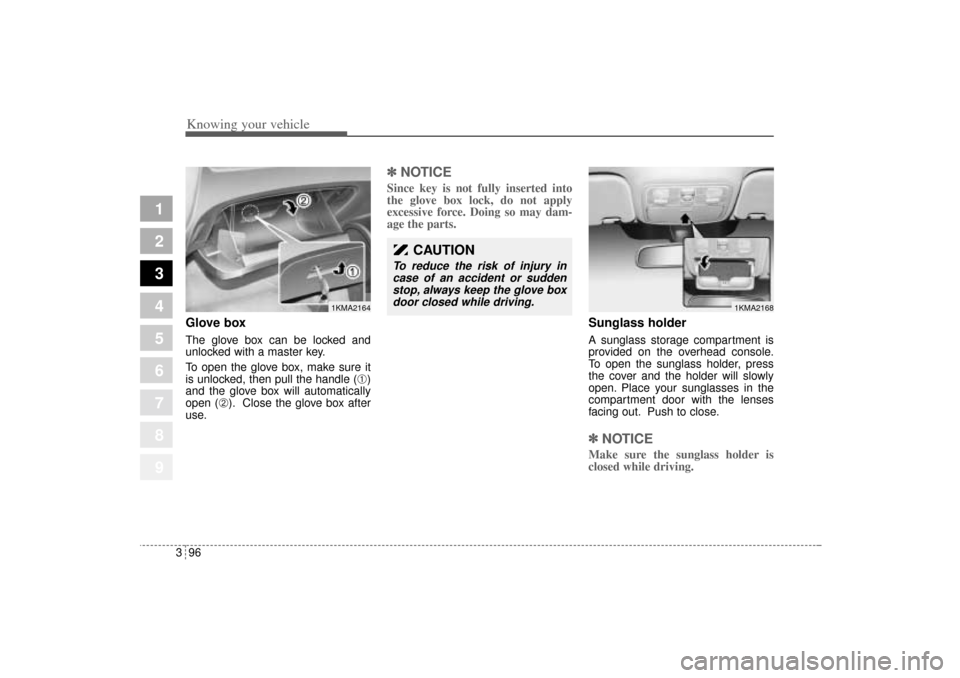
Glove boxThe glove box can be locked and
unlocked with a master key.
To open the glove box, make sure it
is unlocked, then pull the handle (
➀)
and the glove box will automatically
open (
➁). Close the glove box after
use.
✽ ✽
NOTICESince key is not fully inserted into
the glove box lock, do not apply
excessive force. Doing so may dam-
age the parts.
Sunglass holder A sunglass storage compartment is
provided on the overhead console.
To open the sunglass holder, press
the cover and the holder will slowly
open. Place your sunglasses in the
compartment door with the lenses
facing out. Push to close.✽ ✽
NOTICEMake sure the sunglass holder is
closed while driving.
CAUTION
To reduce the risk of injury in
case of an accident or sudden
stop, always keep the glove box
door closed while driving.
1KMA2168
1KMA2164
KM CAN (ENG) 3 (~112).qxd 9/13/2004 4:51 PM Page 96
Page 125 of 354
Driving your vehicle2 4
1
2
3
4
5
6
7
8
9
Illuminated ignition switch
(if equipped)Whenever a door is opened, the igni-
tion switch will be illuminated for your
convenience, provided the ignition
switch is not in the ON position. The
light will go off approximately 10 sec-
onds after closing the door or when
the ignition switch is turned on.
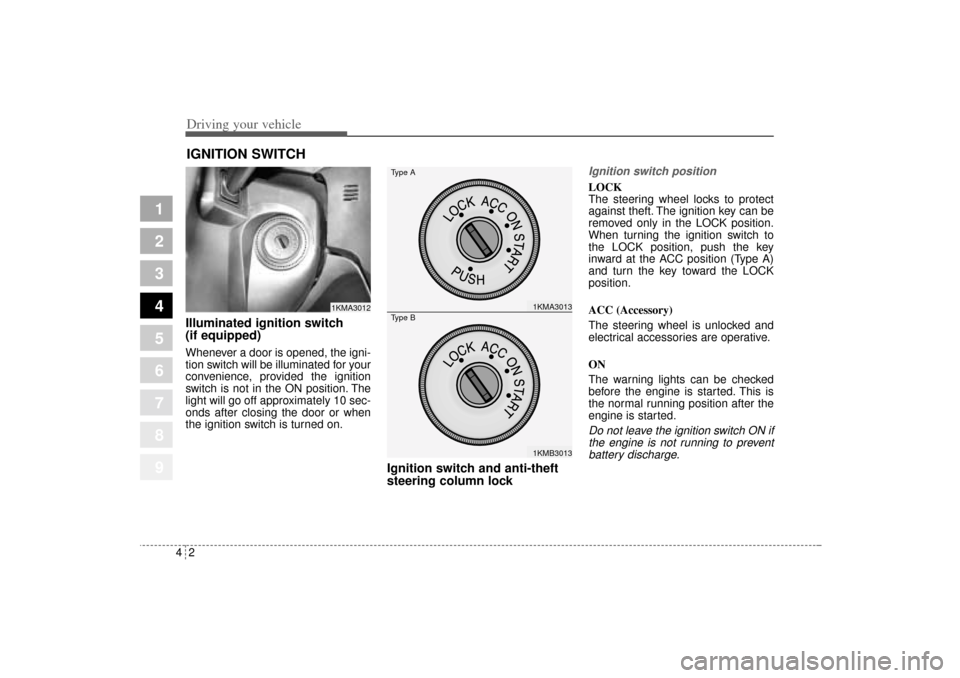
Ignition switch and anti-theft
steering column lock
Ignition switch positionLOCK
The steering wheel locks to protect
against theft. The ignition key can be
removed only in the LOCK position.
When turning the ignition switch to
the LOCK position, push the key
inward at the ACC position (Type A)
and turn the key toward the LOCK
position.
ACC (Accessory)
The steering wheel is unlocked and
electrical accessories are operative.
ON
The warning lights can be checked
before the engine is started. This is
the normal running position after the
engine is started.Do not leave the ignition switch ON if
the engine is not running to prevent
battery discharge.
IGNITION SWITCH
1KMA3012
1KMA30131KMB3013
Type AType B
KM CAN (ENG) 4.qxd 9/13/2004 4:48 PM Page 2
Page 176 of 354
453
Driving your vehicle
1
2
3
4
5
6
7
8
9
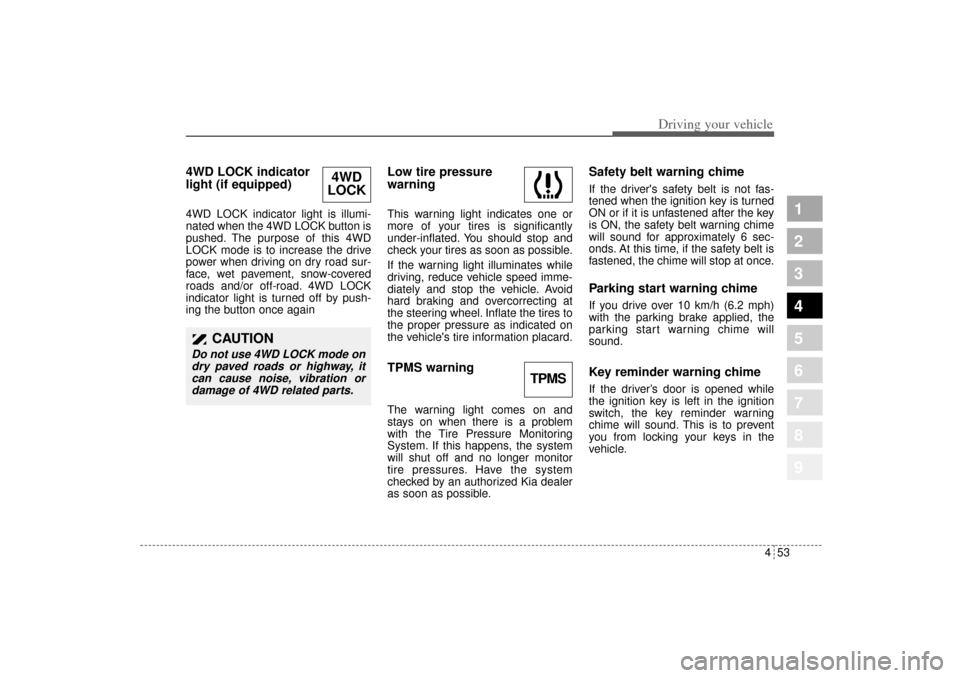
4WD LOCK indicator
light (if equipped) 4WD LOCK indicator light is illumi-
nated when the 4WD LOCK button is
pushed. The purpose of this 4WD
LOCK mode is to increase the drive
power when driving on dry road sur-
face, wet pavement, snow-covered
roads and/or off-road. 4WD LOCK
indicator light is turned off by push-
ing the button once again
Low tire pressure
warningThis warning light indicates one or
more of your tires is significantly
under-inflated. You should stop and
check your tires as soon as possible.
If the warning light illuminates while
driving, reduce vehicle speed imme-
diately and stop the vehicle. Avoid
hard braking and overcorrecting at
the steering wheel. Inflate the tires to
the proper pressure as indicated on
the vehicle's tire information placard.TPMS warning The warning light comes on and
stays on when there is a problem
with the Tire Pressure Monitoring
System. If this happens, the system
will shut off and no longer monitor
tire pressures. Have the system
checked by an authorized Kia dealer
as soon as possible.
Safety belt warning chime If the driver's safety belt is not fas-
tened when the ignition key is turned
ON or if it is unfastened after the key
is ON, the safety belt warning chime
will sound for approximately 6 sec-
onds. At this time, if the safety belt is
fastened, the chime will stop at once.Parking start warning chimeIf you drive over 10 km/h (6.2 mph)
with the parking brake applied, the
parking start warning chime will
sound.Key reminder warning chimeIf the driver’s door is opened while
the ignition key is left in the ignition
switch, the key reminder warning
chime will sound. This is to prevent
you from locking your keys in the
vehicle.
4WD
LOCK
CAUTION
Do not use 4WD LOCK mode on
dry paved roads or highway, it
can cause noise, vibration or
damage of 4WD related parts.
TPMS
KM CAN (ENG) 4.qxd 9/13/2004 4:48 PM Page 53
Page 222 of 354
55
Driving tips
BEFORE DRIVING Before entering vehicle: Be sure that all windows, outside
mirror(s), and outside lights are
clean.
Check the condition of the tires.
Check under the vehicle for any
sign of leaks.
Be sure there are no obstacles
behind you if you intend to back up.Necessary inspections Fluid levels, such as engine oil,
engine coolant, brake fluid, and
washer fluid should be checked on a
regular basis, with the exact interval
depending on the fluid. Further
details are provided in Section 7,
Maintenance.
Before starting Close and lock all doors.
Position the seat so that all con-
trols are easily reached.
Adjust the inside and outside
rearview mirrors.
Be sure that all lights work.
Check all gauges.
Check the operation of warning
lights when the ignition switch is
turned to the ON position.
Release the parking brake and
make sure the brake warning light
goes out.
For safe operation, be sure you are
familiar with your vehicle and its
equipment.
1
2
3
4
5
6
7
8
9
WARNING
- Driving under
the influence of alcohol or
drugs
Drinking and driving is danger-
ous. Drunk driving is the num-
ber one contributor to the high-
way death toll each year. Even a
small amount of alcohol will
affect your reflexes, perceptions
and judgement.
You are much more likely to
have a serious accident if you
drink and drive.
If you are drinking or taking
drugs, don’t drive. Do not ride
with a driver who has been
drinking or taking drugs.
Choose a designated driver or
call a cab.
Driving while under the influ-
ence of drugs is as dangerous
or more dangerous than driving
drunk.
KM CAN (ENG) 5.qxd 9/13/2004 4:48 PM Page 5