2005 KIA Rio spare wheel
[x] Cancel search: spare wheelPage 145 of 238

5-11
Tire Chains
Tire Chain Selection
Regulations regarding the use of tire chains vary
according to location or type of road, so always check
them before installing chains.
Use only SAE Class “S’’ tire chains. Chains must be
the proper size for the vehicle, as recommended by the
chain manufacturer.
Chain Installation
When installing chains on your tires, carefully follow
the instructions of the chain manufacturer.
The chain bands will scratch the wheel covers.
Remove the covers before installing the chains.
WARNING - Tire Chains
The use of chains may adversely affect
vehicle handling.
Do not exceed 50 km/h (30 mph) or the
chain manufacturer’s recommended speed
limit, whichever is lower.
Drive carefully and avoid bumps, holes,
sharp turns and other road hazards, which
may cause the vehicle to bounce.
Avoid sharp turns or locked-wheel braking.
Do not attempt to use a tire chain on the
temporary spare tire because it may impair
vehicle handling and result in damage to the
vehicle and the tire.
RIO ENG CNA 5.qxd 7/29/05 5:07 PM Page 11
Page 167 of 238

In Case Of An Emergency6-18The compact spare should be inflated to 60 psi
(415 kPa).
When using a compact spare tire, observe the
following precautions:
Under no circumstances should you exceed 80 km/h
(50 mph); a higher speed could damage the tire.
Ensure that you drive slowly enough for the road
conditions to avoid all hazards. Any road hazard,
such as a pothole or debris, could seriously damage
the compact spare.
Any continuous road use of this tire could result in
tire failure, loss of vehicle control, and possible
personal injury.
Do not exceed the vehicle’s maximum load rating or
the load-carrying capacity shown on the sidewall of
the compact spare tire. Avoid driving over obstacles. The compact spare tire
diameter is smaller than the diameter of a
conventional tire and reduces the ground clearance
approximately 25 mm (1 in.), which could result in
damage to the vehicle.
Do not take this vehicle through an automatic car
wash.
Do not use tire chains on this tire. Because of the
smaller size, a tire chain will not fit properly. This
could damage the vehicle and result in loss of the
chain.
This tire should not be installed on the front axle if
the vehicle must be driven in snow or on ice.
Do not use the compact spare tire on any other
vehicle because this tire has been designed
especially for your vehicle.
The compact spare’s tread life is shorter than a
regular tire. Inspect your compact spare tire
regularly and replace worn compact spare tires with
the same size and design, mounted on the same
wheel.
✽
NOTICE
Check the inflation pressure after installing the
spare tire. Adjust it to the specified pressure, as
necessary.
RIO ENG CNA 6.qxd 7/29/05 5:15 PM Page 18
Page 168 of 238

6-19 Changing Tires
Jacking Instructions
The jack is provided for emergency tire changing only.
Follow jacking instructions to reduce the possibility of
personal injury.Tire Replacement
1. Park on a level surface and set the parking brake
firmly.
2. Set the automatic transaxle in P (Park), or shift the
manual transaxle into R (Reverse).
3. Activate the hazard warning flasher.
4. Remove the wheel lug nut wrench, jack, jack
handle, and spare tire from the vehicle.
5. Block both the front and rear of the wheel that is
diagonally opposite the jack position.
WARNING - Changing Tires
Never attempt vehicle repairs or a tire
change in the traffic lanes of a public road or
highway. Always move the vehicle completely
off the road and onto the shoulder before
trying to change a tire. If you cannot find a
firm, level place off the road, call a towing
service company for assistance.
Do not exceed the maximum permissible
load of the jack: 600 kg. (1,320 lbs).
Be sure to use the correct front or rear
jacking positions on the vehicle; never use
the bumpers or any other part of the vehicle
for jack support.
Never allow any portion of your body to get
beneath the vehicle while using the jack.
Do not start or run the engine while the
vehicle is supported by the jack.
AS2B06012
Flat tire
Wheel block
RIO ENG CNA 6.qxd 7/29/05 5:15 PM Page 19
Page 171 of 238

In Case Of An Emergency6-22
Once the lug nuts have been tightened, lower the
vehicle fully to the ground and continue to tighten the
lug nuts until they are completely secured.
If you are unsure of the tightness of the wheel lug nuts,
have them checked at the nearest service station. The
specified tightening torque is 103 N.
m (76 ft. lb.).
CAUTION
Your vehicle has metric threads on the wheel studs
and nuts. During wheel removal, make certain
that the same nuts removed are reinstalled - or, if
replaced, that nuts with metric threads and the
same configuration are used. Installation of a non-
metric thread nut on a metric stud or vice-versa
will not secure the wheel to the hub properly and
will damage the stud so that it must be replaced.
Be sure to use extreme care in checking for thread
style before installing aftermarket lug nuts or
wheels. If in doubt, consult an Authorized Kia
Dealer. Damaged studs may result in wheel loss
and personal injury.
10. Remove the lug nuts by turning them
counterclockwise, then remove the wheel.
11. Mount the spare tire into position and tighten the
nuts by hand. Install the lug nuts with the beveled
edge inward.
12. Turn the jack handle counterclockwise and lower
the vehicle until it touches the ground. Tighten the
lug nuts firmly in an “X’’ pattern.
3
2
4
1
1B3106002B
RIO ENG CNA 6.qxd 7/29/05 5:15 PM Page 22
Page 172 of 238
6-23
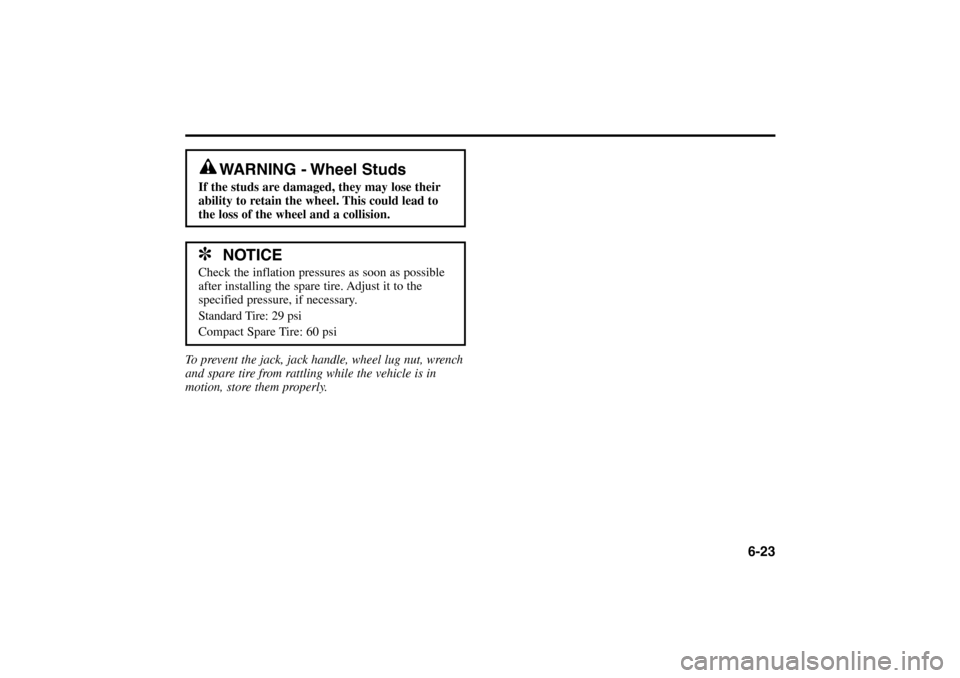
To prevent the jack, jack handle, wheel lug nut, wrench
and spare tire from rattling while the vehicle is in
motion, store them properly.
WARNING - Wheel Studs
If the studs are damaged, they may lose their
ability to retain the wheel. This could lead to
the loss of the wheel and a collision.✽
NOTICE
Check the inflation pressures as soon as possible
after installing the spare tire. Adjust it to the
specified pressure, if necessary.
Standard Tire: 29 psi
Compact Spare Tire: 60 psi
RIO ENG CNA 6.qxd 7/29/05 5:15 PM Page 23
Page 206 of 238

Tires and WheelsTire CareFor proper maintenance, safety, and maximum fuel
economy, you must always maintain recommended tire
inflation pressures and stay within the load limits and
weight distribution recommended for your vehicle.Inflation PressuresCheck all tire pressures (including the spare) monthly
when the tires are cold. “Cold tires” means the car has
not been driven for at least three hours or driven less
than 1.6 km (one mile). Recommended pressures must
be maintained to ensure ride quality, vehicle handling,
and minimum tire wear.Maintenance7-34
All specifications (sizes and pressures) can be found
on a label attached to the front passenger door sill.
The correct tire pressure is 200 kPa (29 psi)
The compact spare should be at 415 kPa (60 psi).
AS2B07021
RIO ENG CNA 7-2.qxd 7/29/05 5:18 PM Page 34
Page 207 of 238
7-35
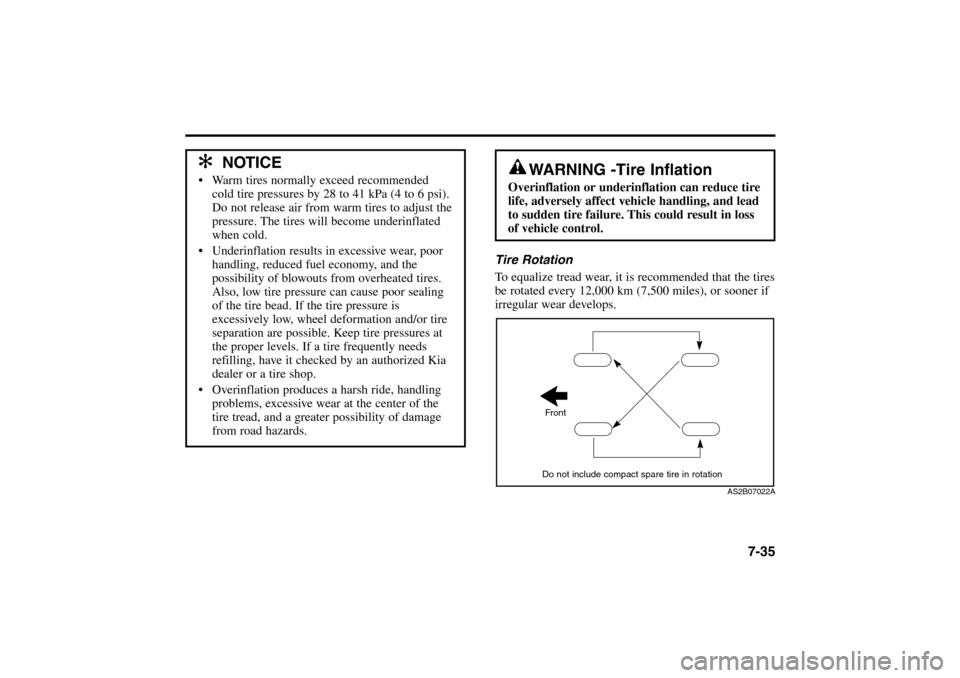
Tire Rotation
To equalize tread wear, it is recommended that the tires
be rotated every 12,000 km (7,500 miles), or sooner if
irregular wear develops.
✻ ✻
NOTICE
Warm tires normally exceed recommended
cold tire pressures by 28 to 41 kPa (4 to 6 psi).
Do not release air from warm tires to adjust the
pressure. The tires will become underinflated
when cold.
Underinflation results in excessive wear, poor
handling, reduced fuel economy, and the
possibility of blowouts from overheated tires.
Also, low tire pressure can cause poor sealing
of the tire bead. If the tire pressure is
excessively low, wheel deformation and/or tire
separation are possible. Keep tire pressures at
the proper levels. If a tire frequently needs
refilling, have it checked by an authorized Kia
dealer or a tire shop.
Overinflation produces a harsh ride, handling
problems, excessive wear at the center of the
tire tread, and a greater possibility of damage
from road hazards.
WARNING -Tire Inflation
Overinflation or underinflation can reduce tire
life, adversely affect vehicle handling, and lead
to sudden tire failure. This could result in loss
of vehicle control.
AS2B07022A
Do not include compact spare tire in rotationFront
RIO ENG CNA 7-2.qxd 7/29/05 5:18 PM Page 35
Page 209 of 238

Compact Spare Tire Replacement
A compact spare tire has a shorter tread life than a
regular size tire. Replace it when you can see the tread
wear indicator bars on the tire. The replacement
compact spare tire should be the same size and design
tire as the one provided with your new Kia and should
be mounted on the same compact spare tire wheel. The
compact spare tire is not designed to be mounted on
a regular size wheel, and the compact spare tire wheel
is not designed for mounting a regular size tire.
7-37
Wheel Alignment and Tire Balance
In addition to proper tire inflation, correct wheel
alignment helps to minmize tire wear. Your vehicle’s
alignment sh
ould be checked every 12 months
or
24,000 km (15,000 miles).
Your tires were properly balanced at the factory, but
they may need to be rebalanced before they wear out.
If you notice a consistent vibration when driving, have
your Kia Dealer inspect your tires. A tire should
always be rebalanced if it has been removed from the
wheel.
✻ ✻
NOTICE
Improper wheel weights can damage your
vehicle’s aluminum wheels. Use only approved
wheel weights.
AS2B07024
Tread wear
indicator bar
Indicator
location mark
RIO ENG CNA 7-2.qxd 7/29/05 5:18 PM Page 37