Page 12 of 318
1 23456789Keys / 3-2 Remote keyless entry / 3-4
Immobilizer system / 3-7
Door locks / 3-8
Windows / 3-13 Seats / 3-16Safety belts / 3-30
Airbags-supplemental restraint system / 3-56
Trunk / 3-75Hood / 3-77
Fuel filler lid / 3-79
Mirrors / 3-82
Interior lights / 3-86
Storage compartment / 3-88
Interior features / 3-91
Sunroof / 3-96Luggage net / 3-99Antenna / 3-100
Knowing your vehicle
Page 27 of 318
Knowing your vehicle
16
3
1 23456789
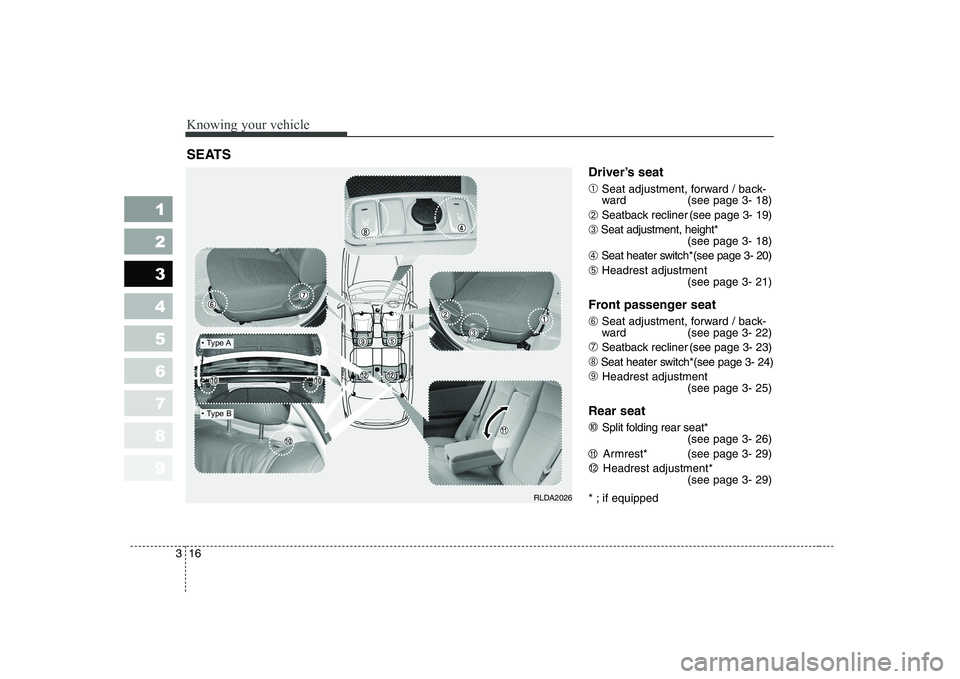
Driver’s seat ➀ Seat adjustment, forward / back-
ward (see page 3- 18)
➁ Seatback recliner (see page 3- 19)
➂ Seat adjustment, height*
(see page 3- 18)
➃ Seat heater switch*(see page 3- 20)
➄ Headrest adjustment
(see page 3- 21)
Front passenger seat ➅ Seat adjustment, forward / back-
ward (see page 3- 22)
➆ Seatback recliner (see page 3- 23)
➇Seat heater switch*(see page 3- 24)
➈ Headrest adjustment
(see page 3- 25)
Rear seat ➉ Split folding rear seat*
(see page 3- 26)
Armrest* (see page 3- 29) Headrest adjustment* (see page 3- 29)
* ; if equipped
SEATS
RLDA2026
11
12
Page 28 of 318
317
1 23456789
Knowing your vehicle
(Continued)
your seatback upright and the
lap portion of the safety belt,
or lap belt, snug and low
across the hips. This position
puts your safety belts in the
best position to protect you incase of an accident.
In order to avoid unnecessary airbag injuries including the
possibility of severe injury or
death, always sit as far back
as possible from the steering
wheel so that your chest is
away at least 250 mm (10 inch-
es) away from the steeringwheel.WARNING
Loose objects in the driver’s foot area could interfere with
the operation of the foot ped-
als, possibly causing an acci-
dent. Loose objects might
interfere with the seat slide
mechanism. Do not place any-
thing under the front seats.
Children should never be left unattended in the car.WARNING - Driver’s seat
Never attempt to adjust seat while the vehicle is moving. This could result in loss of
control, and an accident caus-
ing death, serious injury, or
property damage.
fere with the normal position
of the seatback. Storing items
against a seatback or in any
other way interfering with
proper locking of a seatbackcould result in serious or fatal
injury in a sudden stop or col-lision.
(Continued)
Page 31 of 318
Knowing your vehicle
20
3
1 23456789
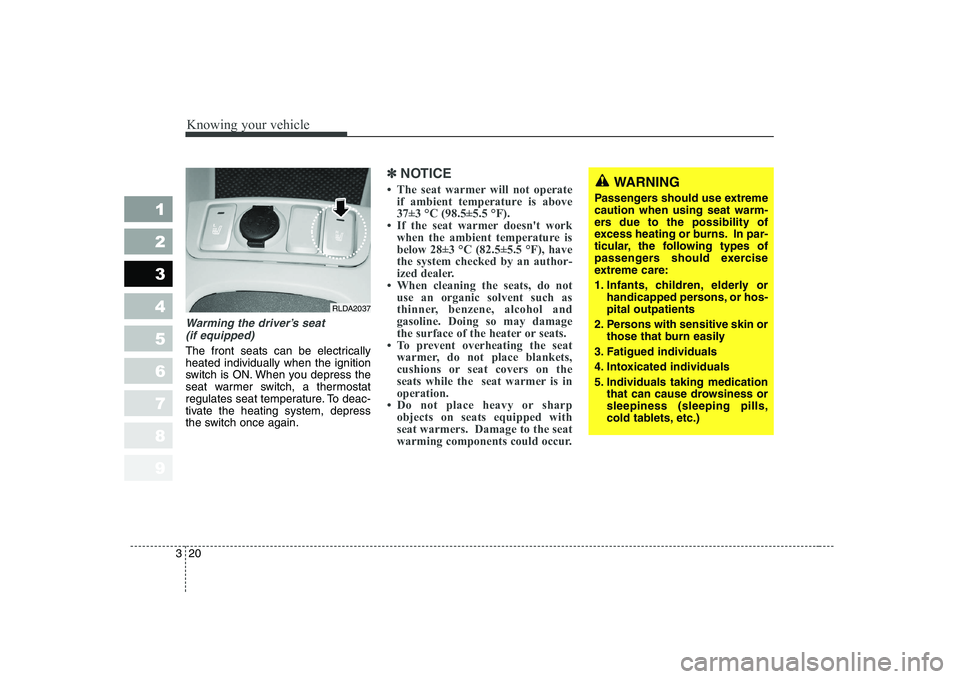
Warming the driver’s seat
(if equipped)
The front seats can be electrically heated individually when the ignition
switch is ON. When you depress the
seat warmer switch, a thermostat
regulates seat temperature. To deac-
tivate the heating system, depress
the switch once again.
✽✽ NOTICE
Page 35 of 318
Knowing your vehicle
24
3
1 23456789
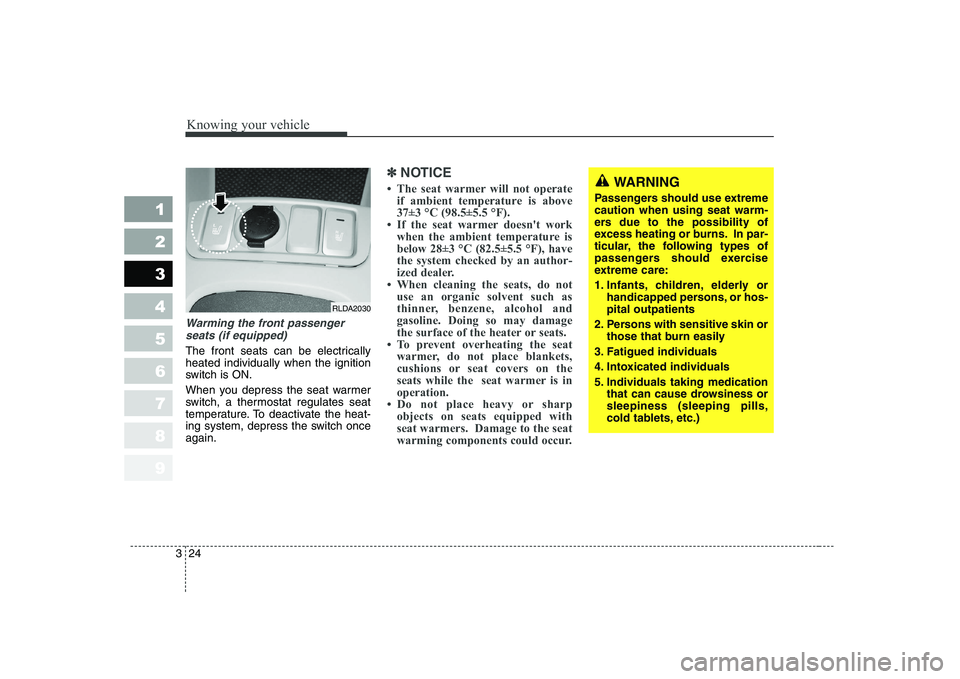
Warming the front passenger
seats (if equipped)
The front seats can be electrically heated individually when the ignition
switch is ON.
When you depress the seat warmer
switch, a thermostat regulates seat
temperature. To deactivate the heat-
ing system, depress the switch onceagain.
✽✽ NOTICE
Page 39 of 318
Knowing your vehicle
28
3
1 23456789
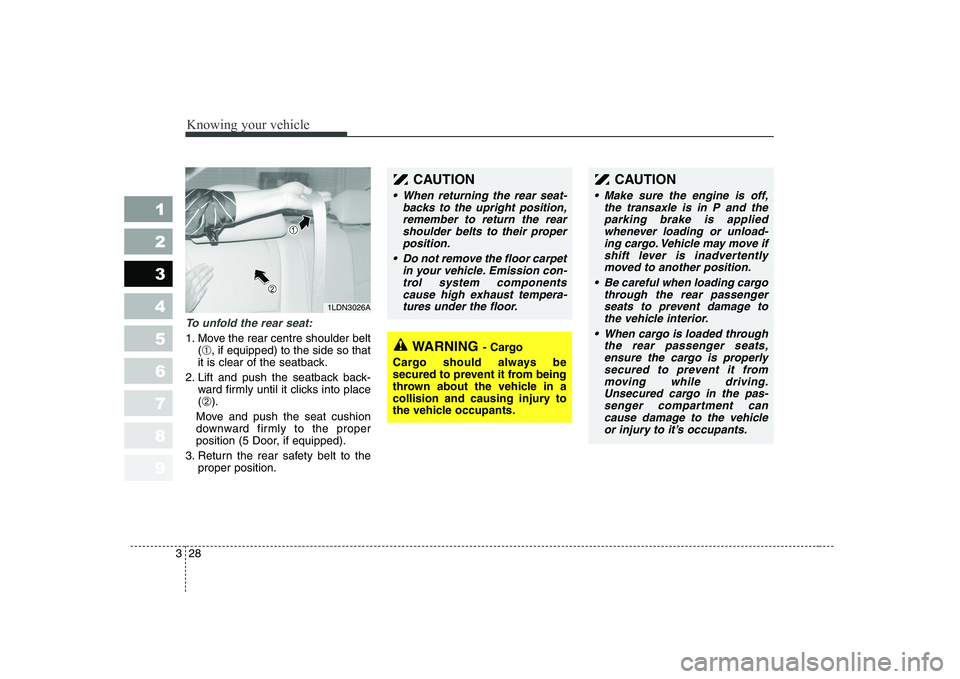
To unfold the rear seat:
1. Move the rear centre shoulder belt
(➀ , if equipped) to the side so that
it is clear of the seatback.
2. Lift and push the seatback back- ward firmly until it clicks into place (➁ ).
Move and push the seat cushion
downward firmly to the proper
position (5 Door, if equipped).
3. Return the rear safety belt to the proper position.
CAUTION
When returning the rear seat-
backs to the upright position,remember to return the rear shoulder belts to their properposition.
Do not remove the floor carpet in your vehicle. Emission con-trol system components cause high exhaust tempera-tures under the floor.
WARNING - Cargo
Cargo should always be
secured to prevent it from being
thrown about the vehicle in a
collision and causing injury to
the vehicle occupants.
CAUTION
Make sure the engine is off, the transaxle is in P and theparking brake is appliedwhenever loading or unload- ing cargo. Vehicle may move ifshift lever is inadvertentlymoved to another position.
Be careful when loading cargo through the rear passengerseats to prevent damage tothe vehicle interior.
When cargo is loaded through the rear passenger seats,ensure the cargo is properly secured to prevent it frommoving while driving.Unsecured cargo in the pas- senger compartment cancause damage to the vehicleor injury to it’s occupants.
1LDN3026A
Page 41 of 318
Knowing your vehicle
30
3
1 23456789
Pre-tensioner seat belt (if equipped)
Your vehicle is equipped with driver’s
and front passenger’s pre-tensioner
seat belts. The purpose of the pre-
tensioner is to make sure that theseat belts fit tightly against the occu-
pant’s body in certain frontal colli-
sions. The pre-tensioner seat belts
will activate together with the
airbags, where the frontal collision is
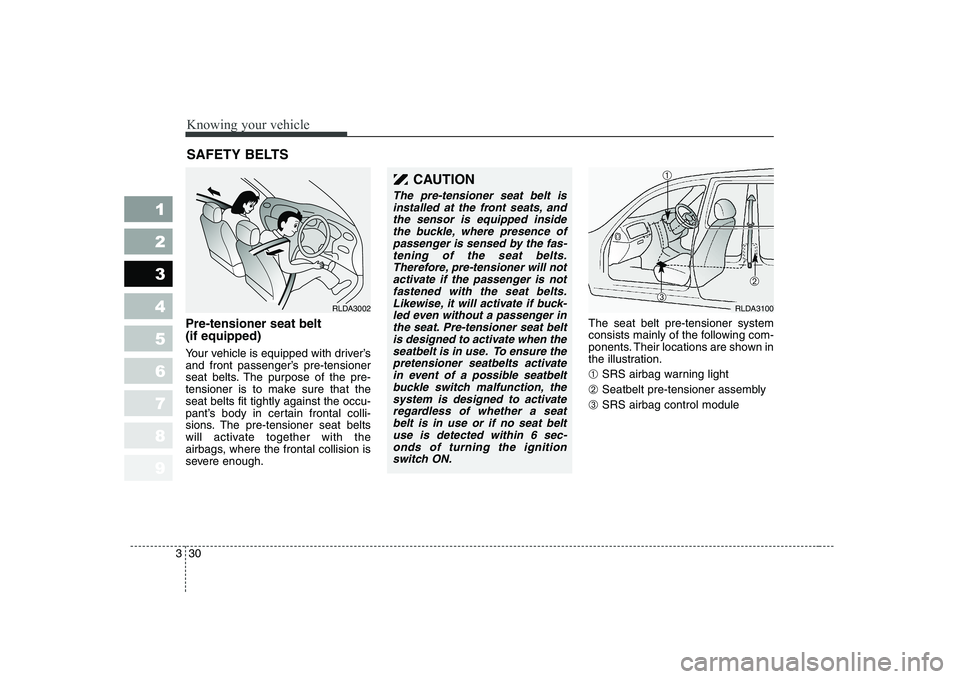
severe enough. The seat belt pre-tensioner system
consists mainly of the following com-
ponents. Their locations are shown in
the illustration. ➀
SRS airbag warning light
➁ Seatbelt pre-tensioner assembly
➂ SRS airbag control module
SAFETY BELTS
RLDA3002
CAUTION
The pre-tensioner seat belt is
installed at the front seats, andthe sensor is equipped insidethe buckle, where presence of passenger is sensed by the fas-tening of the seat belts.Therefore, pre-tensioner will not activate if the passenger is notfastened with the seat belts.Likewise, it will activate if buck- led even without a passenger inthe seat. Pre-tensioner seat beltis designed to activate when theseatbelt is in use. To ensure the pretensioner seatbelts activatein event of a possible seatbeltbuckle switch malfunction, the system is designed to activateregardless of whether a seatbelt is in use or if no seat belt use is detected within 6 sec-onds of turning the ignitionswitch ON.
RLDA3100
➀
➁
➂
Page 44 of 318
333
1 23456789
Knowing your vehicle
We strongly recommend that the
driver and all passengers be proper-
ly restrained at all times by using the
safety belts provided with the vehi-
cle. Proper use of the safety belts
decreases the risk of severe injury or
death in accidents or sudden stops.
All seats (including or except the
centre rear seat) have lap/shoulder
belts. Inertial locks in the safety belt
retractors allow all of the lap/shoul-
der safety belts to remain unlocked
during normal vehicle operation. This
allows the occupants some freedom
of movement and increased comfort
while using the safety belts. If a force
is applied to the vehicle, such as a
strong stop, a sharp turn, or a colli-
sion, the safety belt retractors will
automatically lock the safety belts.Since the inertial locks do not require
a collision in order to lock up, you
may become aware of the safety
belts locking while braking or going
around sharp corners.
Always use the rear seat position(s)
to install your child restraint(s).
Never install a child restraint system in the front passenger position, as an
inflating airbag could cause serious
or fatal injury to a child in that posi-tion.
Safety belts provide the best restraintwhen:
The seatback is upright.
The occupant is sitting upright (not
slouched).
The lap belt is snug across the hips.
The shoulder belt is snug across the chest.
The knees are straight forward.
To help you remember to fasten your
safety belt, a warning light will come
on and a chime will sound. See
Safety Belt Warning Light and Chimeon page 3-36.