Page 218 of 424
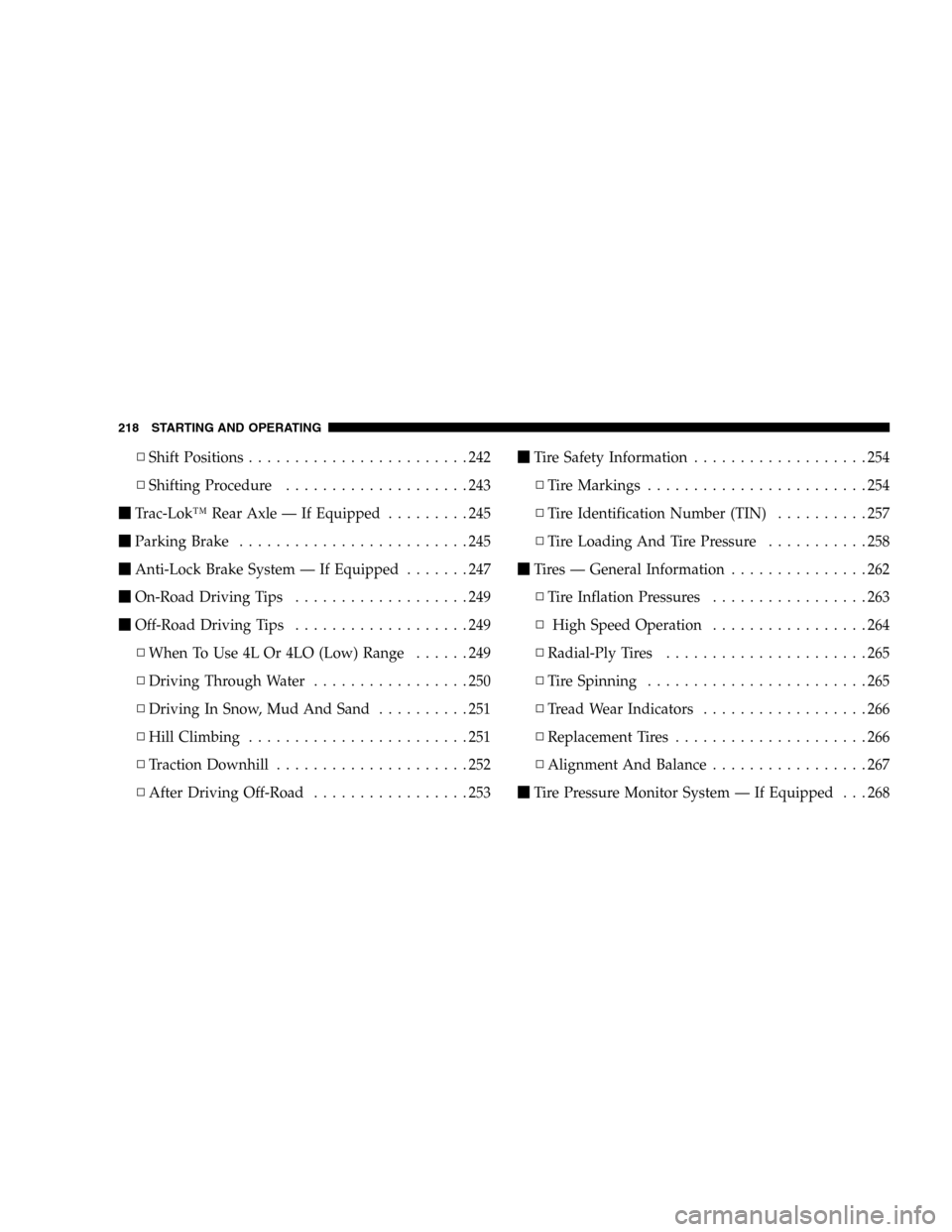
▫Shift Positions........................242
▫Shifting Procedure....................243
�Trac-Lok™ Rear Axle — If Equipped.........245
�Parking Brake.........................245
�Anti-Lock Brake System — If Equipped.......247
�On-Road Driving Tips...................249
�Off-Road Driving Tips...................249
▫When To Use 4L Or 4LO (Low) Range......249
▫Driving Through Water.................250
▫Driving In Snow, Mud And Sand..........251
▫Hill Climbing........................251
▫Traction Downhill.....................252
▫After Driving Off-Road.................253�Tire Safety Information...................254
▫Tire Markings........................254
▫Tire Identification Number (TIN)..........257
▫Tire Loading And Tire Pressure...........258
�Tires — General Information...............262
▫Tire Inflation Pressures.................263
▫High Speed Operation.................264
▫Radial-Ply Tires......................265
▫Tire Spinning........................265
▫Tread Wear Indicators..................266
▫Replacement Tires.....................266
▫Alignment And Balance.................267
�Tire Pressure Monitor System — If Equipped . . . 268
218 STARTING AND OPERATING
Page 220 of 424
STARTING PROCEDURES
Before starting your vehicle, adjust your seat, adjust both
inside and outside mirrors, and fasten your seat belts.
WARNING!
Do not leave children or animals inside parked
vehicles in hot weather. Interior heat build up may
cause serious injury or death.
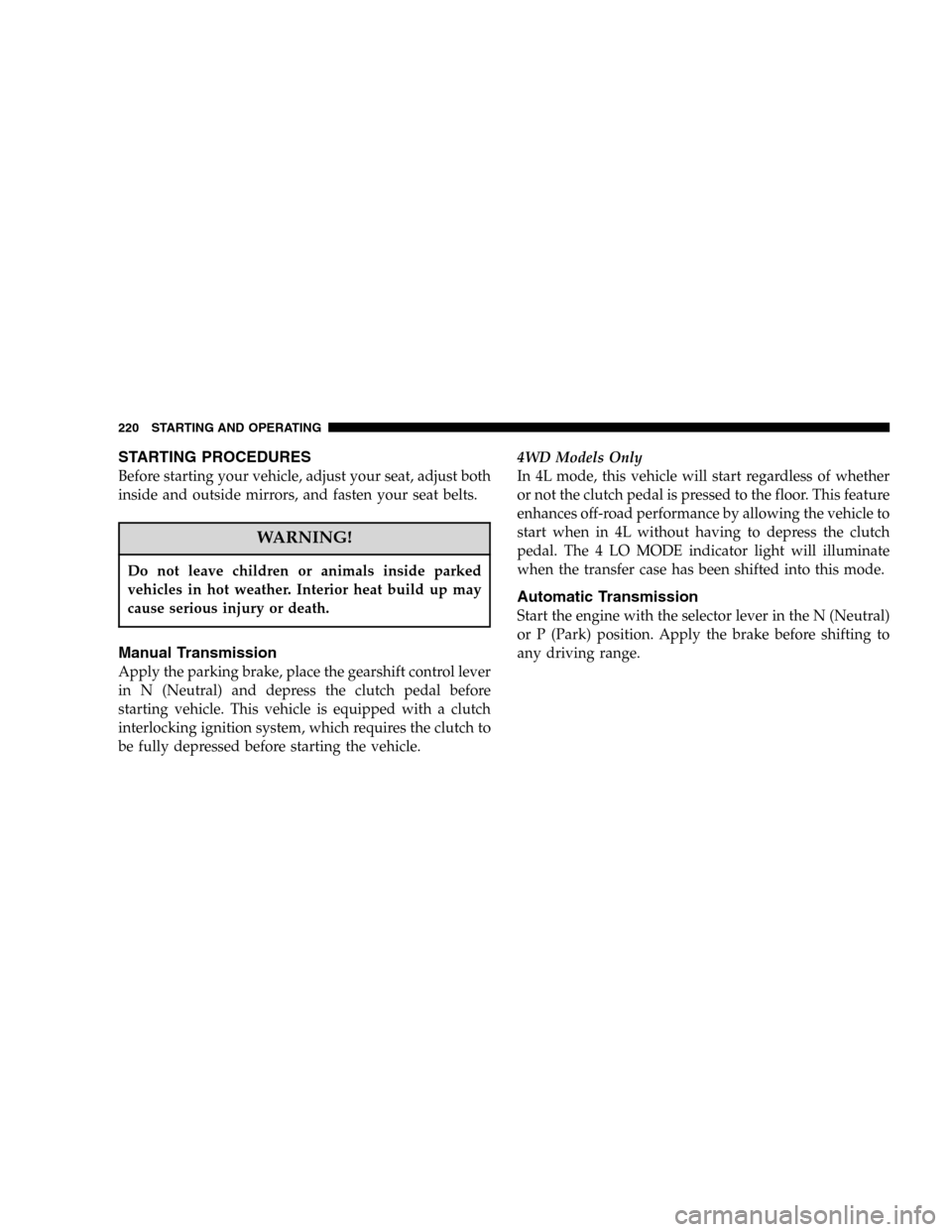
Manual Transmission
Apply the parking brake, place the gearshift control lever
in N (Neutral) and depress the clutch pedal before
starting vehicle. This vehicle is equipped with a clutch
interlocking ignition system, which requires the clutch to
be fully depressed before starting the vehicle.4WD Models Only
In 4L mode, this vehicle will start regardless of whether
or not the clutch pedal is pressed to the floor. This feature
enhances off-road performance by allowing the vehicle to
start when in 4L without having to depress the clutch
pedal. The 4 LO MODE indicator light will illuminate
when the transfer case has been shifted into this mode.
Automatic Transmission
Start the engine with the selector lever in the N (Neutral)
or P (Park) position. Apply the brake before shifting to
any driving range.
220 STARTING AND OPERATING
Page 226 of 424
3. Depress the fuel-water separator knob 20 consecutive
times.
4. Turn the ignition to START and crank the engine a
maximum of 10 seconds. If the engine does not start,
repeat Step 3.NOTE:The engine will typically start within 10 sec-
onds; the engine will idle then stall, purging air from the
fuel lines and filter.
5. Depress the fuel-water separator knob 20 consecutive
times.
6. Turn the ignition to START and crank the engine a
maximum of 10 seconds. The engine should start and
remain running.
NOTE:If the engine does not start, repeat the cycle as
many times as necessary.
ENGINE BLOCK HEATER — IF EQUIPPED
The engine block heater warms engine coolant and
permits quicker starts in cold weather. Connect the cord
to a standard 110-115 volt AC electrical outlet with a
grounded, three wire extension cord. The engine block
heater cord is found under the hood clipped to the heater
line on the left side of the engine (3.7L only).Hand Prime Pump
226 STARTING AND OPERATING
Page 229 of 424
•When “rocking” a stuck vehicle by shifting between a
forward gear and reverse, do not spin wheels faster than
15 mph (24 km/h), or drivetrain damage may result.
Recommended Manual Transmission Shifting
Speeds
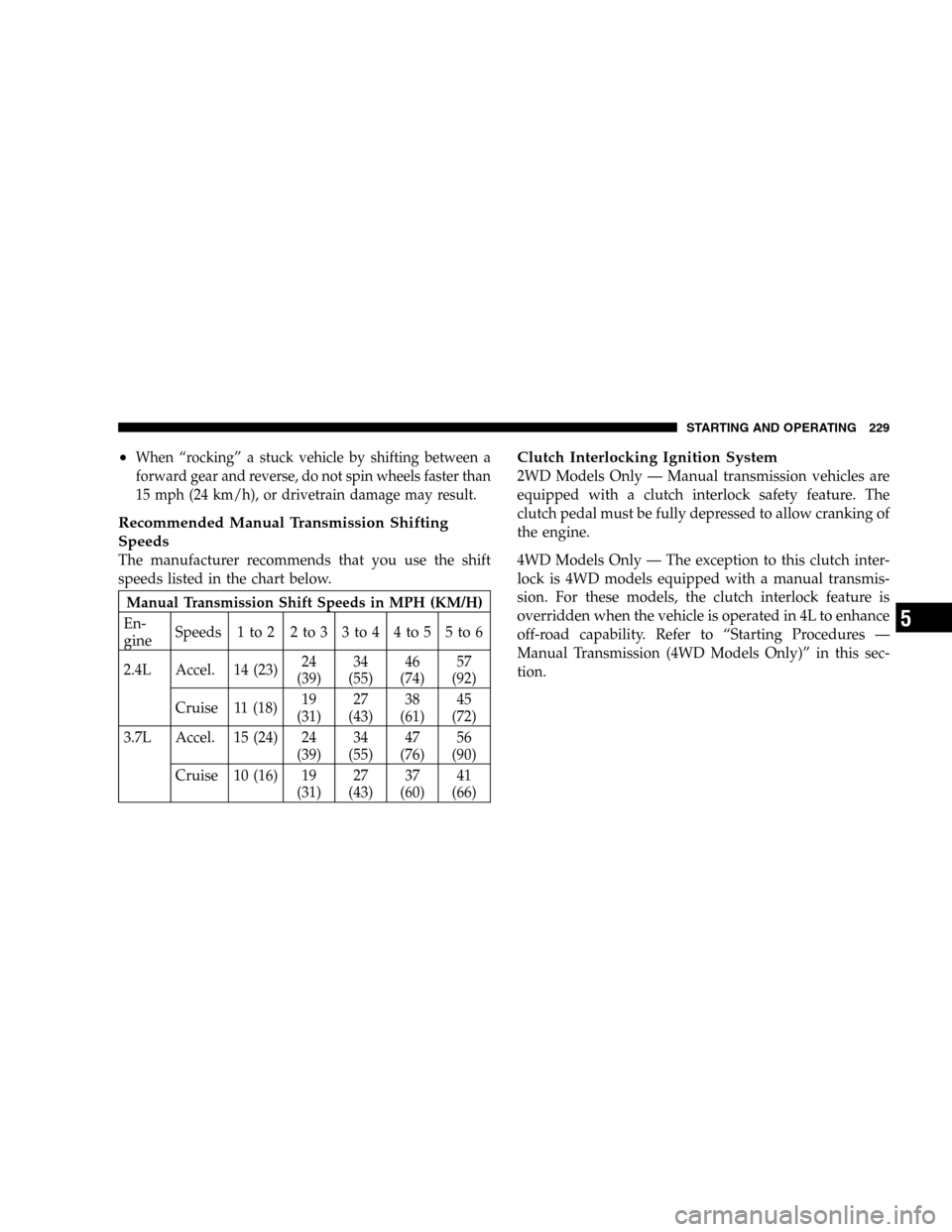
The manufacturer recommends that you use the shift
speeds listed in the chart below.
Manual Transmission Shift Speeds in MPH (KM/H)
En-
gineSpeeds 1 to 2 2 to 3 3 to 4 4 to 5 5 to 6
2.4L Accel. 14 (23)24
(39)34
(55)46
(74)57
(92)
Cruise 11 (18)19
(31)27
(43)38
(61)45
(72)
3.7L Accel. 15 (24) 24
(39)34
(55)47
(76)56
(90)
Cruise 10 (16) 19
(31)27
(43)37
(60)41
(66)
Clutch Interlocking Ignition System
2WD Models Only — Manual transmission vehicles are
equipped with a clutch interlock safety feature. The
clutch pedal must be fully depressed to allow cranking of
the engine.
4WD Models Only — The exception to this clutch inter-
lock is 4WD models equipped with a manual transmis-
sion. For these models, the clutch interlock feature is
overridden when the vehicle is operated in 4L to enhance
off-road capability. Refer to “Starting Procedures —
Manual Transmission (4WD Models Only)” in this sec-
tion.
STARTING AND OPERATING 229
5
Page 230 of 424
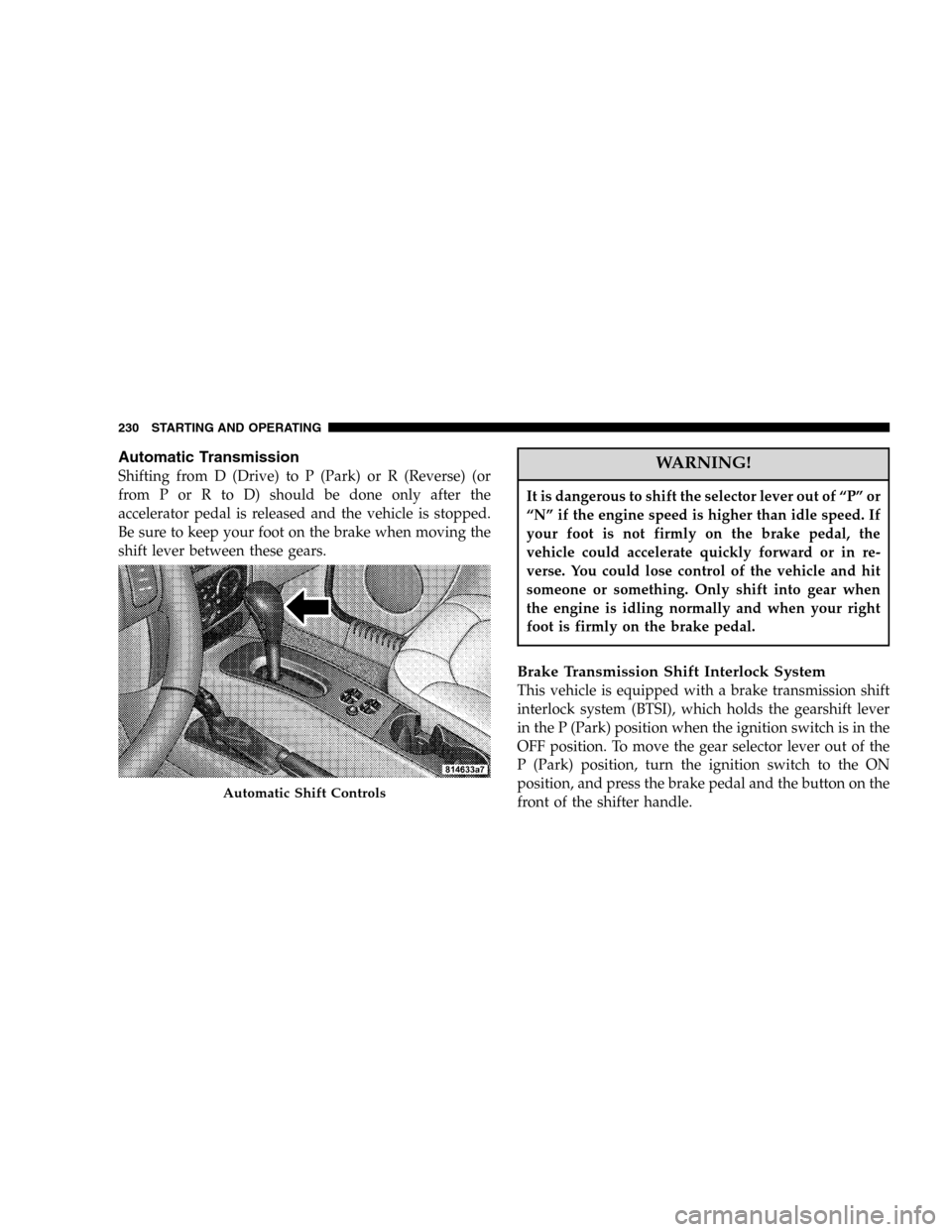
Automatic Transmission
Shifting from D (Drive) to P (Park) or R (Reverse) (or
from P or R to D) should be done only after the
accelerator pedal is released and the vehicle is stopped.
Be sure to keep your foot on the brake when moving the
shift lever between these gears.WARNING!
It is dangerous to shift the selector lever out of “P” or
“N” if the engine speed is higher than idle speed. If
your foot is not firmly on the brake pedal, the
vehicle could accelerate quickly forward or in re-
verse. You could lose control of the vehicle and hit
someone or something. Only shift into gear when
the engine is idling normally and when your right
foot is firmly on the brake pedal.
Brake Transmission Shift Interlock System
This vehicle is equipped with a brake transmission shift
interlock system (BTSI), which holds the gearshift lever
in the P (Park) position when the ignition switch is in the
OFF position. To move the gear selector lever out of the
P (Park) position, turn the ignition switch to the ON
position, and press the brake pedal and the button on the
front of the shifter handle.
Automatic Shift Controls
230 STARTING AND OPERATING
Page 231 of 424
Gear Ranges
P (Park)
Supplements the parking brake by locking the transmis-
sion. The engine can be started in this range. Never use P
(Park) while the vehicle is in motion. Apply the parking
brake when leaving the vehicle in this range. Always
place the gear selector in the P (Park) position first, and
then apply the parking brake.
WARNING!
Unintended movement of a vehicle could injure
those in and near the vehicle. As with all vehicles,
you should never exit a vehicle while the engine is
running. Before exiting a vehicle, you should always
shift the vehicle into P (Park), remove the key from
the ignition, and apply the parking brake. Once the
key is removed from the ignition, the transmission
shift lever is locked in the P (Park) position, securing
the vehicle against unwanted movement. Further-
more, you should never leave children unattended
inside a vehicle.
STARTING AND OPERATING 231
5
Page 232 of 424
The following indicators should be used to ensure that
you have engaged the transmission shift lever into the P
(Park) position:
•When shifting into P (Park), depress the button on the
shift lever and firmly move the lever all the way
forward until it stops.
•Look at the shift indicator window on the console to
ensure it is in the P (Park) position.
•When engaged in P (Park), you will not be able to
move the shifter rearward without depressing the shift
lever button.
CAUTION!
Before moving the shift lever out of P (Park), you must
turn the ignition from LOCK to ON so the steering
wheel and shift lever are released. Otherwise, damage
to the steering column or shifter could result.
R (Reverse)
For moving the vehicle rearward. Always stop before
moving the lever to R (Reverse), except when rocking the
vehicle.
N (Neutral)
Engine may be started in this position.
NOTE:Towing the vehicle, coasting, or otherwise driv-
ing with the transmission in N (Neutral) can cause severe
damage to the transmission.
WARNING!
Do not coast in N (Neutral) and never turn off the
ignition to coast down a hill. These are unsafe
practices that limit your response to changing traffic
or road conditions. You might lose control of the
vehicle.
232 STARTING AND OPERATING
Page 233 of 424
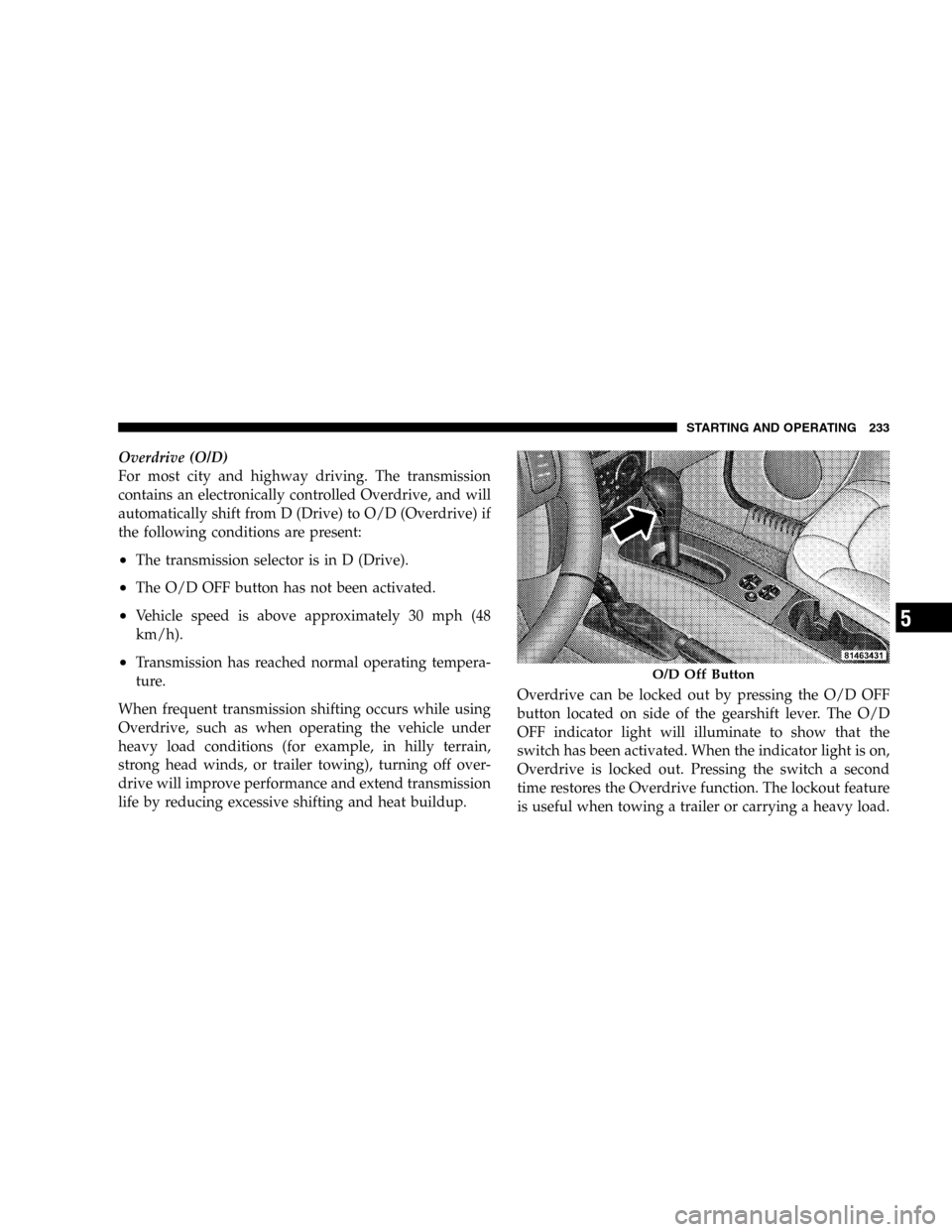
Overdrive (O/D)
For most city and highway driving. The transmission
contains an electronically controlled Overdrive, and will
automatically shift from D (Drive) to O/D (Overdrive) if
the following conditions are present:
•The transmission selector is in D (Drive).
•The O/D OFF button has not been activated.
•Vehicle speed is above approximately 30 mph (48
km/h).
•Transmission has reached normal operating tempera-
ture.
When frequent transmission shifting occurs while using
Overdrive, such as when operating the vehicle under
heavy load conditions (for example, in hilly terrain,
strong head winds, or trailer towing), turning off over-
drive will improve performance and extend transmission
life by reducing excessive shifting and heat buildup.Overdrive can be locked out by pressing the O/D OFF
button located on side of the gearshift lever. The O/D
OFF indicator light will illuminate to show that the
switch has been activated. When the indicator light is on,
Overdrive is locked out. Pressing the switch a second
time restores the Overdrive function. The lockout feature
is useful when towing a trailer or carrying a heavy load.O/D Off Button
STARTING AND OPERATING 233
5