Page 282 of 424
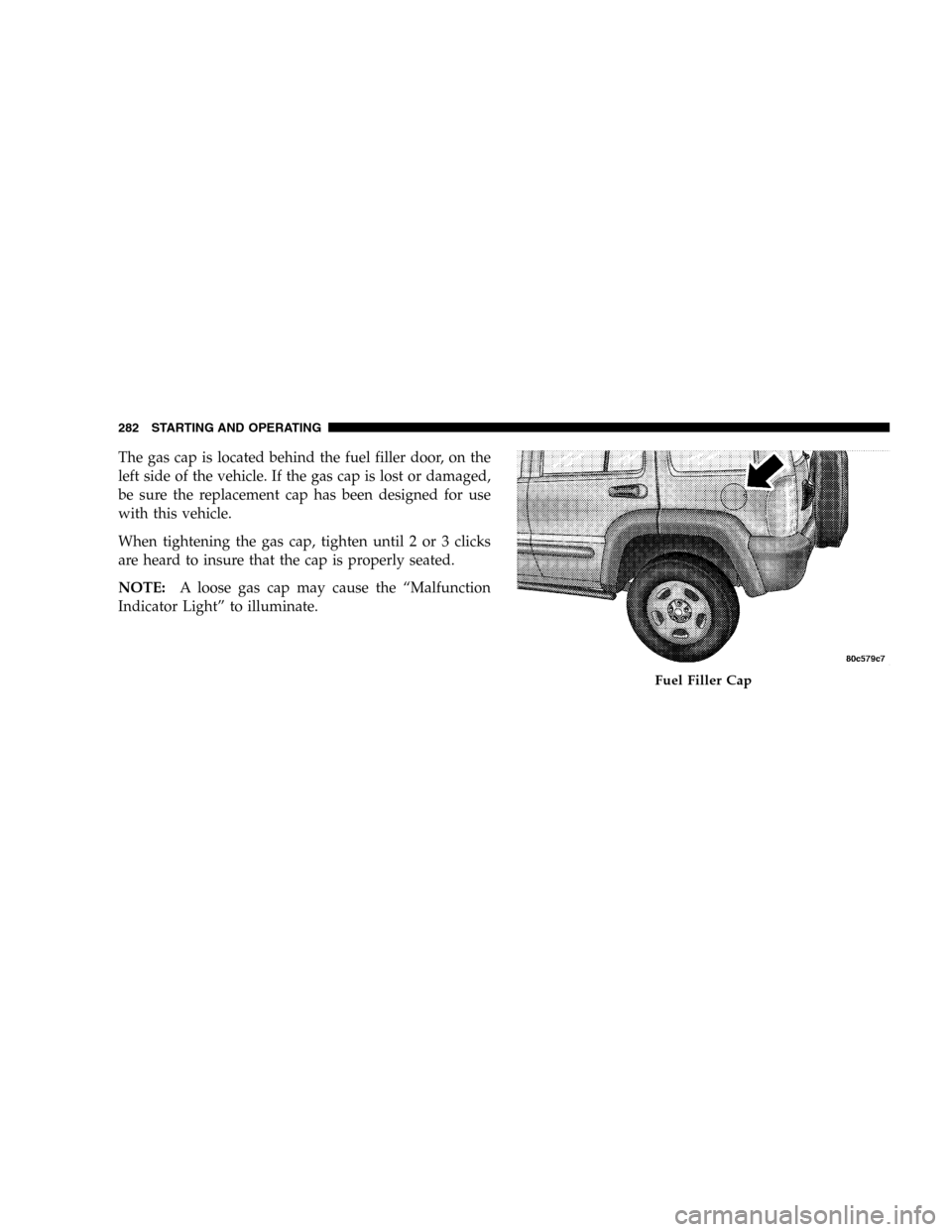
The gas cap is located behind the fuel filler door, on the
left side of the vehicle. If the gas cap is lost or damaged,
be sure the replacement cap has been designed for use
with this vehicle.
When tightening the gas cap, tighten until 2 or 3 clicks
are heard to insure that the cap is properly seated.
NOTE:A loose gas cap may cause the “Malfunction
Indicator Light” to illuminate.
Fuel Filler Cap
282 STARTING AND OPERATING
Page 283 of 424
Loose Fuel Filler Cap Message
If the vehicle diagnostic system determines that the fuel
filler cap is loose, improperly installed, or damaged, a
“CHECK GAS CAP” message will be displayed in the
EVIC (Electronic Vehicle Information Center). Refer to
“Overhead Console” in Section 3 of this manual. Tighten
the fuel filler cap properly and press the odometer reset
button to turn the message off. If the problem continues,
the message will appear the next time the vehicle is
started. Refer to “Onboard Diagnostic System — OBDII”
in Section 7 of this manual for more information.
CAUTION!
Damage to the fuel system or emission control
system could result from using an improper fuel
tank filler cap (gas cap). A poorly fitting cap could let
impurities into the fuel system.
WARNING!
•Never add fuel when the engine is running.
•Never have any smoking materials lit in or near
the vehicle when the fuel cap is removed or the
tank filled.
TRAILER TOWING
In this section you will find information on limits to the
type of towing you can reasonably do with your vehicle.
Before towing a trailer, carefully review this information
to tow your load as efficiently and safely as possible.
To maintain warranty coverage, follow the requirements
and recommendations in this manual concerning ve-
hicles used for trailer towing.
STARTING AND OPERATING 283
5
Page 301 of 424
WARNING!
Do not attempt to push or tow your vehicle to get it
started. Unburned fuel could enter the catalytic
converter and, once the engine has started, ignite and
damage the converter and vehicle.
EMERGENCY TOW HOOKS — IF EQUIPPED
If your vehicle is equipped with tow hooks, they are
mounted in the front and the rear.
CAUTION!
Tow hooks are for emergency use only, to rescue a
vehicle stranded off road. Do not use tow hooks for
tow truck hookup or highway towing. You could
damage your vehicle. Tow straps are recommended
when towing the vehicle, chains may cause vehicle
damage.
WARNING!
Stand clear of vehicles when pulling with tow
hooks. Tow straps and chains may break, causing
serious injury.
WHAT TO DO IN EMERGENCIES 301
6
Page 303 of 424
MAINTAINING YOUR VEHICLE
CONTENTS
�2.4L Engine...........................306
�3.7L Engine...........................307
�2.8L Turbo Diesel Engine.................308
�Onboard Diagnostic System — OBD II........309
▫Loose Fuel Filler Cap Message............309
�Emissions Inspection And Maintenance
Programs............................310
�Replacement Parts......................311
�Dealer Service.........................312�Maintenance Procedures..................312
▫Engine Oil..........................312
▫Drive Belts — Check Condition And Tension . . 316
▫Spark Plugs.........................317
▫Catalytic Converter....................317
▫Engine Timing Belt — 2.4L Engine.........319
▫Ignition Wiring System — 2.4L Engine......319
▫Crankcase Emission Control System........319
▫Air Cleaner Filter.....................319
7
Page 309 of 424
ONBOARD DIAGNOSTIC SYSTEM — OBD II
Your vehicle is equipped with a sophisticated onboard
diagnostic system called OBD II. This system monitors
the performance of the emissions, engine, and automatic
transmission control systems. When these systems are
operating properly, your vehicle will provide excellent
performance and fuel economy, as well as engine emis-
sions well within current government regulations.
If any of these systems require service, the OBD II system
will turn on the “Malfunction Indicator Light.” It will
also store diagnostic codes and other information to
assist your service technician in making repairs. Al-
though your vehicle will usually be drivable and not
need towing, see your dealer for service as soon as
possible.CAUTION!
•Prolonged driving with the “Malfunction Indicator
Light” on could cause further damage to the emis-
sion control system. It could also affect fuel economy
and driveability. The vehicle must be serviced before
any emissions tests can be performed.
•If the “Malfunction Indicator Light” is flashing
while the engine is running, severe catalytic con-
verter damage and power loss will soon occur.
Immediate service is required.
Loose Fuel Filler Cap Message
After fuel is added, the vehicle diagnostic system can
determine if the fuel filler cap is loose, improperly
installed, or damaged. A loose fuel filler cap message will
be displayed in the instrument cluster. Tighten the gas
cap until a�clicking�sound is heard. This is an indication
MAINTAINING YOUR VEHICLE 309
7
Page 312 of 424
DEALER SERVICE
Your dealer has the qualified service personnel, special tools
and equipment to perform all service operations in an
expert manner. Service Manuals are available which include
detailed service information for your vehicle. Refer to these
manuals before attempting any procedure yourself.
NOTE:Intentional tampering with emissions control
systems can result in civil penalties being assessed
against you.
WARNING!
You can be badly injured working on or around a
motor vehicle. Do only that service work for which
you have the knowledge and the proper equipment. If
you have any doubt about your ability to perform a
service job, take your vehicle to a competent mechanic.
MAINTENANCE PROCEDURES
The pages that follow contain therequiredmaintenance
services determined by the engineers who designed your
vehicle.
Besides the maintenance items for which there are fixed
maintenance intervals, there are other items that should
operate satisfactorily without periodic maintenance.
However, if a malfunction of these items does occur, it
could adversely affect the engine or vehicle performance.
These items should be inspected if a malfunction is
observed or suspected.
Engine Oil
Checking Oil Level
To assure proper lubrication of your vehicle’s engine, the
engine oil must be maintained at the correct level. Check
the oil level at regular intervals, such as every fuel stop.
312 MAINTAINING YOUR VEHICLE
Page 314 of 424
IfANYof these apply to you, then change your engine oil
at every interval shown in schedule “B” of the “Mainte-
nance Schedules” section of this manual.
If none of these apply to you, then change your engine oil
at every interval shown on schedule “A” of the “Main-
tenance Schedules” section of this manual
NOTE:Under no circumstances should oil change in-
tervals exceed 6,000 miles (10 000 km) or 6 months
whichever comes first.
Engine Oil Selection (Gasoline Engines)
For best performance and maximum protection for all
engines under all types of operating conditions, the
manufacturer recommends engine oils that are API Cer-
tified and meet the requirements of DaimlerChrysler
Material Standard MS-6395.
American Petroleum Institute (API) Engine Oil
Identification Symbol
This symbol means that the oil has
been certified by the American
Petroleum Institute (API). The
manufacturer only recommends
API Certified engine oils.
Engine Oil Viscosity (2.4L and 3.7L Engines)
SAE 5W-30 engine oil is recommended for all operating
temperatures. This engine oil improves low tempera-
ture starting and vehicle fuel economy. Refer to your
engine oil filler cap for the recommended engine oil
viscosity for your vehicle.
314 MAINTAINING YOUR VEHICLE
Page 317 of 424

Spark Plugs
Spark plugs must fire properly to assure engine perfor-
mance and emission control. New plugs should be in-
stalled at the mileage specified in the appropriate main-
tenance chart. The entire set should be replaced if there is
any malfunction due to a faulty spark plug.
Refer to the “Vehicle Emission Control Information” label
in the engine compartment for spark plug information.
Catalytic Converter
The catalytic converter requires the use of unleaded fuel
only. Leaded gasoline will destroy the effectiveness of the
converter as an emission control device.
Under normal operating conditions, the catalytic con-
verter will not require maintenance. However, it is im-
portant to keep the engine properly tuned to assure
proper catalyst operation and prevent possible catalyst
damage.
CAUTION!
Damage to the catalytic converter can result if your
vehicle is not kept in proper operating condition. In
the event of engine malfunction, particularly involv-
ing engine misfire or other apparent loss of perfor-
mance, have your vehicle serviced promptly. Contin-
ued operation of your vehicle with a severe
malfunction could cause the converter to overheat,
resulting in possible damage to the converter and
vehicle.
MAINTAINING YOUR VEHICLE 317
7