Page 316 of 424
Disposing of Used Engine Oil
Care should be taken in disposing of used engine oil from
your vehicle. Used oil and oil filters, indiscriminately
discarded, can present a problem to the environment.
Contact your authorized dealer, service station, or gov-
ernmental agency for advice on how and where used oil
can be safely discarded in your area.
Engine Oil Filter
The engine oil filter should be replaced at every engine
oil change.
Engine Oil Filter Selection
All of the manufacturer’s engines have a full-flow type
disposable oil filter. Use a filter of this type for replace-
ment. The quality of replacement filters varies consider-
ably. Only high quality filters should be used to assure
most efficient service. Mopar�engine oil filters are high
quality oil filters and are recommended.
Drive Belts — Check Condition and Tension
At the mileage shown in the appropriate “Maintenance
Schedule,” check all drive belts for condition and proper
tension. Improper belt tension can cause belt slippage
and failure.
Inspect the drive belt for evidence of cuts, cracks, or
glazing and replace them if there is any sign of damage
which could result in belt failure. If adjustment is re-
quired, adjust the belts according to the specifications
and procedures shown in the Service Manual.
Special tools are required to properly measure tension
and to restore belt tension to factory specifications. Also,
check belt routing to make sure there is no interference
between the belts and other engine components.
316 MAINTAINING YOUR VEHICLE
Page 319 of 424
Engine Timing Belt — 2.4L Engine
Replace the engine timing belt at the intervals described
in the appropriate maintenance schedule.
Ignition Wiring System — 2.4L Engine
Replace the ignition cables at the intervals described in
the appropriate maintenance schedule.
Crankcase Emission Control System
Proper operation of this system depends on freedom
from sticking or plugging due to deposits. As vehicle
mileage builds up, the PCV valve and passages may
accumulate deposits. If a valve is not working properly,
replace it with a new valve. DO NOT ATTEMPT TO
CLEAN THE OLD PCV VALVE!
Check ventilation hose for indication of damage or
plugging deposits. Replace if necessary.
Air Cleaner Filter
Under normal driving conditions, replace the air filter at
the intervals shown on “Maintenance Schedule A.” If,
however, you drive the vehicle frequently under dusty or
severe conditions, the filter element should be inspected
periodically and replaced if necessary at the intervals
shown on “Maintenance Schedule B.”
WARNING!
The air cleaner can provide protection in the case of
engine backfire. Do not remove the air cleaner
unless it is necessary for repair or maintenance.
Make sure that no one is near the engine compart-
ment before starting the vehicle with the air cleaner
removed. Failure to do so can result in serious
personal injury.
MAINTAINING YOUR VEHICLE 319
7
Page 322 of 424
Refrigerant Recovery and Recycling
R-134a Air Conditioning Refrigerant is a hydrofluorocar-
bon (HFC) that is endorsed by the Environmental Pro-
tection Agency and is an ozone-saving product. How-
ever, the manufacturer recommends that air conditioning
service be performed by dealers or other service facilities
using recovery and recycling equipment.
Power Steering Fluid Check
Checking the power steering fluid level at a defined
service interval is not required. The fluid should only be
checked if a leak is suspected, abnormal noises are
apparent, and/or the system is not functioning as antici-
pated. Coordinate inspection efforts through a certified
“DaimlerChrysler Dealership.”
WARNING!
Fluid level should be checked on a level surface with
the engine off to prevent injury from moving parts,
and to insure accurate fluid level reading. Do not
overfill. Use only the manufacturer’s recommended
fluid.
If necessary, add fluid to restore to the proper indicated
level. With a clean cloth, wipe any spilled fluid from all
surfaces. Refer to Recommended Fluids, Lubricants, and
Genuine Parts for correct fluid type.
Driveline And Steering Component Lubrication
U-joints (cardan joints) are sealed and do not require
lubrication. Prop shafts, yokes, ball joints and other
driveline and steering components may be provided with
grease fittings for lubrication. Lubrication of these com-
ponents at the intervals specified in the appropriate
322 MAINTAINING YOUR VEHICLE
Page 324 of 424
Windshield Washers
The fluid reservoir for the windshield washers and the
rear window washer is shared. It is located in the front of
the engine compartment on the passenger side and
should be checked for fluid level at regular intervals. Fillthe reservoir with windshield washer solvent (not
antifreeze/coolant) and operate the system for a few
seconds to flush out the residual water.
WARNING!
Commercial windshield washer solvents are flam-
mable. They could ignite and burn you. Care must
be exercised when filling or working around the
washer solution.
Exhaust System
The best protection against carbon monoxide entry into
the vehicle body is a properly maintained engine exhaust
system.
If you notice a change in the sound of the exhaust system;
or if the exhaust fumes can be detected inside the vehicle;
or when the underside or rear of the vehicle is damaged;
324 MAINTAINING YOUR VEHICLE
Page 325 of 424

have an authorized technician inspect the complete ex-
haust system and adjacent body areas for broken, dam-
aged, deteriorated, or mispositioned parts. Open seams
or loose connections could permit exhaust fumes to seep
into the passenger compartment. In addition, inspect the
exhaust system each time the vehicle is raised for lubri-
cation or oil change. Replace as required.
Cooling System
WARNING!
You or others can be badly burned by hot antifreeze/
coolant or steam from your radiator. If you see or
hear steam coming from under the hood, don’t open
the hood until the radiator has had time to cool.
Never try to open a cooling system pressure cap
when the radiator or coolant bottle is hot.
Engine Coolant Checks
Check antifreeze/coolant protection every 12 months
(before the onset of freezing weather, where applicable).
If antifreeze/coolant is dirty or rusty in appearance, the
system should be drained, flushed and refilled with fresh
antifreeze/coolant. Check the front of the A/C condenser
(if equipped) or radiator for any accumulation of bugs,
leaves, etc. If dirty, clean by gently spraying water from a
garden hose vertically down the face of the A/C con-
denser (if equipped) or the radiator core.
Check the engine cooling system hoses for brittle rubber,
cracking, tears, cuts, and tightness of connection at the
coolant recovery bottle and radiator. Inspect the entire
system for leaks.
MAINTAINING YOUR VEHICLE 325
7
Page 328 of 424
The cap should be inspected and cleaned if there is any
accumulation of foreign material on the sealing surfaces.
WARNING!
The warning words DO NOT OPEN HOT on the
cooling system pressure cap are a safety precaution.
Never add antifreeze/coolant when the engine is
overheated. Do not loosen or remove the cap to cool
an overheated engine. Heat causes pressure to build
up in the cooling system. To prevent scalding or
injury, do not remove the pressure cap while the
system is hot or under pressure.
Disposal of Used Engine Coolant
Used Hybrid Organic Additive Technology (HOAT)
antifreeze/coolant is a regulated substance requiring
proper disposal. Check with your local authorities to
determine the disposal rules for your community. Toprevent ingestion by animals or children, do not store
HOAT antifreeze/coolant in open containers, or allow it
to remain in puddles on the ground. If ingested by a
child, contact a physician immediately. Clean up ground
spills immediately.
Engine Coolant Level
The coolant recovery bottle provides a quick visual
method for determining that the antifreeze/coolant level
is adequate. With the engine idling, and warm to normal
operating temperature, the level of the antifreeze/coolant
should be between the ranges indicated on the bottle.
The radiator normally remains completely full, so there is
no need to remove the radiator cap unless checking for
antifreeze/coolant freeze point or replacing coolant. Ad-
vise your service attendant of this. As long as the engine
operating temperature is satisfactory, the coolant bottle
need only be checked once a month.
328 MAINTAINING YOUR VEHICLE
Page 329 of 424
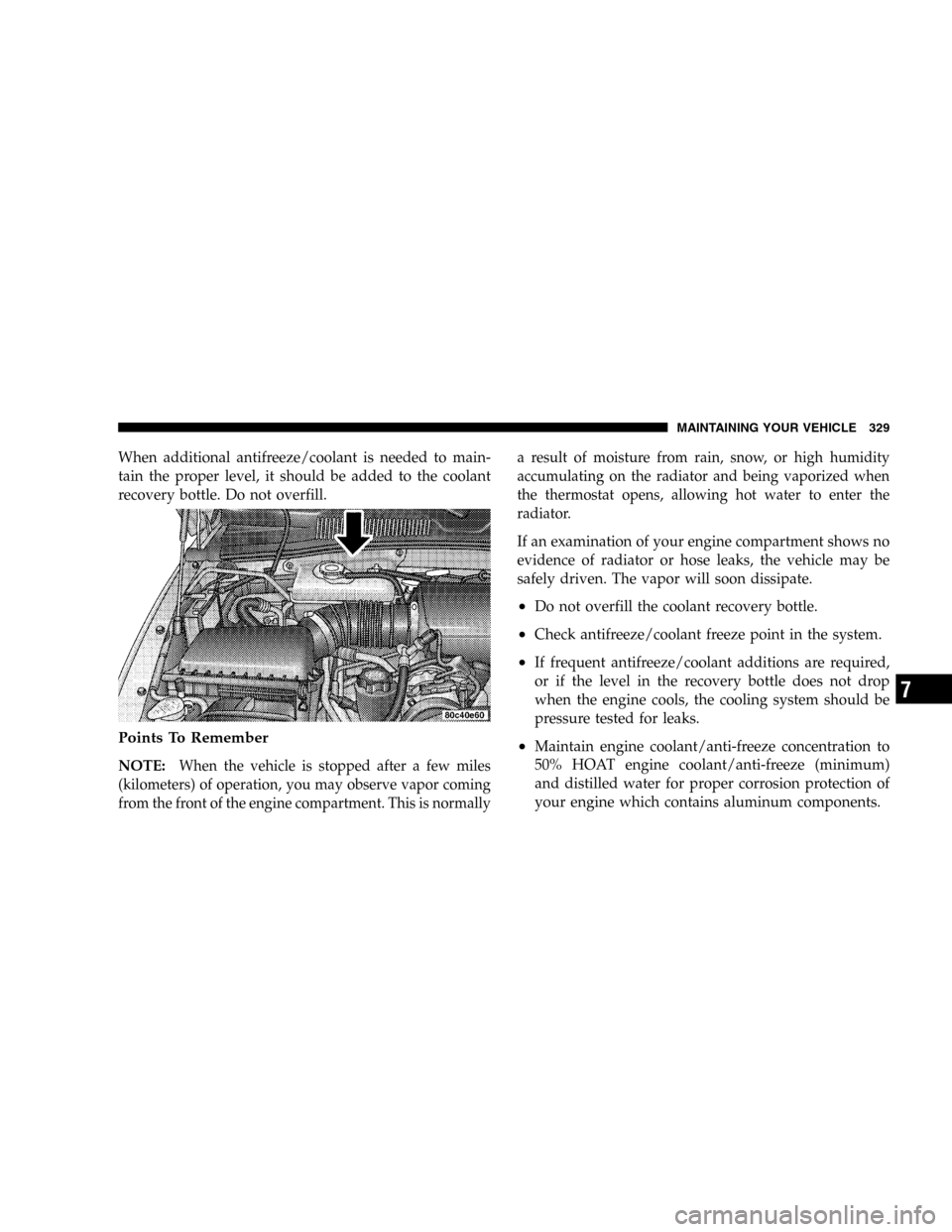
When additional antifreeze/coolant is needed to main-
tain the proper level, it should be added to the coolant
recovery bottle. Do not overfill.
Points To Remember
NOTE:When the vehicle is stopped after a few miles
(kilometers) of operation, you may observe vapor coming
from the front of the engine compartment. This is normallya result of moisture from rain, snow, or high humidity
accumulating on the radiator and being vaporized when
the thermostat opens, allowing hot water to enter the
radiator.
If an examination of your engine compartment shows no
evidence of radiator or hose leaks, the vehicle may be
safely driven. The vapor will soon dissipate.
•Do not overfill the coolant recovery bottle.
•Check antifreeze/coolant freeze point in the system.
•If frequent antifreeze/coolant additions are required,
or if the level in the recovery bottle does not drop
when the engine cools, the cooling system should be
pressure tested for leaks.
•Maintain engine coolant/anti-freeze concentration to
50% HOAT engine coolant/anti-freeze (minimum)
and distilled water for proper corrosion protection of
your engine which contains aluminum components.
MAINTAINING YOUR VEHICLE 329
7
Page 334 of 424
CAUTION!
Using a transmission fluid other than the manufac-
turer’s recommended fluid may cause deterioration
in transmission shift quality and/or torque converter
shudder. Using a transmission fluid other than the
manufacturer’s recommended fluid will result in
more frequent fluid and filter changes. Refer to
Recommended Fluids, Lubricants, and Genuine
Parts for correct fluid type.
Fluid Level Check – 3.7L Gasoline Engine (42RLE)
and 2.8L Diesel Engine (545RFE)
This fluid level should be checked when the engine is
fully warmed up and the fluid in the transmission is
heated to its normal operating temperature. Operation of
the transmission with an improper fluid level will greatly
reduce the life of the transmission and of the fluid.To check the automatic transmission fluid level properly,
the following procedure must be used:
1. The vehicle must be on level ground.
2. The engine should be running at curb idle speed for a
minimum of 60 seconds.
3. Fully apply parking brake.
4. Apply the brakes and shift the transmission into P
(Park).
5. The fluidMUSTbe checked with the transmission in
P (Park) to be sure that the fluid level is accurate.
6. Wipe the dipstick clean and reinsert until seated.
Remove dipstick and note reading.
At normal operating temperature (approximately 180° F
(82° C), the fluid level is correct if it is in the HOT region
334 MAINTAINING YOUR VEHICLE
