Page 314 of 424
IfANYof these apply to you, then change your engine oil
at every interval shown in schedule “B” of the “Mainte-
nance Schedules” section of this manual.
If none of these apply to you, then change your engine oil
at every interval shown on schedule “A” of the “Main-
tenance Schedules” section of this manual
NOTE:Under no circumstances should oil change in-
tervals exceed 6,000 miles (10 000 km) or 6 months
whichever comes first.
Engine Oil Selection (Gasoline Engines)
For best performance and maximum protection for all
engines under all types of operating conditions, the
manufacturer recommends engine oils that are API Cer-
tified and meet the requirements of DaimlerChrysler
Material Standard MS-6395.
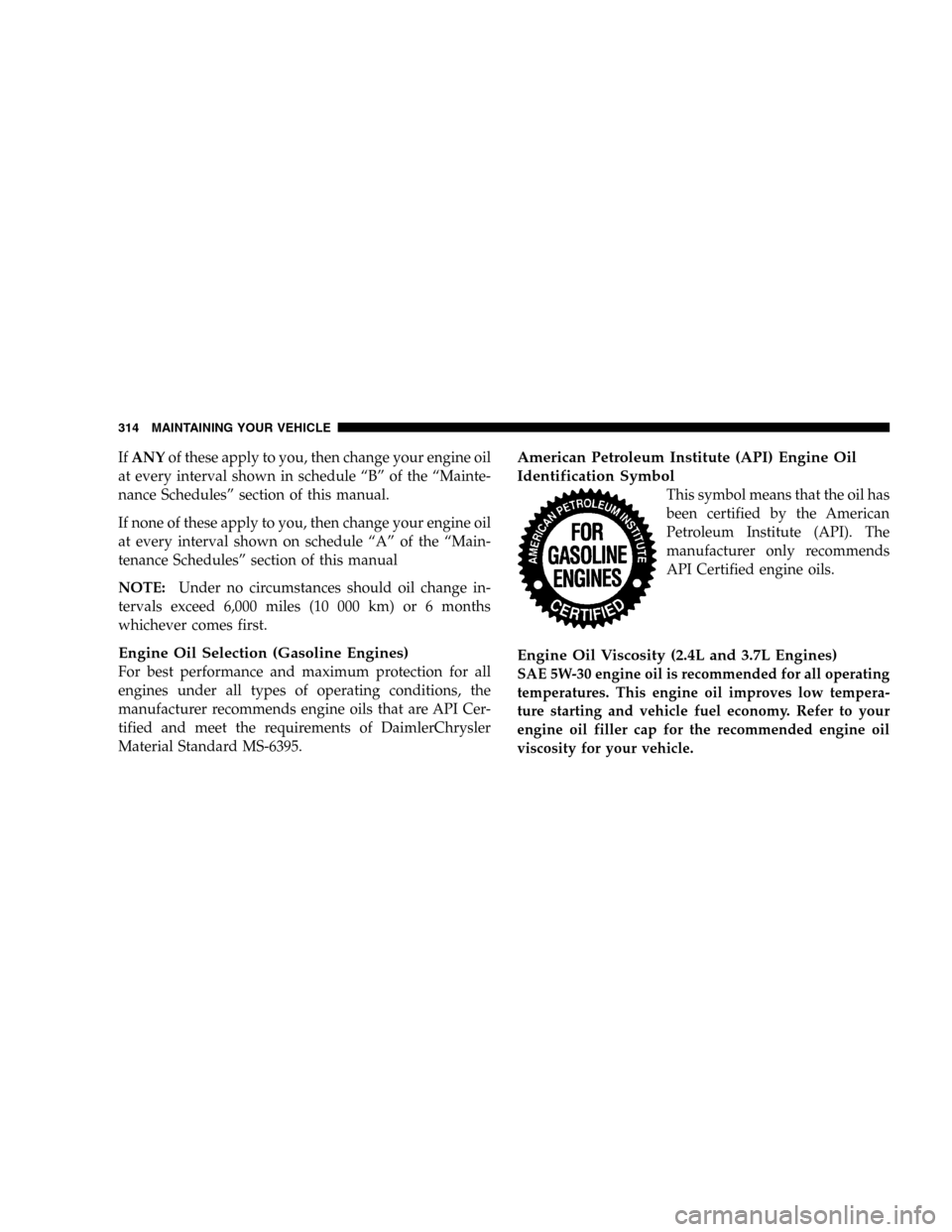
American Petroleum Institute (API) Engine Oil
Identification Symbol
This symbol means that the oil has
been certified by the American
Petroleum Institute (API). The
manufacturer only recommends
API Certified engine oils.
Engine Oil Viscosity (2.4L and 3.7L Engines)
SAE 5W-30 engine oil is recommended for all operating
temperatures. This engine oil improves low tempera-
ture starting and vehicle fuel economy. Refer to your
engine oil filler cap for the recommended engine oil
viscosity for your vehicle.
314 MAINTAINING YOUR VEHICLE
Page 315 of 424
Engine Oil Selection (Diesel Engines)
For best performance and maximum protection for all
engines under all types of operating conditions, the
manufacturer recommends using synthetic engine oils
that are API Certified (SL/CF), and meet the require-
ments of DaimlerChrysler Material Standard MS-10725.
Engine Oil Viscosity (2.8L Diesel Engines)
Use SAE 0W-40 Mobil 1�Synthetic Engine Oil that
meets API categories CF or better and the requirements
of DaimlerChrysler Material Standard MS-10725. If you
cannot find SAE 0W-40, then SAE 5W-40 Mobil 1�
Synthetic Engine Oil is acceptable. Any engine oil that
does not meet the manufacturer’s requirements should
not be used.
Lubricants which do not have both, the engine oil certi-
fication mark and the correct SAE viscosity grade num-
ber should not be used.
Synthetic Engine Oils — All Engines
There are a number of engine oils being promoted as
either synthetic or semi-synthetic. If you chose to use
such a product, use only those oils that are certified by
the American Petroleum Institute (API) to display the
symbol on the front of the container or the proper ACEA
category and show the recommended SAE viscosity
grade. Follow the service schedule that describes your
driving type.
Materials Added To Engine Oils
The manufacturerstrongly recommendsagainst the ad-
dition of any additives (other than leak detection dyes) to
engine oil. Engine oil is an engineered product and it’s
performance may be impaired by supplemental addi-
tives.
MAINTAINING YOUR VEHICLE 315
7
Page 316 of 424
Disposing of Used Engine Oil
Care should be taken in disposing of used engine oil from
your vehicle. Used oil and oil filters, indiscriminately
discarded, can present a problem to the environment.
Contact your authorized dealer, service station, or gov-
ernmental agency for advice on how and where used oil
can be safely discarded in your area.
Engine Oil Filter
The engine oil filter should be replaced at every engine
oil change.
Engine Oil Filter Selection
All of the manufacturer’s engines have a full-flow type
disposable oil filter. Use a filter of this type for replace-
ment. The quality of replacement filters varies consider-
ably. Only high quality filters should be used to assure
most efficient service. Mopar�engine oil filters are high
quality oil filters and are recommended.
Drive Belts — Check Condition and Tension
At the mileage shown in the appropriate “Maintenance
Schedule,” check all drive belts for condition and proper
tension. Improper belt tension can cause belt slippage
and failure.
Inspect the drive belt for evidence of cuts, cracks, or
glazing and replace them if there is any sign of damage
which could result in belt failure. If adjustment is re-
quired, adjust the belts according to the specifications
and procedures shown in the Service Manual.
Special tools are required to properly measure tension
and to restore belt tension to factory specifications. Also,
check belt routing to make sure there is no interference
between the belts and other engine components.
316 MAINTAINING YOUR VEHICLE
Page 323 of 424
“Maintenance Schedule” in Section 8 is very important,
particularly if your vehicle is subjected to off-road or
other heavy-duty use. See your authorized dealer for
complete service information.
Body Lubrication
Locks and all body pivot points, including such items as
seat tracks, doors, swing gate and hood hinges, should be
lubricated periodically to assure quiet, easy operation
and to protect against rust and wear. Prior to the appli-
cation of any lubricant, the parts concerned should be
wiped clean to remove dust and grit; after lubricating
excess oil and grease should be removed. Particular
attention should also be given to hood latching compo-
nents to insure proper function. When performing other
underhood services, the hood latch, release mechanism
and safety catch should be cleaned and lubricated.The external lock cylinders should be lubricated twice a
year, preferably in the fall and spring. Apply a small
amount of a high quality lubricant such as Mopar�Lock
Cylinder Lubricant directly into the lock cylinder.
Windshield Wiper Blades
Clean the rubber edges of the wiper blades and the
windshield periodically with a sponge or soft cloth and a
mild non-abrasive cleaner. This will remove accumula-
tions of salt or road film.
Operation of the wipers on dry glass for long periods
may cause deterioration of the wiper blades. Always use
washer fluid when using the wipers to remove salt or dirt
from a dry windshield. Avoid using the wiper blades to
remove frost or ice from the windshield. Keep the blade
rubber out of contact with petroleum products such as
engine oil, gasoline, etc.
MAINTAINING YOUR VEHICLE 323
7
Page 325 of 424

have an authorized technician inspect the complete ex-
haust system and adjacent body areas for broken, dam-
aged, deteriorated, or mispositioned parts. Open seams
or loose connections could permit exhaust fumes to seep
into the passenger compartment. In addition, inspect the
exhaust system each time the vehicle is raised for lubri-
cation or oil change. Replace as required.
Cooling System
WARNING!
You or others can be badly burned by hot antifreeze/
coolant or steam from your radiator. If you see or
hear steam coming from under the hood, don’t open
the hood until the radiator has had time to cool.
Never try to open a cooling system pressure cap
when the radiator or coolant bottle is hot.
Engine Coolant Checks
Check antifreeze/coolant protection every 12 months
(before the onset of freezing weather, where applicable).
If antifreeze/coolant is dirty or rusty in appearance, the
system should be drained, flushed and refilled with fresh
antifreeze/coolant. Check the front of the A/C condenser
(if equipped) or radiator for any accumulation of bugs,
leaves, etc. If dirty, clean by gently spraying water from a
garden hose vertically down the face of the A/C con-
denser (if equipped) or the radiator core.
Check the engine cooling system hoses for brittle rubber,
cracking, tears, cuts, and tightness of connection at the
coolant recovery bottle and radiator. Inspect the entire
system for leaks.
MAINTAINING YOUR VEHICLE 325
7
Page 331 of 424
WARNING!
Riding the brakes can lead to brake failure and
possibly an accident. Driving with your foot resting
or riding on the brake pedal can result in abnormally
high brake temperatures, excessive lining wear, and
possible brake damage. You wouldn’t have your full
braking capacity in an emergency.
Brake and Power Steering System Hoses
When servicing the vehicle for scheduled maintenance,
inspect surface of hoses for evidence of heat and me-
chanical damage. Hard and brittle rubber, cracking, tears,
cuts, abrasion, and excessive swelling suggest deteriora-
tion of the rubber. Particular attention should be made to
examining those hose surfaces nearest to high heat
sources, such as the exhaust manifold.Inspect all hose clamps and couplings to make sure they
are secure and no leaks are present.
NOTE:Often fluids such as oil, power steering fluid,
and brake fluid are used during assembly plant opera-
tions to ease the assembly of hoses to couplings. There-
fore, oil wetness at the hose-coupling area is not neces-
sarily an indication of leakage. Actual dripping of hot
fluid when systems are under pressure (during vehicle
operation) should be noted before hose is replaced based
on leakage.
NOTE:Inspection of brake hoses should be done when-
ever the brake system is serviced and every engine oil
change.
MAINTAINING YOUR VEHICLE 331
7
Page 333 of 424
Use only manufacturer’s recommended brake fluid, refer
to Recommended Fluids, Lubricants, and Genuine Parts
for correct fluid type.
WARNING!
Use of a brake fluid that may have a lower initial
boiling point or unidentified as to specification, may
result in sudden brake failure during hard pro-
longed braking. You could have an accident.
WARNING!
Overfilling the brake fluid reservoir can result in
spilling brake fluid on hot engine parts and the
brake fluid catching fire.
Use only brake fluid that has been in a tightly closed
container to avoid contamination from foreign matter. Do
not allow petroleum base fluid to contaminate the brake
fluid as seal damage will result.
Automatic Transmission
Selection of Lubricant
It is important that the proper lubricant is used in the
transmission to assure optimum transmission perfor-
mance. Use only manufacturer’s recommended transmis-
sion fluid, refer to Recommended Fluids, Lubricants, and
Genuine Parts for correct fluid type. It is important that
the transmission fluid be maintained at the prescribed
level using the recommended fluid.
MAINTAINING YOUR VEHICLE 333
7
Page 351 of 424
BULB REPLACEMENT
Head Light
1. Open the hood.
2. Reach behind the headlamp unit in the engine com-
partment to access the headlamp bulb lock ring.
3. Firmly grasp the lock ring on the back of the headlamp
unit housing.
4. Rotate the lock ring on the back of the headlamp
housing counter-clockwise to unlock it.
CAUTION!
Do not touch the new bulb with your fingers. Oil
contamination will severely shorten bulb life. If the
bulb comes in contact with any oily surface, clean
the bulb with rubbing alcohol.
5. Disconnect the electrical connector and replace the
bulb.
MAINTAINING YOUR VEHICLE 351
7