Page 329 of 424
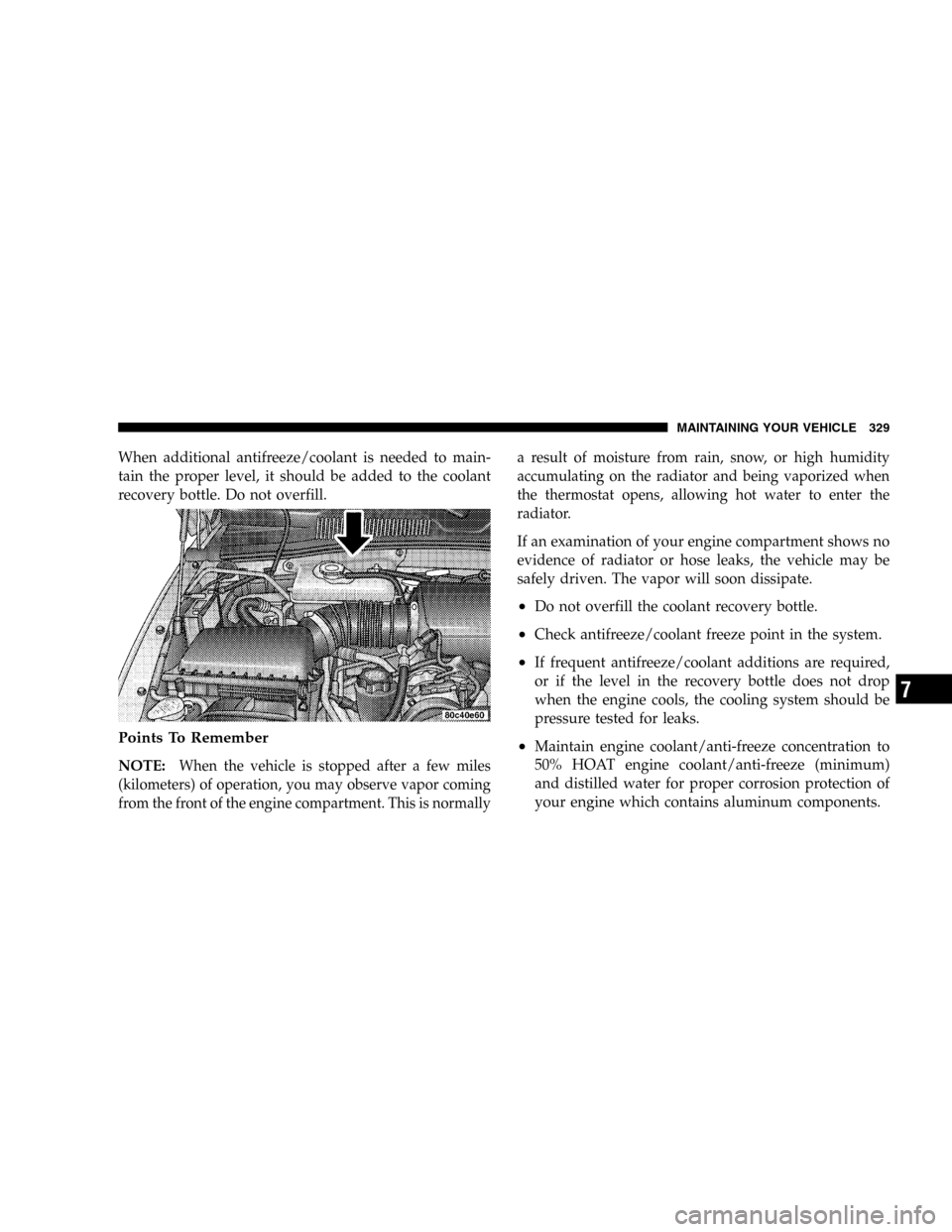
When additional antifreeze/coolant is needed to main-
tain the proper level, it should be added to the coolant
recovery bottle. Do not overfill.
Points To Remember
NOTE:When the vehicle is stopped after a few miles
(kilometers) of operation, you may observe vapor coming
from the front of the engine compartment. This is normallya result of moisture from rain, snow, or high humidity
accumulating on the radiator and being vaporized when
the thermostat opens, allowing hot water to enter the
radiator.
If an examination of your engine compartment shows no
evidence of radiator or hose leaks, the vehicle may be
safely driven. The vapor will soon dissipate.
•Do not overfill the coolant recovery bottle.
•Check antifreeze/coolant freeze point in the system.
•If frequent antifreeze/coolant additions are required,
or if the level in the recovery bottle does not drop
when the engine cools, the cooling system should be
pressure tested for leaks.
•Maintain engine coolant/anti-freeze concentration to
50% HOAT engine coolant/anti-freeze (minimum)
and distilled water for proper corrosion protection of
your engine which contains aluminum components.
MAINTAINING YOUR VEHICLE 329
7
Page 330 of 424
•Make sure that the radiator and coolant recovery
bottle hoses are not kinked or obstructed.
•Keep the front of the radiator clean. Also, if your
vehicle is equipped with air conditioning, keep the
front of the condenser clean.
•Do not change the thermostat for summer or winter
operation. If replacement is ever necessary, install
ONLY the correct type thermostat. Other designs may
result in unsatisfactory cooling performance, poor gas
mileage, and increased emissions.
Hoses and Vacuum/Vapor Harnesses
Inspect surfaces of hoses and nylon tubing for evidence
of heat and mechanical damage. Hard or soft spots,
brittle rubber, cracking, tears, cuts, abrasions, and exces-
sive swelling indicate deterioration of the rubber.Pay particular attention to the hoses nearest to high heat
sources such as the exhaust manifold. Inspect hose rout-
ing to be sure hoses do not touch any heat source or
moving component that may cause heat damage or
mechanical wear.
Insure nylon tubing in these areas has not melted or
collapsed. Inspect all hose connections such as clamps
and couplings to make sure they are secure and no leaks
are present. Components should be replaced immedi-
ately if there is any evidence of degradation that could
cause failure.Brake System
In order to assure brake system performance, all brake
system components should be inspected periodically.
Refer to the appropriate “Maintenance Schedule” in
Section 8 for suggested service intervals.
330 MAINTAINING YOUR VEHICLE
Page 356 of 424
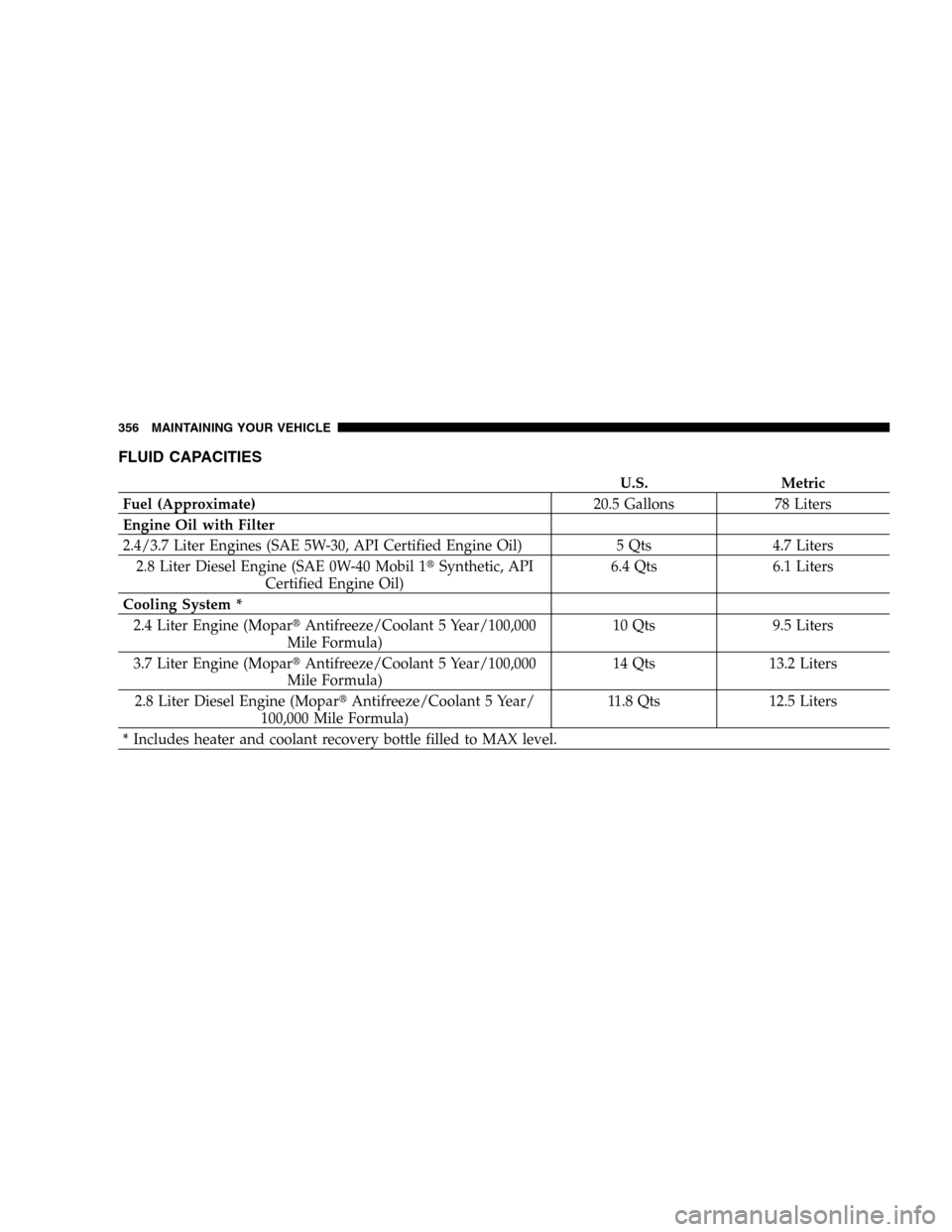
FLUID CAPACITIES
U.S. Metric
Fuel (Approximate)20.5 Gallons 78 Liters
Engine Oil with Filter
2.4/3.7 Liter Engines (SAE 5W-30, API Certified Engine Oil) 5 Qts 4.7 Liters
2.8 Liter Diesel Engine (SAE 0W-40 Mobil 1�Synthetic, API
Certified Engine Oil)6.4 Qts 6.1 Liters
Cooling System *
2.4 Liter Engine (Mopar�Antifreeze/Coolant 5 Year/100,000
Mile Formula)10 Qts 9.5 Liters
3.7 Liter Engine (Mopar�Antifreeze/Coolant 5 Year/100,000
Mile Formula)14 Qts 13.2 Liters
2.8 Liter Diesel Engine (Mopar�Antifreeze/Coolant 5 Year/
100,000 Mile Formula)11.8 Qts 12.5 Liters
* Includes heater and coolant recovery bottle filled to MAX level.
356 MAINTAINING YOUR VEHICLE
Page 402 of 424

Caution, Exhaust Gas...................73,141
CD Changer........................187,193
CD Player..................184,189,191,195,198
CD Player Maintenance................... 211
Cellular Phone........................85,211
Center High Mounted Stop Light............ 355
Chains, Tire............................ 274
Changing A Flat Tire..................... 294
Charging System Light.................... 170
Chart, Tire Sizing........................ 255
Check Engine Light (Malfunction Indicator Light) . 310
Child Restraint......................63,68,70
Child Restraint Tether Anchors.............67,68
Child Safety Locks........................ 24
Climate Control......................... 212
Clock................................ 176
Clutch Interlocking Ignition System........220,229
Command-Trac Operation.................. 236
Compact Disc Maintenance................. 211Compact Disc Player..................178,184
Compass.............................. 137
Compass Calibration..................... 137
Compass Variance....................... 138
Computer, Trip/Travel.................... 135
Console, Overhead....................... 129
Contract, Service........................ 392
Converter, Catalytic...................... 317
Cool Down, Turbo....................... 224
Cooling System......................... 325
Adding Coolant (Antifreeze).............. 327
Coolant Capacity...................... 356
Coolant Level......................... 328
Disposal of Used Coolant................ 328
Drain, Flush, and Refill.................. 326
Inspection........................... 325
Points to Remember.................... 329
Pressure Cap......................... 327
Radiator Cap......................... 327
402 INDEX
Page 404 of 424
Electronic Throttle Control Warning Light...... 175
Electronic Vehicle Information Center......... 131
Emergency, In Case of
Freeing Vehicle When Stuck............... 236
Hazard Warning Flasher................. 292
Jacking............................. 294
Jump Starting......................... 299
Tow Hooks.......................... 301
Emission Control System Maintenance......310,360
Engine
Air Cleaner.......................... 319
Block Heater......................... 226
Break-In Recommendations................ 73
Checking Oil Level..................... 312
Compartment......................306,307
Compartment Identification............306,307
Cooling............................. 325
Exhaust Gas Caution.................... 280
Fails to Start.......................... 222Flooded, Starting...................... 222
Fuel Requirements..................276,356
Jump Starting......................... 299
Malfunction Indicator................... 169
Oil ..............................312,356
Oil Change Interval.................... 313
Oil Disposal.......................... 316
Oil Filter............................ 316
Oil Filter Disposal...................... 316
Oil Selection....................314,315,356
Oil Synthetic......................... 315
Overheating.......................... 293
Starting............................. 220
Temperature Gauge..................... 171
Timing Belt.......................... 319
Engine Oil Viscosity...................314,315
Engine Oil Viscosity Chart..............314,315
Enhanced Accident Response Feature.......... 61
Entry System, Illuminated.................. 19
404 INDEX