2005 Hyundai Terracan parking brake
[x] Cancel search: parking brakePage 416 of 539
2
DRIVING YOUR HYUNDAI
3
!WARNING:
Your vehicle is equipped with tyres designed to provide for safe ride and handling capability.Do not use a size and type of tyre and wheel that is different from the one that was originally installed on yourvehicle. It can affect the safety and performance of your vehicle, which could lead to handling failure orrollover and serious injury. When replacing the tyres, be sure to equip all four tyres with the tyre andwheel of the same size, type, tread, brand and load-carrying capacity. If you nevertheless decide to equipyour vehicle with any tyre/wheel com- bination not recommended by Hyundai for off-road driving, youshould not use these tyres for high- way driving.
TO START THE ENGINEBEFORE STARTING THE ENGINE
C020A01A-EAT Before you start the engine, you should always:
1. Look around the vehicle to be sure
there are no flat tyres, puddles of oil or water or other indications of pos- sible trouble.
2. After entering the car, check to be
sure the parking brake is engaged.
3. Check that all windows, and lights
are clean.
4. Check that the interior and exterior mirrors are clean and in position.
5. Check your seat, seatback and headrest to be sure they are in theirproper positions.
6. Close all the doors.
7. Fasten your seat belt and be sure that all other occupants have fas-tened theirs.
8. Turn off all lights and accessories that are not needed.
9. When you turn the ignition switch to "ON" check that all appropriate warning lights are operating and that you have sufficient fuel.
10.Check the operation of warning lights and all bulbs when key is inthe "ON" position. C030A01HP-EAT Cmbination Ignition Switch and Steering Lock
o If your Hyundai is equipped with a
manual transmission, place the shift lever in neutral and depress the clutch pedal fully.
o If your Hyundai has an automatic
transmission, place the shift lever in"P" (park).
o To start the engine, insert the igni- tion key and turn it to the "START"position. Release it as soon as the engine starts. Do not hold the key inthe "START" position for more than 15 seconds.
NOTE: For safety, the engine will not start if the shift lever is not in "P" or "N" position (Automatic Transmission).
Page 419 of 539
2 DRIVING YOUR HYUNDAI
6
!
!
NOTE: Do not operate the starter for more than 15 seconds continuously or continue to operate the starter afterthe engine has started to avoid dam- aging the starter motor. If the en- gine makes a false start, allow it andthe starter motor to come to rest before attempting to start the en- gine again. Never attempt to startthe engine with the transmission in gear. Do not depress the accelera- tor pedal whilst starting the engine.Allow the engine to idle for 20 sec- onds or so before driving the ve- hicle.
CAUTION:
Do not leave the vehicle unattendedwhilst idling. Never allow the vehicleto idle or warm up in a confined space (i.e. garage) longer than is necessary to move the vehicle intoan open area. C050B01HP-EAT Starting Procedure
1. Insert key, and fasten the seat belt.
2. Apply the parking brake.
3. If your Hyundai is equipped with a
manual transmission, place the shiftlever in neutral and depress theclutch pedal fully. If your Hyundai has an automatic transmission, place the shift lever in "P" (park). NOTE: If the engine were not started within 2 seconds after the preheating is completed, turn the ignition keyonce more to the "LOCK" position during 10 seconds, and then to the "ON" position, in order to preheatagain.
WARNING:
Be sure that the clutch is fully de- pressed when starting a manual tranmission vehicle. Otherwise thereis the potential to cause damage to the vehicle or injury to someone inside or outside the ve-hicle as a result of the forward or backward movement of the vehicle that will occur if the clutch is notdepressed when the vehicle is started.
5. Turn the ignition key to the "START" position and release it when the engine starts.
Amber lamp ON
C050B01HP
Amber lamp OFF
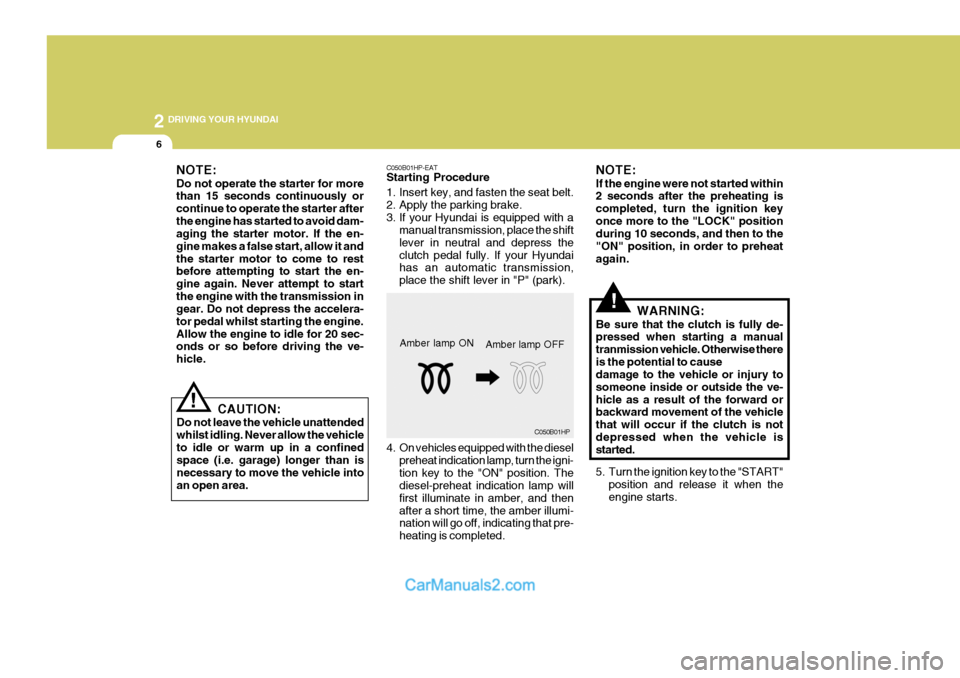
4. On vehicles equipped with the diesel preheat indication lamp, turn the igni- tion key to the "ON" position. The diesel-preheat indication lamp will first illuminate in amber, and thenafter a short time, the amber illumi- nation will go off, indicating that pre- heating is completed.
Page 422 of 539
2
DRIVING YOUR HYUNDAI
9
o When slippery conditions are en-
countered, increased caution should be exercised when gear changing, braking or accelerat- ing. Abrupt changes in speed maycause a loss of traction or control of the vehicle.
o During cold weather, shifting may be difficult until the transmis-sion lubricant has warmed up. This is normal and not harmful tothe transmission.
o If you've come to a complete stop
and it's hard to shift into 1st orR(Reverse), put the shift lever in N(Neutral) position and release the clutch. Press the clutch pedalback down, and then shift into 1st or R(Reverse) gear position.
o Do not use the shift lever as a handrest during driving, as thiscan result in premature wear of the transmission shift forks. C070B01A-EAT Using the Clutch The clutch should be pressed all the way to the floor before shifting, then released slowly. The clutch pedal should aways be used after fully re-turning to the original position. Do not rest your foot on the clutch pedal whilst driving. This can cause unnecessarywear. Do not partially engage the clutch to hold the car on an incline. This causesunnecessary wear. Use the parking brake to hold the car on an incline. Do not operate the clutch pedal rapidlyand repeatedly.
!WARNING:
o Avoid high cornering speeds.
o Do not make quick steering wheel movements, such as sharp lane changes or fast, sharp turns.
o Always wear your seat belts.
In a collision crash, an unbeltedperson is significantly more likely to die than a person wearing a seatbelt.
o The risk of rollover is greatly in- creased if you lose control of yourvehicle at highway speeds.
o Loss of control often occurs if two or more wheels drop off the road-way and the driver oversteers toreenter the roadway.
o In the event your vehicle leaves
the roadway, do not steer sharply.Instead, slow down before pulling back into the travel lanes.
o Never exceed posted speed limits.
Page 425 of 539
2 DRIVING YOUR HYUNDAI
12
!
C090I01E-EAT
CAUTION:
o Shift into "R" and "P" only when the vehicle has completely stopped.
o Do not accelerate the engine in reverse or any of the forward posi-tions with the brakes applied.
o Always apply the footbrake when shifting from "P" or "N" to "R","D", "2" or "L" position.
o Do not use the "P" (Park) posi- tion in place of the parking brake.Always set the parking brake,shift the transmission into "P" (Park) and turn off the ignition when you leave the vehicle, evenmomentarily. Never leave the ve- hicle unattended whilst the en- gine is running.
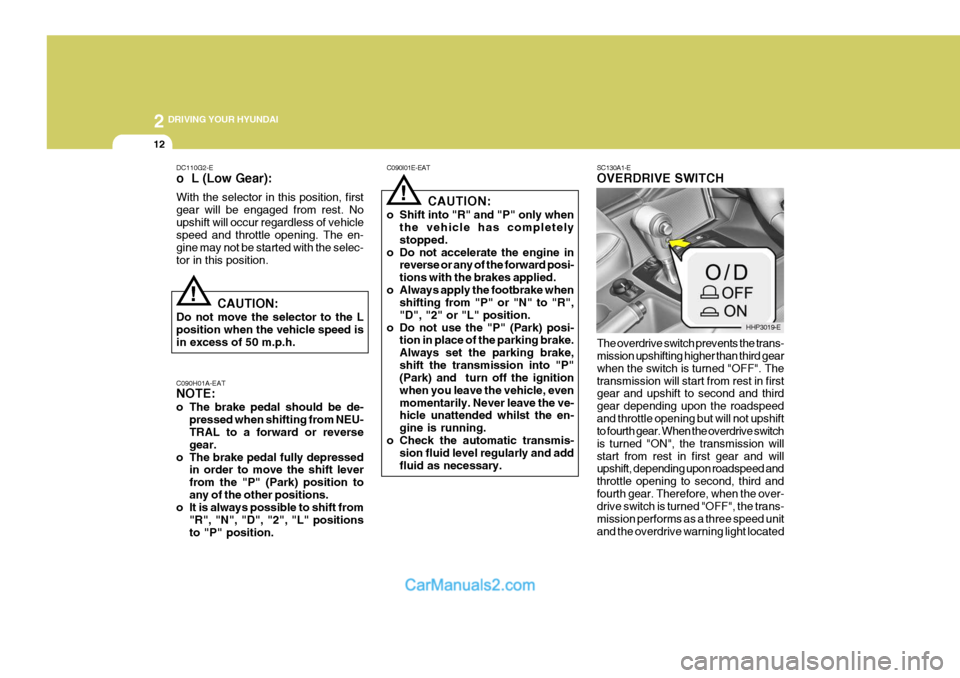
o Check the automatic transmis- sion fluid level regularly and addfluid as necessary. SC130A1-E OVERDRIVE SWITCH The overdrive switch prevents the trans- mission upshifting higher than third gear when the switch is turned "OFF". Thetransmission will start from rest in first gear and upshift to second and third gear depending upon the roadspeedand throttle opening but will not upshift to fourth gear. When the overdrive switch is turned "ON", the transmission willstart from rest in first gear and will upshift, depending upon roadspeed and throttle opening to second, third andfourth gear. Therefore, when the over- drive switch is turned "OFF", the trans- mission performs as a three speed unitand the overdrive warning light located
!
DC110G2-E o L (Low Gear): With the selector in this position, first gear will be engaged from rest. Noupshift will occur regardless of vehicle speed and throttle opening. The en- gine may not be started with the selec-tor in this position.
CAUTION:
Do not move the selector to the Lposition when the vehicle speed isin excess of 50 m.p.h. C090H01A-EAT NOTE:
o The brake pedal should be de- pressed when shifting from NEU- TRAL to a forward or reverse gear.
o The brake pedal fully depressed in order to move the shift leverfrom the "P" (Park) position toany of the other positions.
o It is always possible to shift from
"R", "N", "D", "2", "L" positionsto "P" position.
HHP3019-E
Page 426 of 539
2
DRIVING YOUR HYUNDAI
13
in the instrument cluster will be illumi- nated. When the overdrive switch isturned "ON", the transmission func- tions as a fully automatic four speed unit with the maximum fuel economypotential of the vehicle being realized. HPC120D2-E General Operating Instructions
o The button in the selector handle
must be depressed before the se- lector can be moved.
o The engine may only be started
when the selector is at position "P"or "N".
o Ensure that the footbrake is firmly
applied when shifting from "P" or"N" to "D", "2" or "L" and vice versa.
o Always engage the parking brake
when the vehicle is unattended,never use the "P" position in place of the parking brake.
o Under normal circumstances, the selector should be placed in the "D"position and the transmission al- lowed to select the most ideal ratiofor the circumstances. In this posi- tion maximum fuel economy will be achieved.
o When descending steep gradients where engine braking is required,the selector should be placed at the"2" or "L" position depending upon the vehicle speed. o When ascending steep gradients
using large throttle openings, the transmission may repeatedly change between two adjacent ratios. This is a normal characteristic and may beprevented by cancelling the over- drive facility if the shifting occurs between third and fourth ratios, se-lecting position "2" if the shifting occurs between third and second ratios or selecting position "1" if theshifting occurs between first and second ratios.
o Never move the selector to or from the "P" or "N" position with the accel-erator depressed.
o Ensure that the overdrive switch is at the "ON" position for maximumeconomy.
o If rapid acceleration is required, fully depress the accelerator pedal. Inthis condition, the kickdown mecha- nism will be operated and the trans-mission will automatically downshift according to the vehicle speed.
o The automatic transaxle may be used to great effect if the vehicle becomesstuck in snow or mud by allowing the vehicle to be rocked to and fro. Theengine speed should be held at ap-
Page 432 of 539
2
DRIVING YOUR HYUNDAI
19
!
(6) Since the driving torque is always
applied to the 4 wheels, the perfor- mance of the full-time 4WD vehicle is greatly affected by the condition of the tyres. Be sure to equip it withall four tyres of the same size and type.
o When replacement of any of the tyres or disc wheels is neces-sary, replace all of them.
o Rotate the tyres and check the tyre pressure at regular inter-vals.
WARNING:
Your vehicle is equipped with tyresdesigned to provide for safe ride and handling capability.Do not use a size and type of tyre and wheel that is different from the one that was originally installed on yourvehicle. It can affect the safety and performance of your vehicle, which could lead to handling failure orrollover and serious injury. When replacing the tyres, be sure to equip all four tyres with the tyre andwheel of the same size, type, tread, brand and load-carrying capacity. Ifyou nevertheless decide to equipyour vehicle with any tyre/wheel com- bination not recommended by Hyundai for off-road driving, youshould not use these tyres for high- way driving.
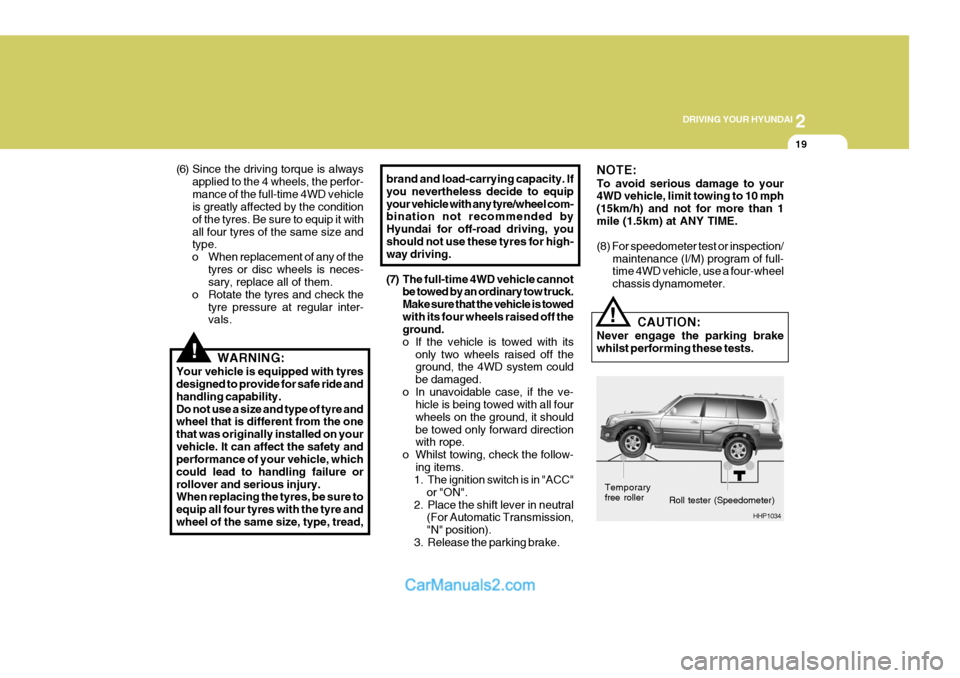
(7) The full-time 4WD vehicle cannot
be towed by an ordinary tow truck. Make sure that the vehicle is towedwith its four wheels raised off the ground.
o If the vehicle is towed with its
only two wheels raised off the ground, the 4WD system could be damaged.
o In unavoidable case, if the ve- hicle is being towed with all fourwheels on the ground, it shouldbe towed only forward direction with rope.
o Whilst towing, check the follow- ing items.
1. The ignition switch is in "ACC"
or "ON".
2. Place the shift lever in neutral (For Automatic Transmission, "N" position).
3. Release the parking brake. NOTE: To avoid serious damage to your 4WD vehicle, limit towing to 10 mph (15km/h) and not for more than 1mile (1.5km) at ANY TIME. (8) For speedometer test or inspection/
maintenance (I/M) program of full- time 4WD vehicle, use a four-wheel chassis dynamometer.
CAUTION:
Never engage the parking brakewhilst performing these tests.
Roll tester (Speedometer)
HHP1034
Temporary free roller
!
Page 433 of 539
2 DRIVING YOUR HYUNDAI
20
!
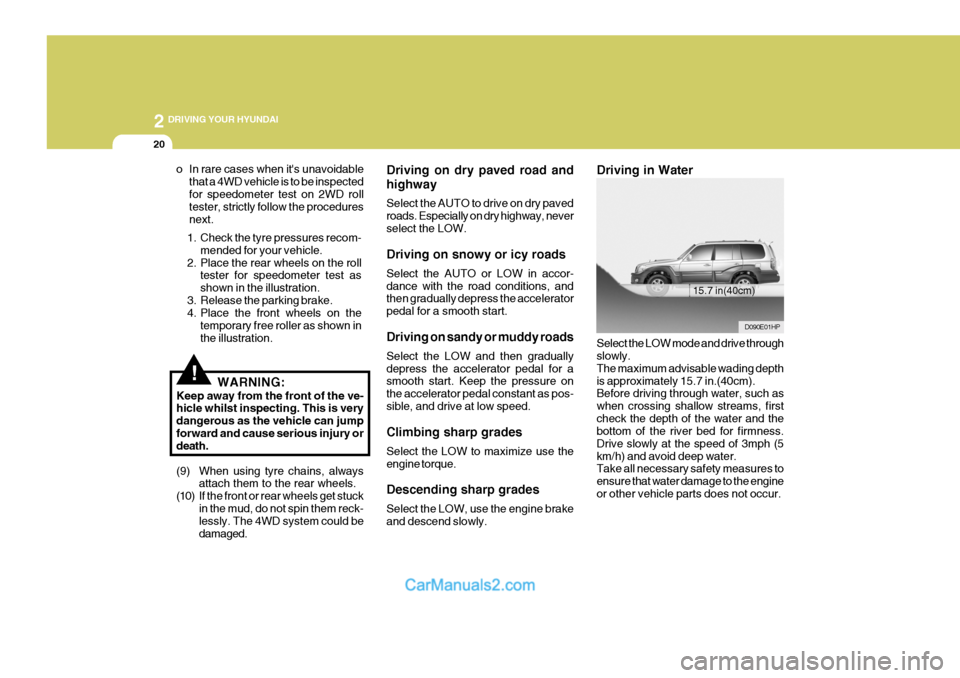
Driving in Water Select the LOW mode and drive through slowly. The maximum advisable wading depthis approximately 15.7 in.(40cm). Before driving through water, such as when crossing shallow streams, firstcheck the depth of the water and the bottom of the river bed for firmness. Drive slowly at the speed of 3mph (5km/h) and avoid deep water. Take all necessary safety measures to ensure that water damage to the engineor other vehicle parts does not occur.
o In rare cases when it's unavoidable
that a 4WD vehicle is to be inspectedfor speedometer test on 2WD roll tester, strictly follow the procedures next. Driving on dry paved road and highway Select the AUTO to drive on dry paved roads. Especially on dry highway, neverselect the LOW. Driving on snowy or icy roads Select the AUTO or LOW in accor- dance with the road conditions, and then gradually depress the accelerator pedal for a smooth start. Driving on sandy or muddy roads Select the LOW and then gradually depress the accelerator pedal for a smooth start. Keep the pressure on the accelerator pedal constant as pos-sible, and drive at low speed. Climbing sharp grades Select the LOW to maximize use the engine torque. Descending sharp grades Select the LOW, use the engine brake and descend slowly.
D090E01HP
15.7 in(40cm)
1. Check the tyre pressures recom-
mended for your vehicle.
2. Place the rear wheels on the roll tester for speedometer test as shown in the illustration.
3. Release the parking brake.
4. Place the front wheels on the
temporary free roller as shown in the illustration.
WARNING:
Keep away from the front of the ve- hicle whilst inspecting. This is very dangerous as the vehicle can jumpforward and cause serious injury or death.
(9) When using tyre chains, always attach them to the rear wheels.
(10) If the front or rear wheels get stuck in the mud, do not spin them reck- lessly. The 4WD system could be damaged.
Page 436 of 539
2
DRIVING YOUR HYUNDAI
23
brake pedal several times whilst driv- ing slowly.
o Apply the parking brake only when the vehicle is at rest.
o Since the power assistance pro-
vided by the brake servo is derived from the engine, coasting with the engine turned off or towing of thevehicle with the engine turned off will result in greatly increased pedal pressures being required to stop thevehicle.
o Do not hold the vehicle on the up-
grade with the accelerator pedal.This can cause the transmission to overheat. Always use the brake pedal or parking brake.DRIVING FOR ECONOMY
C140A01A-EAT You can save fuel and get more miles from your car if you follow these sug-gestions:
o Drive smoothly. Accelerate at a moderate rate. Don't make "jack- rabbit" starts or full-throttle shifts and maintain a steady cruisingspeed. Don't race between stop- lights. Try to adjust your speed to that of the other traffic so you don'thave to change speeds unneces- sarily. Avoid heavy traffic whenever possible. Always maintain a safedistance from other vehicles so you can avoid unnecessary braking. This also reduces brake wear.
o Drive at a moderate speed. The faster you drive, the more fuel yourcar uses. Driving at a moderatespeed, especially on the highway, is one of the most effective ways to reduce fuel consumption.
o Don't "ride" the brake or clutch pedal. This can increase fuel consumptionand also increase wear on thesecomponents. In addition, driving with your foot resting on the brake pedal may cause the brakes to overheat, which reduces their effectivenessand may lead to more serious conse-quences.
o Take care of your tyres. Keep them
inflated to the recommended pres-sure. Incorrect inflation, either too much or too little, results in unnec- essary tyre wear. Check the tyrepressures at least once a month.
o Be sure that the wheels are aligned
correctly. Improper alignment canresult from hitting curbs or driving too fast over irregular surfaces. Poor alignment causes faster tyre wearand may also result in other prob- lems as well as greater fuel con- sumption.
o Keep your car in good condition. For better fuel economy and reducedmaintenance costs, maintain yourcar in accordance with the mainte- nance schedule in Section 5. If you drive your car in severe conditions,more frequent maintenance is re- quired (see Section 5 for details).
o Keep your car clean. For maximum service, your Hyundai should bekept clean and free of corrosive materials. It is especially importantthat mud, dirt, ice, etc. not be al-