Page 235 of 539
6
DO-IT-YOURSELF MAINTENANCE
13
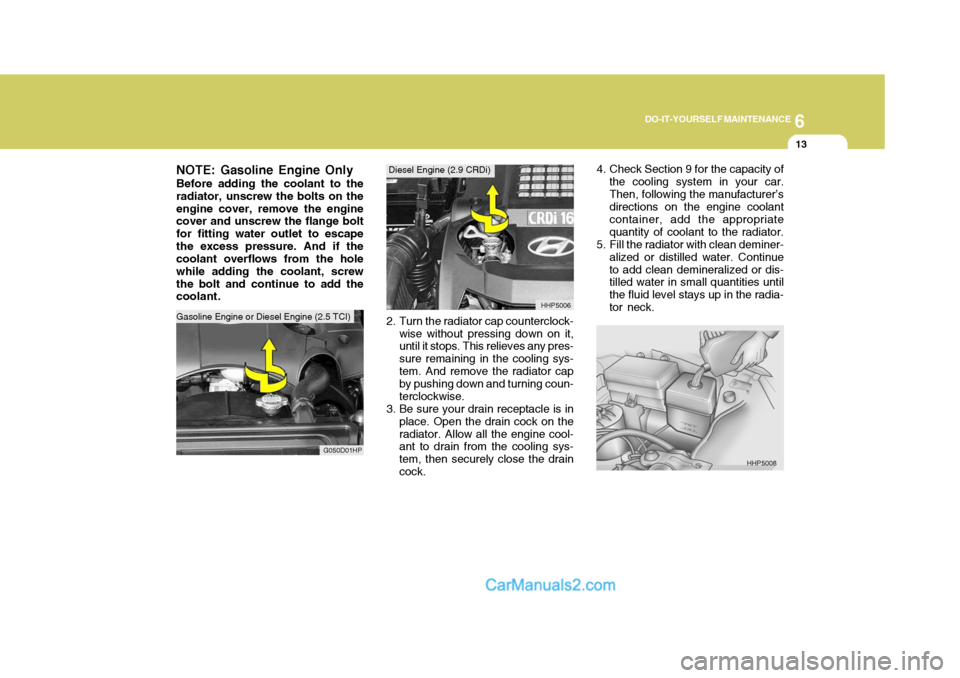
NOTE: Gasoline Engine Only Before adding the coolant to the radiator, unscrew the bolts on theengine cover, remove the engine cover and unscrew the flange bolt for fitting water outlet to escapethe excess pressure. And if the coolant overflows from the hole while adding the coolant, screwthe bolt and continue to add the coolant.
G050D01HP 2. Turn the radiator cap counterclock-
wise without pressing down on it, until it stops. This relieves any pres- sure remaining in the cooling sys- tem. And remove the radiator cap by pushing down and turning coun-terclockwise.
3. Be sure your drain receptacle is in place. Open the drain cock on theradiator. Allow all the engine cool- ant to drain from the cooling sys- tem, then securely close the draincock. HHP5006
4. Check Section 9 for the capacity of
the cooling system in your car.Then, following the manufacturer’s directions on the engine coolant container, add the appropriatequantity of coolant to the radiator.
5. Fill the radiator with clean deminer-
alized or distilled water. Continueto add clean demineralized or dis- tilled water in small quantities until the fluid level stays up in the radia-tor neck.
HHP5008
Gasoline Engine or Diesel Engine (2.5 TCI) Diesel Engine (2.9 CRDi)
Gasoline Engine or Diesel Engine (2.5 TCI)
Page 236 of 539
6 DO-IT-YOURSELF MAINTENANCE
14SPARK PLUGS
!
G060A01HP-GAT
(Gasoline Engine Only)
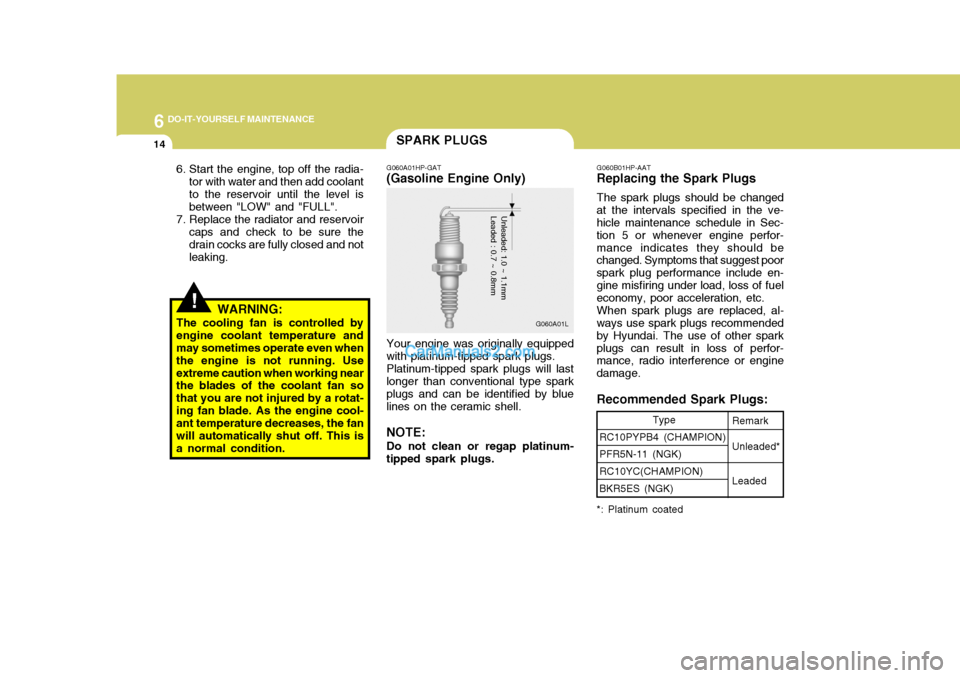
Your engine was originally equipped
with platinum-tipped spark plugs.
Platinum-tipped spark plugs will last
longer than conventional type spark plugs and can be identified by blue lines on the ceramic shell.
NOTE: Do not clean or regap platinum-
tipped spark plugs.
Unleaded: 1.0 ~ 1.1mm Leaded : 0.7 ~ 0.8mm
Type
RC10PYPB4 (CHAMPION) PFR5N-11 (NGK) RC10YC(CHAMPION)BKR5ES (NGK)
G060B01HP-AAT
Replacing the Spark Plugs
The spark plugs should be changed
at the intervals specified in the ve- hicle maintenance schedule in Sec- tion 5 or whenever engine perfor-mance indicates they should be changed. Symptoms that suggest poor spark plug performance include en-gine misfiring under load, loss of fuel economy, poor acceleration, etc.
When spark plugs are replaced, al-
ways use spark plugs recommended by Hyundai. The use of other sparkplugs can result in loss of perfor- mance, radio interference or engine damage. Recommended Spark Plugs:Remark Unleaded* Leaded
*: Platinum coated
6. Start the engine, top off the radia- tor with water and then add coolant to the reservoir until the level is between "LOW" and "FULL".
7. Replace the radiator and reservoir caps and check to be sure thedrain cocks are fully closed and not leaking.
WARNING:
The cooling fan is controlled byengine coolant temperature and may sometimes operate even when the engine is not running. Useextreme caution when working near the blades of the coolant fan so that you are not injured by a rotat-ing fan blade. As the engine cool- ant temperature decreases, the fan will automatically shut off. This isa normal condition. G060A01L
Page 240 of 539
6 DO-IT-YOURSELF MAINTENANCE
18
!
CHECKING THE TRANSMIS- SION OIL (MANUAL)FILLING THE WASHER RES- ERVOIR
CAUTION:
o Radiator antifreeze (engine cool- ant) should not be used in the washer system because it will damage the car's finish.
o The washer should not be oper- ated if the washer reservoir isempty. This can damage the washer fluid pump.
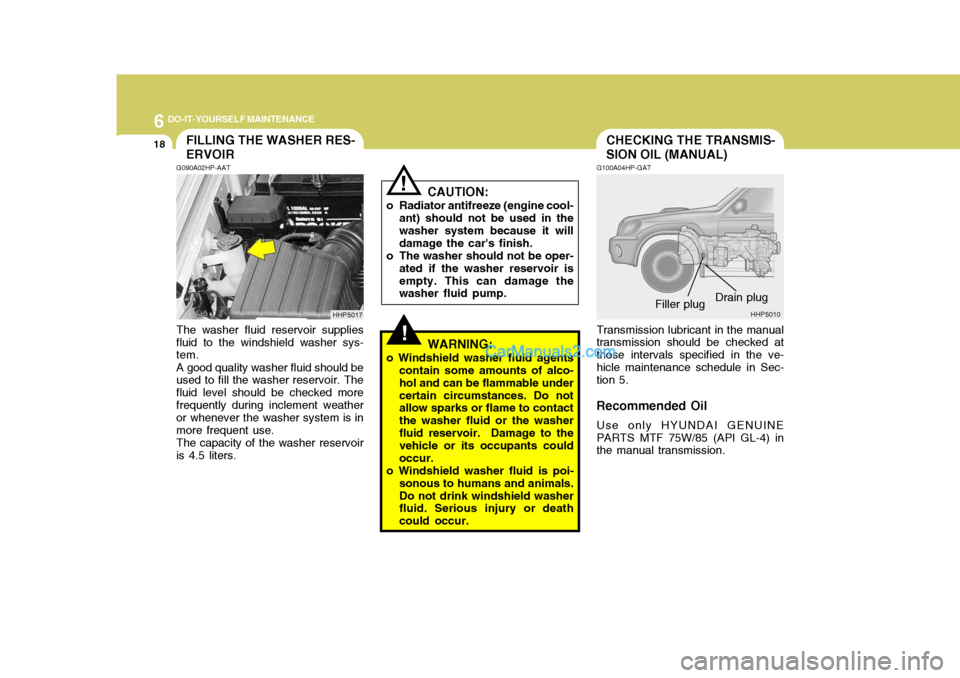
! G100A04HP-GAT Transmission lubricant in the manual transmission should be checked at those intervals specified in the ve-hicle maintenance schedule in Sec- tion 5.
Recommended Oil Use only HYUNDAI GENUINE PARTS MTF 75W/85 (API GL-4) in the manual transmission. Drain plug
G090A02HP-AAT The washer fluid reservoir supplies fluid to the windshield washer sys- tem. A good quality washer fluid should be used to fill the washer reservoir. The fluid level should be checked morefrequently during inclement weather or whenever the washer system is in more frequent use. The capacity of the washer reservoir is 4.5 liters. HHP5017
HHP5010
Filler plug
WARNING:
o Windshield washer fluid agents contain some amounts of alco- hol and can be flammable undercertain circumstances. Do not allow sparks or flame to contact the washer fluid or the washerfluid reservoir. Damage to the vehicle or its occupants could occur.
o Windshield washer fluid is poi- sonous to humans and animals.Do not drink windshield washer fluid. Serious injury or death could occur.
Page 241 of 539
6
DO-IT-YOURSELF MAINTENANCE
19
Manual Transmission Oil Capac- ity
The oil capacity of the manual trans-
mission is;
WARNING:
It is always better to check the
transmission oil level when the engine is cool or cold. If the en- gine is hot, you should exercise great caution to avoid burningyourself on hot engine or exhaust parts.
!
Engine GasolineDiesel (2.9 CRDi)Diesel (2.5 TCI) Capacity 3.2 liters 2.5 liters
G100B01HP-GAT
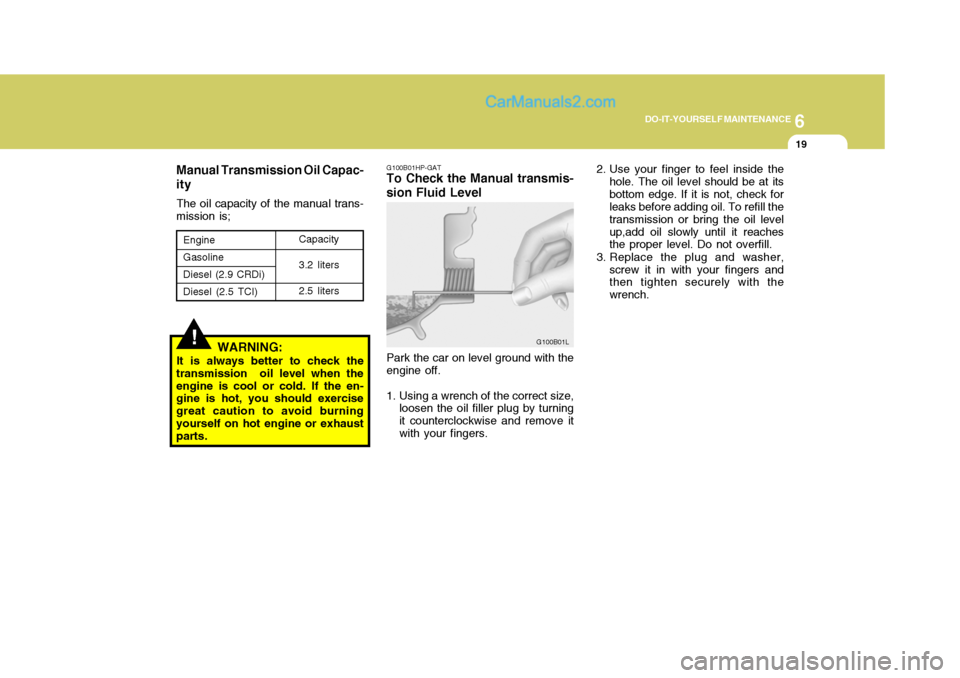
To Check the Manual transmis- sion Fluid Level
Park the car on level ground with the engine off.
1. Using a wrench of the correct size, loosen the oil filler plug by turningit counterclockwise and remove itwith your fingers. G100B01L2. Use your finger to feel inside the
hole. The oil level should be at itsbottom edge. If it is not, check for leaks before adding oil. To refill the transmission or bring the oil levelup,add oil slowly until it reaches the proper level. Do not overfill.
3. Replace the plug and washer, screw it in with your fingers andthen tighten securely with the wrench.
Page 242 of 539
6 DO-IT-YOURSELF MAINTENANCE
20CHECKING THE TRANSMIS- SION FLUID (AUTOMATIC)
!
G110B02HP-GAT
Recommended Fluid
Your Hyundai automatic transmission
is specially designed to operate with MOBIL DEXRON-II. Damage caused by a nonspecified fluid is not coveredby your new vehicle limited warranty.
G110C03HP-GAT
Transmission Fluid Capacity
The fluid capacity of the automatic
transmission is;
WARNING:
The transmission fluid level should
be checked when the engine is at normal operating temperature. This means that the engine, radiator,exhaust system etc., are very hot. Exercise great care not to burn yourself during this procedure. G110D02HP-GAT
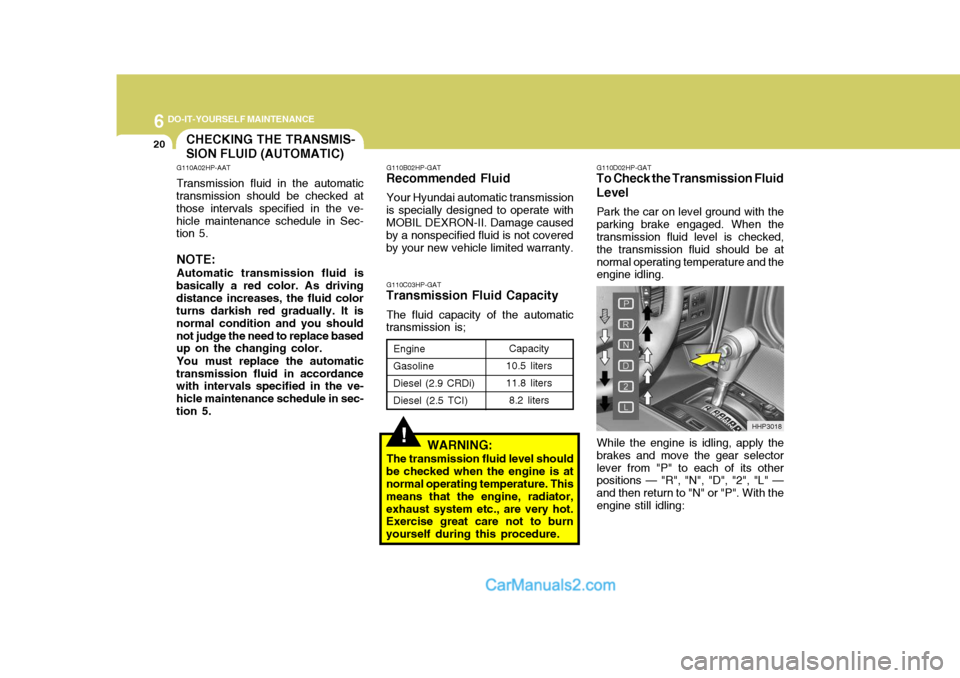
To Check the Transmission Fluid Level
Park the car on level ground with the parking brake engaged. When the transmission fluid level is checked, the transmission fluid should be atnormal operating temperature and the engine idling.
While the engine is idling, apply the
brakes and move the gear selector lever from "P" to each of its other positions — "R", "N", "D", "2", "L" — and then return to "N" or "P". With theengine still idling:
G110A02HP-AAT Transmission fluid in the automatic
transmission should be checked at those intervals specified in the ve-hicle maintenance schedule in Sec- tion 5.
NOTE: Automatic transmission fluid is
basically a red color. As driving distance increases, the fluid color turns darkish red gradually. It is normal condition and you shouldnot judge the need to replace based up on the changing color.
You must replace the automatic
transmission fluid in accordancewith intervals specified in the ve- hicle maintenance schedule in sec-tion 5.
Engine GasolineDiesel (2.9 CRDi)Diesel (2.5 TCI) Capacity
10.5 liters11.8 liters 8.2 liters
HHP3018
Page 243 of 539
6
DO-IT-YOURSELF MAINTENANCE
21
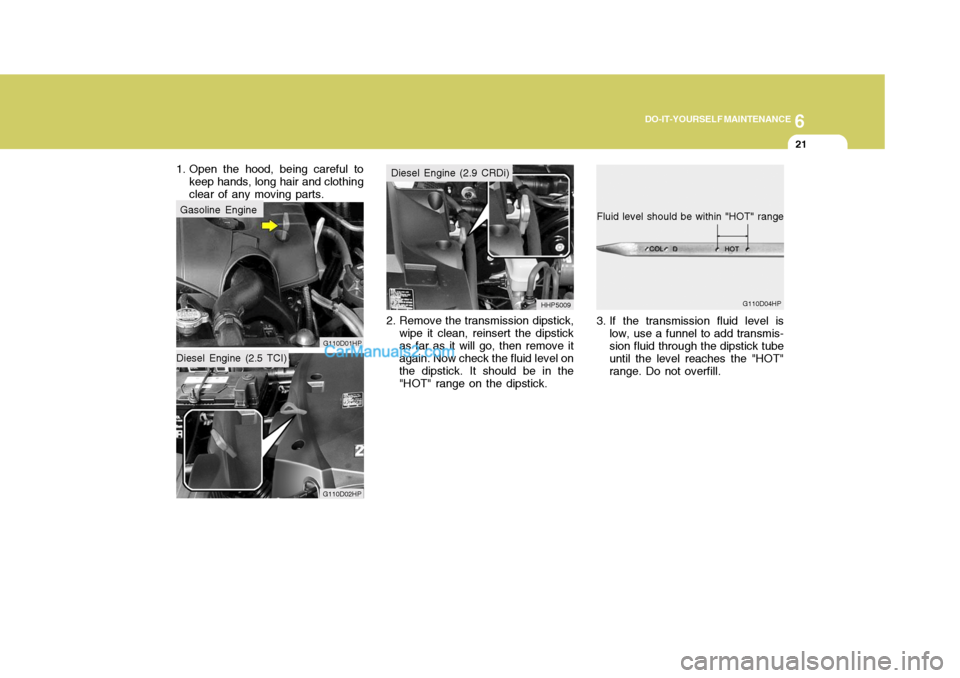
1. Open the hood, being careful to
keep hands, long hair and clothing clear of any moving parts.
2. Remove the transmission dipstick,wipe it clean, reinsert the dipstickas far as it will go, then remove it again. Now check the fluid level on the dipstick. It should be in the"HOT" range on the dipstick. HHP5009
G110D01HP
G110D02HP Fluid level should be within "HOT" range
3. If the transmission fluid level is
low, use a funnel to add transmis- sion fluid through the dipstick tube until the level reaches the "HOT" range. Do not overfill. G110D04HP
Diesel Engine (2.5 TCI)Gasoline Engine
Diesel Engine (2.9 CRDi)
Page 244 of 539
6 DO-IT-YOURSELF MAINTENANCE
22CHECKING THE BRAKES
!
G120A01A-AAT
CAUTION:
Because brakes are essential to the safe operation of the car, it issuggested that they be checked and inspected by your Hyundai dealer. The brakes should bechecked and inspected for wear at those intervals specified in the vehicle maintenance schedule inSection 5.!!WARNING:
The cooling fan is controlled by engine coolant temperature and may sometimes operate even whenthe engine is not running. Use extreme caution when working near the blades of the cooling fan, sothat you are not injured by a rotat- ing fan blade. As the engine cool- ant temperature decreases, the fanwill automatically shut off. This is a normal condition. WARNING (Diesel only):
Never work on injection system
with engine running or within 30 seconds after shutting off engine. High pressure pump, rail, injec- tors and high pressure pipes aresubjected to high pressure even after the engine has been switched off. The fuel jet produced by fuelleaks may cause serious injury, if it contacts with the body. People using pacemakers should notmove closer than 30cm to the ECU or wiring harness within the en- gine room with the engine run-ning, since the high currents in the Common Rail system produce considerable magnetic fields.
Page 246 of 539
6 DO-IT-YOURSELF MAINTENANCE
24AIR CONDITIONING CARECHECKING THE CLUTCH FLUID
G140A01A-AAT
Keeping the Condenser Clean
The air conditioning condenser (and
engine radiator) should be checked periodically for accumulation of dirt, dead insects, leaves, etc. These caninterfere with maximum cooling effi- ciency. When removing such accu- mulations, brush or hose them awaycarefully to avoid bending the cooling fans.
!
G130A01A-AAT
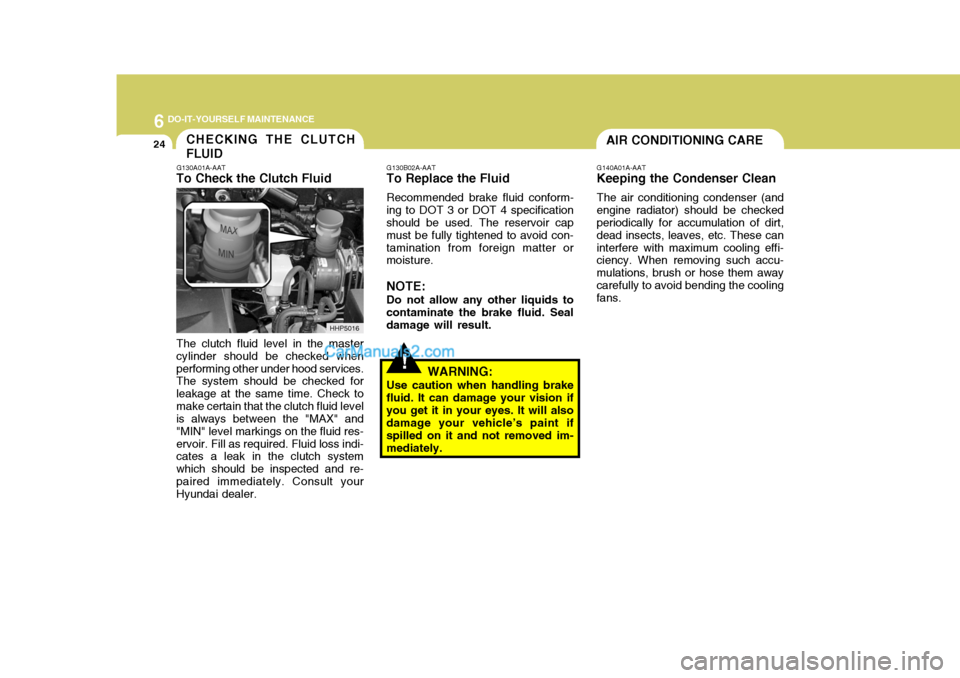
To Check the Clutch Fluid The clutch fluid level in the master cylinder should be checked whenperforming other under hood services. The system should be checked for leakage at the same time. Check tomake certain that the clutch fluid level is always between the "MAX" and "MIN" level markings on the fluid res-ervoir. Fill as required. Fluid loss indi- cates a leak in the clutch system which should be inspected and re-paired immediately. Consult your Hyundai dealer. G130B02A-AAT
To Replace the Fluid
Recommended brake fluid conform-
ing to DOT 3 or DOT 4 specificationshould be used. The reservoir cap must be fully tightened to avoid con-tamination from foreign matter or moisture.
NOTE: Do not allow any other liquids to
contaminate the brake fluid. Seal damage will result.
WARNING:
Use caution when handling brake
fluid. It can damage your vision ifyou get it in your eyes. It will also damage your vehicle’s paint if spilled on it and not removed im-mediately.
HHP5016