2005 Hyundai Terracan torque
[x] Cancel search: torquePage 232 of 539
6 DO-IT-YOURSELF MAINTENANCE
10CHANGING THE ENGINE OIL AND FILTER
!
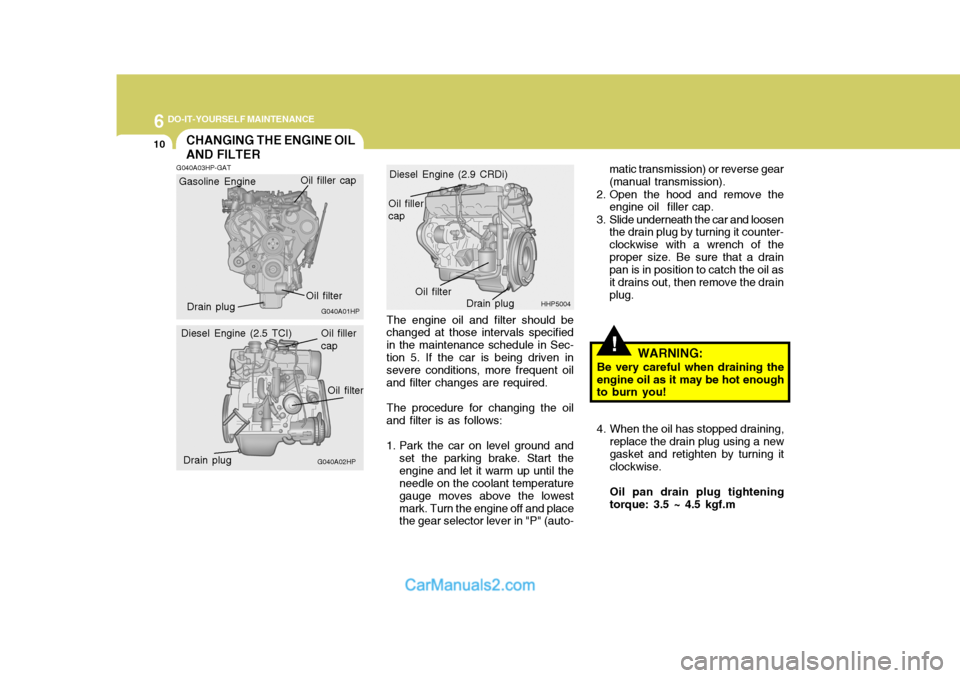
The engine oil and filter should be changed at those intervals specified in the maintenance schedule in Sec- tion 5. If the car is being driven in severe conditions, more frequent oiland filter changes are required. The procedure for changing the oil and filter is as follows:
1. Park the car on level ground and set the parking brake. Start the engine and let it warm up until the needle on the coolant temperature gauge moves above the lowestmark. Turn the engine off and place the gear selector lever in "P" (auto- WARNING:
Be very careful when draining the engine oil as it may be hot enough to burn you!
4. When the oil has stopped draining, replace the drain plug using a new gasket and retighten by turning itclockwise. Oil pan drain plug tightening torque: 3.5 ~ 4.5 kgf.m
G040A03HP-GAT
HHP5004
G040A01HP
G040A02HP matic transmission) or reverse gear (manual transmission).
2. Open the hood and remove the engine oil filler cap.
3. Slide underneath the car and loosen the drain plug by turning it counter-clockwise with a wrench of theproper size. Be sure that a drain pan is in position to catch the oil as it drains out, then remove the drainplug.
Diesel Engine (2.9 CRDi)
Diesel Engine (2.5 TCI)
Gasoline Engine
Oil filter
Drain plug Oil filler cap
Oil filler cap
Oil filter
Drain plug Oil filler cap
Oil filter
Drain plug
Page 233 of 539
6
DO-IT-YOURSELF MAINTENANCE
11CHECKING AND CHANGING THE ENGINE COOLANT
!
G050A01A-AAT
WARNING:
Do not remove the radiator cap when the engine is hot. When the engine is hot, the engine coolantis under pressure and may erupt through the opening if the cap is removed. You could be seriouslyburned if you do not observe this precaution. Do not remove the radiator cap until the radiator iscool to touch.
!
5. Remove the oil filter by turning it counterclockwise with a oil filter wrench of the proper size. A cer- tain amount of oil will come out when you remove the filter. So besure to have your drain pan in place underneath it.
6. Install a new oil filter in accordance with the instructions on the cartonor on the filter itself. Do not over- tighten (Tightening torque: Gaso-
line- 1.2 ~ 1.6 kgf.m, Diesel - 2.3 ~ 2.5 kgf.m) . Be sure that the
mounting surface on the engine is clean and that the old gasket is removed completely. Lubricate the new gasket on the filter with cleanengine oil before installation.
7. Remove the engine oil level dip- stick.
8. Refill the crankcase with the rec- ommended engine oil slowly. Referto the specification in chapter 9 for engine oil capacity.
! CAUTION:
Slowly pour the recommended oil by using a funnel. Do not overfill not to damage the engine. 9. Start the engine and check to be
sure no oil is leaking from thedrain plug or oil filter.
10.Shut off the engine and recheck
the oil level.
NOTE: Always dispose of used engine oil
in an environmentally acceptable manner. It is suggested that it be placed in a sealed container andtaken to a service station for recla- mation. Do not pour the oil on the ground or put it into the house-hold trash.
WARNING:
Used motor oil may cause irrita-
tion or cancer of the skin if left incontact with the skin for prolongedperiods of time. Wash your hands thoroughly with soap and warm water as soon as possible afterhandling used oil.
Page 280 of 539
8
CONSUMER INFORMATION
5
!
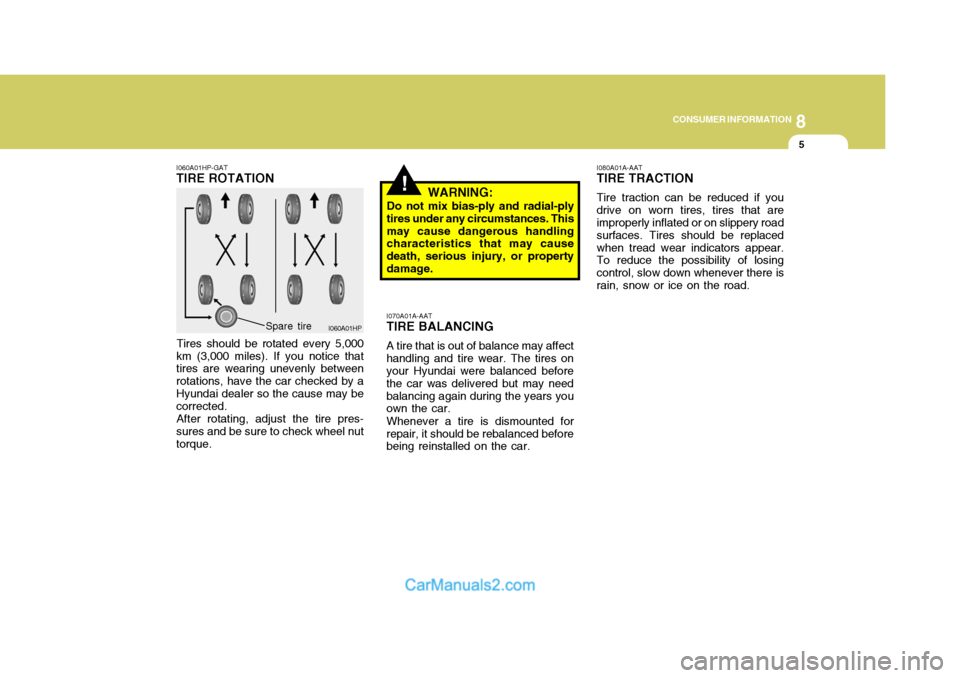
I060A01HP-GAT TIRE ROTATION
Tires should be rotated every 5,000
km (3,000 miles). If you notice that tires are wearing unevenly between rotations, have the car checked by aHyundai dealer so the cause may be corrected.
After rotating, adjust the tire pres-
sures and be sure to check wheel nut torque. I060A01HP
Spare tire WARNING:
Do not mix bias-ply and radial-ply
tires under any circumstances. This may cause dangerous handling characteristics that may cause death, serious injury, or propertydamage.
I070A01A-AAT TIRE BALANCING A tire that is out of balance may affect handling and tire wear. The tires on your Hyundai were balanced before the car was delivered but may needbalancing again during the years you own the car. Whenever a tire is dismounted for repair, it should be rebalanced before being reinstalled on the car. I080A01A-AAT TIRE TRACTION Tire traction can be reduced if you drive on worn tires, tires that are improperly inflated or on slippery road surfaces. Tires should be replacedwhen tread wear indicators appear. To reduce the possibility of losing control, slow down whenever there israin, snow or ice on the road.
Page 430 of 539
2
DRIVING YOUR HYUNDAI
17
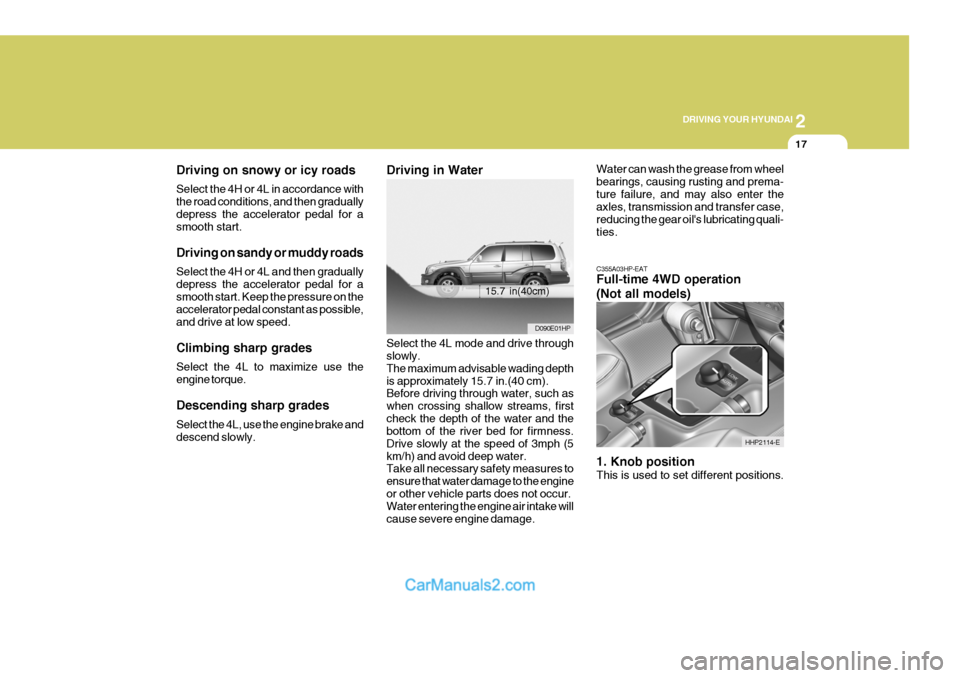
C355A03HP-EAT Full-time 4WD operation (Not all models) 1. Knob position This is used to set different positions.
15.7 in(40cm) D090E01HP
HHP2114-E
Driving on snowy or icy roads Select the 4H or 4L in accordance with the road conditions, and then graduallydepress the accelerator pedal for a smooth start. Driving on sandy or muddy roads Select the 4H or 4L and then gradually depress the accelerator pedal for asmooth start. Keep the pressure on the accelerator pedal constant as possible, and drive at low speed. Climbing sharp grades Select the 4L to maximize use the engine torque. Descending sharp grades Select the 4L, use the engine brake and descend slowly.
Driving in Water
Water can wash the grease from wheelbearings, causing rusting and prema-ture failure, and may also enter the axles, transmission and transfer case, reducing the gear oil's lubricating quali-ties.
Select the 4L mode and drive through slowly. The maximum advisable wading depthis approximately 15.7 in.(40 cm). Before driving through water, such as when crossing shallow streams, firstcheck the depth of the water and the bottom of the river bed for firmness. Drive slowly at the speed of 3mph (5km/h) and avoid deep water. Take all necessary safety measures to ensure that water damage to the engineor other vehicle parts does not occur. Water entering the engine air intake will cause severe engine damage.
Page 432 of 539
2
DRIVING YOUR HYUNDAI
19
!
(6) Since the driving torque is always
applied to the 4 wheels, the perfor- mance of the full-time 4WD vehicle is greatly affected by the condition of the tyres. Be sure to equip it withall four tyres of the same size and type.
o When replacement of any of the tyres or disc wheels is neces-sary, replace all of them.
o Rotate the tyres and check the tyre pressure at regular inter-vals.
WARNING:
Your vehicle is equipped with tyresdesigned to provide for safe ride and handling capability.Do not use a size and type of tyre and wheel that is different from the one that was originally installed on yourvehicle. It can affect the safety and performance of your vehicle, which could lead to handling failure orrollover and serious injury. When replacing the tyres, be sure to equip all four tyres with the tyre andwheel of the same size, type, tread, brand and load-carrying capacity. Ifyou nevertheless decide to equipyour vehicle with any tyre/wheel com- bination not recommended by Hyundai for off-road driving, youshould not use these tyres for high- way driving.
(7) The full-time 4WD vehicle cannot
be towed by an ordinary tow truck. Make sure that the vehicle is towedwith its four wheels raised off the ground.
o If the vehicle is towed with its
only two wheels raised off the ground, the 4WD system could be damaged.
o In unavoidable case, if the ve- hicle is being towed with all fourwheels on the ground, it shouldbe towed only forward direction with rope.
o Whilst towing, check the follow- ing items.
1. The ignition switch is in "ACC"
or "ON".
2. Place the shift lever in neutral (For Automatic Transmission, "N" position).
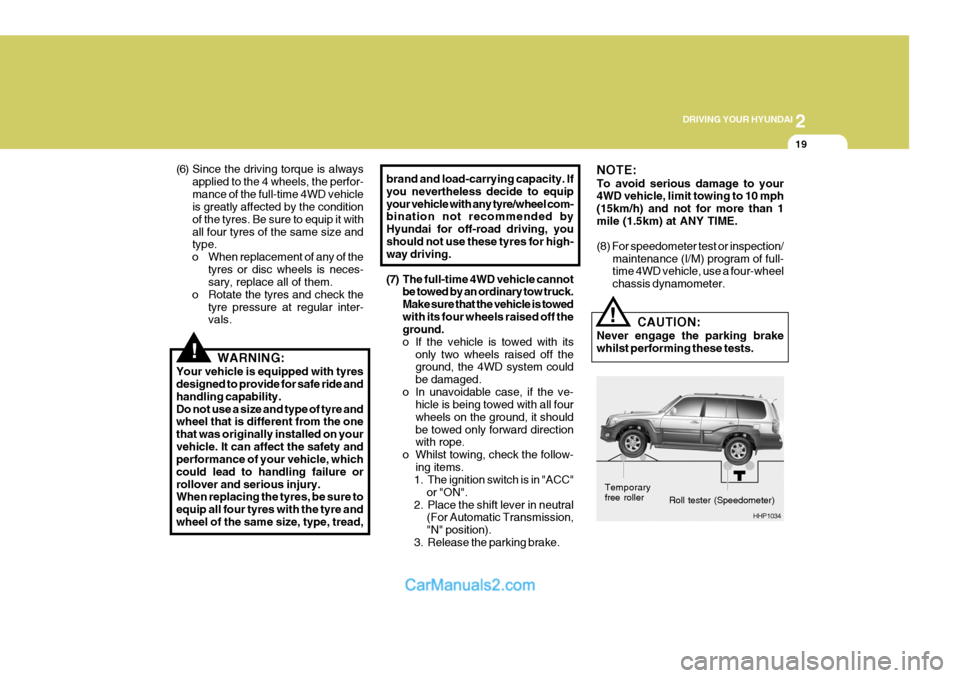
3. Release the parking brake. NOTE: To avoid serious damage to your 4WD vehicle, limit towing to 10 mph (15km/h) and not for more than 1mile (1.5km) at ANY TIME. (8) For speedometer test or inspection/
maintenance (I/M) program of full- time 4WD vehicle, use a four-wheel chassis dynamometer.
CAUTION:
Never engage the parking brakewhilst performing these tests.
Roll tester (Speedometer)
HHP1034
Temporary free roller
!
Page 433 of 539
2 DRIVING YOUR HYUNDAI
20
!
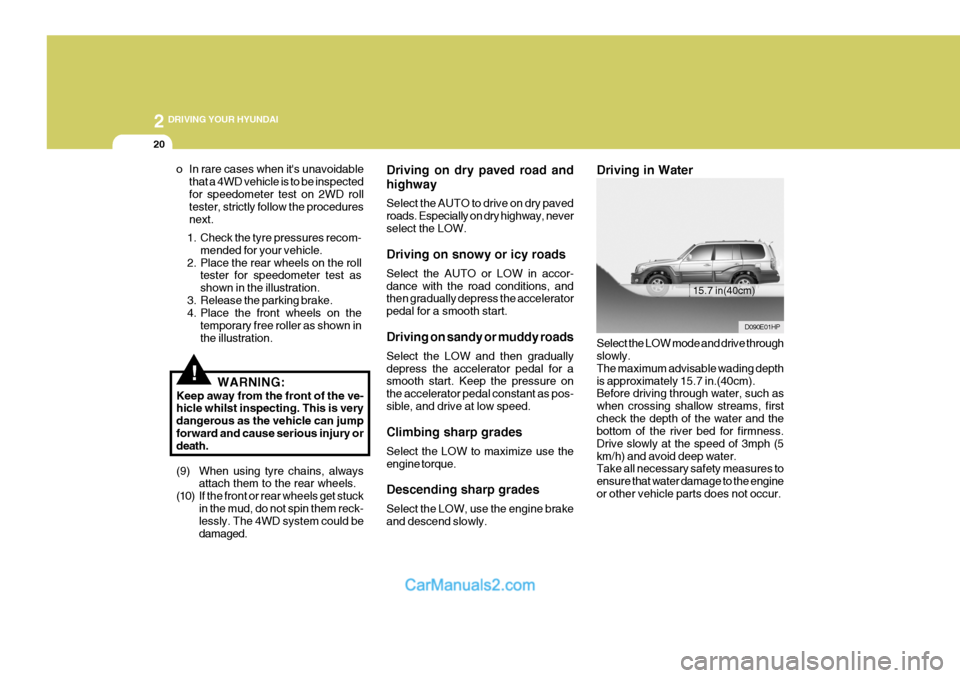
Driving in Water Select the LOW mode and drive through slowly. The maximum advisable wading depthis approximately 15.7 in.(40cm). Before driving through water, such as when crossing shallow streams, firstcheck the depth of the water and the bottom of the river bed for firmness. Drive slowly at the speed of 3mph (5km/h) and avoid deep water. Take all necessary safety measures to ensure that water damage to the engineor other vehicle parts does not occur.
o In rare cases when it's unavoidable
that a 4WD vehicle is to be inspectedfor speedometer test on 2WD roll tester, strictly follow the procedures next. Driving on dry paved road and highway Select the AUTO to drive on dry paved roads. Especially on dry highway, neverselect the LOW. Driving on snowy or icy roads Select the AUTO or LOW in accor- dance with the road conditions, and then gradually depress the accelerator pedal for a smooth start. Driving on sandy or muddy roads Select the LOW and then gradually depress the accelerator pedal for a smooth start. Keep the pressure on the accelerator pedal constant as pos-sible, and drive at low speed. Climbing sharp grades Select the LOW to maximize use the engine torque. Descending sharp grades Select the LOW, use the engine brake and descend slowly.
D090E01HP
15.7 in(40cm)
1. Check the tyre pressures recom-
mended for your vehicle.
2. Place the rear wheels on the roll tester for speedometer test as shown in the illustration.
3. Release the parking brake.
4. Place the front wheels on the
temporary free roller as shown in the illustration.
WARNING:
Keep away from the front of the ve- hicle whilst inspecting. This is very dangerous as the vehicle can jumpforward and cause serious injury or death.
(9) When using tyre chains, always attach them to the rear wheels.
(10) If the front or rear wheels get stuck in the mud, do not spin them reck- lessly. The 4WD system could be damaged.
Page 435 of 539
2 DRIVING YOUR HYUNDAI
22EFFECTIVE BRAKING
HPC140A1-E Braking system performance and fric- tion material life are greatly affected by the driving style adopted. The follow- ing suggestions are made to assist inachieving the best results from the braking system.
o Anticipate the road and conditions ahead in order that heavy braking may be avoided.
o When descending long gradients, use the engine to assist in retardingthe vehicle to minimize the possibil-ity of brake fade occurring.
o When trailer towing, ensure that the
trailer brakes function correctly anduse engine braking to assist the vehicle braking system.
o Use only genuine Hyundai replace- ment brake pads and shoes to en-sure consistent friction characteris- tics and wear rates.
o After driving through deep water (e.g. fording), the brakes may becomewet and performance reduced. Al-ways check brake efficiency after emerging from the water and dry the brakes by lightly depressing theLIMITED-SLIP DIFFEREN- TIAL
D190A01HP-EAT (Not all models) A limited-slip differential, if equipped, is for the rear wheel differential only.The features of this limited-slip differ- ential are described below: Just as with a conventional differential,the wheel on one side is allowed to turn at a different speed from the wheel on the other side when the vehicle iscornering. The difference between the limited-slip differential and a conven- tional differential is that if the wheel onone side of the vehicle loses traction, a greater amount of torque is applied to the rear wheel on the other side toimprove traction.
gency braking, always maintain a safe distance between you and ob- jects ahead. Vehicle speeds should always be reduced during extremeroad conditions. The braking distance for cars equipped with an anti-lock brakingsystem may be longer than for those without it in the following road con- ditions.
o Driving on rough, gravel or snow-
covered roads.
o Driving with tire chains installed.
o Driving on roads where the road surface is pitted or has different surface height.
These roads should be driven atreduced speeds. The safety features of an ABS equipped vehicle should not be tested by high speed drivingor cornering. This could endanger the safety of yourself or others.
! CAUTION:
o Never start the engine with the gearshift lever placed in the for- ward or reverse whilst one of therear wheels is jacked up and the other in contact with the ground; doing so may cause the vehicle tojump forward.
o Use only recommended oil for
LSD in the rear axle.See page 9-5 for the recommended oil descriptions.
Page 451 of 539
3
IN CASE OF EMERGENCY
7
!
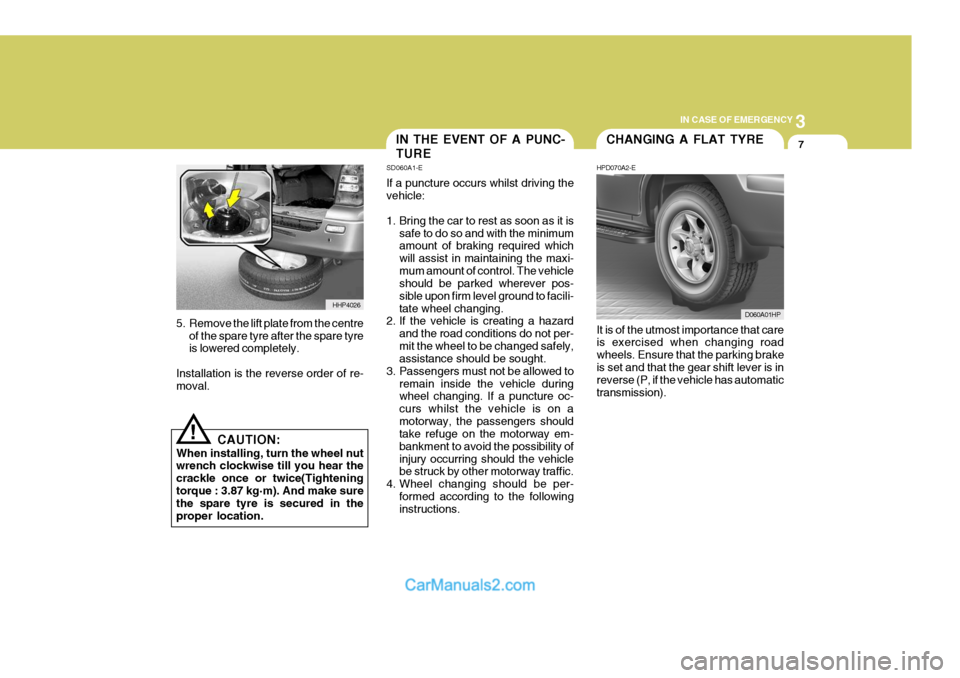
5. Remove the lift plate from the centre
of the spare tyre after the spare tyre is lowered completely.
Installation is the reverse order of re-moval.
CAUTION:
When installing, turn the wheel nutwrench clockwise till you hear the crackle once or twice(Tighteningtorque : 3.87 kg·m). And make sure the spare tyre is secured in the proper location. It is of the utmost importance that care is exercised when changing road wheels. Ensure that the parking brakeis set and that the gear shift lever is in reverse (P, if the vehicle has automatic transmission).
HHP4026
IN THE EVENT OF A PUNC- TURE
SD060A1-E If a puncture occurs whilst driving the vehicle:
1. Bring the car to rest as soon as it is
safe to do so and with the minimum amount of braking required which will assist in maintaining the maxi-mum amount of control. The vehicle should be parked wherever pos- sible upon firm level ground to facili-tate wheel changing.
2. If the vehicle is creating a hazard
and the road conditions do not per-mit the wheel to be changed safely, assistance should be sought.
3. Passengers must not be allowed to remain inside the vehicle duringwheel changing. If a puncture oc- curs whilst the vehicle is on amotorway, the passengers should take refuge on the motorway em- bankment to avoid the possibility ofinjury occurring should the vehicle be struck by other motorway traffic.
4. Wheel changing should be per- formed according to the followinginstructions.CHANGING A FLAT TYRE
HPD070A2-E
D060A01HP