Page 205 of 271
6
DO-IT-YOURSELF MAINTENANCE
7
!
3. Slide underneath the car and loosen the
drain plug by turning it counterclockwise with
a wrench of the proper size. Be sure that a
drain pan is in position to catch the oil as it
drains out, then remove the drain plug.
4. When the oil has stopped draining, replace
the drain plug using a new gasket and re-
tighten by turning it clockwise.
Oil pan drain plug tightening torque:
25.3 ~ 32.5 lb.ft (3.5 ~ 4.5 kgf.m)
HNF5006-1
(2.4L)
(3.3L) The engine oil and filter should be changed at
those intervals specified in the maintenance
schedule in Section 5. If the car is being driven
in severe conditions, more frequent oil and filter
changes are required.
The procedure for changing the oil and filter is
as follows:
1. Park the car on level ground and set the
parking brake. Start the engine and let it
warm up until the needle on the coolant
temperature gauge moves above the lowest
mark. Turn the engine off and place the gear
selector lever in "P" (automatic) or reverse
gear (manual transaxle).
2. Open the hood and remove the engine oil
filler cap.
NOTE:Loosen the oil filter cap by turning it coun-
terclockwise to drain well the oil in the oil
filter (3.3L only).
WARNING:
Be very careful when draining the engine oil
as it may be hot enough to burn you!
HNF5005-1
G040B01NF
Page 206 of 271
6
DO-IT-YOURSELF MAINTENANCE
8
CHECKING AND CHANGING THE
ENGINE COOLANT!
G050A01A-AAT
WARNING:
Do not remove the radiator cap when the
engine is hot. When the engine is hot, the
engine coolant is under pressure and may
erupt through the opening if the cap is
removed. You could be seriously burned if
you do not observe this precaution. Do not
remove the radiator cap until the radiator is
cool to the touch.
!
5. Remove the oil filter by turning it counter-
clockwise with a oil filter wrench of the proper
size. A certain amount of oil will come out
when you remove the filter. So be sure to
have your drain pan in place underneath it.
6. Install a new oil filter in accordance with the
instructions on the carton or on the filter itself.
Do not over-tighten.
Tightening torque:
8.7 ~ 11.6 lb.ft (1.2 ~ 1.6 kgf.m)
Be sure that the mounting surface on the
engine is clean and that the old gasket is
removed completely. Lubricate the new
gasket on the filter with clean engine oil
before installation.
7. Remove the engine oil level dipstick.
8. Refill the crankcase with the recommended
engine oil. Refer to the specification in chap-
ter 9 for engine oil capacity.
CAUTION:
Slowly pour the recommended oil into a
funnel. Do not overfill to avoid damage to
the engine.
NOTE:Always dispose of used engine oil in an
environmentally acceptable manner. It is
suggested that it be placed in a sealed
container and taken to a service station for
reclamation. Do not pour the oil on the
ground or put it into the household trash.
PROPOSITION 65 WARNING:
Used engine oil may cause irritation or
cancer of the skin if left in contact with the
skin for prolonged periods of time. Used
engine oil contains chemicals that have
caused cancer in laboratory animals. Al-
ways protect your skin by washing your
hands thoroughly with soap and warm
water as soon as possible after handling
used oil.
!
9. Start the engine and check to be sure no oil
is leaking from the drain plug or oil filter.
10.Shut off the engine and recheck the oil level.
Page 208 of 271
6
DO-IT-YOURSELF MAINTENANCE
10
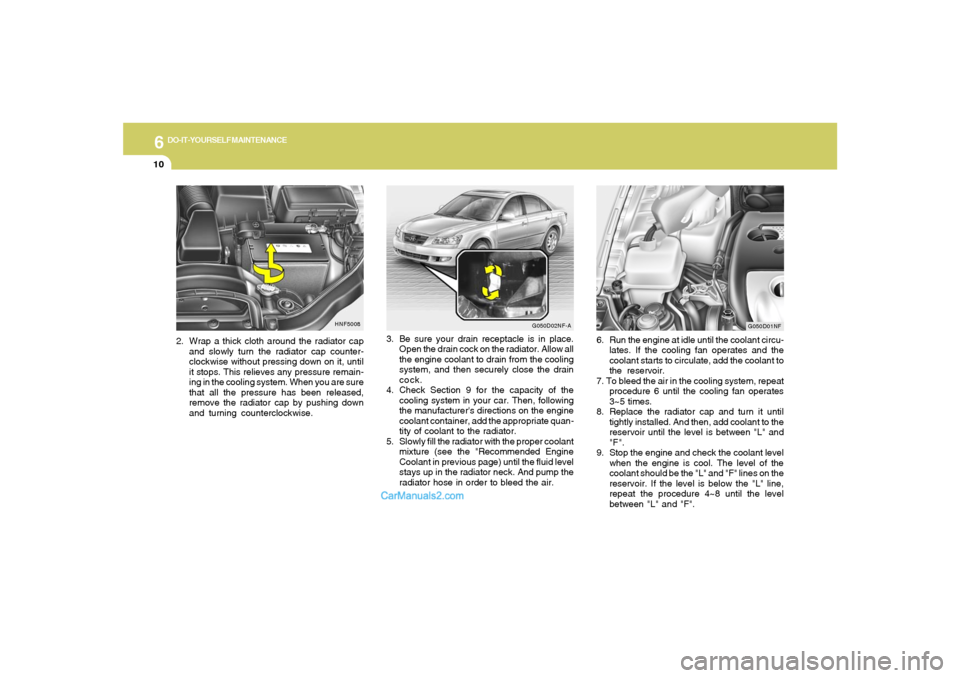
3. Be sure your drain receptacle is in place.
Open the drain cock on the radiator. Allow all
the engine coolant to drain from the cooling
system, and then securely close the drain
cock.
4. Check Section 9 for the capacity of the
cooling system in your car. Then, following
the manufacturer's directions on the engine
coolant container, add the appropriate quan-
tity of coolant to the radiator.
5. Slowly fill the radiator with the proper coolant
mixture (see the "Recommended Engine
Coolant in previous page) until the fluid level
stays up in the radiator neck. And pump the
radiator hose in order to bleed the air.
HNF5008
2. Wrap a thick cloth around the radiator cap
and slowly turn the radiator cap counter-
clockwise without pressing down on it, until
it stops. This relieves any pressure remain-
ing in the cooling system. When you are sure
that all the pressure has been released,
remove the radiator cap by pushing down
and turning counterclockwise.
G050D02NF-A
G050D01NF
6. Run the engine at idle until the coolant circu-
lates. If the cooling fan operates and the
coolant starts to circulate, add the coolant to
the reservoir.
7. To bleed the air in the cooling system, repeat
procedure 6 until the cooling fan operates
3~5 times.
8. Replace the radiator cap and turn it until
tightly installed. And then, add coolant to the
reservoir until the level is between "L" and
"F".
9. Stop the engine and check the coolant level
when the engine is cool. The level of the
coolant should be the "L" and "F" lines on the
reservoir. If the level is below the "L" line,
repeat the procedure 4~8 until the level
between "L" and "F".
Page 211 of 271
6
DO-IT-YOURSELF MAINTENANCE
13
!
WARNING:
It is recommended that the engine be cool
or cold when changing the spark plugs. If
the engine is hot, you could burn yourself
on the insulated connector, the spark plug
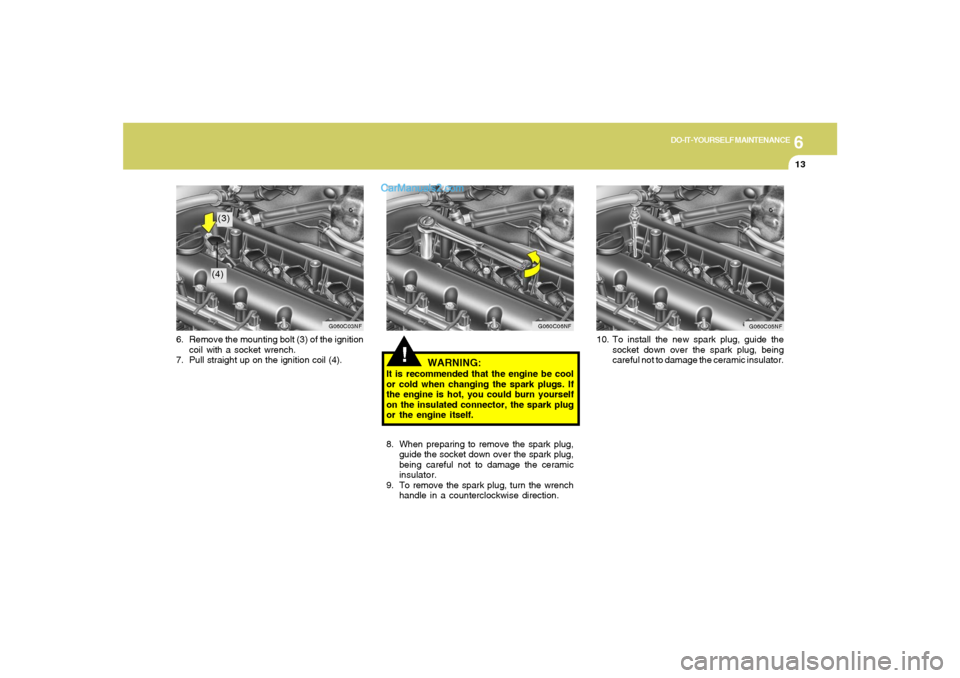
or the engine itself. 6. Remove the mounting bolt (3) of the ignition
coil with a socket wrench.
7. Pull straight up on the ignition coil (4).
G060C03NF
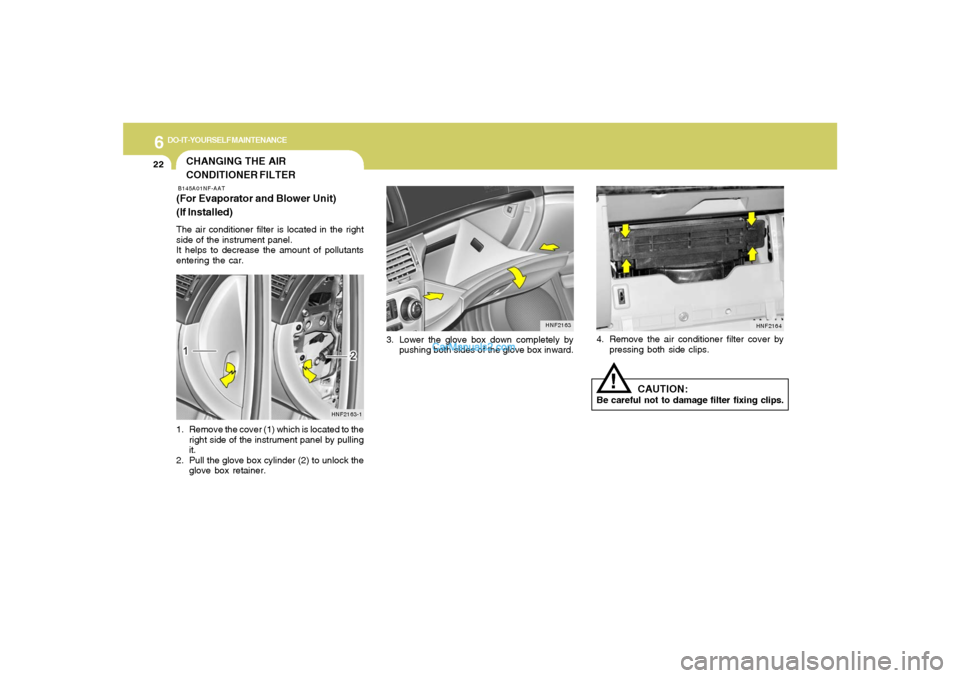
8. When preparing to remove the spark plug,
guide the socket down over the spark plug,
being careful not to damage the ceramic
insulator.
9. To remove the spark plug, turn the wrench
handle in a counterclockwise direction. (3)
(4)
G060C06NF
G060C05NF
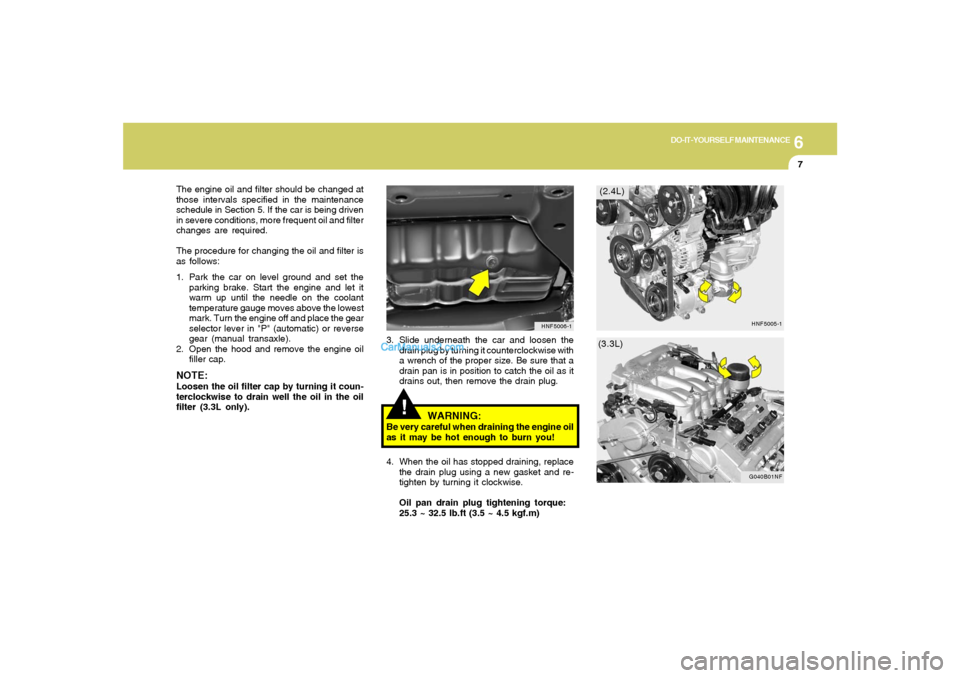
10. To install the new spark plug, guide the
socket down over the spark plug, being
careful not to damage the ceramic insulator.
Page 213 of 271
6
DO-IT-YOURSELF MAINTENANCE
15
HHR5048
(1)
WINDSHIELD WIPER BLADESG080A02A-AATThe wiper blades should be carefully inspected
from time to time and cleaned to remove accu-
mulations of road film or other debris. To clean
the wiper blades and arms, use a clean sponge
or cloth with a mild soap or detergent and water.
If the wipers continue to streak or smear the
glass, replace them with genuine Hyundai re-
placement parts or their equivalent.
!
CAUTION:
o Do not operate the wipers on dry glass.
This can result in more rapid wear of the
wiper blades and may scratch the glass.
o Keep the blade rubber out of contact
with petroleum products such as engine
oil, gasoline, etc.
G080B01HR-GATReplacing the Wiper BladesTo replace the wiper blades, raise the wiper to
the vertical position.To remove the wiper blade1. Push down the wiper blade with the locking
clip (1) pressed to detach it from the wiper
arm.
G080A01NF-A
2. Raise the wiper blade lightly and pull it up.
HHR5049
Page 216 of 271
6
DO-IT-YOURSELF MAINTENANCE
18
CHECKING THE TRANSAXLE
FLUID (AUTOMATIC)G110A01E-AATTransaxle fluid in the automatic transaxle should
be checked at those intervals specified in the
vehicle maintenance schedule in Section 5.NOTE:Automatic transaxle fluid is basically red in
color. As driving distance increases, the
fluid color turns darkish red gradually. It is
a normal condition and you should not
judge the need to replace based upon the
changing color.
You must replace the automatic transaxle
fluid in accordance with intervals specified
in the vehicle maintenance schedule in
section 5.
!
G110B05A-AATRecommended FluidYour Hyundai automatic transaxle is specially
designed to operate with HYUNDAI GENUINE
ATF SP III, DIAMOND ATF SP III, SK ATF SP
III or other brands meeting the SP III specifica-
tion approved by Hyundai Motor Co.. Damage
caused by a nonspecified fluid is not covered by
your new vehicle limited warranty.
CAUTION:
Use of aftermarket ATF additives may cause
damage to the automatic transaxle.
Only use HYUNDAI GENUINE ATF SP III,
DIAMOND ATF SP III, SK ATF SP III or other
brands meeting the SP III specification ap-
proved by Hyundai Motor Co.. If you are
having your vehicle serviced at a facility
other than a Hyundai dealer, verify that the
correct ATF is used for your vehicle.
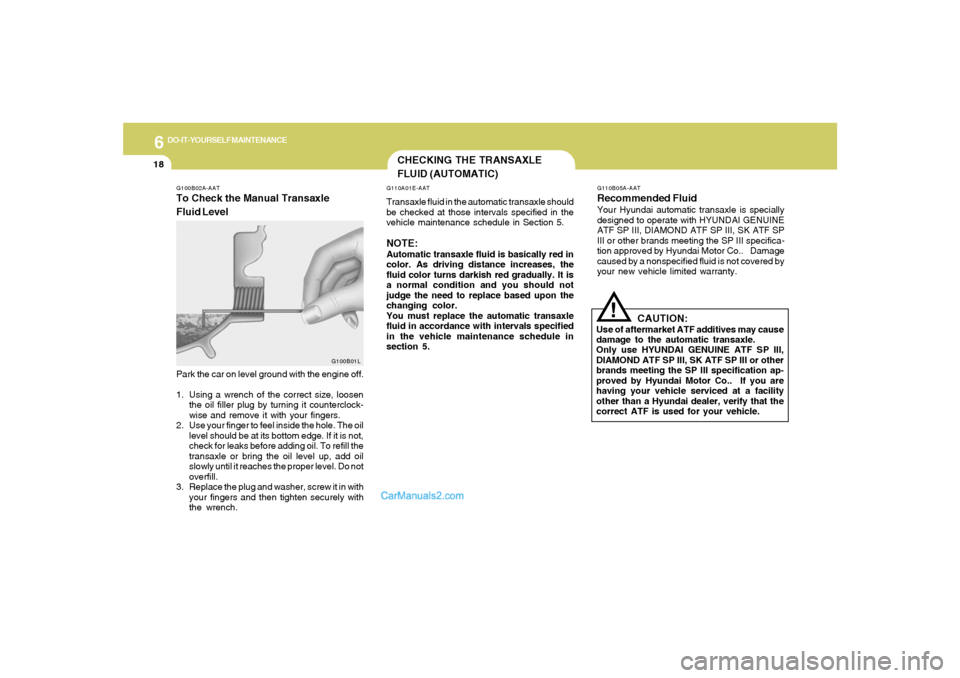
G100B02A-AATTo Check the Manual Transaxle
Fluid Level
G100B01L
Park the car on level ground with the engine off.
1. Using a wrench of the correct size, loosen
the oil filler plug by turning it counterclock-
wise and remove it with your fingers.
2. Use your finger to feel inside the hole. The oil
level should be at its bottom edge. If it is not,
check for leaks before adding oil. To refill the
transaxle or bring the oil level up, add oil
slowly until it reaches the proper level. Do not
overfill.
3. Replace the plug and washer, screw it in with
your fingers and then tighten securely with
the wrench.
Page 220 of 271
6
DO-IT-YOURSELF MAINTENANCE
22
3. Lower the glove box down completely by
pushing both sides of the glove box inward.
HNF2163
CHANGING THE AIR
CONDITIONER FILTERB145A01NF-AAT(For Evaporator and Blower Unit)
(If Installed)The air conditioner filter is located in the right
side of the instrument panel.
It helps to decrease the amount of pollutants
entering the car.
1. Remove the cover (1) which is located to the
right side of the instrument panel by pulling
it.
2. Pull the glove box cylinder (2) to unlock the
glove box retainer.
HNF2163-1
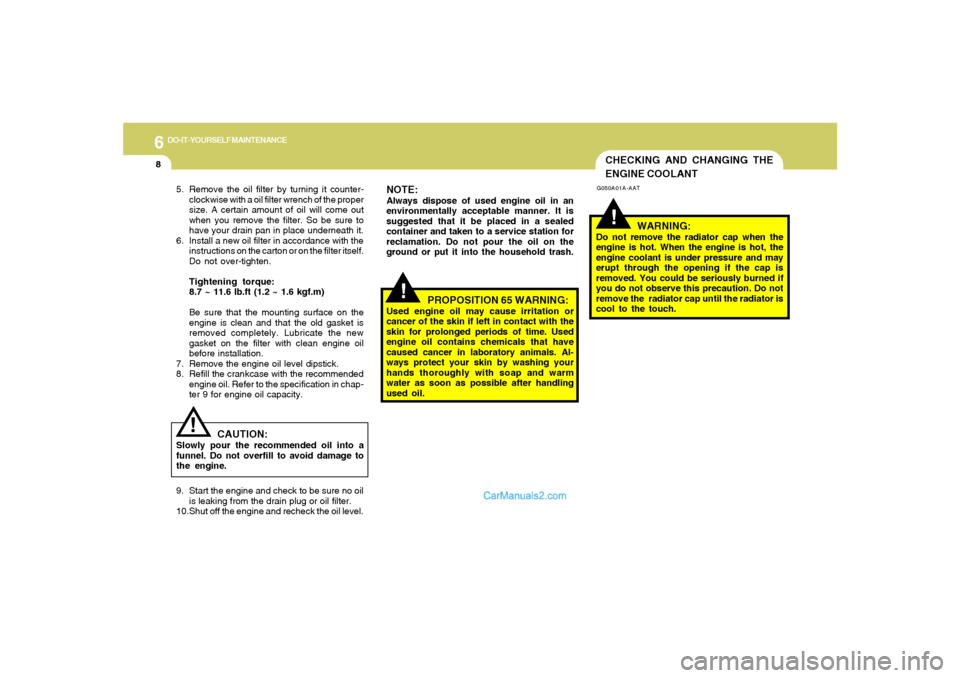
4. Remove the air conditioner filter cover by
pressing both side clips.
HNF2164
CAUTION:
Be careful not to damage filter fixing clips.
!
Page 230 of 271
6
DO-IT-YOURSELF MAINTENANCE
32
HNF5027
9. Remove the protective cap from the re-
placement bulb and install the new bulb by
matching the plastic base with the headlight
hole. Reattach the bulb spring and recon-
nect the connector.
10. Use the protective cap and carton to
promptly dispose of the old bulb.
11. Check for proper headlight aim.
HNF5023
4. Using a socket wrench of the correct size,
remove the headlight assembly mounting
bolts.
HNF5024
5. Disconnect the power cord from the back of
the headlight.
HNF5025
6. Turn the plastic cover counterclockwise
and remove it.
HNF5026
7. Disconnect the connector from the bulb base in
the back of the headlight.
8. Push the bulb spring to remove the headlight
bulb.