2005 Hyundai Santa Fe ECU
[x] Cancel search: ECUPage 41 of 277
1FEATURES OF YOUR HYUNDAI30
!
WARNING:
If the child restraint seat is not anchored
properly, the risk of a child being seriously
injured or killed in a collision greatly in-
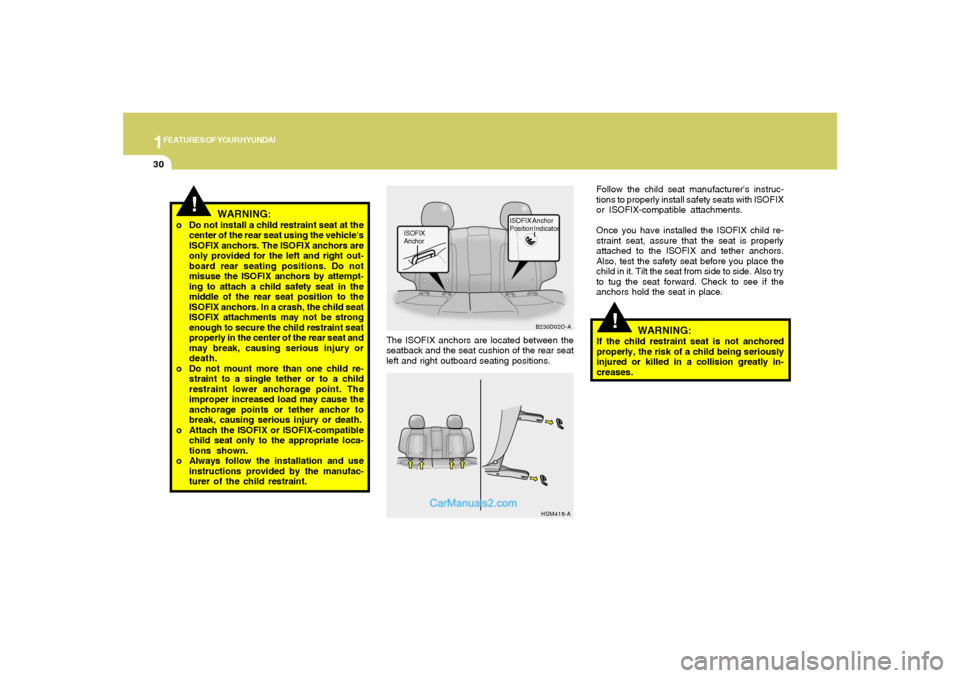
creases. The ISOFIX anchors are located between the
seatback and the seat cushion of the rear seat
left and right outboard seating positions.
B230D02O-A
ISOFIX
Anchor
ISOFIX Anchor
Position Indicator
Follow the child seat manufacturer's instruc-
tions to properly install safety seats with ISOFIX
or ISOFIX-compatible attachments.
Once you have installed the ISOFIX child re-
straint seat, assure that the seat is properly
attached to the ISOFIX and tether anchors.
Also, test the safety seat before you place the
child in it. Tilt the seat from side to side. Also try
to tug the seat forward. Check to see if the
anchors hold the seat in place.
HSM418-A
!
WARNING:
o Do not install a child restraint seat at the
center of the rear seat using the vehicle's
ISOFIX anchors. The ISOFIX anchors are
only provided for the left and right out-
board rear seating positions. Do not
misuse the ISOFIX anchors by attempt-
ing to attach a child safety seat in the
middle of the rear seat position to the
ISOFIX anchors. In a crash, the child seat
ISOFIX attachments may not be strong
enough to secure the child restraint seat
properly in the center of the rear seat and
may break, causing serious injury or
death.
o Do not mount more than one child re-
straint to a single tether or to a child
restraint lower anchorage point. The
improper increased load may cause the
anchorage points or tether anchor to
break, causing serious injury or death.
o Attach the ISOFIX or ISOFIX-compatible
child seat only to the appropriate loca-
tions shown.
o Always follow the installation and use
instructions provided by the manufac-
turer of the child restraint.
Page 42 of 277

1
FEATURES OF YOUR HYUNDAI
31
!
B230G01O-AATInstallation on Outboard Rear Seats
WARNING:
o If the retractor is not in the Automatic
Locking mode, the child restraint sys-
tem can move when your vehicle turns or
stops abruptly.
o Do not install any child restraint system
in the front passenger seat. Should an
accident occur and cause the passenger
side airbag to deploy, it could severely
injure or kill an infant or child seated in
an infant or child seat. Therefore, only
use a child restraint system in the rear
seat of your vehicle. To install a child restraint system in the outboard
rear seats, extend the shoulder/lap belt entirely
from its retractor until a "click" is felt. This will
engage the seat belt retractor automatic locking
feature, which allows the seat belt to retract but
not extend. Install the child restraint system,
buckle the seat belt and allow the seat belt to
take up any slack. Make sure that the lap portion
of the belt is tight around the child restraint
system and the shoulder portion of the belt is
positioned so that it can not interfere with the
child's head or neck. Also, double check to be
sure that the retractor has engaged the Auto-
matic Locking feature by trying to extend web-
bing out of the retractor. If the retractor is in the
Automatic Locking mode, the belt will be locked.After installation of the child restraint system, try
to move it in all directions to be sure the child
restraint system is securely installed. If you need
to tighten the belt, pull more webbing toward the
retractor. When you unbuckle the seat belt and
allow it to retract, the retractor will automatically
revert back to its normal seated passenger
Emergency Locking usage condition.NOTE:o Before installing the child restraint sys-
tem in any seating position, read the
instructions supplied by the child re-
straint system manufacturer.
o If the seat belt does not operate as de-
scribed, have the system checked imme-
diately by your authorized Hyundai dealer.
B230G01L B230F01JM-AAT
Installation on Rear Seat Center PositionTo install a child restraint system in the center
rear seat, extend the shoulder/lap belt entirely
from its retractor until a "click" is felt. This will
engage the seat belt retractor automatic locking
feature, which allows the seat belt to retract but
not extend. Install the child restraint system,
buckle the seat belt and allow the seat belt to
take up any slack. Make sure that the lap portion
of the belt is tight around the child restraint
system and the shoulder portion of the belt is
positioned so that it can not interfere with the
child's head or neck. Also, double check to be
sure that the retractor has engaged the Auto-
matic Locking feature by trying to extend web-
bing out of the retractor. If the retractor is in the
Automatic Locking mode, the belt will be locked.
B235G01O-A
Page 52 of 277
1
FEATURES OF YOUR HYUNDAI
41
!
NOTE:The "PASSENGER AIR BAG OFF" indicator
illuminates for about 6 seconds after the
ignition key is turned to the "ON" position
or after the engine is started. If the front
passenger seat is occupied, the occupant
classification sensor will then classify the
front passenger within approximately 10
seconds after the ignition is turned on.
CAUTION:
If the occupant classification system is not
working properly, the SRS airbag warning
light on the instrument panel will
illuminate because the passenger's front
airbags are connected with the occupant
classification system. If there is a malfunc-
tion of the occupant classification system,
the "PASSENGER AIR BAG OFF" indicator
will not illuminate and the passenger's front
airbags will inflate in frontal impact crashes
even if there is no occupant in the front
passenger's seat. If the SRS airbag warning
light does not illuminate when the ignition
key is turned to the "ON" position, remains
illuminated after approximately 6 seconds
when the ignition key is turned to the "ON"
position, or if it illuminates while the vehicle
is being driven, have an authorized Hyundai
dealer inspect the occupant classification
system and the SRS airbag system as soon
as possible.
!
!
WARNING:
WARNING:
o Even though your vehicle is equipped
with the occupant classification sys-
tem, do not install a child restraint sys-
tem in the front passenger's seat. A child
restraint system must never be placed in
the front seat. Children who are too large
for child restraint systems should al-
ways occupy the rear seat and use the
available lap/shoulder belts. Children are
afforded the most safety in the event of
an accident when they are restrained by
a proper restraint system in the rear seat.
o If the "PASSENGER AIR BAG OFF" indi-
cator is illuminated when the front
passenger's seat is occupied by an adult
and he/she sits properly (sitting upright
with the seat back in an upright position,
centered on the seat cushion with their
seat belt on, legs comfortably extended
and their feet on the floor), have that
person sit in the rear seat.
o If you change the weight on the front
passenger seat, the "PASSENGER AIR
BAG OFF" indicator may be turned on or
off for a few seconds, disabling or en-
abling the passenger airbags.o Do not modify or replace the front pas-
senger seat. Don't place anything on or
attach anything to the front passenger
seat. This can adversely affect the occu-
pant classification system.
o Do not sit on sharp objects such as tools
when occupying the front passenger
seat. This can adversely affect the occu-
pant classification system.
o Do not use accessory seat covers on the
front seats.
o Accident statistics show that children
are safer if they are restrained in the rear
than the front seat. It is recommended
that child restraints be secured in a rear
seat, including an infant riding in a rear-
facing infant seat, a child riding in a
forward-facing child seat and an older
child riding in a booster seat.
Page 89 of 277
1FEATURES OF YOUR HYUNDAI78
Operating HomeLinkSimply press the appropriate HomeLink button
to activate the trained product (garage door,
security system, entry door lock, estate gate,
lighting, etc.). The original handheld transmit-
ters may also be used at any time. 3. Return to the vehicle and firmly press and
release the programmed HomeLink button.
Press and release the same HomeLink but-
ton a second time to complete the program-
ming process. (Some devices may require
you to press and release a third time to
complete the programming.)
4. Now HomeLink mirror and rolling-code-
equipped device should be synchronized.
The remaining HomeLink buttons may now
be programmed if this has not been done
previously. 1. When programming the buttons for the first
time, press and hold the two outside
HomeLink buttons ( , ), releasing when
the indicator light begins to flash (approxi-
mately 20 seconds). This procedure erases
the factory-set default codes. Do not per-
form this step when programming additional
transmitters.
Flashing
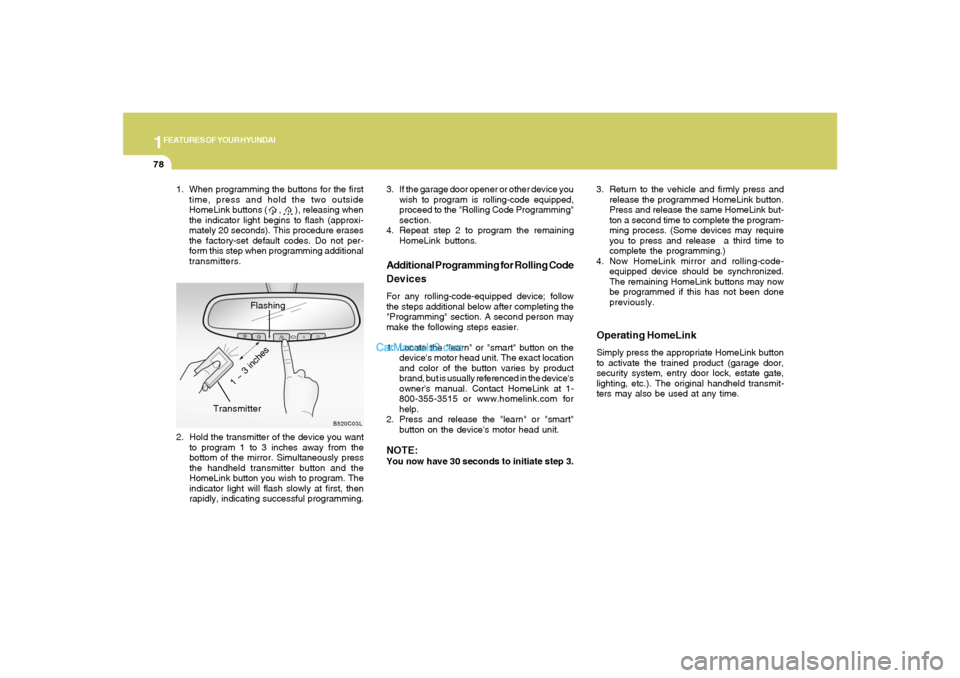
2. Hold the transmitter of the device you want
to program 1 to 3 inches away from the
bottom of the mirror. Simultaneously press
the handheld transmitter button and the
HomeLink button you wish to program. The
indicator light will flash slowly at first, then
rapidly, indicating successful programming.
B520C03L
Transmitter
1 ~ 3 inches
Additional Programming for Rolling Code
DevicesFor any rolling-code-equipped device; follow
the steps additional below after completing the
"Programming" section. A second person may
make the following steps easier.
1. Locate the "learn" or "smart" button on the
device's motor head unit. The exact location
and color of the button varies by product
brand, but is usually referenced in the device's
owner's manual. Contact HomeLink at 1-
800-355-3515 or www.homelink.com for
help.
2. Press and release the "learn" or "smart"
button on the device's motor head unit.NOTE:You now have 30 seconds to initiate step 3. 3. If the garage door opener or other device you
wish to program is rolling-code equipped,
proceed to the "Rolling Code Programming"
section.
4. Repeat step 2 to program the remaining
HomeLink buttons.
Page 92 of 277

1
FEATURES OF YOUR HYUNDAI
81
B540B02O-AATTail gate Window
HSM2012
o When you push the tail gate window release
button to open the tail gate window, it will
spring up slightly.
Raise the tail gate window. The window will
raise completly by itself after it has been
raised halfway.
o To close the tail gate window, lower the tail
gate window, and it will close by itself.
To be sure the tail gate window is securely
fastened, try to pull it up again.NOTE:The tail gate window lock is operated is in
connection with the tail gate lock. To open
the tail gate window make sure the tail gate
is unlocked with a key or the central door
locking switch.
B540C01HP-GATLUGGAGE COMPARTMENT LIGHTLuggage compartment light has a 3-position
switch. The three positions are:
o In the "MIDDLE" position, the luggage com-
partment light comes on when the tail gate is
opened, then goes out when it is closed.
o In the "ON" position, the light stays on at all
times.
o In the "OFF" position, the light stays off at all
times.
HSM2113
LUGGAGE COMPARTMENT
B640A01S-AATCARGO SECURITY SCREEN
(If installed)
B640A01O
To use the security screen, pull it out of the
retractor and hook it to the anchors as illus-
trated.
Page 93 of 277
1FEATURES OF YOUR HYUNDAI82
!
CAUTION:
To prevent damage to the goods or the
vehicle, care should be taken when carrying
fragile or bulky objects in the luggage com-
partment.
!
WARNING:
Avoid eye injury. DO NOT overstretch. The
luggage net ALWAYS keep your face and
body out of its recoil path. DO NOT use
when the luggage net straps have visible
signs of wear or damage.
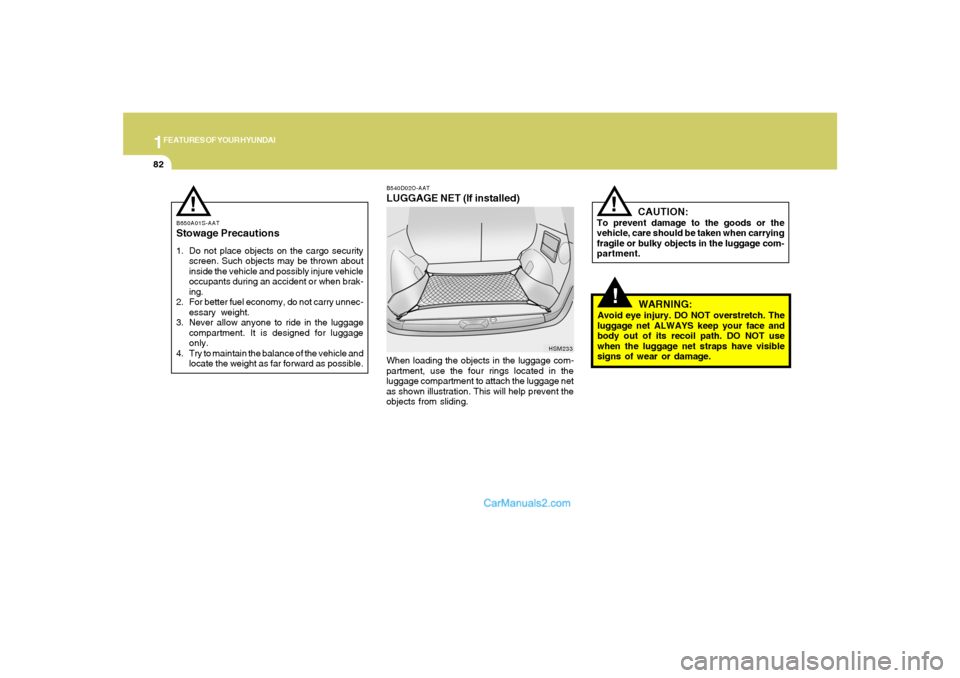
B540D02O-AATLUGGAGE NET (If installed)When loading the objects in the luggage com-
partment, use the four rings located in the
luggage compartment to attach the luggage net
as shown illustration. This will help prevent the
objects from sliding.
HSM233 B650A01S-AAT
Stowage Precautions1. Do not place objects on the cargo security
screen. Such objects may be thrown about
inside the vehicle and possibly injure vehicle
occupants during an accident or when brak-
ing.
2. For better fuel economy, do not carry unnec-
essary weight.
3. Never allow anyone to ride in the luggage
compartment. It is designed for luggage
only.
4. Try to maintain the balance of the vehicle and
locate the weight as far forward as possible.
!
Page 94 of 277
1
FEATURES OF YOUR HYUNDAI
83
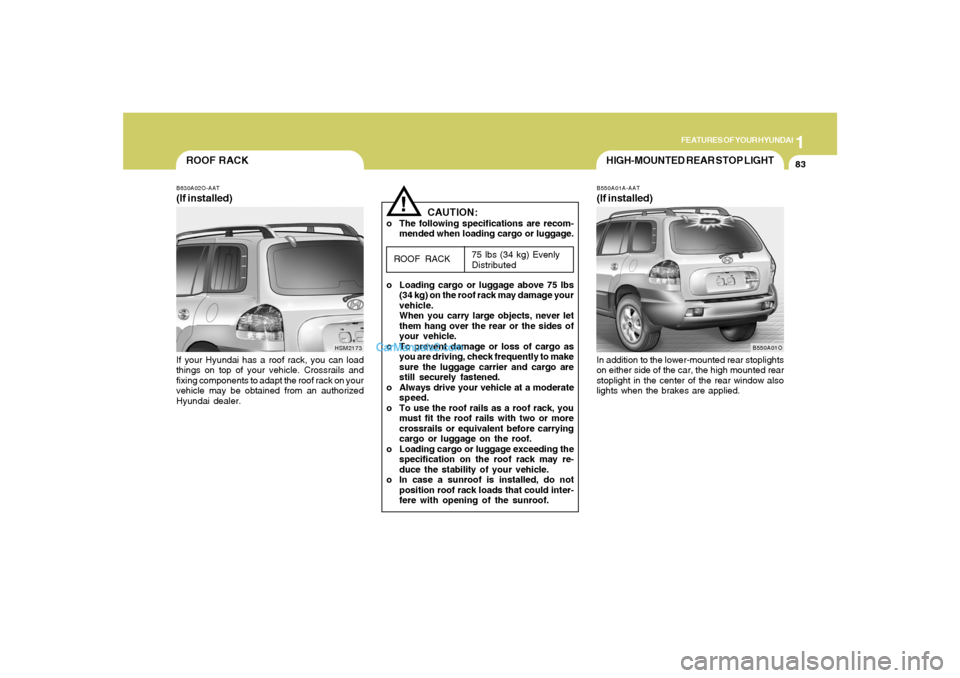
ROOF RACKB630A02O-AAT(If installed)If your Hyundai has a roof rack, you can load
things on top of your vehicle. Crossrails and
fixing components to adapt the roof rack on your
vehicle may be obtained from an authorized
Hyundai dealer.
HSM2173
CAUTION:
o The following specifications are recom-
mended when loading cargo or luggage.
75 lbs (34 kg) Evenly
Distributed
o Loading cargo or luggage above 75 lbs
(34 kg) on the roof rack may damage your
vehicle.
When you carry large objects, never let
them hang over the rear or the sides of
your vehicle.
o To prevent damage or loss of cargo as
you are driving, check frequently to make
sure the luggage carrier and cargo are
still securely fastened.
o Always drive your vehicle at a moderate
speed.
o To use the roof rails as a roof rack, you
must fit the roof rails with two or more
crossrails or equivalent before carrying
cargo or luggage on the roof.
o Loading cargo or luggage exceeding the
specification on the roof rack may re-
duce the stability of your vehicle.
o In case a sunroof is installed, do not
position roof rack loads that could inter-
fere with opening of the sunroof.ROOF RACK!
HIGH-MOUNTED REAR STOP LIGHTB550A01A-AAT(If installed)In addition to the lower-mounted rear stoplights
on either side of the car, the high mounted rear
stoplight in the center of the rear window also
lights when the brakes are applied.
B550A01O
Page 96 of 277
1
FEATURES OF YOUR HYUNDAI
85
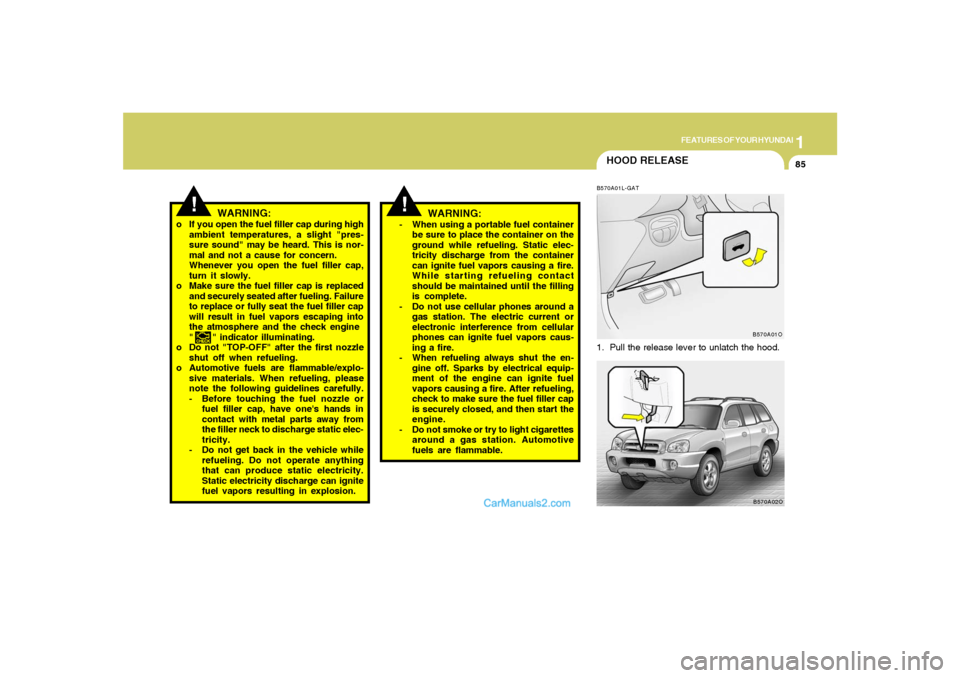
HOOD RELEASEB570A01L-GAT1. Pull the release lever to unlatch the hood.
WARNING:
o If you open the fuel filler cap during high
ambient temperatures, a slight "pres-
sure sound" may be heard. This is nor-
mal and not a cause for concern.
Whenever you open the fuel filler cap,
turn it slowly.
o Make sure the fuel filler cap is replaced
and securely seated after fueling. Failure
to replace or fully seat the fuel filler cap
will result in fuel vapors escaping into
the atmosphere and the check engine
" " indicator illuminating.
o Do not "TOP-OFF" after the first nozzle
shut off when refueling.
o Automotive fuels are flammable/explo-
sive materials. When refueling, please
note the following guidelines carefully.
- Before touching the fuel nozzle or
fuel filler cap, have one's hands in
contact with metal parts away from
the filler neck to discharge static elec-
tricity.
- Do not get back in the vehicle while
refueling. Do not operate anything
that can produce static electricity.
Static electricity discharge can ignite
fuel vapors resulting in explosion.
B570A01OB570A02O
!
!
WARNING:
- When using a portable fuel container
be sure to place the container on the
ground while refueling. Static elec-
tricity discharge from the container
can ignite fuel vapors causing a fire.
While starting refueling contact
should be maintained until the filling
is complete.
- Do not use cellular phones around a
gas station. The electric current or
electronic interference from cellular
phones can ignite fuel vapors caus-
ing a fire.
- When refueling always shut the en-
gine off. Sparks by electrical equip-
ment of the engine can ignite fuel
vapors causing a fire. After refueling,
check to make sure the fuel filler cap
is securely closed, and then start the
engine.
- Do not smoke or try to light cigarettes
around a gas station. Automotive
fuels are flammable.