2005 Hyundai Santa Fe engine
[x] Cancel search: enginePage 235 of 277
6
DO-IT-YOURSELF MAINTENANCE
24
G250A01A-AATFOR MORE INFORMATION ABOUT
YOUR HYUNDAIIf you desire additional information about main-
taining and servicing your Hyundai, you may
purchase a factory Shop Manual at your Hyundai
dealer's parts department. This is the same
manual used by dealership technicians and
while it is highly technical it can be useful in
obtaining a better understanding of your car and
how it works.
G240A01A-AATPOWER STEERING HOSESIt is suggested that you check the power steer-
ing hose connections for fluid leakage at those
intervals specified in the vehicle maintenance
schedule in Section 5.
The power steering hoses should be replaced
if there is severe surface cracking, pulling,
scuffing or worn spots. Deterioration of the hose
could cause premature failure. Recommended Fluid
Use PSF-3 type fluidNOTE:Do not start the engine when the power
steering oil reservoir is empty.
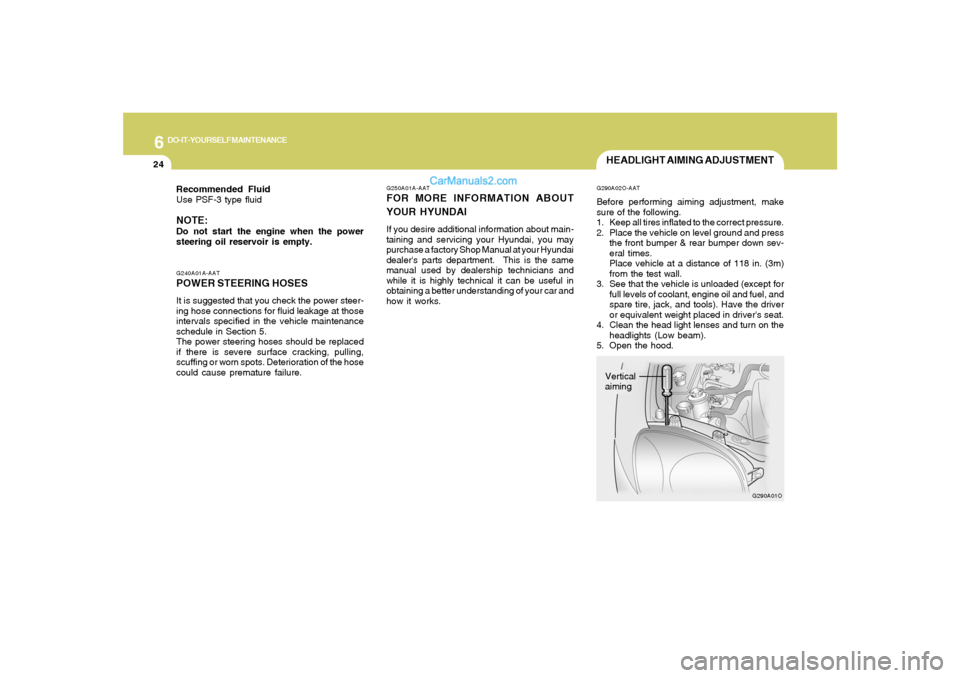
HEADLIGHT AIMING ADJUSTMENTG290A02O-AATBefore performing aiming adjustment, make
sure of the following.
1. Keep all tires inflated to the correct pressure.
2. Place the vehicle on level ground and press
the front bumper & rear bumper down sev-
eral times.
Place vehicle at a distance of 118 in. (3m)
from the test wall.
3. See that the vehicle is unloaded (except for
full levels of coolant, engine oil and fuel, and
spare tire, jack, and tools). Have the driver
or equivalent weight placed in driver's seat.
4. Clean the head light lenses and turn on the
headlights (Low beam).
5. Open the hood.
G290A01O
Vertical
aiming
Page 237 of 277
6
DO-IT-YOURSELF MAINTENANCE
26
REPLACEMENT OF LIGHT BULBS!
G260A02A-AATBefore attempting to replace a light bulb, be sure
the switch is turned to the "OFF" position.
The next paragraph shows how to reach the
light bulbs so they may be changed. Be sure to
replace the burned-out bulb with one of the
same number and wattage rating.
See page 6-32 for the wattage description.
CAUTION:
Keep the lamps out of contact with petro-
leum products, such as oil, gasoline, etc.
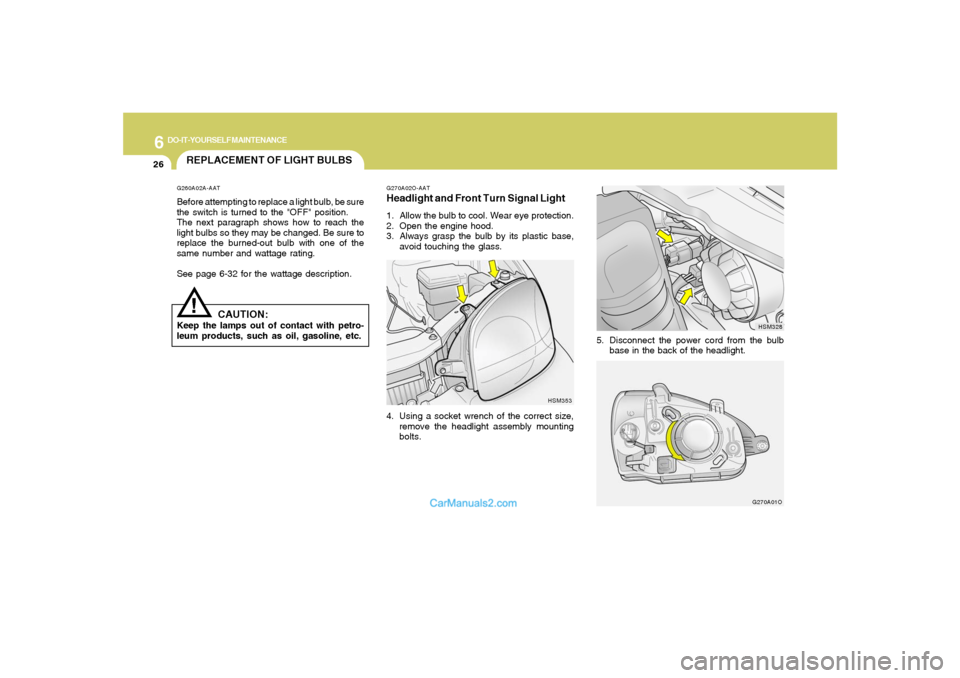
G270A02O-AATHeadlight and Front Turn Signal Light1. Allow the bulb to cool. Wear eye protection.
2. Open the engine hood.
3. Always grasp the bulb by its plastic base,
avoid touching the glass.
4. Using a socket wrench of the correct size,
remove the headlight assembly mounting
bolts.
HSM353
G270A01O
5. Disconnect the power cord from the bulb
base in the back of the headlight.
HSM328
Page 244 of 277
6
DO-IT-YOURSELF MAINTENANCE
33
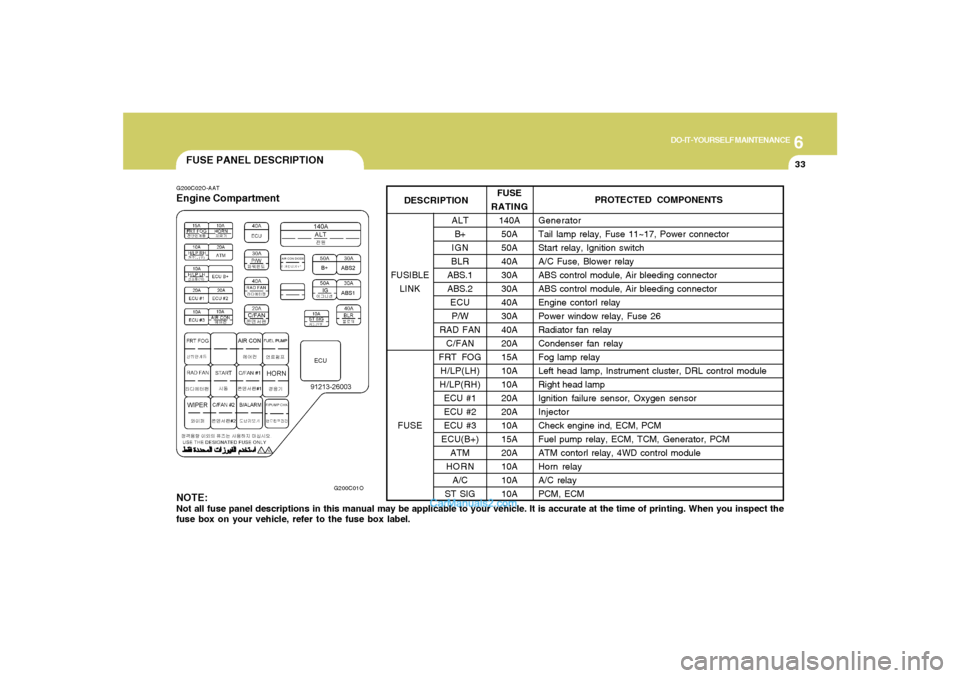
FUSE PANEL DESCRIPTIONG200C02O-AATEngine Compartment
G200C01O
NOTE:Not all fuse panel descriptions in this manual may be applicable to your vehicle. It is accurate at the time of printing. When you inspect the
fuse box on your vehicle, refer to the fuse box label.FUSE
RATING
140A
50A
50A
40A
30A
30A
40A
30A
40A
20A
15A
10A
10A
20A
20A
10A
15A
20A
10A
10A
10APROTECTED COMPONENTS
Generator
Tail lamp relay, Fuse 11~17, Power connector
Start relay, Ignition switch
A/C Fuse, Blower relay
ABS control module, Air bleeding connector
ABS control module, Air bleeding connector
Engine contorl relay
Power window relay, Fuse 26
Radiator fan relay
Condenser fan relay
Fog lamp relay
Left head lamp, Instrument cluster, DRL control module
Right head lamp
Ignition failure sensor, Oxygen sensor
Injector
Check engine ind, ECM, PCM
Fuel pump relay, ECM, TCM, Generator, PCM
ATM contorl relay, 4WD control module
Horn relay
A/C relay
PCM, ECM
ALT
B+
IGN
BLR
ABS.1
ABS.2
ECU
P/W
RAD FAN
C/FAN
FRT FOG
H/LP(LH)
H/LP(RH)
ECU #1
ECU #2
ECU #3
ECU(B+)
ATM
HORN
A/C
ST SIG FUSIBLE
LINK
FUSE
DESCRIPTION
Page 247 of 277
7
EMISSION CONTROL SYSTEMS2
EMISSION CONTROL SYSTEM
H010D01A-AAT3. Exhaust Emission Control SystemThe Exhaust Emission Control System is a
highly effective system which controls exhaust
emissions while maintaining good vehicle
performace.
H010B01A-AAT1. Crankcase Emission Control
SystemThe positive crankcase ventilation system is
employed to prevent air pollution caused by
blow-by gases being emitted from the crank-
case. This system supplies filtered air to the
crankcase through the air intake hose. Inside
the crankcase, the fresh air mixes with blow-by
gases, which then pass through the PCV valve
and into the induction system.
H010A03O-AATYour Hyundai is equipped with an emission
control system to meet all requirements of the
U.S. Environmental Protection Agency or Cali-
fornia Air Resources Board.
There are three emission control systems which
are as follows.
(1) Crankcase emission control system
(2) Evaporative emission control system
(3) Exhaust emission control system
In order to assure the proper function of the
emission control systems, it is recommended
that you have your car inspected and main-
tained by an authorized Hyundai dealer in ac-
cordance with the maintenance schedule in this
manual.
Caution for the Inspection and Maintenance
Test (V6 Vehicle with Traction Control Sys-
tem)
o 2.7 V6 - To prevent the vehicle from
misfiring during dynamometer testing,
disconnect the ABS connector in the
engine compartment. After dynamom-
eter testing is completed, erase the ABS/
TCS DTC (Diagnotic Trouble Code) with
a GST (Generic Scan Tool) or Hi-Scan
Pro. For more information, see shop
manual (Wheel Speed Sensor).(The ORVR system is designed to allow the
vapors from the fuel tank to be loaded into a
canister while refueling at the gas station, pre-
venting the escape of fuel vapors into the
atmosphere.)
CanisterFuel vapors generated inside the fuel tank are
absorbed and stored in the canister. When the
engine is running, the fuel vapors absorbed in
the canister are drawn into the induction system
through the purge control solenoid valve.Purge Control Solenoid Valve (PCSV)The purge control solenoid valve is controlled
by the Engine Control Module (ECM); when the
engine coolant temperature is low during idling,
the PCSV closes so that evaporated fuel is not
taken into the engine. After the engine warms-
up during ordinary driving, the PCSV opens to
introduce evaporated fuel to the engine.
H010C01S-AAT2. Evaporative Emission Control (Includ-
ing ORVR: Onboard Refueling Vapor
Recovery) SystemThe Evaporative Emission Control System is
designed to prevent fuel vapors from escaping
into the atmosphere. o 3.5 V6 - To prevent the vehicle from
misfiring during dynamometer testing,
turn the Traction Control System (TCS)
off by pressing the TCS switch.
After dynamometer testing is completed,
turn the TCS system back on by pressing
the TCS switch again.
Page 248 of 277
7
EMISSION CONTROL SYSTEMS
3
CATALYTIC CONVERTER
EGR SYSTEM
!
H010E01Y-AAT(If installed)This system helps reduce nitrogen oxides by
recirculating a part of the exhaust gas into the
engine, thereby reducing cylinder combustion
temperature, which results in lower output of
oxides of nitrogen.
WARNING:
o Use unleaded fuel only.
o Maintain the engine in good operating
condition. Extremely high catalytic con-
verter temperatures can result from im-
proper operation of the electrical, igni-
tion or multiport electronic fuel injec-
tion.
o If your engine stalls, pings, knocks, or is
hard to start, have your Hyundai dealer
inspect and repair the problem as soon
as possible.
o Avoid driving with a very low fuel level.
Running out of gasoline may cause the
engine to misfire and result in damage to
the catalytic converter.
o Avoid idling the engine for periods
longer than 10 minutes.
o The vehicle should not be pushed or
pulled to get started. This may cause the
catalytic converter to overheat and cre-
ate a fire hazard.
o Do not touch the catalytic converter or
any other part of the exhaust system
while the catalytic converter is hot. Shut
off the engine, wait for at least one hour
before touching the catalytic converter
or any other part of the exhaust system.
o Remember that your Hyundai dealer is
your best source of assistance.
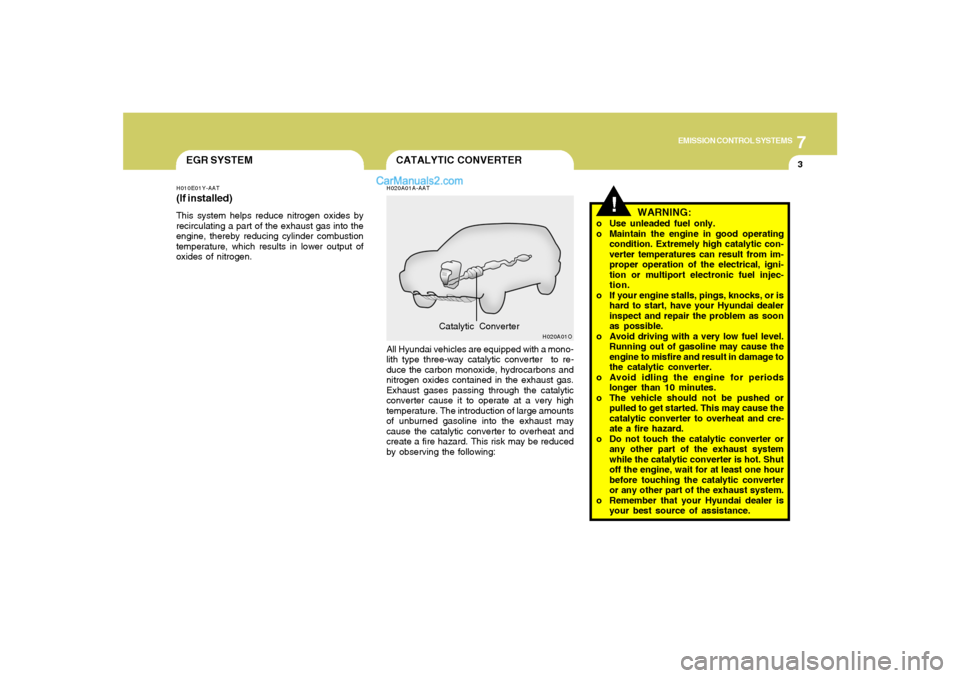
H020A01A-AATAll Hyundai vehicles are equipped with a mono-
lith type three-way catalytic converter to re-
duce the carbon monoxide, hydrocarbons and
nitrogen oxides contained in the exhaust gas.
Exhaust gases passing through the catalytic
converter cause it to operate at a very high
temperature. The introduction of large amounts
of unburned gasoline into the exhaust may
cause the catalytic converter to overheat and
create a fire hazard. This risk may be reduced
by observing the following:
H020A01O
Catalytic Converter
Page 250 of 277
Vehicle Identification Number (VIN) .............................. 8-2
Engine Number ............................................................. 8-2
Tire Information ............................................................. 8-2
Recommended Inflation Pressures ............................... 8-3
Tire Sidewall Labeling ................................................... 8-4
Tire Terminology and Definitions ................................... 8-6
Snow Tires .................................................................... 8-8
Tire Chains .................................................................... 8-9
Tire Rotation .................................................................. 8-9
Tire Balancing ............................................................... 8-9
Tire Traction................................................................8-10
When to Replace Tires ...............................................8-10
Tire Maintenance........................................................8-11
Spare Tire and Tools ...................................................8-11
Warranties for Your Hyundai Vehicle..........................8-12
Consumer Information.................................................8-12
Reporting Safety Defects............................................8-15
Binding Arbitration of Warranty Claims.......................8-15
CONSUMER INFORMATION, REPORTING
SAFETY DEFECTS & BINDING
ARBITRATION OF WARRANTY CLAIMS
8
8
Page 251 of 277
8
CONSUMER INFORMATION, REPORTING SAFETY DEFECTS & BINDING ARBITRATION OF WARRANTY CLAIMS2
ENGINE NUMBER
VEHICLE IDENTIFICATION
NUMBER (VIN)
I010B01A-AAT I010A01O-AAT
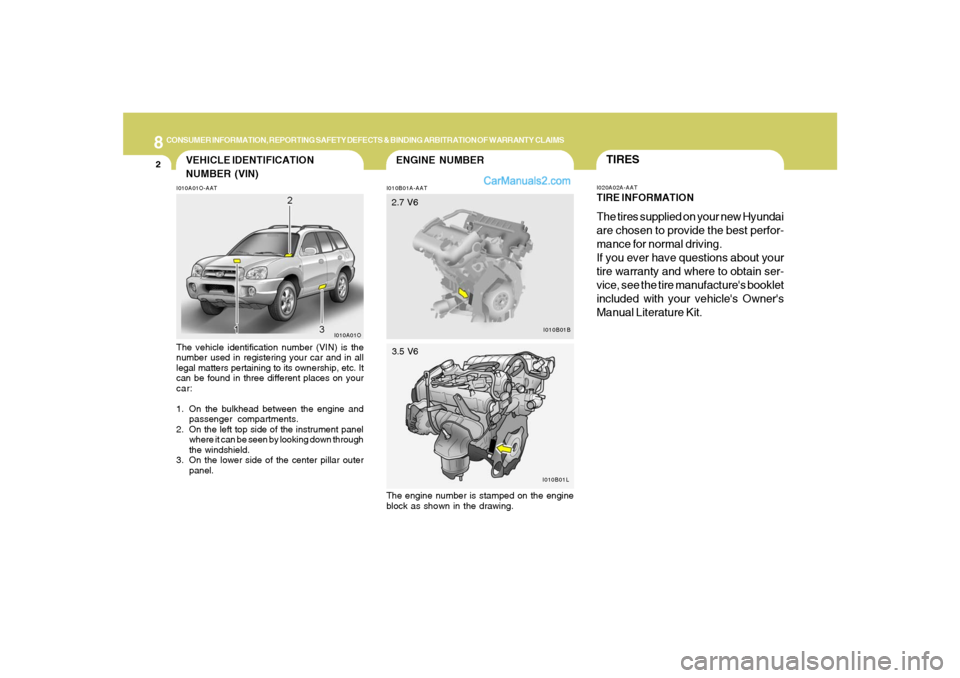
The vehicle identification number (VIN) is the
number used in registering your car and in all
legal matters pertaining to its ownership, etc. It
can be found in three different places on your
car:
1. On the bulkhead between the engine and
passenger compartments.
2. On the left top side of the instrument panel
where it can be seen by looking down through
the windshield.
3. On the lower side of the center pillar outer
panel.
The engine number is stamped on the engine
block as shown in the drawing.
I010A01O
2.7 V6
I010B01B
I010B01L
3.5 V6
TIRESI020A02A-AATTIRE INFORMATIONThe tires supplied on your new Hyundai
are chosen to provide the best perfor-
mance for normal driving.
If you ever have questions about your
tire warranty and where to obtain ser-
vice, see the tire manufacture's booklet
included with your vehicle's Owner's
Manual Literature Kit.
Page 272 of 277
10
INDEX
3
Corrosion protection
Cleaning the interior....................................................................... 4-5
Protecting your Hyundai from corrosion....................................... 4-2
Washing and waxing...................................................................... 4-3
Cruise Control...................................................................................1-89
D
Defrosting / Defogging ...................................................................1-101
Door
Central door locks.......................................................................... 1-7
Door locks...................................................................................... 1-4
Front door edge warning light ......................................................1-88
Locking, unlocking front door with a key ...................................... 1-5
Drink Holder ......................................................................................1-67
Drive Belts.........................................................................................6-19
Driving
Driving for economy .....................................................................2-20
Smooth cornering.........................................................................2-21
Winter driving...............................................................................2-21
E
Emission Control System ................................................................... 7-2
Engine
Before starting the engine .............................................................. 2-3
Compartment (2.7 V6)................................................................... 6-2
Compartment (3.5 V6)................................................................... 6-3
Coolant........................................................................................... 6-8
Coolant temperature gauge .........................................................1-52If the engine overheats .................................................................. 3-4
Number........................................................................................... 8-2
Oil ................................................................................................... 6-5
Starting........................................................................................... 2-5
Engine Exhaust Can Be Dangerous .................................................. 2-2
F
Fan Speed Control............................................................................1-93
Floor Mat Anchor ..............................................................................1-86
Fog Light
Front.............................................................................................1-62
Front Seats
Adjustable front seats ..................................................................1-12
Adjustable headrests...................................................................1-13
Adjusting seat forward and rearward ..........................................1-12
Adjusting seatback angle .............................................................1-12
Fuel
Auto fuel cut switch ......................................................................1-84
Capacity......................................................................................... 9-2
Gauge...........................................................................................
1-52
Recommendations......................................................................... 1-2
Fuel Filler Lid
Remote release............................................................................1-84
Full Traction Control System (FTCS)..............................................2-14
Full-time 4WD Operation..................................................................2-16
Fuses ................................................................................................6-20