2005 Hyundai Matrix fuel
[x] Cancel search: fuelPage 215 of 407

1
FEATURES OF YOUR HYUNDAI
51
B260N02FC-GAT Malfunction Indicator
Light (If installed)
This light illuminates when there is a malfunction of an exhaust gas relatedcomponent, and the system is not functioning properly so that the ex- haust gas regulation values are notsatisfied. This light will illuminate when the ignition key is tuned to the "ON" position, and will go out after the en-gine start. If it illuminates while driving, or does not illuminate when the ignition key is turned to the "ON" position, takeyour car to your nearest authorized Hyundai dealer and have the system checked.
!
B260P02Y-GAT ABS Service Reminder Indicator (SRI)(If installed)
When the key is turned to the "ON" position, the Anti-Lock Brake System indicator will come on and then go offin a few seconds. If the ABS SRI remains on, comes on while driving, or does not come on when the key isturned to the "ON" position, this indi- cates that there may be a problem with the ABS.If this occurs, have your vehicle checked by your Hyundai dealer as soon as possible. The normal brakingsystem will still be operational, but without the assistance of the anti-lock brake system.
WARNING:
If the both ABS SRI and Parking Brake/Brake fluid level warning lights remain "ON" or come on while driving, there may be a problemwith E.B.D (Electronic Brake Force Distribution). If this occurs, avoid sudden stopsand have your vehicle checked by your Hyundai dealer as soon aspossible.
B265A01FC-GAT Fuel Filter Warning Light
(Diesel Engine)
This light illuminates when the engine has started and goes off after a few seconds. If it lights up while the engineis running, it indicates that water has accumulated inside the fuel filter. If this happens, remove the water from thefuel filter. (Refer to "6-33 page")
Page 217 of 407

1
FEATURES OF YOUR HYUNDAI
53
!
B280A01A-AAT FUEL GAUGE The needle on the gauge indicates the approximate fuel level in the fuel tank. B290A02E-AAT ENGINE COOLANT TEMPERA- TURE GAUGE
HFC2045 HFC2101
WARNING:
Never remove the radiator cap when the engine is hot. The engine cool- ant is under pressure and coulderupt and cause severe burns. Wait until the engine is cool before re- moving the radiator cap. The needle on the engine coolant tem-perature gauge should stay in themiddle between "H" and "C". If it moves across the dial to "H" (Hot), pull over and stop as soon as possible and turnoff the engine. Then open the hood and after the engine has cooled, check the coolant level and the water pumpdrive belt. If you suspect cooling sys- tem trouble, have your cooling system checked by a Hyundai dealer as soonas possible.
INSTRUMENT CLUSTER
Page 220 of 407

1FEATURES OF YOUR HYUNDAI
56TRIP COMPUTER
B400B01FC-GAT (If Installed) The trip computer is a microcomputer- controlled driver information gauge that displays information related to driving, such as a distance to empty, averagespeed and drive time on the LCD. 1. Distance to Empty
Distance to empty symbol
DISTANCE TO EMPTY AVERAGE SPEED DRIVE TIME
HFC2051 HFC2052
Distance to empty
o This mode indicates the estimated distance to empty from the current fuel in the fuel tank and distance to empty symbol.
o When refueling with more than 6 liters, the trip computer will recog-nize refueling.
o When the battery has been rein- stalled after being discharged ordisconnected, drive more than 32kmfor an accurate distance to empty.
Reset switch
o The reset switch is used to zero the
multi-functional display mode.
o Pushing in the reset switch changes the display as follows;
Page 240 of 407
1FEATURES OF YOUR HYUNDAI
76
!WARNING:
Fuel vapors are dangerous. Before refueling, always stop the engineand never allow sparks or open flames near the filler area. If you need to replace the filler cap, use agenuine Hyundai replacement part. If you open the fuel filler cap during high ambient temperatures, a slight"pressure sound" may be heard. This is normal and not a cause for concern.Whenever you open the fuel filler
cap, turn it slowly. HFC2016
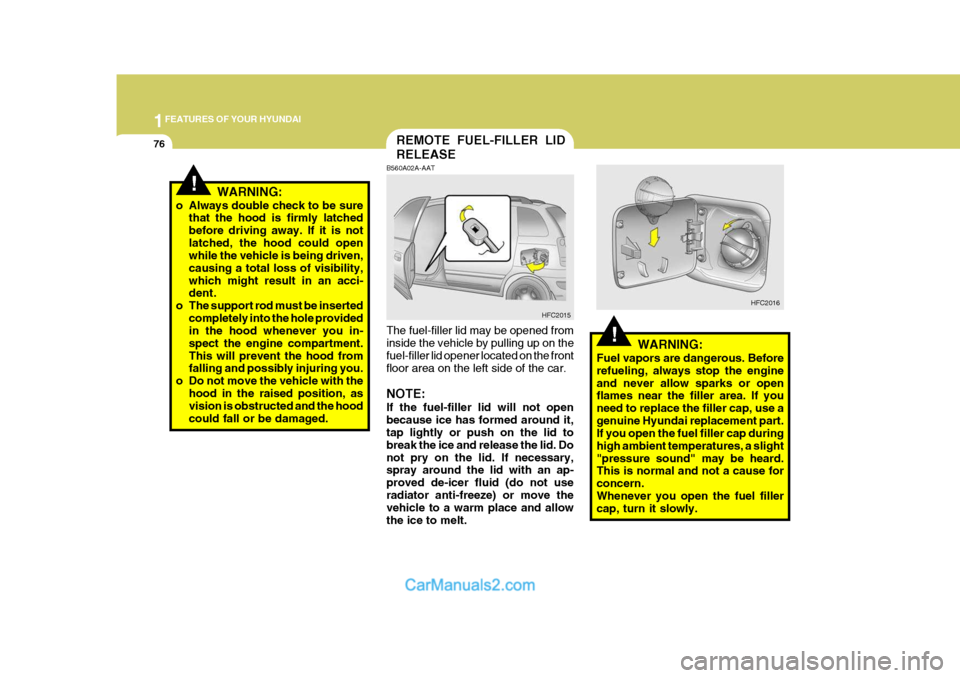
REMOTE FUEL-FILLER LID RELEASE
B560A02A-AAT The fuel-filler lid may be opened from inside the vehicle by pulling up on the fuel-filler lid opener located on the frontfloor area on the left side of the car. NOTE: If the fuel-filler lid will not open because ice has formed around it, tap lightly or push on the lid to break the ice and release the lid. Donot pry on the lid. If necessary, spray around the lid with an ap- proved de-icer fluid (do not useradiator anti-freeze) or move the vehicle to a warm place and allow the ice to melt. HFC2015
!WARNING:
o Always double check to be sure that the hood is firmly latched before driving away. If it is notlatched, the hood could open while the vehicle is being driven, causing a total loss of visibility,which might result in an acci- dent.
o The support rod must be inserted completely into the hole providedin the hood whenever you in- spect the engine compartment.This will prevent the hood from falling and possibly injuring you.
o Do not move the vehicle with the hood in the raised position, asvision is obstructed and the hood could fall or be damaged.
Page 244 of 407

1FEATURES OF YOUR HYUNDAI
80
!
STEERING WHEEL TILT LEVER
B600A01A-AAT (If Installed) To Adjust the Steering Wheel:
1. Push the lever downward to unlock.
2. Raise or lower the steering wheel to
the desired position.
3. After adjustment, securely tighten the lever by pulling it upward. HFC2041
WARNING:
Do not attempt to adjust the steer-ing wheel while driving as this may result in loss of control of the ve-hicle which may cause serious in- jury or death.AUTO FUEL CUT SWITCH
!
B560B01O-GAT (Gasoline Engine) The auto fuel cut switch is located on the driver's side of the engine compart-ment. In the event of a collision or sudden impact, the auto fuel cut device cuts offthe fuel supply. If this device is acti- vated, it must be reset by pressing in on the top of the switch before theengine can be restarted.
WARNING:
Before resetting the auto fuel cutswitch, the fuel line should be checked for fuel leaks. HFC4001
o Always drive your vehicle at a
moderate speed.
o To use the roof rails as a roof rack, you must fit the roof rails with two or more crossrails orequivalent before carrying cargo or lugguage on the roof.
o When crossrail is adapted, you can load things on the roof rack.
o Loading cargo or luggage over
specification on the roof rack may damage stability of your vehicle.
Page 292 of 407

2
DRIVING YOUR HYUNDAI
3
!
TO START THE ENGINEBEFORE STARTING THE ENGINE
C020A01O-GAT Before you start the engine, you should always:
1. Look around the vehicle to be sure
there are no flat tires, puddles of oil, water or other indications of pos- sible trouble.
2. After entering the car, check to be sure the parking brake is engaged.
3. Check that all windows, and lights are clean.
4. Check that the interior and exterior
mirrors are clean and in position.
5. Check your seat, seatback and headrest to be sure they are in theirproper positions.
6. Lock all the doors.
7. Fasten your seat belt and be sure
that all other occupants have fas- tened theirs.
8. Turn off all lights and accessories
that are not needed. C030A01A-GAT COMBINATION IGNITION SWITCH Before starting the engine:
o If your Hyundai is equipped with a
manual transaxle, place the shift lever in neutral and depress theclutch pedal fully.
o If your Hyundai has an automatic
transaxle, place the shift lever in "P"(park).
o To start the engine, insert the igni-
tion key and turn it to the "START"position. Release it as soon as the engine starts. Do not hold the key in the "START" position for more than15 seconds.
NOTE: For safety, the engine will not start if the shift lever is not in "P" or "N"Position (Automatic Transaxle).
WARNING: (DIESEL ENGINE)
To ensure that sufficient vacuum exists within the brake system dur- ing cold weather start-up condi-tions, it is necessary to run the engine at idle for several seconds after starting the engine.
9. When you turn the ignition switch to
"ON", check that all appropriatewarning lights are operating and that you have sufficient fuel.
10.Check the operation of warning lights and all bulbs when key is inthe "ON" position.
Page 297 of 407

2 DRIVING YOUR HYUNDAI
8
C070D02A-AAT Good Driving Practices
o Never take the car out of gear andcoast down a hill. This is extremely hazardous. Always leave the car in gear.
o Don't "ride" the brakes. This can cause them to overheat and mal-function. Instead, when you are driv- ing down a long hill, slow down andshift to a lower gear. When you do this, engine braking will help slow the car.
o Slow down before shifting to a lower gear. This will help avoid over-rev-ving the engine, which can causedamage.
o Slow down when you encounter
cross winds. This gives you muchbetter control of your car.
o Be sure the car is completely stopped
before you attempt to shift into re-verse. The transaxle can be dam- aged if you do not. To shift into reverse, depress the clutch, movethe shift lever to neutral, wait three seconds, then shift to the reverse position.
C070E03A-GAT RECOMMENDED SHIFT POINTS The shift points as shown above are recommended for optimum fueleconomy and performance.
C070B01A-AAT Using the Clutch The clutch should be pressed all the way to the floor before shifting, thenreleased slowly. The clutch pedal should always be used after fully re- turning to the original position. Do notrest your foot on the clutch pedal while driving. This can cause unnecessary wear. Do not partially engage the clutchto hold the car on an incline. This causes unnecessary wear. Use the parking brake to hold the car on anincline. Do not operate the clutch pedal rapidly and repeatedly.
Shift
from-to 1-2 2-33-4 4-5 Recommended
20 km/h (15 mph)40 km/h (25 mph) 55 km/h (35 mph)75 km/h (45 mph)
Page 298 of 407

2
DRIVING YOUR HYUNDAI
9
!
!
C090A01A-GAT Automatic transaxle
C090A01FCNOTE:
Depress the brake pedal and push the button when shift- ing.Push the button when shift- ing. The selector lever can beshifted freely.
For optimum fuel economy, acceler-ate gradually. The transaxle will auto- matically shift to the second, third and overdrive gears.
o Exercise extreme caution when driv- ing on a slippery surface. Be espe- cially careful when braking, acceler- ating or shifting gears. On a slippery surface, an abrupt change in ve-hicle speed can cause the drive wheels to lose traction and the ve- hicle to go out of control.
The highly efficient Hyundai automatic transaxle has four forward speeds and one reverse speed. It has a conven-tional shift pattern as shown in the illustration. At night, with the first posi- tion of the multi-function switch, theappropriate symbol on the shift pattern indicator will be illuminated according to the range selected.
WARNING:
o The risk of rollover is greatly in- creased if you lose control ofyour vehicle at highway speeds.
o Loss of control often occurs if
two or more wheels drop off theroadway and the driver oversteers to reenter the roadway.
o In the event your vehicle leaves the roadway, do not steer sharply.Instead, slow down before pull- ing back into the travel lanes
o In a collision crash, an unbelted person is significantly more likelyto die than a person wearing aseatbelt.
o Never exceed posted speed lim-
its. CAUTION:
Never shift into "R" or "P" position while the vehicle is moving.