Page 359 of 407

6 DO-IT-YOURSELF MAINTENANCE
14
4. Turn the radiator cap counterclock-
wise without pressing down on it, until it stops. This relieves any pres- sure remaining in the cooling sys-tem. And remove the radiator cap by pushing down and turning coun- terclockwise.Fill the radiator with clean deminer-alized or distilled water. Continueto add clean demineralized or dis- tilled water in small quantities until the fluid level stays up in the radia-tor neck. G050D01FC
G050D02FC
5. Start the engine, top off the radia- tor with water and then add engine coolant to the reservoir until the level is between "L" and "F".
6. Replace the radiator and reservoir caps and check to be sure thedrain cocks are fully closed and not leaking.
G050D02A-AAT
To Change the Coolant
The coolant should be changed at
those intervals specified in the ve-hicle maintenance schedule in Sec- tion 5.
! CAUTION:
Engine coolant can damage the
finish of your car. If you spill en- gine coolant on the car, wash it off thoroughly with clean water.
1. Park the car on level ground, set the park-ing brake and remove the radiator cap when cool.
2. Be sure your drain receptacle is in
place. Open the drain cock on theradiator. Allow all the engine cool- ant to drain from the cooling sys- tem, then securely close the draincock.
3. Check Section 9 for the capacity of the cooling system in your car.Then, following the manufacturer's directions on the engine coolant container, add the appropriatequantity of coolant to the radiator.
Page 360 of 407

6
DO-IT-YOURSELF MAINTENANCE
15
!
SPARK PLUGS
WARNING:
The cooling fan is controlled by engine coolant temperature and may sometimes operate even when the engine is not running. Useextreme caution when working near the blades of the cooling fan so that you are not injured by arotating fan blade. As the engine coolant temperature decreases, the fan will automatically shut off. Thisis a normal condition. G060A01L
G060B02S-GAT
REPLACING THE SPARK PLUGS (Gasoline Engine)
The spark plugs should be changed
at the intervals specified in the ve- hicle maintenances schedule in Sec- tion 5 or whenever engine perfor-mance indicates they should be changed. Symptoms that suggest poor spark plug performance include en-gine misfiring under load, loss of fuel economy, poor acceleration, etc. When spark plugs are replaced, al-ways use spark plugs recommended by Hyundai. The use of other spark plugs can result in loss of perfor-mance, radio interference or engine damage.
Unleaded: 1.0 ~ 1.1 mm (0.039 ~ 0.043 in.) Leaded: 0.7 ~ 0.8 mm (0.028 ~ 0.032 in.)
NOTE: When replacing the spark plugs, genuine Hyundai replacement partsare recommended.
Recommended Spark Plugs:
CHAMPION NGK Leaded
engine
RC10YCBKR5ES
Unleaded
engine
RC10YC4BKR5ES-11
Page 361 of 407

6 DO-IT-YOURSELF MAINTENANCE
16
!WARNING:
It is recommended that the engine
be cool or cold when changing the spark plugs. If the engine is hot, you could burn yourself on theinsulated connector, the spark plug or the engine itself. HGK2574. When preparing to remove the old
spark plug, guide the socket down over the spark plug, being careful not to damage the ceramic insula- tor.
5. To remove the spark plug, turn the wrench handle in a counterclock-wise direction.
6. To install the new spark plug, guide
the socket down over the sparkplug, being careful not to damage the ceramic insulator.
HGK258
3. To remove the spark plug cable,
pull straight up on the insulated connector, not the cable. Pulling on the cable may damage the car- bon core conductor.
G060C01S-GAT Changing the Spark Plugs You will find it easier to change spark plugs if the engine is cold. Always change one spark plug at a time. This helps avoid getting the wires mixedup.
1. Remove the center cover on the
engine rocker cover.
2. Using a clean cloth, remove any dirt that has accumulated around the spark plug so it cannot fall intothe cylinder when the spark plug is removed. HGK256
Page 362 of 407
6
DO-IT-YOURSELF MAINTENANCE
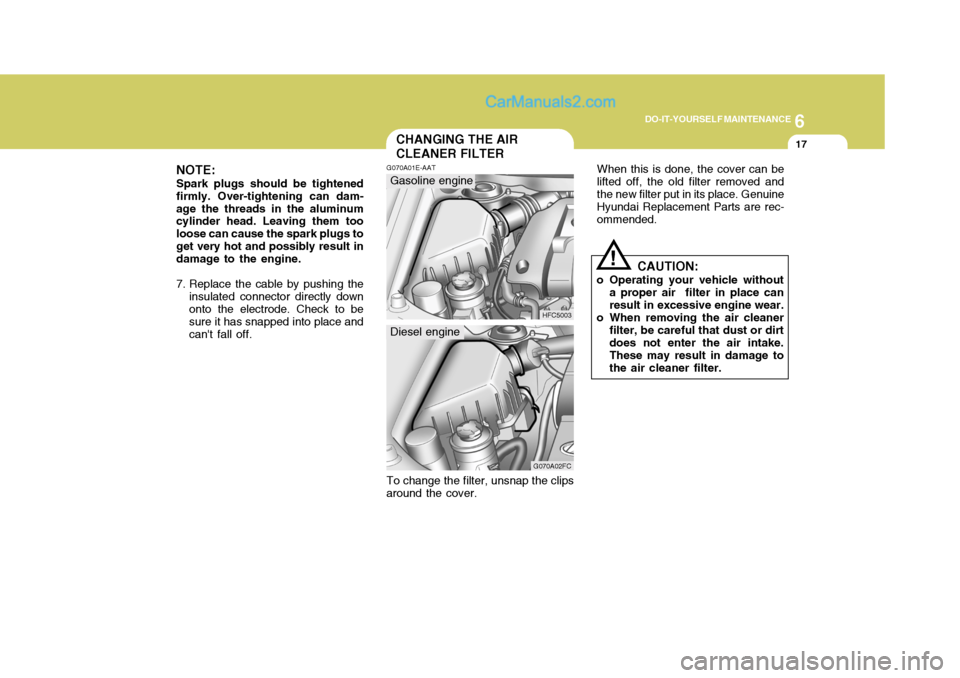
17CHANGING THE AIR CLEANER FILTER
NOTE: Spark plugs should be tightened firmly. Over-tightening can dam-age the threads in the aluminum cylinder head. Leaving them too loose can cause the spark plugs toget very hot and possibly result in damage to the engine.
7. Replace the cable by pushing the insulated connector directly down onto the electrode. Check to be sure it has snapped into place and can't fall off. G070A01E-AAT
HFC5003
Gasoline engine
When this is done, the cover can belifted off, the old filter removed andthe new filter put in its place. Genuine Hyundai Replacement Parts are rec- ommended.
!
G070A02FC CAUTION:
o Operating your vehicle without a proper air filter in place can result in excessive engine wear.
o When removing the air cleaner
filter, be careful that dust or dirtdoes not enter the air intake. These may result in damage to the air cleaner filter.
Diesel engine
To change the filter, unsnap the clips
around the cover.
Page 363 of 407

6 DO-IT-YOURSELF MAINTENANCE
18
!
The washer fluid reservoir supplies
fluid to the windshield washer sys- tem.
A good quality washer fluid should be
used to fill the washer reservoir. Thefluid level should be checked more frequently during inclement weather or whenever the washer system is inmore frequent use. The capacity of the washer reservoir
is 3.0 liters (3.2 U.S. quarts).
FILLING THE WASHER RESERVOIRWINDSHIELD WIPER BLADES G090A01A-GAT
HFC5010
CAUTION:
o Do not operate the wipers on dry glass. This can result in more rapid wear of the wiper blades and may scratch the glass.
o Keep the blade rubber out of contact with petroleum productssuch as engine oil, gasoline, etc.
G080A02A-AAT The wiper blades should be carefully
inspected from time to time and cleaned to remove accumulations ofroad film or other debris. To clean the wiper blades and arms, use a clean sponge or cloth with a mild soap ordetergent and water. If the wipers continue to streak or smear the glass, replace them with genuine Hyundaireplacement parts or their equivalent. HEF119
Page 364 of 407
6
DO-IT-YOURSELF MAINTENANCE
19
!
CHECKING THE TRANSAXLE OIL
!
CAUTION:
o Radiator antifreeze (engine cool- ant) should not be used in the washer system because it will damage the car's finish.
o The washer should not be oper- ated if the washer reservoir isempty. This can damage the washer fluid pump.
G100A01A
G100A01FC-GAT
MANUAL TRANSAXLE
Transaxle lubricant in the manual
transaxle should be checked at those intervals specified in the vehicle main- tenance schedule in Section 5. Recommended Oil
Use only HYUNDAI GENUINE
PARTS MTF 75W/85 (API GL-4) in the manual transaxle. Manual Transaxle Oil Capacity
The oil capacity of the manual
transaxle is 2.15 liters (2.3 U.S. quarts)/ (2.0 liters, (2.11 U.S. quarts) -1.5 CRDi). Drain plug
Filler plug WARNING:
It is always better to check thetransaxle oil level when the engine is cool or cold. If the engine is hot, you should exercise great cautionto avoid burning yourself on hot engine or exhaust parts.
Page 365 of 407

6 DO-IT-YOURSELF MAINTENANCE
20
!
3. Replace the plug and washer,
screw it in with your fingers and then tighten securely with the wrench.
G110A02E-AAT
AUTOMATIC TRANSAXLE
Transaxle fluid in the automatic transaxle should be checked at those intervals specified in the vehicle main- tenance schedule in Section 5. NOTE: Automatic transaxle fluid is a red color. As driving distance in- creases, the fluid color turns dark-ish red gradually. It is a normal condition and you should not judge the need to replace basedupon the changing color.You must replace the automatictransaxle fluid in accordance withintervals specified in the vehicle maintenance schedule in section 5. G110B04A-AAT
Recommended Fluid
Your Hyundai automatic transaxle is
specially designed to operate with HYUNDAI GENUINE ATF SP III, DIA- MOND ATF SP-III, SK ATF SP III orother brands approved by Hundai Motor Co,. Damage caused by a nonspecified fluid is not covered byyour new vehicle limited warranty.
G100B02A-AAT
To Check the Maunal Transaxle Fluid Level
G100B01L
Park the car on level ground with the
engine off.
1. Using a wrench of the correct size,
loosen the oil filler plug by turning it counterclockwise and remove it with your fingers.
2. Use your finger or suitable tool to feel inside the hole. The oil level should be at its bottom edge. If it isnot, check for leaks before adding oil. To refill the transaxle or bring the oil level up,add oil slowly until itreaches the proper level. Do not overfill. CAUTION:
Use of aftermarket ATF additives
may cause damage to the auto-matic transaxle. Only use HYUNDAI GENUINE ATF SP III, DIAMONDATF SP III, SK ATF SP III or other brands approved by Hyundai Mo- tor Co., If you are having yourvehicle serviced at a facility other than a Hyundai dealer, verify ATF is used for your vehicle.
Page 366 of 407

6
DO-IT-YOURSELF MAINTENANCE
21
C090A01FC
G110D03A-GAT
To Check the Transaxle Fluid Level
Park the car on level ground with the
parking brake engaged. When the transaxle fluid level is checked, the transaxle fluid should be at normaloperating temperature and the en- gine idling. While the engine is idling, apply thebrakes and move the gear selector lever from "P" to each of its other positions -- "R", "N", "D", "2", "L" -- and then return to "N" or "P". With theengine still idling:
1. Open the hood, being careful to
keep hands, long hair and clothing clear of any moving parts.
2. Remove the transaxle dipstick, wipe it clean, reinsert the dipstick as faras it will go, then remove it again.Now check the fluid level on the dipstick. It should be in the "HOT" range on the dipstick. HFC5008
!
G110C01FC-GAT
Transaxle Fluid Capacity
The fluid capacity of the automatic
transaxle is 6.1 liters (1.6 DOHC)/6.7 liters (1.8 DOHC).
WARNING:
The transaxle fluid level should be
checked when the engine is at normal operating temperature. Thismeans that the engine, radiator, exhaust system etc., are very hot. Exercise great care not to burnyourself during this procedure.