2005 Hyundai Azera fuel cap
[x] Cancel search: fuel capPage 87 of 297
1FEATURES OF YOUR HYUNDAI
70INSTRUMENT CLUSTER
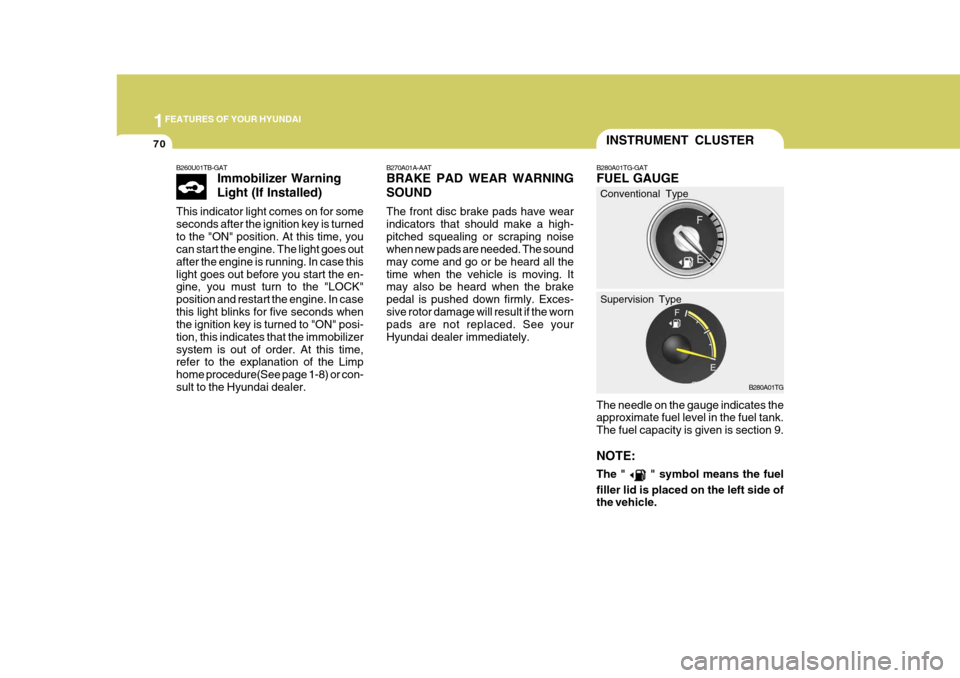
B270A01A-AAT BRAKE PAD WEAR WARNING SOUND The front disc brake pads have wear indicators that should make a high-pitched squealing or scraping noise when new pads are needed. The sound may come and go or be heard all thetime when the vehicle is moving. It may also be heard when the brake pedal is pushed down firmly. Exces-sive rotor damage will result if the worn pads are not replaced. See your Hyundai dealer immediately. B280A01TG-GAT FUEL GAUGE
The needle on the gauge indicates the approximate fuel level in the fuel tank. The fuel capacity is given is section 9. NOTE: The "
" symbol means the fuel
filler lid is placed on the left side of the vehicle. B280A01TG
Conventional Type Supervision Type
B260U01TB-GAT
Immobilizer Warning Light (If Installed)
This indicator light comes on for some seconds after the ignition key is turnedto the "ON" position. At this time, you can start the engine. The light goes out after the engine is running. In case thislight goes out before you start the en- gine, you must turn to the "LOCK" position and restart the engine. In casethis light blinks for five seconds when the ignition key is turned to "ON" posi- tion, this indicates that the immobilizersystem is out of order. At this time, refer to the explanation of the Limp home procedure(See page 1-8) or con-sult to the Hyundai dealer.
Page 120 of 297

1
FEATURES OF YOUR HYUNDAI
103
!WARNING:
o Fuel vapors are dangerous. Be- fore refueling, always stop the engine and never allow sparks oropen flames near the filler area. If you need to replace the filler cap, use a genuine Hyundai replace-ment part. If you open the fuel filler cap during high ambient tempera-tures, a slight "pressure sound" may be heard. This is normal and not a cause for concern.Whenever you open the fuel filler cap, turn it slowly. HTG2023
REMOTE FUEL-FILLER LID RELEASE
B560A02NF-GAT The fuel-filler lid may be opened from inside the vehicle by pushing on thefuel-filler lid opener located on the driver side door. NOTE: If the fuel-filler lid will not open because ice has formed around it, tap lightly or push on the lid tobreak the ice and release the lid. Do not pry on the lid. If necessary, spray around the lid with an ap-proved de-icer fluid (do not use radiator anti-freeze) or move the vehicle to a warm place and allowthe ice to melt. HTG2022HIGH-MOUNTED REAR STOP LIGHT
B550A01A-AAT In addition to the lower-mounted rear stop lights on either side of the car, the high mounted rear stop light in thecenter of the rear window also lights when the brakes are applied. B550A01TG
Page 121 of 297
1FEATURES OF YOUR HYUNDAI
104
o Automotive fuels are flammable/
explosive materials. When refuel- ing, please note the following guidelines carefully. Failure tofollow these guidelines may re- sult in severe personal injury, se- vere burns or death by fire orexplosion.
- Before refueling always note thelocation of the Emergency Gaso- line Shut-Off, if available, at the gas station facility.
- Before touching the fuel nozzle
or fuel filler cap, you shouldeliminate potentially dangerous static electricity discharge bytouching another metal part of the front of the vehicle, a safe distance away from the fuel fillerneck, nozzle, or other gas source.
- Do not get back into a vehicle
once you have begun refueling.Do not touch, rub or slide against any item or fabric (polyester,satin, nylon, etc.) capable of pro- ducing static electricity. Static electricity discharge can ignitefuel vapors resulting in explo- sion.If you must re-enter the vehicle,
you should once again elimi- nate potentially dangerous static electricity discharge by touch-ing a metal part of the vehicle, away from the fuel filler neck, nozzle or other gasoline source.
- When using a portable fuel con- tainer be sure to place the con-tainer on the ground prior torefueling. Static electricity dis- charge from the container can ignite fuel vapors causing a fire.Once refueling has begun, con- tact with the vehicle should be maintained until the filling iscomplete. Use only portable fuel containers designed to carry and store gasoline.
- Do not use cellular phones around a gas station or whilerefueling any vehicle. Electriccurrent and/or electronic inter- ference from cellular phones can potentially ignite fuel vaporscausing a fire. If you must use your cellular phone use it in a place away from the gas station. - When refueling always shut the
engine off. Sparks produced byelectrical components related tothe engine can ignite fuel va- pors causing a fire. Always in- sure that the engine is OFF be-fore and during refueling. Once refueling is complete, check to make sure the fuel filler cap anddoor are securely closed, before starting the engine.
- Do not light any fire around a gas station. DO NOT use matchesor a lighter and DO NOT SMOKE or leave a lit cigarette in yourvehicle while at a gas station especially during refueling. Automotive fuel is highly flam-mable and can, when ignited, result in explosion by flames.
- If a fire breaks out during refuel- ing, leave the vicinity of the ve-hicle, and immediately contact the manager of the gas stationor contact the police and local fire department. Follow any safety instructions they provide.
Page 231 of 297

5VEHICLE MAINTENANCE REQUIREMENTS
4
Note : (1) For every 40,000 km : "R" (2) For every 160,000 km : "R" (3) For every 96,000 km or 48 months, whichever occurs first : "I"(4) For every 20,000 km : "I"
NO.
1234 5 6789
10111213 ENGINE CONTROL SYSTEM MAINTENANCEENGINE OIL & FILTERDRIVE BELT (AUTO-TENSIONER, ALTERNATOR, P/STR'G, W/PUMP)FUEL FILTER (MPI TYPE)FUEL LINES, FUEL HOSES & CONNECTIONSVAPOR HOSE & FUEL FILLER CAP VACUUM HOSE CRANKCASE VENTILATION HOSEAIR CLEANER FILTERSPARK PLUGS (Leaded)SPARK PLUGS (Unleaded-IRIDIUM COATED)VALVE CLEARANCE FUEL TANK AIR FILTER ELECTRONIC THROTTLE CONTROL
F030A01A-GAT The following maintenance services must be performed to assure good vehicle control and performance. Keep receipts for all vehicle services to protect your warranty. Where both mileage and time are shown, the frequency of service is determinedby whichever occurs first. F030B01TG-GAT R :Replace I : Inspect and, after Inspection, clean, adjust, repair or replace if necessary.
SCHEDULED MAINTENANCE
120
96
R I
R
I II
R
I
105
84
R
I I I I I
90 72
R I I III
R R
75 60
R
I I I I I
60 48
R I
R
III
R
I
4536
R
IIII I
R
30 24
R I I II
R
I
1512
R
III I IKILOMETERS X 1000 MONTHSDESCRIPTION
See Note (1) See Note (2) See Note (3) See Note (4)
Page 234 of 297
5
VEHICLE MAINTENANCE REQUIREMENTS
7EXPLANATION OF SCHED- ULED MAINTENANCE ITEMS
F060M01A-AAT
o Engine Oil and Filter
The engine oil and filter should be changed at the intervals specified in the maintenance schedule. If the car is being driven in severe conditions,more frequent oil and filter changes are required. F060B01NF-GAT
o Drive Belts
Inspect all drive belts for evidence of cuts, cracks, excessive wear or oil saturation and replace if necessary.Drive belts should be checked periodi- cally for proper tension. F060C01A-AAT
o Fuel Filter
A clogged filter can limit the speed at
which the vehicle may be driven, dam-age the emission system and cause hard starting. If an excessive amountof foreign matter accumulates in the fuel tank, the filter may require re- placement more frequently. After installing a new filter, run the
engine for several minutes, and checkfor leaks at the connections. Fuel fil- ters should be installed by trained technicians.
F060D01A-AAT
o Fuel Lines, Fuel Hoses and
Connections
Check the fuel lines, fuel hoses and
connections for leakage and damage. Have a trained technician replace any damaged or leaking parts immediately. F060G01A-AAT
o Vapor Hose and Fuel Filler Cap The vapor hose and fuel filler cap should be inspected at those intervals specified in the maintenance sched- ule. Make sure that a new vapor hoseor fuel filler cap is correctly replaced. F060F01A-AAT
o Vacuum, Crankcase
Ventilation Hoses
Inspect the surface of hoses for evi- dence of heat and/or mechanical dam- age. Hard and brittle rubber, cracking, tears, cuts, abrasions, and excessiveswelling indicate deterioration. Particu- lar attention should be paid to examine those hose surfaces nearest to highheat sources, such as the exhaust manifold.
Page 279 of 297
7EMISSION CONTROL SYSTEMS
2EMISSION CONTROL SYSTEMS
H010A01A-GAT
(If Installed)
Your Hyundai is equipped with an
emission control system to meet all requirements of the Emission prohibi- tion rules of your province.
There are three emission control sys-
tems which are as follows.
(1) Crankcase emission control sys- tem
(2) Evaporative emission control sys- tem
(3) Exhaust emission control system
In order to assure the proper function
of the emission control systems, it is recommended that you have your carinspected and maintained by an au- thorized Hyundai dealer in accordance with the maintenance schedule in thismanual. H010B01A-AAT
1. Crankcase Emission Control
System
The positive crankcase ventilation
(PCV) system is employed to preventair pollution caused by blow-by gasesbeing emitted from the crankcase. This system supplies fresh filtered air to the crankcase through the air in-take hose. Inside the crankcase, the fresh air mixes with blow-by gases, which then pass through the PCVvalve into the induction system.
H010C02Y-GAT
2. Evaporative Emission
Control System
The Evaporative Emission Control
System is designed to prevent fuelvapors from escaping into the atmo-sphere. Canister
While the engine is inoperative, fuel
vapors generated inside the fuel tankare absorbed and stored in the canis-ter. When the engine is running, the fuel vapors absorbed in the canister are drawn into the induction systemthrough the purge control solenoid valve. Purge Control Solenoid Valve
The purge control solenoid valve is
controlled by the ECM (Engine Control Module); when the engine coolant tem- perature is low, and during idling, it closes, so that evaporated fuel is not taken into the surge tank. After enginewarm-up, during ordinary driving, it opens so as to introduce evaporated fuel to the surge tank.
Page 289 of 297

9 VEHICLE SPECIFICATIONS
2
Standard OptionSpare
225/60 R16
235/55 R17
Full Size
3.3L
130A (13.5V)
J010A01TG-GAT MEASUREMENT4895 (192.7)
1865 (73.4) 1490 (58.6)
2780 (109.4)
1580 (62.2)1565 (61.6)
Overall lengthOverall width Overall heightWheel base Wheel tread
Front
Rear
Type Wheel free play Rack strokeOil pump type Rack and pinion0 ~ 30 mm (0 ~ 1.18 in.) 146 mm (5.74 in.) Vane type
J060A01TG-GAT FUEL SYSTEM
J020A01TG-GAT POWER STEERING J030A01TG-GAT TIRE
Item BatteryAlternator
J040A01TG-GAT ELECTRICAL
mm (in.)
Fuel tank capacity75 liter
CMF 68AH
J050A01TG-GAT BRAKE
Dual hydraulic with brake booster Ventilated discSolid disc Cable operated on rear wheel
Type Front brake typeRear brake type Parking brake
Page 294 of 297

10
INDEX
3
Console Box .............................................................. 1-96
Cooling Fans ............................................................. 6-25
Corrosion protection
Cleaning the interior .................................................. 4-5
Protecting your Hyundai from corrosion ................... 4-2
Washing and waxing ................................................. 4-4
Cruise Control .......................................................... 1-109
D Defrosting/Defogging ................................................ 1-119
Door
Central door locks .................................................. 1-12
Door edge warning light ........ ................................1-107
Door locks ................................................................ 1-9
Locking and unlocking front door with a key .......... 1-10
Drink Holder ............................................................... 1-87
Drive Belt ................................................................... 6-21
Driving Driving for economy ............................................... 2-14
Smooth corneri ng .................................................... 2-16
Winter driving .......................................................... 2-16
E Electronic Stability Program (ESP) ...........................2-11
Emission Contro l System ............................................ 7-2
Engine Before starting the engine ........................................ 2-3Compartment ............................................................ 6-2
Coolant ..................................................................... 6-7 Coolant temperature gauge
.....................................1-71
If the engine overheats ............................................. 3-4
Number ..................................................................... 8-2
Oil ............................................................................. 6-4 Starting ..................................................................... 2-5
Engine Exhaust Can Be Dangerous ............................ 2-2
F
Fan Speed Control ............. ...........................1-115, 1-125
Fog Light Switch Front ....................................................................... 1-79
Rear ........................................................................ 1-80
Front Seats
Active headrests ..................................................... 1-23
Adjustable front seats ............................................. 1-21
Adjustable headrests .............................................. 1-22
Adjusting seat forward and rearward .......................1-21
Adjusting seatback angle ....................................... 1-21
Power seat ............................................................. 1-24
Fuel Capacity ................................................................... 9-2
Gauge ..................................................................... 1-70
Recommendations .................................................... 1-2
Fuel Filler Lid Remote release .................................................... 1-103
Fuse Panel Description ............................................. 6-37
Fuses ........................................................................ 6-21