Page 150 of 219

5
VEHICLE MAINTENANCE REQUIREMENTS4
SCHEDULED MAINTENANCE
150
240
120
R
I
I
R
R
R MILES X 1000
KILOMETERS X 1000
MONTHS
EMISSION CONTROL ITEMS
ENGINE OIL AND FILTER
FUEL FILTER
FUEL LINES, FUEL HOSES AND CONNECTIONS
VACUUM AND CRANKCASE VENTILATION HOSES
VAPOR HOSE AND FUEL FILLER CAP
AIR CLEANER FILTER
FUEL TANK AIR FILTER
SPARK PLUGS No.DESCRIPTION
1
2
3
4
5
6
7
87.5
12
6
R15
24
12
R
I22.5
36
18
R30
48
24
R
I
I
R
R
R37.5
60
30
R45
72
36
R
I52.5
84
42
R
R
I60
96
48
R
I
I
R
R
R67.5
108
54
R75
120
60
R
I82.5
132
66
R90
144
72
R
I
I
R
R
R97.5
156
78
R105
168
84
R
R
I
I112.5
180
90
R120
192
96
R
I
I
R
R
R127.5
204
102
R135
216
108
R
I142.5
228
114
R
F030B03A-AATR : Replace I : Inspect and, after inspection, clean, adjust, repair or replace if necessaryF030A01A-AATThe following maintenance services must be performed to assure good vehicle control and performance. Keep receipts for all vehicle services to protect
your warranty. Where both mileage and time are shown, the frequency of service is determined by whichever occurs first.
Page 153 of 219

5
VEHICLE MAINTENANCE REQUIREMENTS
7
EXPLANATION OF SCHEDULED
MAINTENANCE ITEMS
F060D01A-AATo Fuel Lines, Fuel Hoses and
ConnectionsCheck the fuel lines, fuel hoses and connec-
tions for leakage and damage. Have a trained
techincian, replace any damaged or leaking
parts immediately.
F060C01A-AATo Fuel FilterA clogged filter can limit the speed at which the
vehicle may be driven, damage the emission
system and cause hard starting. If an excessive
amount of foreign matter accumulates in the fuel
tank, the filter may require replacement more
frequently.
After installing a new filter, run the engine for
several minutes, and check for leaks at the
connections.
Fuel filters should be installed by trained techni-
cians.F060M01A-AATo Engine Oil and FilterThe engine oil and filter should be changed at
the intervals specified in the maintenance sched-
ule. If the car is being driven in severe condi-
tions, more frequent oil and filter changes are
required.
F060H01A-AATo Air Cleaner FilterA Genuine Hyundai air cleaner filter is recom-
mended when the filter is replaced.F060G01A-AATo Vapor Hose and Fuel Filler CapThe vapor hose and fuel filler cap should be
inspected at those intervals specified in the
maintenance schedule. Make sure that a new
vapor hose or fuel filler cap is correctly re-
placed.
F060F01A-AATo Vacuum, Crankcase Ventilation
HosesInspect the surface of hoses for evidence of
heat and/or mechanical damage. Hard and brittle
rubber, cracking, tears, cuts, abrasions, and
excessive swelling indicate deterioration. Par-
ticular attention should be paid to examine those
hose surfaces nearest to high heat sources,
such as the exhaust manifold.
Inspect the hose routing to assure that the
hoses do not come in contact with any heat
source, sharp edges or moving component which
might cause heat damage or mechanical wear.
Inspect all hose connections, such as clamps
and couplings, to make sure they are secure,
and that no leaks are present. Hoses should be
replaced immediately if there is any evidence of
deterioration or damage.
F060B01A-AATo Drive BeltsInspect all drive belts for evidence of cuts,
cracks, excessive wear or oil saturation and
replace if necessary. Drive belts should be
checked periodically for proper tension and ad-
justed as necessary.F060J01A-AATo Spark PlugsMake sure to install new spark plugs of the
correct heat range.
Page 189 of 219
6
DO-IT-YOURSELF MAINTENANCE
34
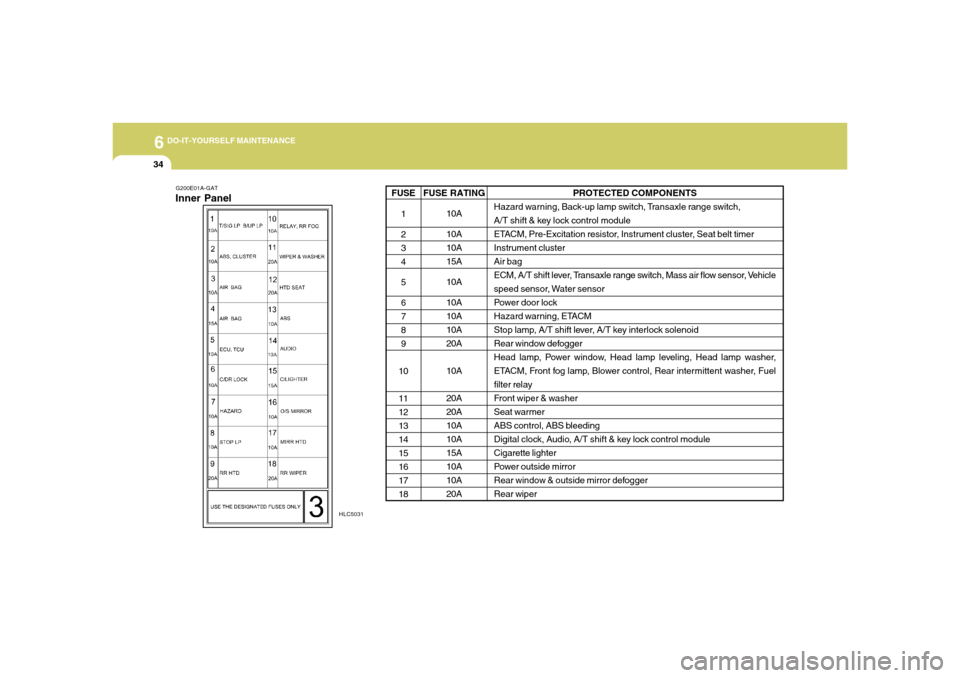
G200E01A-GATInner Panel
HLC5031
PROTECTED COMPONENTS
Hazard warning, Back-up lamp switch, Transaxle range switch,
A/T shift & key lock control module
ETACM, Pre-Excitation resistor, Instrument cluster, Seat belt timer
Instrument cluster
Air bag
ECM, A/T shift lever, Transaxle range switch, Mass air flow sensor, Vehicle
speed sensor, Water sensor
Power door lock
Hazard warning, ETACM
Stop lamp, A/T shift lever, A/T key interlock solenoid
Rear window defogger
Head lamp, Power window, Head lamp leveling, Head lamp washer,
ETACM, Front fog lamp, Blower control, Rear intermittent washer, Fuel
filter relay
Front wiper & washer
Seat warmer
ABS control, ABS bleeding
Digital clock, Audio, A/T shift & key lock control module
Cigarette lighter
Power outside mirror
Rear window & outside mirror defogger
Rear wiper
FUSE RATING
10A
10A
10A
15A
10A
10A
10A
10A
20A
10A
20A
20A
10A
10A
15A
10A
10A
20A FUSE
1
2
3
4
5
6
7
8
9
10
11
12
13
14
15
16
17
18
Page 191 of 219

7
EMISSION CONTROL SYSTEMS2
EMISSION CONTROL SYSTEM
Canister
Fuel vapors generated inside the fuel tank are
absorbed and stored in the onboard canister.
When the engine is running, the fuel vapors
absorbed in the canister are drawn into the
induction system through the purge control
solenoid valve.Purge Control Solenoid Valve (PCSV)The purge control solenoid valve is controlled
by the Engine Control Module (ECM); when
the engine coolant temperature is low during
idling, the PCSV closes so that evaporated fuel
is not taken into the engine. After the engine
warms-up during ordinary driving, the PCSV
opens to introduce evaporated fuel to the
engine.
H010B01A-AAT1. CRANKCASE EMISSION CONTROL
SYSTEMThe positive crankcase ventilation system is
employed to prevent air pollution caused by
blow-by gases being emitted from the crank-
case. This system supplies filtered fresh air to
the crankcase through the air intake hose.
Inside the crankcase, the fresh air mixes with
blow-by gases, then passes through the PCV
valve into the induction system.
H010A01A-AATYour Hyundai is equipped with an emission
control system to meet all requirements of the
U.S. Environmental Protection Agency or Cali-
fornia Air Resources Board.
There are three emission control systems
which are as follows.
1) Crankcase Emission Control System
2) Evaporative Emission Control System
3) Exhaust Emission Control System
In order to ensure the proper function of the
emission control systems, it is recommended
that you have your car inspected and main-
tained by an authorized Hyundai dealer in
accordance with the maintenance schedule in
this manual.
H010D01A-AAT3. EXHAUST EMISSION
CONTROL SYSTEMThe Exhaust Emission Control System is a
highly effective system which controls ex-
haust emissions while maintaining good ve-
hicle performace.
H010C01S-AAT2. Evaporative Emission Control (Includ-
ing ORVR: Onboard Refueling Vapor
Recovery) SystemThe Evaporative Emission Control System is
designed to prevent fuel vapors from escaping
into the atmosphere.
(The ORVR system is designed to allow the
vapors from the fuel tank to be loaded into a
canister while refueling at the gas station,
preventing the escape of fuel vapors into the
atmosphere.)