2005 Hyundai Accent warning light
[x] Cancel search: warning lightPage 128 of 219

32WHAT TO DO IN AN EMERGENCY
IF THE ENGINE WILL NOT START!
D010B02A-AATIf Engine Doesn't Turn Over or Turns
Over Slowly
D010A01A-AATD010C01A-AAT
If Engine Turns Over Normally but Does
Not Start1. Check fuel level.
2. With the key in the "OFF" position, check all
connectors at ignition coil and spark plugs.
Reconnect any that may be disconnected or
loose.
3. Check the fuel line in the engine room.
4. If the engine still refuses to start, call a
Hyundai dealer or seek other qualified assis-
tance.
WARNING:
If the engine will not start, do not push or
pull the car to start it. This could result in a
collision or cause other damage. In addition,
push or pull starting may cause the catalytic
converter to be overloaded and create a fire
hazard.
D010B01AD010C01A-D
1. If your car has an automatic transaxle, be
sure the gear selector lever is in "N" or "P"
and the emergency brake is set.
2. Check the battery connections to be sure
they are clean and tight.
3. Turn on the interior light. If the light dims or
goes out when you operate the starter, the
battery is discharged.
4. Check the starter connections to be sure
they are securely tightened.
5. Do not push or pull the vehicle to start it. See
instructions for "Jump Starting".
Page 129 of 219

3
WHAT TO DO IN AN EMERGENCY
3
JUMP STARTING
D010D01A-AATIf the Engine Stalls While Driving1. Reduce your speed gradually, keeping a
straight line. Move cautiously off the road to
a safe place.
2. Turn on your emergency flashers.
3. Try to start the engine again. If your vehicle
will not start, contact a Hyundai dealer or
seek other qualified assistance.
!
D020A02A-AAT
WARNING:
The gas produced by the battery during the
jump-start operation is highly explosive. If
these instructions are not followed exactly,
serious personal injury and damage to the
vehicle may occur! If you are not sure how to
follow this procedure, seek qualified assis-
tance. Automobile batteries contain sulfuric
acid. This is poisonous and highly corrosive.
When jump starting, wear protective glasses
and be careful not to get acid on yourself,
your clothing or on the car.Discharged
battery
Booster
battery
HLC4001
o If you should accidentally get acid on your
skin or in your eyes, immediately remove
any contaminated clothing and flush the area
with clear water for at least 15 minutes. Then
promptly obtain medical attention. If you must
be transported to an emergency facility, con-
tinue to apply water to the affected area with
a sponge or cloth.
o The gas produced by the battery during the
jump-start operation is highly explosive. Do
not smoke or allow a spark or open flame in
the vicinity.
o The battery being used to provide the jump
start must be 12-volt. If you cannot deter-
mine that it is a 12-volt battery, do not at-
tempt to use it for the jump start.
o To jump start a car with a discharged battery,
follow this procedure exactly:
1. If the booster battery is installed in another
vehicle, be sure the two vehicles are not
touching.
2. Turn off all unnecessary lights and acces-
sories in both vehicles.
3. Attach the clamps of the jumper cable in the
exact location shown on the previous page.
First, attach one clamp of the jumper cable to
the positive (+) post or cable of the dis-
charged battery. Then attach the other end
of the same cable to the positive (+) post or
cable of the booster battery. Next, using the
other cable, attach one clamp to the nega-
tive (-) post or cable of the booster battery.
Page 130 of 219

34WHAT TO DO IN AN EMERGENCY
IF THE ENGINE OVERHEATS
!!
WARNING:
While the engine is running, keep hands,
long hair and clothing away from moving
parts such as the fan and drive belts to
prevent injury.
D030A02A-AATIf your temperature gauge indicates overheat-
ing, you experience a loss of power, or hear loud
pinging or knocking, the engine is probably too
hot. If this happens, you should:
1. Pull off the road and stop as soon as it is safe
to do so.
2. Place the gear selector lever in "P" (auto-
matic), or neutral (manual transaxle) and set
the parking brake. If the air conditioner is on,
turn it off.
3. If coolant is running out under the car or
steam is coming out from the hood, stop the
engine. Do not open the hood until the cool-
ant has stopped running or the steaming has
stopped. If there is no visible loss of coolant
and no steam, leave the engine running and
check to be sure the engine cooling fan is
operating. If the fan is not running, turn the
engine off.
4. Check to see if the water pump drive belt is
missing. If it is not missing, check to see that
it is tight. If the drive belt seems to be
satisfactory, check for coolant leaking from
the radiator, hoses or under the car. (If the air
conditioner had been in use, it is normal for
cold water to be draining from it when you
stop).5. If the water pump drive belt is broken or
coolant is leaking out, stop the engine im-
mediately and call the nearest Hyundai deal-
er for assistance.
WARNING:
Do not remove the radiator cap when the
engine is hot. This may allow coolant to be
blown out of the opening and cause serious
burns.
6. If you cannot find the cause of the overheat-
ing, wait until the engine temperature has
returned to normal. Then, if coolant has been
lost, carefully add water to the reservoir
(Page 6-7) to bring the fluid level in the
reservoir up to the halfway mark.
7. Proceed with caution, keeping alert for fur-
ther signs of overheating. If overheating hap-
pens again, call a Hyundai dealer for assis-
tance. Then attach the other end of that cable to a
solid metal part of the engine away from the
battery. Do not connect the cable to any
moving part.
4. Start the engine in the car with the booster
battery and let it run for a few minutes. This
will help to assure that the booster battery is
fully charged. During the jumping operation,
run the engine in this vehicle at about 2000
rpm.
5. Start the engine in the car with the dis-
charged battery using the normal starting
procedure. After the engine starts, leave the
jumper cables connected and let the engine
run at fast idle or about 2000 rpm for several
minutes.
6. Carefully remove the jumper cables in the
reverse order of attachment.
If you do not know why your battery became
discharged (because the lights were left on,
etc.), have the charging system checked by
your Hyundai dealer.
Page 136 of 219

310
WHAT TO DO IN AN EMERGENCY
!
Raise the car high enough so that the
fully inflated spare tire can be in-
stalled. To do this, you will need more
ground clearance than is required to
remove the flat tire.
D060G02Y-AAT6. Changing Wheels
Loosen the wheel nuts and remove
them with your fingers. Slide the wheel
off the studs and lay it flat so it cannot
roll away. To put the wheel on the
hub, pick up the spare tire, line up the
holes with the studs and slide the
wheel onto them. If this is difficult, tip
the wheel slightly and get the top hole
in the wheel lined up with the top
stud. Then jiggle the wheel back and
forth until the wheel can be slid over
the other studs.
D060G01A
WARNING:
Do not get under the car when it is
supported by the jack! This is very
dangerous as the vehicle could
fall and cause serious injury or
death. No one should stay in the
car while the jack is being used.
!
WARNING:
Wheels and wheel covers may have
sharp edges. Handle them care-
fully to avoid possible severe in-
jury.
Before putting the wheel into place,
be sure that there is nothing on
the hub or wheel (such as mud,
tar, gravel, etc.) that interferes with
the wheel fitting solidly against
the hub. If there is, remove it.
D060G02A
Page 176 of 219

6
DO-IT-YOURSELF MAINTENANCE
21
CHECKING THE BATTERY!
G210A01A-AAT
WARNING:
When working with batteries, carefully ob-
serve the following precautions to avoid se-
rious injuries.o If battery fluid is on your skin, flush the
affected areas with water for at least 15
minutes and then seek medical assistance.
o If battery fluid is in your eyes, rinse out your
eyes with water and get medical assistance
as soon as possible. While you are being
driven to get medical assistance, continue to
rinse your eyes by using a sponge or soft
cloth saturated with water.
o If you swallow battery fluid, drink a large
quantity of water or milk followed by milk of
magnesia, eat a raw egg or drink vegetable
oil. Get medical assistance as soon as pos-
sible.
While batteries are being charged (either by a
battery charger or by the vehicle's alternator),
they produce explosive gases. Always observe
these warnings to prevent injuries from occur-
ring:
o Charge batteries only in a well ventilated
area.
o Do not permit flames, sparks or smoking in
the area.
o Keep children away from the area.
D010B01A
The fluid in the battery contains a strong solution
of sulfuric acid, which is poisonous and highly
corrosive. Be careful not to spill it on yourself or
the car. If you do spill battery fluid on yourself,
immediately do the following:
G210B02A-AATChecking the BatteryKeep the battery clean. Any evidence of corro-
sion around the battery posts or terminals should
be removed using a solution of household bak-
ing soda and warm water. After the battery
terminals are dry, cover them with a light coating
of grease.
WARNING:
Always read the following instruc-
tions carefully when handling a
battery.
Keep lighted cigarettes and all
other flames or sparks away from
the battery.
Hydrogen, which is a highly com-
bustible gas, is always present in
battery cells and may explode if
ignited.
Keep batteries out of the reach of
children because batteries con-
tain highly corrosive SULFURIC
ACID. Do not allow battery acid to
contact your skin, eyes, clothing
or paint finish.
!
Page 179 of 219

6
DO-IT-YOURSELF MAINTENANCE
24
SPECIFICATIONS:"H";
Horizontal center line of headlights from
ground : 25.8 in. (656 mm)
"W";
Distance between each headlight center :
42.4 in. (1,078 mm)
"L";
Distance between the headlights and the
wall that the lights are tested against:
118 in. (3,000 mm).
G290B02A-AATAdjustment After Headlight Assembly
ReplacementIf the vehicle has had front body repair and the
headlight assembly has been replaced, the head-
light aiming should be checked using an aiming
screen as shown in the illustration. Turn on the
headlight switch. (Low Beam Position)
1. Adjust headlights so that main axis of light is
parallel to center line of the body and is
aligned with point "P" shown in the illustra-
tion.
2. Dotted lines in the illustration show the cen-
ter of headlights.
G290B01A-2
HGround
line Horizontal line0.8 in. (21mm)Vertical line
L
W
H
Cut-off line"P"
!
6. Draw the vertical line (through the center of
each headlight) and the horizontal line
(through the center of each headlight) on the
aiming screen.
And then, draw a parallel line at 0.8 in.(21
mm) under the horizontal line.
7. Adjust each cut-off line of the low beam to
the parallel line with a phillips screwdriver
- VERTICAL AIMING
WARNING:
Horizontal aiming should be adjusted by an
authorized Hyundai dealer.
Page 181 of 219

6
DO-IT-YOURSELF MAINTENANCE
26
!
WARNING:
The halogen bulb contains gas under pres-
sure and if impacted could shatter, resulting
in flying fragments. Always wear eye protec-
tion when servicing the bulb. Protect the
bulb against abrasions or scratches and
against liquids when lighted. Turn the bulb
on only when installed in a headlight. Re-
place the headlight if damaged or cracked.
Keep the bulb out of the reach of children
and dispose of the used bulb with care. 8. Remove the protective cap from the replace-
ment bulb and install the new bulb by match-
ing the plastic base with the headlight hole.
Re-attach the bulb spring and install the dust
cover. Reconnect the power cord.
9. Use the protective cap and carton to dispose
of the old bulb.
10.Check for proper headlight aim.
G270A03O
HLC5011
7. Push the bulb spring to remove the headlight
bulb.
HLC5010
Page 189 of 219
6
DO-IT-YOURSELF MAINTENANCE
34
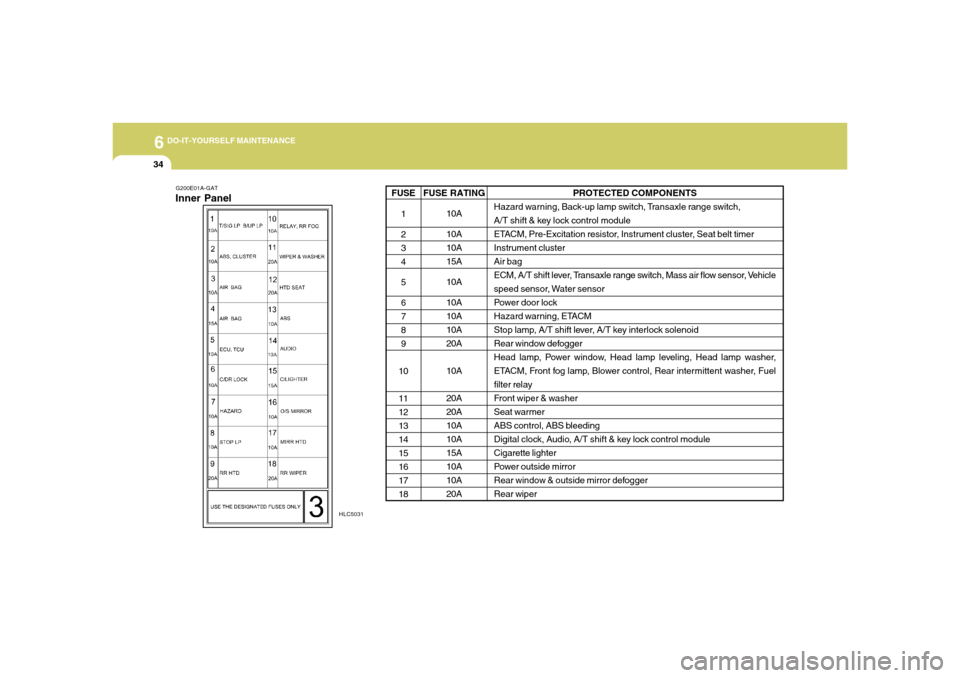
G200E01A-GATInner Panel
HLC5031
PROTECTED COMPONENTS
Hazard warning, Back-up lamp switch, Transaxle range switch,
A/T shift & key lock control module
ETACM, Pre-Excitation resistor, Instrument cluster, Seat belt timer
Instrument cluster
Air bag
ECM, A/T shift lever, Transaxle range switch, Mass air flow sensor, Vehicle
speed sensor, Water sensor
Power door lock
Hazard warning, ETACM
Stop lamp, A/T shift lever, A/T key interlock solenoid
Rear window defogger
Head lamp, Power window, Head lamp leveling, Head lamp washer,
ETACM, Front fog lamp, Blower control, Rear intermittent washer, Fuel
filter relay
Front wiper & washer
Seat warmer
ABS control, ABS bleeding
Digital clock, Audio, A/T shift & key lock control module
Cigarette lighter
Power outside mirror
Rear window & outside mirror defogger
Rear wiper
FUSE RATING
10A
10A
10A
15A
10A
10A
10A
10A
20A
10A
20A
20A
10A
10A
15A
10A
10A
20A FUSE
1
2
3
4
5
6
7
8
9
10
11
12
13
14
15
16
17
18