2005 Hyundai Accent engine temperature
[x] Cancel search: engine temperaturePage 159 of 219

6
DO-IT-YOURSELF MAINTENANCE4
CHECKING THE ENGINE OILG030A01A-AATEngine oil is essential to the performance and
service of the engine. It is suggested that you
check the oil level at least once a week in
normal use and more often if you are on a trip or
driving in severe conditions.
G030C02A-AATTo Check the Oil LevelBefore checking the oil, warm up the engine to
the normal operating temperature and be sure it
is parked on level ground. Turn the engine off.
Wait five minutes, then remove the dipstick,
wipe it off, fully reinsert the dipstick and with-
draw it again. Then note the highest level the oil
has reached on the dipstick. It should be be-
tween the upper ("F") and lower ("L") range.
G030D01A-AATAdding OilIf the oil level is close to or below the "L" mark,
add oil until it reaches the "F" mark. To add oil:
1. Remove the oil filler cap by turning it counter-
clockwise.
2. Add oil, then check the level again. Do not
overfill.
3. Replace the cap by turning it clockwise.
The distance between the "F" and "L" marks is
equal to about 1 quart of oil.
G030C03A
G030D03A G030B01O-AAT
Recommended OilThe engine oil quality should meet the following
classification.
API SJ, SL or ABOVE,
ILSAC GF-3 or ABOVENOTE:o For good fuel economy, SAE 5W-20 (5W-
30), ILSAC GF-3 engine oil is preferred
regardless of regional option and engine
variation.
G030B01JM-U
o If SAE 5W-20, ILSAC GF-3 engine oil is
not available, secondary recommended
engine oil for corresponding temperature
range can be used.
Page 160 of 219

6
DO-IT-YOURSELF MAINTENANCE
5
CHANGING THE OIL AND FILTER
!
G040A03A-AAT
3. Slide underneath the car and loosen the
drain plug by turning it counterclockwise with
a wrench of the proper size. Be sure that a
drain pan is in position to catch the oil as it
drains out, then remove the drain plug.
F040A02TB
Oil filler cap
Drain plug Oil filter
.........
WARNING:
Be very careful when draining the engine oil
as it may be hot enough to burn you!
4. When the oil has stopped draining, replace
the drain plug using a new gasket and re-
tighten by turning it clockwise.
Oil pan drain plug tightening torque:
3.5 ~ 4.5 kgf.m
5. Remove the oil filter by turning it counter-
clockwise with a oil filter wrench of the proper
size. A certain amount of oil will come out
when you remove the filter. So be sure to
have your drain pan in place underneath it.
6. Install a new oil filter in accordance with the
instructions on the carton or on the filter
itself. Do not over-tighten (Tightening torque
: 1.2 ~ 1.6 kgf.m).
Be sure that the mounting surface on the
engine is clean and that the old gasket is
removed completely. Lubricate the new gas-
ket on the filter before installation with clean
engine oil.7. Refill the crankcase with the recommended
engine oil. Refer to the specification in chap-
ter 9 for engine oil capacity.
8. Start the engine and check to be sure no oil
is leaking from the drain plug or oil filter.
9. Shut off the engine and recheck the oil
level.
NOTE:Always dispose of used engine oil in an
environmentally acceptable manner. It is sug-
gested that it be placed in a sealed container
and taken to a service station for reclama-
tion. Do not pour the oil on the ground or put
it in with the household trash.
The engine oil and filter should be changed at
those intervals specified in the maintenance
schedule in Section 5. If the car is being driven
in severe conditions, more frequent oil and filter
changes are required.
The procedure for changing the oil and filter is
as follows:
1. Park the car on level ground and set the
parking brake. Start the engine and let it
warm up until the needle on the temperature
gauge moves above the lowest mark. Turn
the engine off and place the gear selector
lever in "P" (automatic) or reverse gear
(manual transaxle).
2. Open the hood and remove the engine oil
filler cap.
!
PROPOSITION 65 WARNING:
Used engine oil may cause irritation or can-
cer of the skin if left in contact with the skin
for prolonged periods of time. Used engine
oil contains chemicals that have caused can-
cer in laboratory animals. Always protect
your skin by washing your hands thoroughly
with soap and warm water as soon as pos-
sible after handling used oil.
Page 161 of 219

6
DO-IT-YOURSELF MAINTENANCE6
CHECKING AND CHANGING
THE ENGINE COOLANT!
G050A01A-AAT G050B01A-AAT
Recommended Engine CoolantUse a high quality ethylene-glycol coolant in a
50/50 mix with water. The engine coolant should
be compatible with aluminum engine parts. Ad-
ditional corrosion inhibitors or additives should
not be used. The cooling system must be main-
tained with the correct concentration and type of
engine coolant to prevent freezing and corro-
sion.
Never allow the concentration of antifreeze to
exceed the 60% level or go below the 35% level
or damage to the coolant system may result. For
proper concentration when adding or replacing
the coolant, refer to the following table.
WARNING:
Do not remove the radiator cap when the
engine is hot. When the engine is hot, the
engine coolant is under pressure and may
erupt through the opening if the cap is re-
moved. You could be seriously burned if you
do not observe this precaution. Do not re-
move the radiator cap until the radiator is
cool to the touch.
Water
65%
60%
50%
40% Antifreeze
solution
35%
40%
50%
60% Ambient
temperature
°F (°C)
5 (-15)
-13 (-25)
-31 (-35)
-49 (-45)Engine coolant
concentration
G050C01A-AATTo Check the Coolant LevelThe coolant level can be seen on the side of the
plastic coolant reservoir. The level of the coolant
should be between the "L" and "F" lines on the
reservoir when the engine is cool. If the level is
below the "L" mark, add engine coolant to bring
it up between "L" and "F". If the level is low,
inspect for coolant leaks and recheck the fluid
level frequently. If the level drops again, visit
your Hyundai dealer for an inspection and diag-
nosis of the reason.
HLC5005
Page 163 of 219
6
DO-IT-YOURSELF MAINTENANCE8
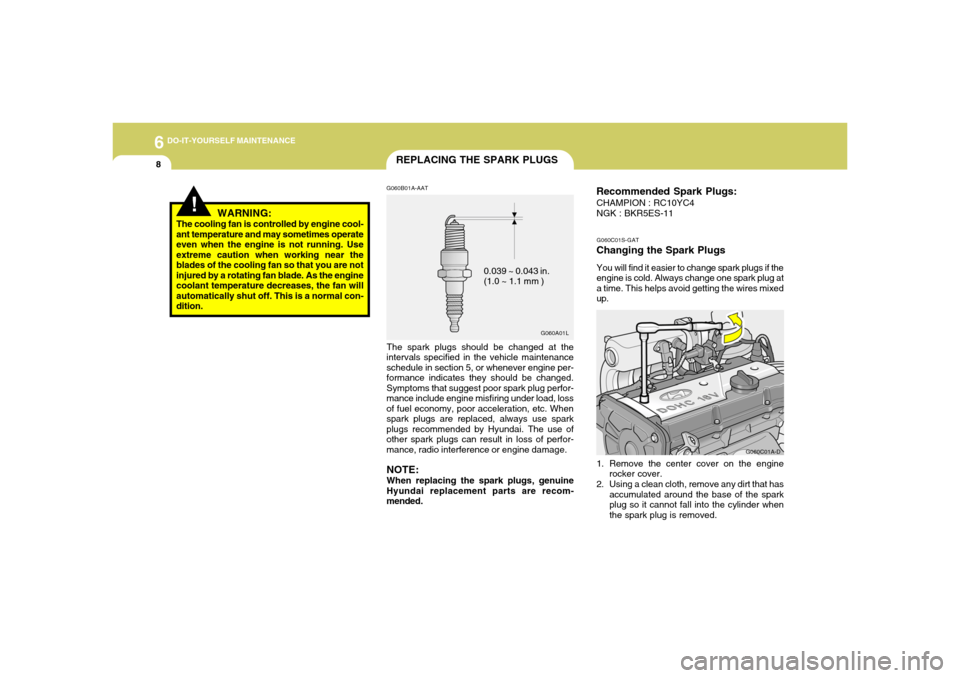
REPLACING THE SPARK PLUGSG060B01A-AAT
G060A01L
0.039 ~ 0.043 in.
(1.0 ~ 1.1 mm )
The spark plugs should be changed at the
intervals specified in the vehicle maintenance
schedule in section 5, or whenever engine per-
formance indicates they should be changed.
Symptoms that suggest poor spark plug perfor-
mance include engine misfiring under load, loss
of fuel economy, poor acceleration, etc. When
spark plugs are replaced, always use spark
plugs recommended by Hyundai. The use of
other spark plugs can result in loss of perfor-
mance, radio interference or engine damage.
NOTE:When replacing the spark plugs, genuine
Hyundai replacement parts are recom-
mended.
G060C01S-GATChanging the Spark PlugsYou will find it easier to change spark plugs if the
engine is cold. Always change one spark plug at
a time. This helps avoid getting the wires mixed
up.
G060C01A-D
1. Remove the center cover on the engine
rocker cover.
2. Using a clean cloth, remove any dirt that has
accumulated around the base of the spark
plug so it cannot fall into the cylinder when
the spark plug is removed.Recommended Spark Plugs:CHAMPION : RC10YC4
NGK : BKR5ES-11
!
WARNING:
The cooling fan is controlled by engine cool-
ant temperature and may sometimes operate
even when the engine is not running. Use
extreme caution when working near the
blades of the cooling fan so that you are not
injured by a rotating fan blade. As the engine
coolant temperature decreases, the fan will
automatically shut off. This is a normal con-
dition.
Page 168 of 219

6
DO-IT-YOURSELF MAINTENANCE
13
While the engine is idling, apply the brakes and
move the gear selector lever from "P" to each of
its other positions -- "R", "N", "D", "2", "L" -- and
then return to "N" or "P". With the engine still
idling:
1. Open the hood, being careful to keep hands,
hair and clothing clear of any moving parts.
2. Remove the transaxle dipstick, wipe it clean,
reinsert the dipstick as far as it will go, then
remove it again. Now check the fluid level on
the dipstick. It should be in the "HOT" range
on the dipstick.
G110D03A G110D02A-AAT
To Check the Transaxle Fluid LevelPark the car on level ground with the parking
brake engaged. When the transaxle fluid level is
checked, the transaxle fluid should be at normal
operating temperature and the engine idling.
C090A01A
!
3. If the transaxle fluid level is low, use a funnel
to add transaxle fluid through the dipstick
tube until the level reaches the "HOT" range.
Do not overfill.
G110D04A
Fluid level should be within
"HOT" rangeWARNING:
The cooling fan is controlled by the engine
coolant temperature and may sometimes op-
erate even when the engine is not running.
Use extreme caution when working near the
blades of the cooling fan, so that you are not
injured by a rotating fan blade. As the engine
coolant temperature decreases, the fan will
automatically shut off. This is a normal con-
dition.
Page 177 of 219

6
DO-IT-YOURSELF MAINTENANCE
22
POWER STEERING FLUID LEVEL
CHECKING ELECTRIC COOLING
FANS!
G220A01A-AAT G230A03A-AAT
G220B01A-AATChecking Engine Cooling FanThe engine cooling fan should come on auto-
matically if the engine coolant temperature is
high.
WARNING:
The radiator fan is controlled by engine cool-
ant temperature and may sometimes operate
even when the engine is not running. Use
extreme caution when working near the
blades of the cooling fan, so that you are not
injured by a rotating fan blade. As the cool-
ant temperature decreases the fan will auto-
matically shut off. This is a normal condition.G220C01A-AATChecking Condenser Cooling FanThe condenser cooling fan should come on
automatically whenever the air conditioner is in
operation.
HLC5006
The power steering fluid level should be checked
regularly. To check the power steering fluid
level, be sure the engine is "OFF", then check to
make certain that the power steering fluid level
is between the "MAX" and "MIN" level markings
on the fluid reservoir.NOTE:Grinding noise from the power steering pump
may be heard immediately after the engine is
started in extremely cold conditions (below
-4°F). If the noise stops during warm up,
there is no abnormal function in the system.
It is due to a power steering fluid character-
istic in extremely cold conditions.
If any electrolyte gets into your
eyes, flush your eyes with clean
water for at least 15 minutes and
get immediate medical attention.
If possible, continue to apply wa-
ter with a sponge or cloth until
medical attention is received.
If electrolyte gets on your skin,
thoroughly wash the contacted
area.
If you feel a pain or a burning
sensation, get medical attention
immediately.
Wear eye protection when charg-
ing or working near a battery.
Always provide ventilation when
working in an enclosed space.
o When lifting a plastic-cased battery, ex-
cessive pressure on the case may cause
battery acid to leak, resulting in personal
injury. Lift with a battery carrier or with
your hands on opposite corners.
o Never attempt to charge the battery when
the battery cables are connected.
o The electrical ignition system works with
high voltage.
Never touch these components with the
engine running or the ignition switched
on.
Page 191 of 219

7
EMISSION CONTROL SYSTEMS2
EMISSION CONTROL SYSTEM
Canister
Fuel vapors generated inside the fuel tank are
absorbed and stored in the onboard canister.
When the engine is running, the fuel vapors
absorbed in the canister are drawn into the
induction system through the purge control
solenoid valve.Purge Control Solenoid Valve (PCSV)The purge control solenoid valve is controlled
by the Engine Control Module (ECM); when
the engine coolant temperature is low during
idling, the PCSV closes so that evaporated fuel
is not taken into the engine. After the engine
warms-up during ordinary driving, the PCSV
opens to introduce evaporated fuel to the
engine.
H010B01A-AAT1. CRANKCASE EMISSION CONTROL
SYSTEMThe positive crankcase ventilation system is
employed to prevent air pollution caused by
blow-by gases being emitted from the crank-
case. This system supplies filtered fresh air to
the crankcase through the air intake hose.
Inside the crankcase, the fresh air mixes with
blow-by gases, then passes through the PCV
valve into the induction system.
H010A01A-AATYour Hyundai is equipped with an emission
control system to meet all requirements of the
U.S. Environmental Protection Agency or Cali-
fornia Air Resources Board.
There are three emission control systems
which are as follows.
1) Crankcase Emission Control System
2) Evaporative Emission Control System
3) Exhaust Emission Control System
In order to ensure the proper function of the
emission control systems, it is recommended
that you have your car inspected and main-
tained by an authorized Hyundai dealer in
accordance with the maintenance schedule in
this manual.
H010D01A-AAT3. EXHAUST EMISSION
CONTROL SYSTEMThe Exhaust Emission Control System is a
highly effective system which controls ex-
haust emissions while maintaining good ve-
hicle performace.
H010C01S-AAT2. Evaporative Emission Control (Includ-
ing ORVR: Onboard Refueling Vapor
Recovery) SystemThe Evaporative Emission Control System is
designed to prevent fuel vapors from escaping
into the atmosphere.
(The ORVR system is designed to allow the
vapors from the fuel tank to be loaded into a
canister while refueling at the gas station,
preventing the escape of fuel vapors into the
atmosphere.)
Page 192 of 219

7
EMISSION CONTROL SYSTEMS
3
CATALYTIC CONVERTER
!
!
H020A01A-AATAll Hyundai vehicles are equipped with a mono-
lith type three-way catalytic converter to
reduce the carbon monoxide, hydrocarbons
and nitrogen oxides contained in the exhaust
gas. Exhaust gases passing through the cata-
lytic converter cause it to operate at a very
high temperature. The introduction of large
amounts of unburned gasoline into the ex-
haust may cause the catalytic converter to
overheat and create a fire hazard. This risk
may be reduced by observing the following:system.
WARNING:
o Remember that your Hyundai dealer is
your best source of assistance.
o Do not stop your Hyundai over any
combustible material such as grass,
paper, leaves or rags. These materials
might contact the hot catalytic con-
verter and a fire might result.
HLC5022
Catalytic Converter
WARNING:
o Use unleaded fuel only.
o Maintain the engine in good operating
condition. Extremely high catalytic con-
verter temperatures can result from im-
proper operation of the electrical, igni-
tion or multiport electronic fuel injec-
tion.
o If your engine stalls, pings, knocks, or
is hard to start, have your Hyundai
dealer inspect and repair the problem
as soon as possible.
o Avoid driving with a very low fuel level.
Running out of gasoline may cause the
engine to misfire and result in damage
to the catalytic converter.
o Avoid idling the engine for periods
longer than 10 minutes.
o The vehicle should not be pushed or
pulled to get started. This may cause
the catalytic converter to overheat and
create a fire hazard.
o Do not touch the catalytic converter or
any other part of the exhaust system
while the catalytic converter is hot.
Shut off the engine, wait for at least one
hour before touching the catalytic con-
verter or any other part of the exhaust