2005 Hyundai Accent air filter
[x] Cancel search: air filterPage 165 of 219

6
DO-IT-YOURSELF MAINTENANCE
10
WINDSHIELD WIPER BLADES
CHANGING THE AIR CLEANER
FILTER
G080A02A-AATThe wiper blades should be carefully inspected
from time to time and cleaned to remove accu-
mulations of road film or other debris. To clean
the wiper blades and arms, use a clean sponge
or cloth with a mild soap or detergent and water.
If the wipers continue to streak or smear the
glass, replace them with genuine Hyundai re-
placement parts or their equivalent.
HEF119
CAUTION:
o Do not operate the wipers on dry glass.
This can result in more rapid wear of the
wiper blades and may scratch the glass.
o Keep the blade rubber out of contact with
petroleum products such as engine oil,
gasoline, etc.
!
G070A03Y-AATThe replacement of air cleaner filter is per-
formed in the following manner.
1. Unsnap the clips around the cover.
2. When this is done, the cover can be lifted off,
the old filter removed and the new filter put in
its place.
Genuine Hyundai replacement parts are recom-
mended.
G070A01A
CAUTION:
o Operating your vehicle without a proper
air filter in place can result in excessive
engine wear.
o When removing the air cleaner filter, be
careful that dust or dirt does not enter the
air intake. These may result in damage to
the air cleaner filter.
!
Page 171 of 219
6
DO-IT-YOURSELF MAINTENANCE
16
CHANGING THE AIR CONDITIONER
FILTER
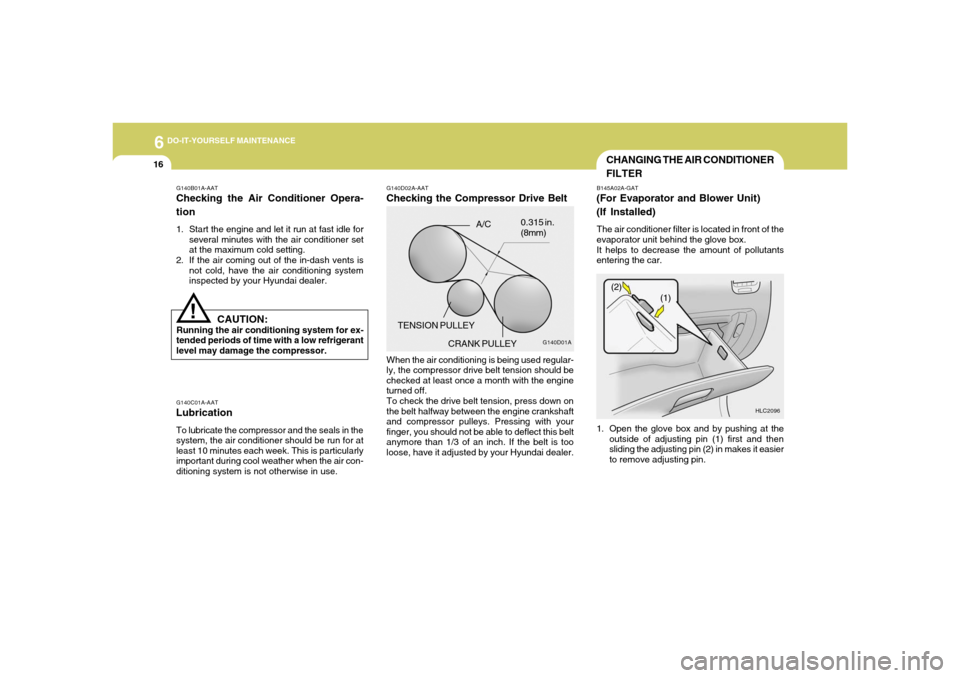
G140D02A-AATChecking the Compressor Drive BeltWhen the air conditioning is being used regular-
ly, the compressor drive belt tension should be
checked at least once a month with the engine
turned off.
To check the drive belt tension, press down on
the belt halfway between the engine crankshaft
and compressor pulleys. Pressing with your
finger, you should not be able to deflect this belt
anymore than 1/3 of an inch. If the belt is too
loose, have it adjusted by your Hyundai dealer.CRANK PULLEY
G140D01A
A/C
TENSION PULLEY0.315 in.
(8mm)
HLC2096 B145A02A-GAT
(For Evaporator and Blower Unit)
(If Installed)The air conditioner filter is located in front of the
evaporator unit behind the glove box.
It helps to decrease the amount of pollutants
entering the car.
1. Open the glove box and by pushing at the
outside of adjusting pin (1) first and then
sliding the adjusting pin (2) in makes it easier
to remove adjusting pin.
G140C01A-AATLubricationTo lubricate the compressor and the seals in the
system, the air conditioner should be run for at
least 10 minutes each week. This is particularly
important during cool weather when the air con-
ditioning system is not otherwise in use.G140B01A-AATChecking the Air Conditioner Opera-
tion1. Start the engine and let it run at fast idle for
several minutes with the air conditioner set
at the maximum cold setting.
2. If the air coming out of the in-dash vents is
not cold, have the air conditioning system
inspected by your Hyundai dealer.
CAUTION:
Running the air conditioning system for ex-
tended periods of time with a low refrigerant
level may damage the compressor.
!
(1) (2)
Page 172 of 219

6
DO-IT-YOURSELF MAINTENANCE
17
HLC2097
2. Remove the cable and the wiring from the
filter cover.
HLC2098
3. Remove the filter cover by pushing the upper
end of the filter cover.
HLC2099
4. Replace the two filters.
5. Installation is the reverse order of disassem-
bly.
CAUTION:
Be sure to install the air conditioner filter in
the direction of the arrow sign. Otherwise, it
may cause noise or deterioration.
!
CHECKING THE FREE-PLAYG150A01A-AATSteering WheelTo check the steering wheel free-play, stop the
car with the wheels pointed straight ahead and
gently move the steering wheel back and forth.
Use very light finger pressure and be sensitive
to changes in resistance that mark the limits of
the free-play. If the free-play is greater than
specified, have it inspected by your Hyundai
dealer and adjusted or repaired if necessary.
HLC50081.18 in.
(30 mm)
Page 189 of 219
6
DO-IT-YOURSELF MAINTENANCE
34
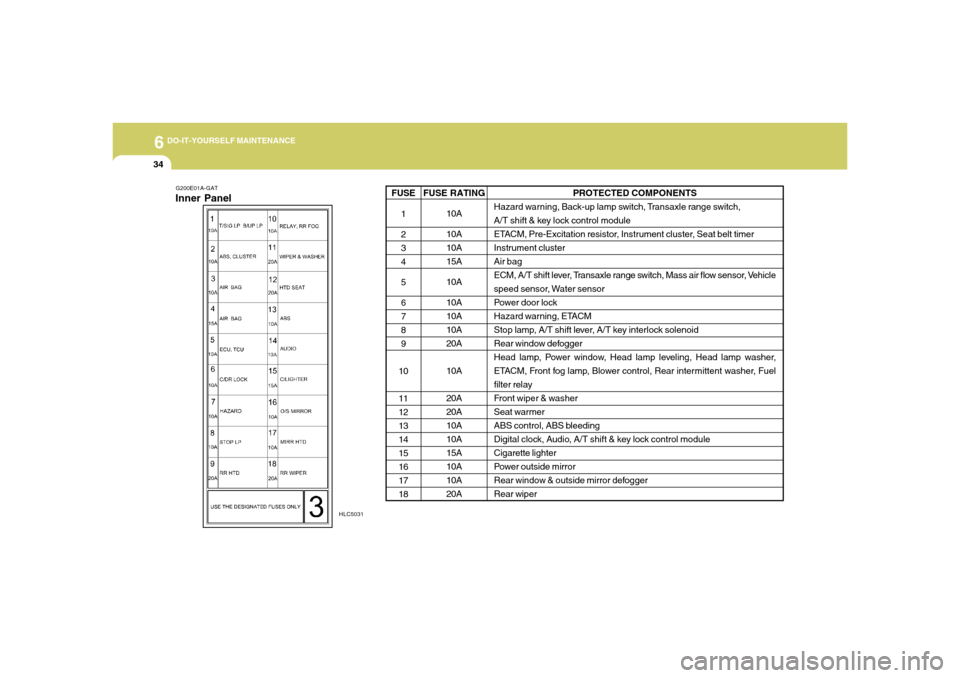
G200E01A-GATInner Panel
HLC5031
PROTECTED COMPONENTS
Hazard warning, Back-up lamp switch, Transaxle range switch,
A/T shift & key lock control module
ETACM, Pre-Excitation resistor, Instrument cluster, Seat belt timer
Instrument cluster
Air bag
ECM, A/T shift lever, Transaxle range switch, Mass air flow sensor, Vehicle
speed sensor, Water sensor
Power door lock
Hazard warning, ETACM
Stop lamp, A/T shift lever, A/T key interlock solenoid
Rear window defogger
Head lamp, Power window, Head lamp leveling, Head lamp washer,
ETACM, Front fog lamp, Blower control, Rear intermittent washer, Fuel
filter relay
Front wiper & washer
Seat warmer
ABS control, ABS bleeding
Digital clock, Audio, A/T shift & key lock control module
Cigarette lighter
Power outside mirror
Rear window & outside mirror defogger
Rear wiper
FUSE RATING
10A
10A
10A
15A
10A
10A
10A
10A
20A
10A
20A
20A
10A
10A
15A
10A
10A
20A FUSE
1
2
3
4
5
6
7
8
9
10
11
12
13
14
15
16
17
18
Page 191 of 219

7
EMISSION CONTROL SYSTEMS2
EMISSION CONTROL SYSTEM
Canister
Fuel vapors generated inside the fuel tank are
absorbed and stored in the onboard canister.
When the engine is running, the fuel vapors
absorbed in the canister are drawn into the
induction system through the purge control
solenoid valve.Purge Control Solenoid Valve (PCSV)The purge control solenoid valve is controlled
by the Engine Control Module (ECM); when
the engine coolant temperature is low during
idling, the PCSV closes so that evaporated fuel
is not taken into the engine. After the engine
warms-up during ordinary driving, the PCSV
opens to introduce evaporated fuel to the
engine.
H010B01A-AAT1. CRANKCASE EMISSION CONTROL
SYSTEMThe positive crankcase ventilation system is
employed to prevent air pollution caused by
blow-by gases being emitted from the crank-
case. This system supplies filtered fresh air to
the crankcase through the air intake hose.
Inside the crankcase, the fresh air mixes with
blow-by gases, then passes through the PCV
valve into the induction system.
H010A01A-AATYour Hyundai is equipped with an emission
control system to meet all requirements of the
U.S. Environmental Protection Agency or Cali-
fornia Air Resources Board.
There are three emission control systems
which are as follows.
1) Crankcase Emission Control System
2) Evaporative Emission Control System
3) Exhaust Emission Control System
In order to ensure the proper function of the
emission control systems, it is recommended
that you have your car inspected and main-
tained by an authorized Hyundai dealer in
accordance with the maintenance schedule in
this manual.
H010D01A-AAT3. EXHAUST EMISSION
CONTROL SYSTEMThe Exhaust Emission Control System is a
highly effective system which controls ex-
haust emissions while maintaining good ve-
hicle performace.
H010C01S-AAT2. Evaporative Emission Control (Includ-
ing ORVR: Onboard Refueling Vapor
Recovery) SystemThe Evaporative Emission Control System is
designed to prevent fuel vapors from escaping
into the atmosphere.
(The ORVR system is designed to allow the
vapors from the fuel tank to be loaded into a
canister while refueling at the gas station,
preventing the escape of fuel vapors into the
atmosphere.)
Page 214 of 219

10
INDEX
2
CCare of Cassette tapes..................................................................1-91
Care of Disc .....................................................................................1-91
Cargo Area Cover ...........................................................................1-63
Catalytic Converter............................................................................ 7-3
Changing a flat tire ............................................................................ 3-7
Child-Protector Rear Door Look ....................................................... 1-5
Child Restraint System ....................................................................1-22
Installing a child restraint seat with the
"Tether Anchorage" system ....................................................1-24
Securing the child restraint seat with the "ISOFIX" system ...1-25
Cigarette Lighter..............................................................................1-52
Clock................................................................................................1-52
Clutch
Checking fluid.............................................................................6-15
Pedal free-play............................................................................6-18
Combination Light
Headlight flasher.........................................................................1-48
Headlight switch..........................................................................1-47
High-beam switch.......................................................................1-48
Lane change signal....................................................................1-47
Turn signal operation.................................................................1-47
Cooling Fans....................................................................................6-22
Corrosion Protection
Cleaning the interior..................................................................... 4-5
Protecting your Hyundai from corrosion.................................... 4-2
Washing and waxing.................................................................... 4-3 A
Airbag......................................................................................................
1-30
Air Cleaner Filter ..............................................................................6-10
Air Conditioner
Care.............................................................................................6-15
Filter.............................................................................................1-73
Operation.....................................................................................1-71
Antenna............................................................................................1-93
Ashtray.............................................................................................1-52
Audio Fault Code .............................................................................1-90
Audio System
Cassette tape player operation (H245)....................................1-82
Compact disc player operation (H265)....................................1-87
Stereo radio operation (H215, H245, H265) ........ 1-76, 1-79, 1-84
Automatic Transaxle.......................................................................... 2-7
Overdrive switch.......................................................................... 2-9
Shift lock release.......................................................................... 2-9
B
Battery..............................................................................................6-21
Bi-Level Heating...............................................................................1-69
Binding Arbitration............................................................................8-16
Brake
Anti-lock system.........................................................................2-11
Checking the brakes ..................................................................6-14
Fluid .............................................................................................6-14
Pedal clearance..........................................................................6-18
Pedal free-play............................................................................6-18
Practices.....................................................................................2-10
Breaking-In your new Hyundai ......................................................... 1-3