2005 Hyundai Accent ECU
[x] Cancel search: ECUPage 38 of 219

1FEATURES OF YOUR HYUNDAI26
!
WARNING:
o Do not install a child restraint seat at
the center of the rear seat using the
vehicle's ISOFIX anchors. The ISOFIX
anchors are only provided for the left
and right outboard rear seating posi-
tions. Do not misuse the ISOFIX an-
chors by attempting to attach a child
restraint seat improperly in the middle
of the reat seat position to the ISOFIX
anchors. In a crash, the child seat ISOFIX
attachments may not be strong enough
to secure the child restraint seat prop-
erly in the center of the rear seat and
may break, causing serious injury or
death.
o When using the vehicle’s “ISOFIX” sys-
tem to install a child restraint system in
the rear seat, all unused vehicle rear
seat belt metal latch plates or tabs must
be latched securely in their seat belt
buckles and the seat belt webbing must
be retracted behind the child restraint
to prevent the child from reaching and
taking hold of unretracted seat belts.
Unlatched metal latch plates or tabs
may allow the child to reach the
unretracted seat belts which may result
in strangulation and a serious injury or
death to the child in the child restraint.
!
The ISOFIX anchors are located between the
seatback and the seat cushion of the rear seat
B230D02A-1
ISOFIX
Anchor
ISOFIX Anchor
Position Indicator
B230D03A-1
WARNING:
o Do not mount more than one child
restraint to a single tether or to a child
restraint lower anchorage point. The
improper increased load may cause the
anchorage points or tether anchor to
break, causing serious injury or death.
o Attach the ISOFIX or ISOFIX-compat-
ible child seat only to the appropriate
locations shown.
o Always follow the installation and use
instructions provided by the manufac-
turer of the child restraint.
Page 39 of 219

1
FEATURES OF YOUR HYUNDAI
27
To install a child restraint system in the out-
board rear seats, extend the shoulder/lap belt
entirely from its retractor until a "click" is felt.
This will engage the seat belt retractor auto-
matic locking feature, which allows the seat
belt to retract but not extend. Install the child
restraint system, buckle the seat belt and
allow the seat belt to take up any slack. Make
sure that the lap portion of the belt is tight
around the child restraint system and the
shoulder portion of the belt is positioned so that
it cannot interfere with the child's head or neck.
Also, double check to be sure that the retrac-
tor has engaged the automatic locking feature
by trying to extend webbing out of the retrac-
tor. If the retractor is in the automatic lockingB230G01A-AATInstallation on Outboard Rear SeatsOn outboard rear seats
B230G01A B230F01A-AAT
Installation on Rear Seat Center
PositionUse the center seat belt for the rear seat to
secure the child restraint system as illustrated.
After installation of the child restraint system,
rock the child seat back and forth, and side to
side to ensure that it is properly secured by the
seat belt.
If the child seat moves, readjust the length of the
seat belt. Then, if equipped, insert the child
restraint tether strap hook into the child restraint
hook holder and tighten to secure the seat.
Always refer to the child restraint system
manufacturer's recommendation before install-
ing the child restraint system in your vehicle.
B230F01A
On center rear seat
left and right outboard seating positions.
Follow the child seat manufacturer's instruc-
tions to properly install safety seats with ISOFIX
or ISOFIX-compatible attachments.
Once you have installed the ISOFIX child re-
straint seat, assure that the seat is properly
attached to the ISOFIX and tether anchors.
Also, test the safety seat before you place the
child in it. Tilt the seat from side to side. Also
try to tug the seat forward. Check to see if the
anchors hold the seat in place.
WARNING:
If the child restraint seat is not anchored
properly, the risk of a child being seriously
injured or killed in a collision greatly increases.
!
Page 40 of 219

1FEATURES OF YOUR HYUNDAI28
!
!
The seat belt pre-tensioner system consists
mainly of the following components. Their lo-
cations are shown in the illustration.
1. SRS airbag warning light
2. Seat belt pre-tensioner assembly
3. SRS control module
B180C02A-AATPre-Tensioner Seat BeltYour Hyundai vehicle is equipped with driver's
and front passenger's pre-tensioner seat belts.
The purpose of the pre-tensioner is to make
sure that the seat belts fit tightly against the
occupant's body in certain frontal collisions. The
pre-tensioner seat belts can be activated alone
or, where the frontal collision is severe enough,
together with the airbags.
When the vehicle stops suddenly, or if the
occupant tries to lean forward too quickly, the
seat belt retractor will lock into position. In
certain frontal collisions, the pre-tensioner will
activate and pull the seat belt into tighter
contact against the occupant's body.
Passenger's
airbag
HXG229B180D01A
Driver's airbag
1
23
WARNING:
To obtain maximum benefit from a pre-
tensioner seat belt:
1. The seat belt must be worn correctly.
2. The seat belt must be adjusted to the
correct position. mode, the belt will be locked. After installation
of the child restraint system, try to move it in
all directions to be sure the child restraint
system is securely installed. If you need to
tighten the belt, pull more webbing toward the
retractor. When you unbuckle the seat belt
and allow it to retract, the retractor will auto-
matically revert back to its normal seated
passenger emergency locking usage condition.
NOTE:o Before installing the child restraint sys-
tem, read the instructions supplied by the
child restraint system manufacturer.
o If the seat belt does not operate as de-
scribed, have the system checked imme-
diately by your authorized Hyundai dealer.
WARNING:
o If the retractor is not in the Automatic
Locking mode, the child restraint system
can move when your vehicle turns or
stops abruptly.
o Do not install any child restraint system
in the front passenger seat. Should an
accident occur and cause the passenger
side airbag to deploy, it could severely
injure or kill an infant or child seated in an
infant or child seat. Therefore, only use a
child restraint system in the rear seat of
your vehicle.
Page 72 of 219
1FEATURES OF YOUR HYUNDAI60
B560A02S-AAT
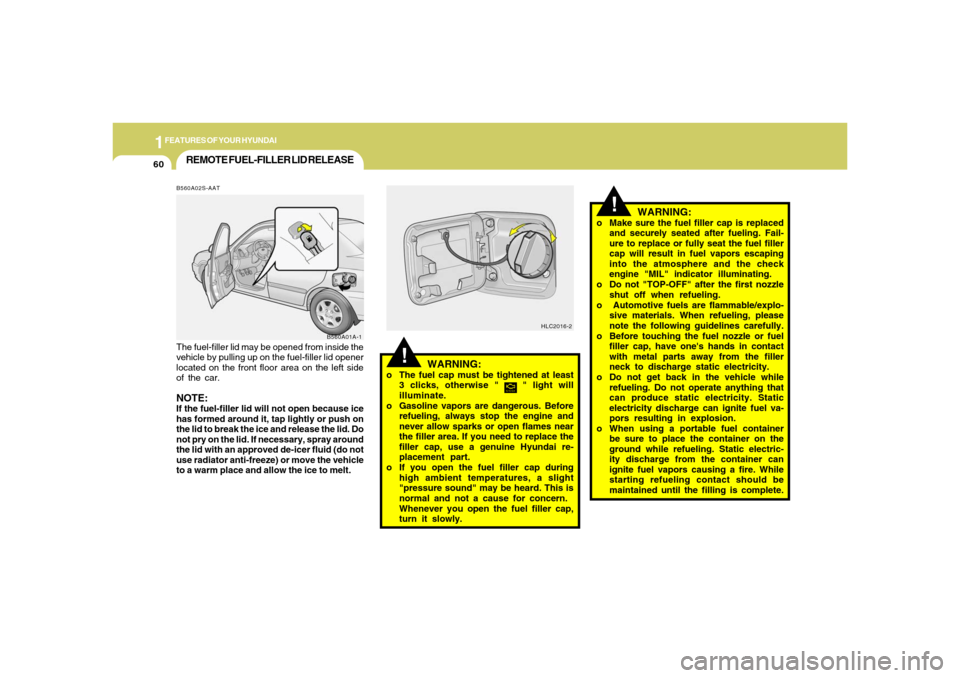
B560A01A-1The fuel-filler lid may be opened from inside the
vehicle by pulling up on the fuel-filler lid opener
located on the front floor area on the left side
of the car.NOTE:If the fuel-filler lid will not open because ice
has formed around it, tap lightly or push on
the lid to break the ice and release the lid. Do
not pry on the lid. If necessary, spray around
the lid with an approved de-icer fluid (do not
use radiator anti-freeze) or move the vehicle
to a warm place and allow the ice to melt.REMOTE FUEL-FILLER LID RELEASE
!
WARNING:
o The fuel cap must be tightened at least
3 clicks, otherwise " " light will
illuminate.
o Gasoline vapors are dangerous. Before
refueling, always stop the engine and
never allow sparks or open flames near
the filler area. If you need to replace the
filler cap, use a genuine Hyundai re-
placement part.
o If you open the fuel filler cap during
high ambient temperatures, a slight
"pressure sound" may be heard. This is
normal and not a cause for concern.
Whenever you open the fuel filler cap,
turn it slowly.
HLC2016-2
!
o Make sure the fuel filler cap is replaced
and securely seated after fueling. Fail-
ure to replace or fully seat the fuel filler
cap will result in fuel vapors escaping
into the atmosphere and the check
engine "MIL" indicator illuminating.
o Do not "TOP-OFF" after the first nozzle
shut off when refueling.
o Automotive fuels are flammable/explo-
sive materials. When refueling, please
note the following guidelines carefully.
o Before touching the fuel nozzle or fuel
filler cap, have one's hands in contact
with metal parts away from the filler
neck to discharge static electricity.
o Do not get back in the vehicle while
refueling. Do not operate anything that
can produce static electricity. Static
electricity discharge can ignite fuel va-
pors resulting in explosion.
o When using a portable fuel container
be sure to place the container on the
ground while refueling. Static electric-
ity discharge from the container can
ignite fuel vapors causing a fire. While
starting refueling contact should be
maintained until the filling is complete.
WARNING:
Page 73 of 219
1
FEATURES OF YOUR HYUNDAI
61
!
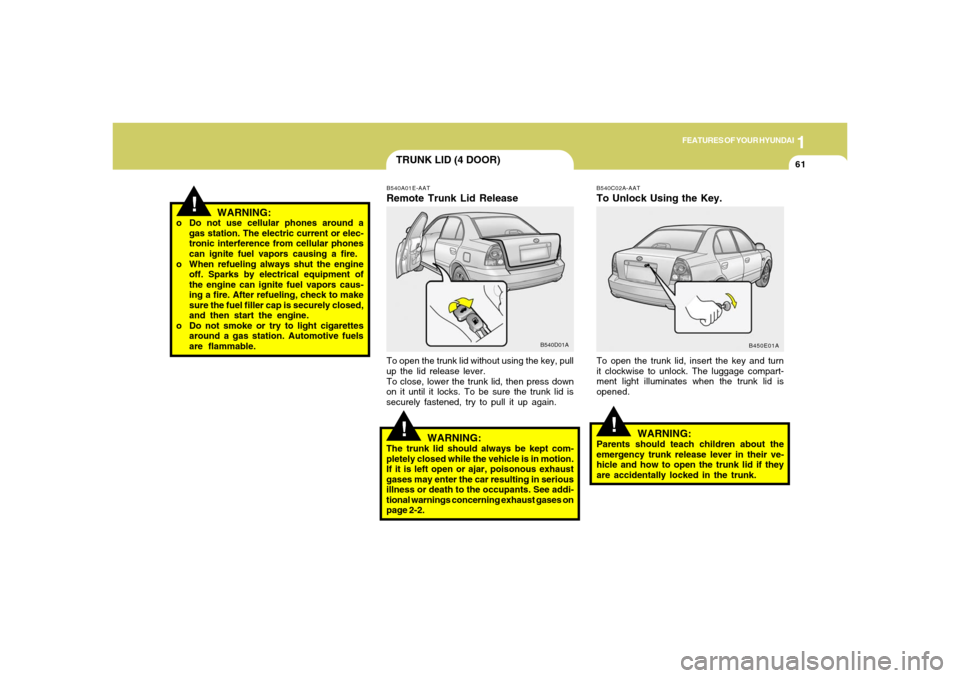
TRUNK LID (4 DOOR)
B540C02A-AATTo Unlock Using the Key.To open the trunk lid, insert the key and turn
it clockwise to unlock. The luggage compart-
ment light illuminates when the trunk lid is
opened.
B450E01A
!
B540A01E-AATRemote Trunk Lid Release
B540D01A
To open the trunk lid without using the key, pull
up the lid release lever.
To close, lower the trunk lid, then press down
on it until it locks. To be sure the trunk lid is
securely fastened, try to pull it up again.
WARNING:
The trunk lid should always be kept com-
pletely closed while the vehicle is in motion.
If it is left open or ajar, poisonous exhaust
gases may enter the car resulting in serious
illness or death to the occupants. See addi-
tional warnings concerning exhaust gases on
page 2-2.
!
WARNING:
Parents should teach children about the
emergency trunk release lever in their ve-
hicle and how to open the trunk lid if they
are accidentally locked in the trunk. o Do not use cellular phones around a
gas station. The electric current or elec-
tronic interference from cellular phones
can ignite fuel vapors causing a fire.
o When refueling always shut the engine
off. Sparks by electrical equipment of
the engine can ignite fuel vapors caus-
ing a fire. After refueling, check to make
sure the fuel filler cap is securely closed,
and then start the engine.
o Do not smoke or try to light cigarettes
around a gas station. Automotive fuels
are flammable.
WARNING:
Page 126 of 219

2
DRIVING YOUR HYUNDAI
20
!
!
WARNING:
Items you carry inside your vehicle
can strike and injure people in a
sudden stop or turn, or in a crash.
o Put things in the cargo area of
your vehicle. Try to spread the
weight evenly.
o Never stack items, like suitcases,
inside the vehicle above the tops
of the seats.
o Do not leave an unsecured child
restraint in your vehicle.
o When you carry something in-
side the vehicle, secure it.
o Do not drive with a seat folded
down unless necessary. WARNING:
o Overloading your vehicle can
cause heat buildup in your
vehicle's tires and possible tire
failure that could lead to a crash.
o Overloading your vehicle can
cause increased stopping dis-
tances that could lead to a crash.
o A crash resulting from poor han-
dling vehicle damage, tire failure,
or increased stopping dis-
tances could result in serious
injury or death.The label will help you decide how
much cargo and installed equipment
your vehicle can carry.
If you carry items inside your vehicle
– like suitcases, tools, packages, or
anything else – they more as fast as
the vehicle goes. If you have to stop or
turn quickly, or if there is a crash, the
items will keep going and can cause
an injury if they strikes the driver or a
passenger.
Page 128 of 219

32WHAT TO DO IN AN EMERGENCY
IF THE ENGINE WILL NOT START!
D010B02A-AATIf Engine Doesn't Turn Over or Turns
Over Slowly
D010A01A-AATD010C01A-AAT
If Engine Turns Over Normally but Does
Not Start1. Check fuel level.
2. With the key in the "OFF" position, check all
connectors at ignition coil and spark plugs.
Reconnect any that may be disconnected or
loose.
3. Check the fuel line in the engine room.
4. If the engine still refuses to start, call a
Hyundai dealer or seek other qualified assis-
tance.
WARNING:
If the engine will not start, do not push or
pull the car to start it. This could result in a
collision or cause other damage. In addition,
push or pull starting may cause the catalytic
converter to be overloaded and create a fire
hazard.
D010B01AD010C01A-D
1. If your car has an automatic transaxle, be
sure the gear selector lever is in "N" or "P"
and the emergency brake is set.
2. Check the battery connections to be sure
they are clean and tight.
3. Turn on the interior light. If the light dims or
goes out when you operate the starter, the
battery is discharged.
4. Check the starter connections to be sure
they are securely tightened.
5. Do not push or pull the vehicle to start it. See
instructions for "Jump Starting".
Page 138 of 219

312
WHAT TO DO IN AN EMERGENCY
IF YOUR CAR MUST BE TOWED
D060J01E-AATAfter Changing Wheels
If you have a tire gauge, remove the
valve cap and check the air pressure.
D080A01A-AAT
CAUTION:
Your car can be damaged if towed incor-
rectly!
HLC4012
If your car has to be towed, it should be done by
your Hyundai dealer or a commercial tow truck
service. This will help assure that your car is not
damaged in towing. Also, professionals are gen-
erally aware of state and local laws governing
towing. In any case, rather than risk damage to
your car, it is suggested that you show this
information to the tow truck operator. Be sure
that a safety chain system is used and that all
state and local laws are observed.
D080A01A
o OK FOR AUTOMATIC OR MANUAL
TRANSAXLE EQUIPPED VEHICLE!
After changing wheels, have a techni-
cian tighten the wheel nuts to their
proper torque as soon as possible.
Wheel nut tightening torque:
Steel wheel & aluminium alloy wheel:
65-80 lb.ft (900-1,100 kg.cm)If the pressure is lower than recom-
mended, drive slowly to the nearest
service station and inflate to the cor-
rect pressure. If it is too high, adjust
it until it is correct. Always reinstall
the valve cap after checking or ad-
justing tire pressure. If the cap is not
replaced, air may leak from the tire. If
you lose a valve cap, buy another
and install it as soon as possible.
After you have changed wheels, al-
ways secure the flat tire in its place in
the trunk and return the jack and tools
to their proper storage locations.