2005 HUMMER H2 height
[x] Cancel search: heightPage 349 of 468

Brake Wear
Your vehicle has four-wheel disc brakes.
Disc brake pads have built-in wear indicators that make
a high-pitched warning sound when the brake pads
are worn and new pads are needed. The sound
may come and go or be heard all the time your vehicle
is moving, except when you are pushing on the
brake pedal rmly.
{CAUTION:
The brake wear warning sound means that
soon your brakes will not work well. That
could lead to an accident. When you hear
the brake wear warning sound, have your
vehicle serviced.
Notice:Continuing to drive with worn-out brake
pads could result in costly brake repair.Some driving conditions or climates may cause a brake
squeal when the brakes are rst applied or lightly
applied. This does not mean something is wrong with
your brakes.
Properly torqued wheel nuts are necessary to help
prevent brake pulsation. When tires are rotated, inspect
brake pads for wear and evenly tighten wheel nuts in
the proper sequence to GM torque specications.
Brake linings should always be replaced as complete
axle sets.
Brake Pedal Travel
See your dealer if the brake pedal does not return to
normal height, or if there is a rapid increase in
pedal travel. This could be a sign of brake trouble.
Brake Adjustment
Every time you make a brake stop, your disc brakes
adjust for wear.
5-37
Page 367 of 468

Tire Sidewall Labelling
Useful information about a tire is molded into the
sidewall. The following illustrations are examples of a
typical P-Metric and a LT-Metric tire sidewall.
(A) Tire Size:The tire size code is a combination of
letters and numbers used to dene a particular
tire’s width, height, aspect ratio, construction type and
service description. See the “Tire Size” illustration
later in this section for more detail.(B) TPC Spec (Tire Performance Criteria
Specication):Original equipment tires designed to
GM’s specic tire performance criteria have a TPC
specication code molded onto the sidewall. GM’s TPC
specications meet or exceed all federal safety
guidelines.
(C) DOT (Department of Transportation):The
Department of Transportation (DOT) code indicates that
the tire is in compliance with the U.S. Department of
Transportation Motor Vehicle Safety Standards.
(D) Tire Identication Number (TIN):The letters and
numbers following DOT code are the Tire Identication
Number (TIN). The TIN shows the manufacturer and
plant code, tire size, and date the tire was manufactured.
The TIN is molded onto both sides of the tire, although
only one side may have the date of manufacture.
(E) Tire Ply Material:The type of cord and number of
plies in the sidewall and under the tread.
(F) Uniform Tire Quality Grading (UTQG):Tire
manufacturers are required to grade tires based on three
performance factors: treadwear, traction and
temperature resistance. For more information, see
Uniform Tire Quality Grading on page 5-64.
(G) Maximum Cold Ination Load Limit:Maximum
load that can be carried and the maximum pressure
needed to support that load. For information on
recommended tire pressure seeInation - Tire Pressure
on page 5-60andLoading Your Vehicle on page 4-58. Passenger (P-Metric) Tire
5-55
Page 368 of 468

(A) Tire Size:The tire size code is a combination of
letters and numbers used to dene a particular
tire’s width, height, aspect ratio, construction type and
service description. See the “Tire Size” illustration
later in this section for more detail.
(B) TPC Spec (Tire Performance Criteria
Specication):Original equipment tires designed to
GM’s specic tire performance criteria have a TPCspecication code molded onto the sidewall. GM’s TPC
specications meet or exceed all federal
safety guidelines.
(C) Dual Tire Maximum Load:Maximum load that can
be carried and the maximum pressure needed to
support that load when used in a dual conguration. For
information on recommended tire pressure see
Ination - Tire Pressure on page 5-60andLoading Your
Vehicle on page 4-58.
(D) DOT (Department of Transportation):The
Department of Transportation (DOT) code indicates that
the tire is in compliance with the U.S. Department of
Transportation Motor Vehicle Safety Standards.
(E) Tire Identication Number (TIN):The letters and
numbers following DOT code are the Tire Identication
Number (TIN). The TIN shows the manufacturer and
plant code, tire size, and date the tire was manufactured.
The TIN is molded onto both sides of the tire, although
only one side may have the date of manufacture.
(F) Tire Ply Material:The type of cord and number of
plies in the sidewall and under the tread.
(G) Single Tire Maximum Load:Maximum load that
can be carried and the maximum pressure needed to
support that load when used as a single. For information
on recommended tire pressure seeInation - Tire
Pressure on page 5-60andLoading Your Vehicle on
page 4-58. Light Truck (LT-Metric) Tire
5-56
Page 369 of 468
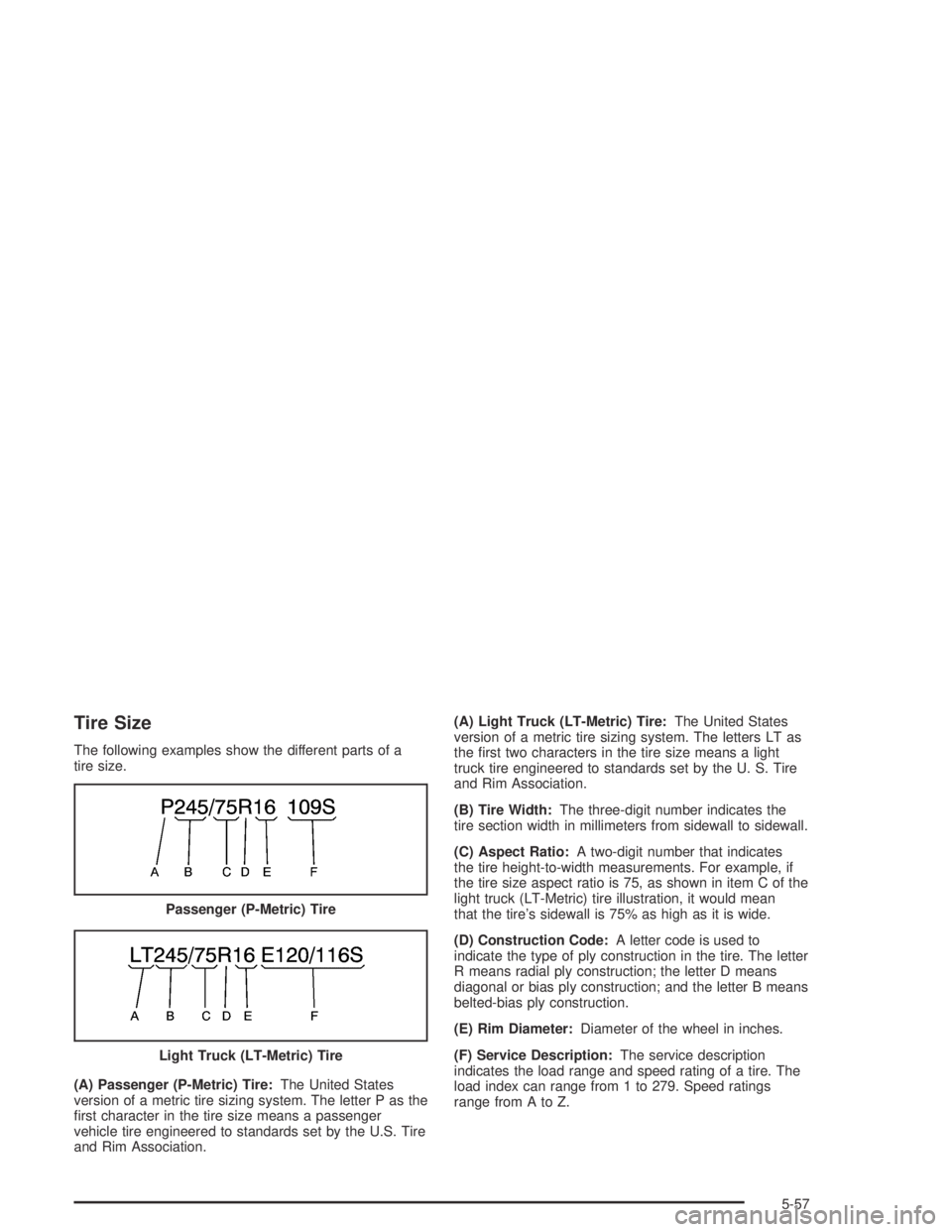
Tire Size
The following examples show the different parts of a
tire size.
(A) Passenger (P-Metric) Tire:The United States
version of a metric tire sizing system. The letter P as the
rst character in the tire size means a passenger
vehicle tire engineered to standards set by the U.S. Tire
and Rim Association.(A) Light Truck (LT-Metric) Tire:The United States
version of a metric tire sizing system. The letters LT as
the rst two characters in the tire size means a light
truck tire engineered to standards set by the U. S. Tire
and Rim Association.
(B) Tire Width:The three-digit number indicates the
tire section width in millimeters from sidewall to sidewall.
(C) Aspect Ratio:A two-digit number that indicates
the tire height-to-width measurements. For example, if
the tire size aspect ratio is 75, as shown in item C of the
light truck (LT-Metric) tire illustration, it would mean
that the tire’s sidewall is 75% as high as it is wide.
(D) Construction Code:A letter code is used to
indicate the type of ply construction in the tire. The letter
R means radial ply construction; the letter D means
diagonal or bias ply construction; and the letter B means
belted-bias ply construction.
(E) Rim Diameter:Diameter of the wheel in inches.
(F) Service Description:The service description
indicates the load range and speed rating of a tire. The
load index can range from 1 to 279. Speed ratings
range from A to Z. Passenger (P-Metric) Tire
Light Truck (LT-Metric) Tire
5-57
Page 370 of 468

Tire Terminology and Denitions
Air Pressure:The amount of air inside the tire pressing
outward on each square inch of the tire. Air pressure
is expressed in pounds per square inch (psi) or
kilopascal (kPa).
Accessory Weight:This means the combined weight
of optional accessories. Some examples of optional
accessories are, automatic transmission, power steering,
power brakes, power windows, power seats, and
air conditioning.
Aspect Ratio:The relationship of a tire’s height to
its width.
Belt:A rubber coated layer of cords that is located
between the plies and the tread. Cords may be made
from steel or other reinforcing materials.
Bead:The tire bead contains steel wires wrapped by
steel cords that hold the tire onto the rim.
Bias Ply Tire:A pneumatic tire in which the plies are
laid at alternate angles less than 90 degrees to the
centerline of the tread.
Cold Ination Pressure:The amount of air pressure in
a tire, measured in pounds per square inch (psi) or
kilopascals (kPa) before a tire has built up heat
from driving. SeeInation - Tire Pressure on page 5-60.Curb Weight:This means the weight of a motor
vehicle with standard and optional equipment including
the maximum capacity of fuel, oil and coolant, but
without passengers and cargo.
DOT Markings:A code molded into the sidewall of a
tire signifying that the tire is in compliance with the U.S.
Department of Transportation (DOT) motor vehicle
safety standards. The DOT code includes the Tire
Identication Number (TIN), an alphanumeric designator
which can also identify the tire manufacturer, production
plant, brand and date of production.
GVWR:Gross Vehicle Weight Rating, seeLoading
Your Vehicle on page 4-58.
GAWR FRT:Gross Axle Weight Rating for the front
axle, seeLoading Your Vehicle on page 4-58.
GAWR RR:Gross Axle Weight Rating for the rear axle,
seeLoading Your Vehicle on page 4-58.
Intended Outboard Sidewall:The side of an
asymmetrical tire, that must always face outward when
mounted on a vehicle.
KiloPascal (kPa):The metric unit for air pressure.
Light Truck (LT-Metric) Tire:A tire used on light duty
trucks and some multipurpose passenger vehicles.
5-58
Page 378 of 468

Wheel Replacement
Replace any wheel that is bent, cracked or badly rusted
or corroded. If wheel nuts keep coming loose, the
wheel, wheel bolts and wheel nuts should be replaced.
If the wheel leaks air, replace it (except some
aluminum wheels, which can sometimes be repaired).
See your dealer if any of these conditions exist.
Your dealer will know the kind of wheel you need.
Each new wheel should have the same load-carrying
capacity, diameter, width, offset and be mounted
the same way as the one it replaces.
If you need to replace any of your wheels, wheel bolts
or wheel nuts, replace them only with new GM
original equipment parts. This way, you will be sure to
have the right wheel, wheel bolts and wheel nuts
for your vehicle.{CAUTION:
Using the wrong replacement wheels, wheel
bolts or wheel nuts on your vehicle can be
dangerous. It could affect the braking and
handling of your vehicle, make your tires lose
air and make you lose control. You could have
a collision in which you or others could be
injured. Always use the correct wheel, wheel
bolts and wheel nuts for replacement.
Notice:The wrong wheel can also cause problems
with bearing life, brake cooling, speedometer or
odometer calibration, headlamp aim, bumper height,
vehicle ground clearance and tire or tire chain
clearance to the body and chassis.
SeeChanging a Flat Tire on page 5-70for
more information.
5-66
Page 408 of 468

Washing Your Vehicle
The paint nish on the vehicle provides beauty, depth of
color, gloss retention, and durability.
The best way to preserve the vehicle’s nish is to keep it
clean by washing it often with lukewarm or cold water.
Do not wash the vehicle in the direct rays of the sun.
Use a car washing soap. Do not use strong soaps
or chemical detergents. Be sure to rinse the vehicle well,
removing all soap residue completely. GM-approved
cleaning products can be obtained from your dealer. See
Vehicle Care/Appearance Materials on page 5-100.
Do not use cleaning agents that are petroleum based,
or that contain acid or abrasives. All cleaning agents
should be ushed promptly and not allowed to dry on the
surface, or they could stain. Dry the nish with a soft,
clean chamois or an all-cotton towel to avoid surface
scratches and water spotting.
High pressure car washes may cause water to enter
the vehicle.
The overall height, width, and underbody clearances of
the HUMMER H2 are similar to current General
Motors’ full-size light duty trucks. This means a
HUMMER H2 should t in a standard car wash. But, if
your vehicle has added accessories like roof-mounted
lamps or a roof basket, it might not t properly in a
standard car wash.Notice:Certain add-on accessories can change the
dimensions of your vehicle. If you’ve added items
to the outside of your vehicle, it might not t
properly in a standard car wash. Your vehicle and
the car wash could be damaged. To help prevent
damage, know how accessories have changed the
dimensions of your vehicle and check with the
car wash manager before entering a car wash.
Notice:If you drive your vehicle through an
automatic car wash that does not have enough
clearance for any roof-mounted accessories (such
as off-road lamps or a roof basket) on your vehicle,
you can damage your vehicle. To avoid damaging
your vehicle in a car wash, remove any
roof-mounted accessories if you can, and do not
use an automatic car wash while roof-mounted
accessories are on your vehicle. SeePower Winch
Platform on page 4-57andOff-Road Lamps on
page 3-16for more information.
Also seeLuggage Carrier on page 2-55for
more information.
5-96
Page 464 of 468

Rear Seat Audio (RSA)....................................3-87
Rear Seat Passengers, Safety Belts..................1-30
Rearview Mirror, Automatic Dimming with
Compass and Temperature Display................2-43
Rearview Mirror, Automatic Dimming with
OnStar
®, Compass and Temperature Display.....2-41
Reclining Seatbacks.......................................... 1-5
Recommended Fluids and Lubricants.................6-12
Recovery Loops..............................................4-53
Recreational Vehicle Towing.............................4-64
Remote Keyless Entry System............................ 2-4
Remote Keyless Entry System, Operation............ 2-5
Removing the Flat Tire and Installing the
Spare Tire..................................................5-79
Removing the Spare Tire and Tools...................5-71
Replacement Bulbs.........................................5-52
Reporting Safety Defects
Canadian Government..................................7-11
General Motors...........................................7-11
United States Government............................7-10
Restraint System Check
Checking Your Restraint Systems...................1-69
Replacing Restraint System Parts After a
Crash.....................................................1-70
Restraint Systems
Checking....................................................1-69
Replacing Parts...........................................1-70Retained Accessory Power (RAP)......................2-26
Ride Height, Selectable Extended Rear Ride......4-65
Right Front Passenger Position, Safety Belts......1-30
Roadside
Assistance Program....................................... 7-6
Rocking Your Vehicle to Get it Out....................4-53
Routing, Engine Drive Belt...............................6-14
Running Your Engine While You Are Parked.......2-40
S
Safety Belt
Reminder Light............................................3-28
Safety Belts
Care of......................................................5-95
Driver Position............................................1-22
How to Wear Safety Belts Properly................1-22
Questions and Answers About Safety Belts.....1-21
Rear Safety Belt Comfort Guides for
Children and Small Adults.........................1-33
Rear Seat Passengers.................................1-30
Right Front Passenger Position......................1-30
Safety Belt Extender....................................1-35
Safety Belt Use During Pregnancy.................1-29
Safety Belts Are for Everyone.......................1-16
Safety Warnings and Symbols.............................. iii
Scheduled Maintenance..................................... 6-4
10