Page 159 of 273

This section gives you tips on
starting the engine under various
conditions, and how to operate the
automatic transmission. It also
includes important inf ormation on
parking your vehicle, the braking
system, the VTM-4System, the VSA
system (EX-L model only), the tire
pressure monitoring system, and
f acts you need if you are planning to
tow a trailer. ........................
Driving Guidelines .158
.......................
Starting the Engine .159
..............
Automatic Transmission . 160
..............................
VTM-4 System .164
Tire Pressure Monitoring ........................
System (TPMS) .165
..................................
Parking Tips .167
.............................
Braking System .168
...............
Anti-lock Brakes (ABS) . 169
Vehicle Stability Assist (VSA) ........................................
System .171
.............................
VSA Of f Switch .172
...........................
Towing a Trailer .173
......................
Trailer Driving Tips .180
Towing Your Vehicle Behind a ................................
Motorhome .182
Of f -Highway Driving ..................................
Guidelines .183
Driving
Driving
157
Page 161 of 273

Apply the parking brake.
In cold weather, turn of f all
electrical accessories to reduce
the drain on the battery.
Make sure the shif t lever is in
Park. Press on the brake pedal.
Without touching the accelerator
pedal, turn the ignition key to the
START (III) position. Do not hold
the key in START for more than
15 seconds at a time. If the engine
does not start right away, pause
f or at least 10 seconds bef ore
trying again.If the engine does not start within
15 seconds, or starts but stalls
right away, repeat step 4 with the
accelerator pedal pressed halfway
down. If the engine starts, release
pressure on the accelerator pedal
so the engine does not race.
If the engine fails to start, press
the accelerator pedal all the way
downandholdittherewhile
starting to clear flooding. If the
engine still does not start, return
to step 5.
5.
6.
1.
2.
3.
4.
75
Starting the Engine
Driving
159
Immobilizer System T he immobilizer system protects your
vehicle f rom thef t. If an improperly-
coded key (or other device) is used, the
engine’s f uel system is disabled. See
on page . The engine is harder to start in cold
weather. Also, the thinner air f ound at
altitudes above 8,000 f eet (2,400
meters) adds to this problem.
Page 163 of 273

�µ�µ �µ
�µTo shift from: PtoR
RtoP
NtoR
Dto2 2to1
1to2
2toD
DtoD DtoN
DtoD NtoDRtoN Do this:
Press the brake pedal and
pull the shift lever towards
you.
Pull the shift lever towards
you.
Move the lever.
3
3
3
3
This position mechani-
cally locks the transmission. Use
Park whenever you are turning of f or
starting the engine. To shif t out of
Park, you must press on the brake
pedal and have your f oot of f the
accelerator pedal.
If you have done all of the above and
still cannot move the lever out of
Park, see on
page .
To avoid transmission damage, come
to a complete stop bef ore shif ting
into Park. The shif t lever must be in
Park bef ore you can remove the key
from the ignition switch.
Press the brake
pedal and pull the shif t lever towards
you to shift from Park to Reverse. To
shif t f rom Reverse to Neutral, come
to a complete stop and then shift. Use Neutral if you
need to restart a stalled engine, or if
it is necessary to stop brief ly with
the engine idling. Shif t to the Park
position if you need to leave your
vehicle for any reason. Press on the
brake pedal when you are moving
the shift lever from Neutral to
another gear.
Use this position f or
your normal driving. The
transmission automatically selects a
suitable gear for the vehicle speed
and acceleration. You may notice the
transmission shif ting up at higher
speeds when the engine is cold. This
helps the engine warm up f aster.
163
CONT INUED
Park (P)
Shif t L ock Release
Reverse (R) Neutral (N)
Drive (D)
Automatic Transmission
Driving
161
Page 165 of 273
Do this if pushing on the brake pedal
and pulling the shif t lever does not
shif t the transmission out of Park:Set the parking brake. Push down on the key while you
pull the shif t lever towards you
and move it out of Park to Neutral.
Remove the key from the Shift
Lock Release slot, then install the
cover. Press the brake pedal, and
restart the engine.
If you need to use the Shif t Lock
Release, it means your vehicle is
developing a problem. Have the
vehicle checked by your dealer.
Put a cloth on the edge of the Shif t
Lock Release slot cover next to
theshiftlever.Useasmallflat-
tipped screwdriver or f inger nail
f ile to remove the cover. Caref ully
pryoff theedgeof thecover.
Insert the key in the Shift Lock
Release slot.
Remove the key from the ignition
switch.
3.
4. 5.
6.
1.
2. Shif t L ock Release
Automatic Transmission
Driving
163
Page 169 of 273
Always use the parking brake when
you park your vehicle. Make sure
the parking brake is set f irmly or
your vehicle may roll if it is on an
incline.
Set the parking brake bef ore you put
the transmission in Park. This keeps
the vehicle from moving and putting
pressure on the parking mechanism
in the transmission.Make sure the windows are closed.
Turn of f the lights.
Place any packages, valuables, etc.
in the cargo area, or take them
with you.
Lock the doors.
Never park over dry leaves, tall
grass, or other f lammable
materials. The hot three way
catalytic converter could cause
these materials to catch on fire.
If the vehicle is f acing uphill, turn
the f ront wheels away f rom the
curb.
If the vehicle is f acing downhill,
turn the front wheels toward the
curb.Make sure the parking brake is
f ully released bef ore driving away.
Driving with the parking brake
partially set can overheat or
damage the rear brakes.
Parking T ips
Parking T ips
Driving
167
Page 170 of 273

Check the brakes after driving
through deep water. Apply the
brakes moderately to see if they f eel
normal. If not, apply them gently and
f requently until they do. Be extra
cautious in your driving.
Resting your f oot on the pedal keeps
the brakes applied lightly, builds up
heat, and reduces their ef f ectiveness.
It also keeps your brake lights on all
the time, conf using drivers behind
you.
Constant application of the brakes
when going down a long hill builds
up heat and reduces their ef f ective-
ness. Use the engine to assist the
brakes by taking your f oot of f the
accelerator and downshif ting to a
lower gear. Your vehicle is equipped with disc
brakes at all f our wheels. A power
assist helps reduce the ef f ort needed
on the brake pedal. The ABS helps
you retain steering control when
braking very hard. The hydraulic system that operates
the brakes has two separate circuits.
Each circuit works diagonally across
the vehicle (the lef t-f ront brake is
connected with the right-rear brake,
etc.). If one circuit should develop a
problem, you will still have braking
at two wheels. Braking System Design
Braking System
168
Page 171 of 273
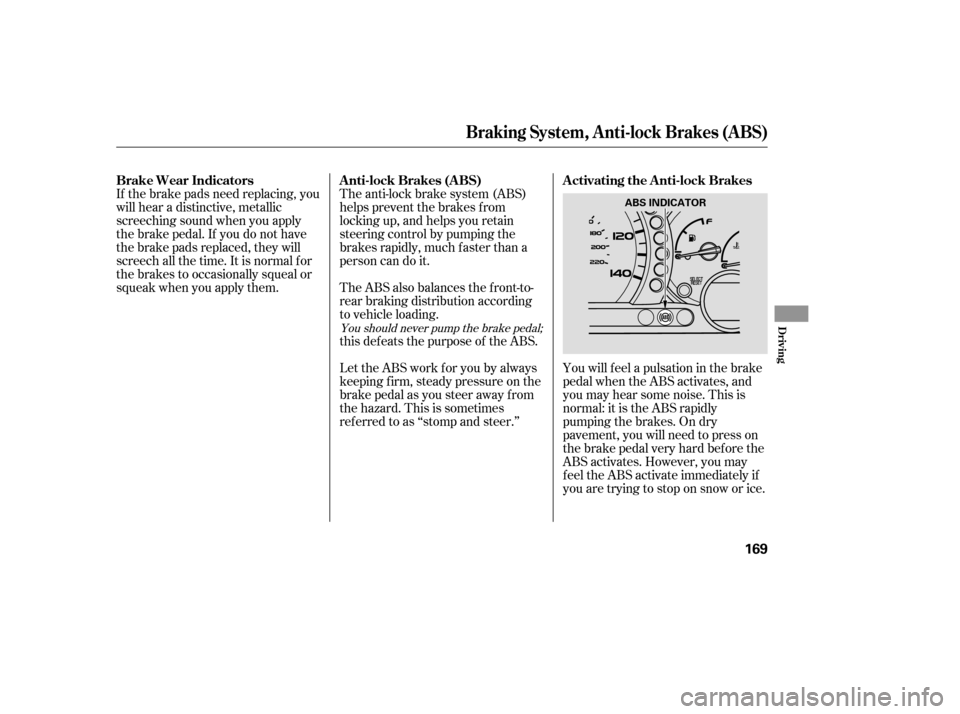
If the brake pads need replacing, you
will hear a distinctive, metallic
screeching sound when you apply
the brake pedal. If you do not have
the brake pads replaced, they will
screech all the time. It is normal f or
the brakes to occasionally squeal or
squeak when you apply them.The anti-lock brake system (ABS)
helps prevent the brakes f rom
locking up, and helps you retain
steering control by pumping the
brakes rapidly, much f aster than a
person can do it.
The ABS also balances the f ront-to-
rear braking distribution according
to vehicle loading.
You will f eel a pulsation in the brake
pedal when the ABS activates, and
you may hear some noise. This is
normal: it is the ABS rapidly
pumpingthebrakes.Ondry
pavement, you will need to press on
thebrakepedalveryhardbeforethe
ABS activates. However, you may
feel the ABS activate immediately if
you are trying to stop on snow or ice.
this def eats the purpose of the ABS.
Let the ABS work f or you by always
keeping f irm, steady pressure on the
brake pedal as you steer away from
the hazard. This is sometimes
ref erred to as ‘‘stomp and steer.’’
You should never pump the brake pedal;
Brake Wear Indicators
Anti-lock Brakes (ABS) Activating the Anti-lock Brakes
Braking System, Anti-lock Brakes (ABS)
Driving
169
ABS INDICATOR
Page 172 of 273

If the ABS indicator comes on, the
anti-lock f unction of the braking
system has shut down. The brakes
still work like a conventional system,
but without anti-lock. You should
have your dealer inspect your vehicle
as soon as possible.
If the ABS indicator and the brake
system indicator come on together,
and the parking brake is f ully
released, the front-to-rear braking
distribution system may also be shut
down.
Test your brakes as instructed on
page . If the brakes f eel normal,
drive slowly and have your vehicle
repaired by your dealer as soon as
possible. Avoid sudden hard braking
which could cause the rear wheels to
lock up and possibly lead to a loss of
control.It only helps with the
steering control during braking.
such as trying to take a
corner too f ast or making a sudden
lane change. Always drive at a safe
speed f or the road and weather
conditions.
Always steer moderately
when you are braking hard. Severe
or sharp steering wheel movement
can still cause your vehicle to veer
into oncoming traffic or off the road. on loose or
uneven surf aces, such as gravel or
snow, than a vehicle without anti-
lock. Slow down and allow a greater
distance between vehicles under
those conditions.
236
Anti-lock Brakes (ABS)
ABS Indicator A BS does not reduce the time or
distance it takes to stop the
vehicle.
A BS will not prevent a skid that
results f rom changing direction
abruptly,
A BS cannot prevent a loss of
stability.A vehicle with A BS may require a
longer distance to stopImport ant Saf et y Reminders
170