2005 HONDA PILOT service
[x] Cancel search: servicePage 150 of 273
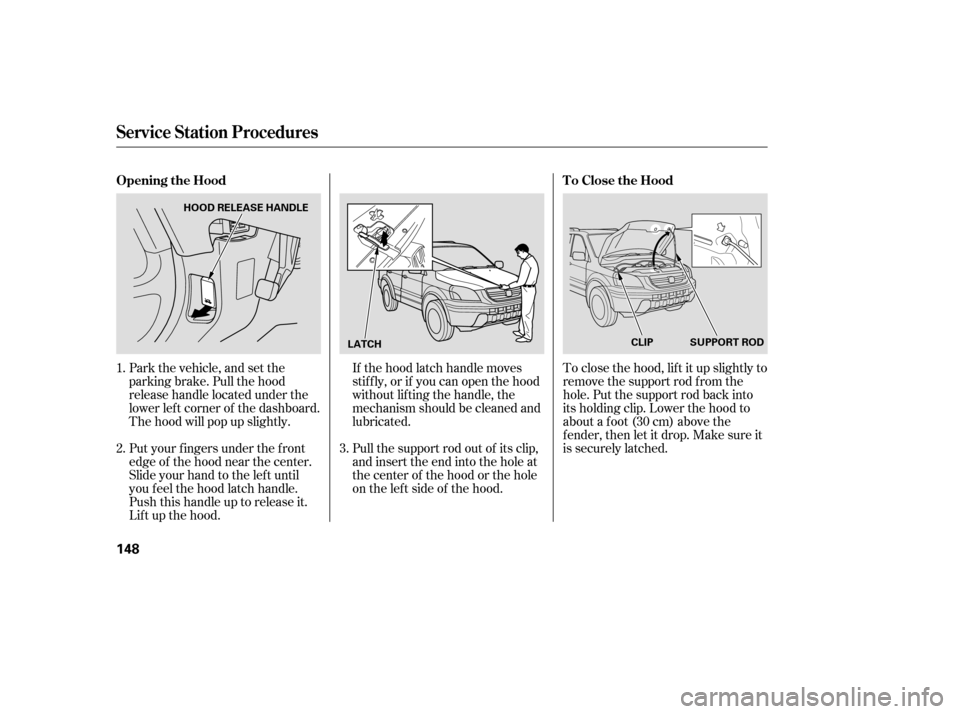
Park the vehicle, and set the
parking brake. Pull the hood
release handle located under the
lower lef t corner of the dashboard.
The hood will pop up slightly.If the hood latch handle moves
stif f ly, or if you can open the hood
without lifting the handle, the
mechanism should be cleaned and
lubricated.
Pull the support rod out of its clip,
and insert the end into the hole at
the center of the hood or the hole
on the lef t side of the hood.
Put your f ingers under the f ront
edge of the hood near the center.
Slide your hand to the lef t until
you f eel the hood latch handle.
Push this handle up to release it.
Lif t up the hood. To close the hood, lif t it up slightly to
remove the support rod f rom the
hole. Put the support rod back into
its holding clip. Lower the hood to
about a f oot (30 cm) above the
f ender, then let it drop. Make sure it
is securely latched.
3.
2. 1.
Service Station Procedures
Opening the Hood T o Close the Hood
148
LATCHSUPPORT ROD
CLIP
HOOD RELEASE HANDLE
Page 151 of 273

Wait a f ew minutes af ter turning the
engine of f bef ore you check the oil.Remove the dipstick again, and
check the level. It should be
between the upper and lower
marks.
If it is near or below the lower mark,
see on page . Look at the coolant level in the
radiator reserve tank. Make sure it is
between the MAX and MIN lines. If
it is below the MIN line, see
on page f or
inf ormation on adding the proper
coolant.
Refer to on page f or inf ormation
about checking other items on your
vehicle.
Remove the dipstick (orange loop).
Wipe of f the dipstick with a clean
cloth or paper towel.
Insert it all the way back into its
tube.
1.
2.
3. 4.
199 202
191
Service Station Procedures
Oil Check
A dding OilEngine Coolant Check
A dding
Engine Coolant
Owner’s Maintenance
Checks
Bef ore Driving
149
UPPER MARK
LOWER MARK MAX
MIN RESERVE TANK
DIPSTICK
Page 167 of 273

Your vehicle is equipped with a tire
pressure monitoring system (TPMS)
that turns on every time you start the
engine and monitors the pressure in
your tires while driving.
Each tire has its own pressure
sensor. If the air pressure of a tire
becomes signif icantly low, the
sensor in that tire immediately sends
a signal that causes the low tire
pressure indicator and the
appropriate tire on the tire pressure
monitor to come on.Each tire, including the spare, should
be checked monthly when cold and
set to the recommended inf lation
pressure as specif ied in the vehicle
placard and this owner’s manual (see
page ).
Although your tire pressure is
monitored, you must manually check
thetirepressuresmonthly.
If you think you can saf ely drive a
short distance to a service station,
proceed slowly, and inf late the tire to
the recommended pressure shown
on the driver’s doorjamb.
When the tire pressure monitoring
system warning indicator is on, one
or more of your tires is signif icantly
under-inf lated. You should stop and
check your tires as soon as possible,
and inflate them to the proper
pressureasindicatedonthevehicle’s
tire inf ormation placard.
Driving on a signif icantly under-
inf lated tire causes the tire to
overheat and can lead to tire failure.
Under-inf lation also reduces f uel
efficiency and tire tread life, and may
af f ect the vehicle’s handling and
stopping ability.
If the tire is f lat, or if the tire
pressure is too low to continue
driving, replace the tire with the
compact spare tire. 247
Tire Pressure Monitoring System (TPMS)
Low Tire Pressure
Indicator
Driving
165
Page 168 of 273

The appropriate tire indicator and
low tire pressure indicator comes on
if a tire becomes signif icantly
underinf lated. Seeon page .The indicator comes on and stays on
if there is a problem with the tire
pressure monitoring system.
If you see this message, the system
is of f and is not monitoring the tire
pressures. Have the system checked
by your dealer as soon as possible. Each wheel is equipped with a tire
pressure sensor mounted inside the
tire behind the valve stem. You must
use TPMS specif ic wheels. It is
recommended that you always have
your tires serviced by your dealer or
qualif ied technician.
If you have a f lat tire, the low tire
pressure and tire monitor indicators
will come on. Replace the indicated
flat tire with the compact spare tire
(see page ). Af ter you replace the f lat tire, the
Low Tire Pressure indicator stays on.
This is normal; the system is not
monitoring the spare tire pressure.
Manually check the spare tire
pressure to be sure it is correct.
Never use a puncture-repairing agent
in a f lat tire. If used, you will have to
replace the tire pressure sensor.
Havetheflattirerepairedbyyour
dealer as soon as possible.
224
165
Tire Pressure Monitoring System (TPMS)
Tire Pressure Monitor
Low Tire
Pressure Indicator Tire Pressure Monitoring
System (T PMS) Indicator
Changing a T ire with T PMS
166
Page 182 of 273

Your vehicle tires and spare are in
good condition and properly
inf lated.
The trailer tires and spare are in
good condition and inf lated as
recommended by the trailer
maker.Foryoursafetyandthesafetyof
others, take time to practice driving
maneuvers bef ore heading f or the
open road, and f ollow the guidelines
below.
Avoid towing a trailer during your
vehicle’s f irst 600 miles (1,000 km)
(see page ).
Drive slower than normal in all
driving situations, and obey posted
speed limits f or vehicles with trailers.
When towing a f ixed-sided trailer (e.
g., camper), do not exceed 55 mph
(88 km/h). At higher speeds, the
trailer may sway or affect vehicle
handling.
To prevent the transmission f rom
shif ting f requently, drive in the D
position.
The added weight, length, and
height of a trailer will af f ect your
vehicle’s handling and perf ormance,
so driving with a trailer requires
some special driving skills and
techniques. Towing perf ormance can be
af f ected by high altitude, high
temperature, or when climbing
steep grades. Theref ore, premium
fuelisrecommendedwhentowing
more than 3,500 lbs (1,590 kg).
When preparing to tow, and bef ore
driving away, be sure to check the
f ollowing:
The vehicle has been properly
serviced, and the tires, brakes,
suspension, cooling system, and
lights are in good operating
condition.
If you tow f requently, f ollow the
Severe Conditions maintenance
schedule.
The trailer has been properly
serviced and is in good condition.
All weights and loads are within
limits.
Thehitch,safetychains,andany
other attachments are secure.
All items in or on the trailer are
properly secured and cannot shif t
while you drive. 146
Trailer Driving Tips
Break-In Period
T owing Speeds and Gears
Driving Saf ely With a T railer
180
Page 186 of 273

Before you leave the pavement, be
sure to do all scheduled maintenance
and service and that you inspect your
vehicle. Pay special attention to the
condition of the tires and check the
tire pressure.
After you return to the pavement,
caref ully inspect your vehicle to
make sure there is no damage that
could make driving it unsaf e.
Recheck the condition of the tires
and the tire pressure.
The route presents limits (too steep
or bumpy roads). You have limits
(driving skill and comf ort). And your
vehicle has limits (traction, stability,
and power).
Driving of f -highway can be
hazardous if you f ail to recognize
limits and take the proper
precautions.Forbettertractiononallsurfaces,
accelerate slowly and gradually build
up speed. If you try to start too fast
on wet soil, mud, snow, or ice, you
might not have enough traction to
get underway and you may dig
yourself a hole. Starting with the
shif t lever in second gear (2) will
help you have a smoother start on
snow and ice.
Debris in the road can damage your
suspension or other components.
Because your vehicle has a high
center of gravity, driving over a large
obstacle, or allowing a wheel to drop
into a deep hole can cause your
vehicle to tip or roll over.
If you can’t clearly see all road
conditions or obstacles, walk the
slope bef ore you drive on it. If you
have any doubt whether or not you
can saf ely drive on the slope, don’t
do it. Find another route.
If you are driving up a hill and f ind
that you cannot continue,
. Your vehicle could roll
over. Slowly back down the hill,
f ollowing the same route you took up
the hill.
Keep in mind that you will usually
need more time and distance to
brake to a stop on unpaved surf aces.
Avoid hard braking. Do not pump
the brakes; let the anti-lock braking
system pump them f or you.
do not try to
turn around
Check Out Your Vehicle
Remember: A ccelerating and Braking
A voiding Obstacles
Driving on Slopes
Of f -Highway Driving Guidelines
184
Page 187 of 273

If you get stuck, engage the VTM-4
Lock (see page ). Caref ully try to
go in the direction (f orward or
reverse) that you think will get you
unstuck. Do not spin the tires at high
speeds. It will not help you get out
and may cause damage to the
transmission or VTM-4 system.
If you are unable to f ree yourself ,
your vehicle is equipped with f ront
and rear tow hooks designed f or this
purpose.
Use a nylon strap to attach the Pilot
to the recovery vehicle and caref ully
take out the slack in the strap. Once
the strap is tight, the recovery
vehicle should apply f orce.
Remember that the recovery vehicle
needs good traction to avoid
becoming stuck, too.
Bef ore driving through water, stop
and make sure that:
The water is not deep enough to
cover your wheel hubs, axles or
exhaust pipe. You could stall and
not be able to restart your engine.
The water can also damage
important vehicle components.
The banks are sloped so you can
drive out.
The water is not f lowing too f ast.
Deep rushing water can sweep you
downstream. Even very shallow
rushingwatercanwashthe
ground f rom under your tires and
cause you to lose traction and
possibly roll over.
The banks and surf ace under the
water provide good traction. The
water may hide hazards such as
rocks, holes, or mud. If you decide it is saf e to drive
through water, choose a suitable
speed and engage the VTM-4 Lock.
Proceed without shif ting or changing
speeds, and do not stop the vehicle
or shut of f the engine.
After driving through water, test
your brakes. If they got wet, gently
pump them while driving slowly until
they operate normally.
If the water is deeper than the wheel
hubs, some additional service may
be required. This service is not
covered by your warranties.
164
CONT INUED
If You Get Stuck
Crossing a Stream
Of f -Highway Driving Guidelines
Driving
185
Page 189 of 273

This section also includes
Maintenance Schedules f or normal
driving and severe driving conditions,
a Maintenance Record, and instruc-
tions f or simple maintenance tasks
you may want to take care of
yourself .
If you have the skills and tools to per-
f orm more complex maintenance
tasks on your vehicle, you may want
to purchase the Service Manual. See
page f or inf ormation on how to
obtain a copy, or see your dealer. This section explains why it is
important to keep your vehicle well
maintained and how to f ollow basic
maintenance saf ety precautions.......................
Maintenance Saf ety .188
.................
Maintenance Schedule . 189
....................
Maintenance Record .195
..............................
Fluid Locations .198
........................
Adding Engine Oil .199
.........
Changing the Oil and Filter . 200
..............................
Engine Coolant .202
....................
Windshield Washers .203
.....
Automatic Transmission Fluid . 204
...............................
Dif f erential Oil .205
....................................
Timing Belt .205
....................................
Brake Fluid .206
....................
Power Steering Fluid . 207
.............................................
Lights .208
.....................................
Floor Mats .213
.......................
Cleaning Seat Belts .213
.................................
Wiper Blades .214
...............................................
Tires .216
...................
Checking the Battery . 221
.............................
Vehicle Storage .222
261
Maintenance
Maint enance
187