Page 150 of 273
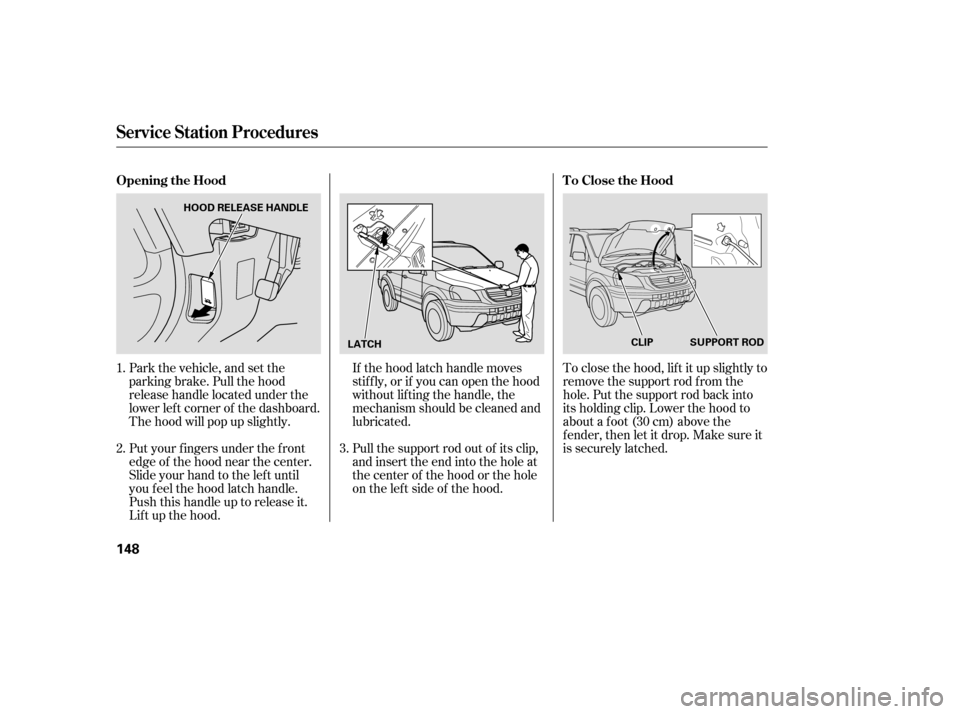
Park the vehicle, and set the
parking brake. Pull the hood
release handle located under the
lower lef t corner of the dashboard.
The hood will pop up slightly.If the hood latch handle moves
stif f ly, or if you can open the hood
without lifting the handle, the
mechanism should be cleaned and
lubricated.
Pull the support rod out of its clip,
and insert the end into the hole at
the center of the hood or the hole
on the lef t side of the hood.
Put your f ingers under the f ront
edge of the hood near the center.
Slide your hand to the lef t until
you f eel the hood latch handle.
Push this handle up to release it.
Lif t up the hood. To close the hood, lif t it up slightly to
remove the support rod f rom the
hole. Put the support rod back into
its holding clip. Lower the hood to
about a f oot (30 cm) above the
f ender, then let it drop. Make sure it
is securely latched.
3.
2. 1.
Service Station Procedures
Opening the Hood T o Close the Hood
148
LATCHSUPPORT ROD
CLIP
HOOD RELEASE HANDLE
Page 159 of 273

This section gives you tips on
starting the engine under various
conditions, and how to operate the
automatic transmission. It also
includes important inf ormation on
parking your vehicle, the braking
system, the VTM-4System, the VSA
system (EX-L model only), the tire
pressure monitoring system, and
f acts you need if you are planning to
tow a trailer. ........................
Driving Guidelines .158
.......................
Starting the Engine .159
..............
Automatic Transmission . 160
..............................
VTM-4 System .164
Tire Pressure Monitoring ........................
System (TPMS) .165
..................................
Parking Tips .167
.............................
Braking System .168
...............
Anti-lock Brakes (ABS) . 169
Vehicle Stability Assist (VSA) ........................................
System .171
.............................
VSA Of f Switch .172
...........................
Towing a Trailer .173
......................
Trailer Driving Tips .180
Towing Your Vehicle Behind a ................................
Motorhome .182
Of f -Highway Driving ..................................
Guidelines .183
Driving
Driving
157
Page 161 of 273

Apply the parking brake.
In cold weather, turn of f all
electrical accessories to reduce
the drain on the battery.
Make sure the shif t lever is in
Park. Press on the brake pedal.
Without touching the accelerator
pedal, turn the ignition key to the
START (III) position. Do not hold
the key in START for more than
15 seconds at a time. If the engine
does not start right away, pause
f or at least 10 seconds bef ore
trying again.If the engine does not start within
15 seconds, or starts but stalls
right away, repeat step 4 with the
accelerator pedal pressed halfway
down. If the engine starts, release
pressure on the accelerator pedal
so the engine does not race.
If the engine fails to start, press
the accelerator pedal all the way
downandholdittherewhile
starting to clear flooding. If the
engine still does not start, return
to step 5.
5.
6.
1.
2.
3.
4.
75
Starting the Engine
Driving
159
Immobilizer System T he immobilizer system protects your
vehicle f rom thef t. If an improperly-
coded key (or other device) is used, the
engine’s f uel system is disabled. See
on page . The engine is harder to start in cold
weather. Also, the thinner air f ound at
altitudes above 8,000 f eet (2,400
meters) adds to this problem.
Page 165 of 273
Do this if pushing on the brake pedal
and pulling the shif t lever does not
shif t the transmission out of Park:Set the parking brake. Push down on the key while you
pull the shif t lever towards you
and move it out of Park to Neutral.
Remove the key from the Shift
Lock Release slot, then install the
cover. Press the brake pedal, and
restart the engine.
If you need to use the Shif t Lock
Release, it means your vehicle is
developing a problem. Have the
vehicle checked by your dealer.
Put a cloth on the edge of the Shif t
Lock Release slot cover next to
theshiftlever.Useasmallflat-
tipped screwdriver or f inger nail
f ile to remove the cover. Caref ully
pryoff theedgeof thecover.
Insert the key in the Shift Lock
Release slot.
Remove the key from the ignition
switch.
3.
4. 5.
6.
1.
2. Shif t L ock Release
Automatic Transmission
Driving
163
Page 169 of 273
Always use the parking brake when
you park your vehicle. Make sure
the parking brake is set f irmly or
your vehicle may roll if it is on an
incline.
Set the parking brake bef ore you put
the transmission in Park. This keeps
the vehicle from moving and putting
pressure on the parking mechanism
in the transmission.Make sure the windows are closed.
Turn of f the lights.
Place any packages, valuables, etc.
in the cargo area, or take them
with you.
Lock the doors.
Never park over dry leaves, tall
grass, or other f lammable
materials. The hot three way
catalytic converter could cause
these materials to catch on fire.
If the vehicle is f acing uphill, turn
the f ront wheels away f rom the
curb.
If the vehicle is f acing downhill,
turn the front wheels toward the
curb.Make sure the parking brake is
f ully released bef ore driving away.
Driving with the parking brake
partially set can overheat or
damage the rear brakes.
Parking T ips
Parking T ips
Driving
167
Page 172 of 273

If the ABS indicator comes on, the
anti-lock f unction of the braking
system has shut down. The brakes
still work like a conventional system,
but without anti-lock. You should
have your dealer inspect your vehicle
as soon as possible.
If the ABS indicator and the brake
system indicator come on together,
and the parking brake is f ully
released, the front-to-rear braking
distribution system may also be shut
down.
Test your brakes as instructed on
page . If the brakes f eel normal,
drive slowly and have your vehicle
repaired by your dealer as soon as
possible. Avoid sudden hard braking
which could cause the rear wheels to
lock up and possibly lead to a loss of
control.It only helps with the
steering control during braking.
such as trying to take a
corner too f ast or making a sudden
lane change. Always drive at a safe
speed f or the road and weather
conditions.
Always steer moderately
when you are braking hard. Severe
or sharp steering wheel movement
can still cause your vehicle to veer
into oncoming traffic or off the road. on loose or
uneven surf aces, such as gravel or
snow, than a vehicle without anti-
lock. Slow down and allow a greater
distance between vehicles under
those conditions.
236
Anti-lock Brakes (ABS)
ABS Indicator A BS does not reduce the time or
distance it takes to stop the
vehicle.
A BS will not prevent a skid that
results f rom changing direction
abruptly,
A BS cannot prevent a loss of
stability.A vehicle with A BS may require a
longer distance to stopImport ant Saf et y Reminders
170
Page 183 of 273

If the vehicle’s wheels slip when
retrieving a boat f rom the water,
shif t to f irst gear, and turn on VTM-4
lock (see page ). Disengage
VTM-4 lock as soon as the boat is
out of the water to prevent damage
to the VTM-4 system. Follow all normal precautions when
parking, including putting the
transmission in Park and f irmly
setting the parking brake. Also, place
wheel chocks at each of the trailer’s
tires. Always drive slowly and have
someone guide you when backing up.
Grip the of the steering
wheel; then turn the wheel to the lef t
to get the trailer to move to the lef t,
andturnthewheelrighttomovethe
trailer to the right.
If you must stop when f acing uphill,
use the f oot brake or parking brake.
Do not try to hold the vehicle in
placebypressingontheaccelerator,
as this can cause the automatic
transmission to overheat.
When driving down hills, reduce
your speed and shif t down to D . Do
not ‘‘ride’’ the brakes.
Crosswinds and air turbulence
caused by passing trucks can disrupt
your steering and cause trailer
swaying. When being passed by a
large vehicle, keep a constant speed,
and steer straight ahead. Do not try
to make quick steering or braking
corrections.
If the automatic transmission shif ts
f requently while going up a hill, shif t
to D . When climbing hills, closely watch
your temperature gauge. If it nears
the red (hot) mark, turn the air
conditioning of f , reduce speed and, if
necessary, pull to the side of the
road to let the engine cool. Maketurnsmoreslowlyandwider
than normal. The trailer tracks a
smaller arc than your vehicle, and it
canhitorrunoversomethingthe
vehicle misses. Allow more time and
distance f or braking. Do not brake or
turn suddenly as this could cause the
trailer to jackknif e or turn over.
164
bottom
3
3
Trailer Driving Tips
Ret rieving a Boat
Parking
Backing Up
Handling Crosswinds and Buf f et ing
Driving on Hills
Making T urns and Braking
Remember, it
takes longer to slow down and
stop when towing a trailer.
Driving
181
Page 184 of 273

Your vehicle can be towed behind a
motorhome at legal highway speeds
up to 65 mph (100 km/h). Do not
exceed 65 mph (100 km/h) or severe
transmission damage will occur. To
avoid damage to the 4WD system, it
must be towed with all f our wheels
on the ground (f lat towing).
When purchasing a tow bar, make
sure you select a reputable
manuf acturer. Follow the
manufacturer’s attachment
instructions caref ully.
Perf orm the f ollowing procedure
everyday immediately bef ore you
begin towing. Otherwise severe
automatic transmission damage will
occur.Check the transmission f luid level
(see page ).
Start the engine. Press on the brake pedal. Move
the shif t lever through all its
positions.
ShifttoD,thentoN.Letthe
engine run f or three minutes, then
turn it off.
Release the parking brake.
Leave the ignition switch in the
ACCESSORY (I) position so the
steering wheel does not lock.
Make sure the radio and any
items plugged into the
accessory power sockets are
turned of f so you do not run
down the battery.
If you tow more than 8 hours in one
day, you should repeat the above
procedure at least every 8 hours
(when you stop f or f uel, etc.)
204
Do not overf ill. Ext ended T owing
Towing Your Vehicle Behind a Motorhome
182
Improper towing preparation will
damage the transmission. Follow the
above procedure exactly. If you cannot
shif t the transmission or start the
engine, your car must be transported
on a f lat-bed or trailer.
The steering system can be damaged if
the steering wheel is locked. Leave the
ignition switch in the ACCESSORY (I)
position, and make sure the steering
wheel turns f reely bef ore you begin
towing.