Page 44 of 414
When buying a child seat, you need
to choose either a conventional child
seat, or one designed f or use with
the Lower Anchors and Tethers f or
Children (LATCH) system.
Conventional child seats must be
secured to a vehicle with a seat belt,
whereas LATCH-compatible seats
are secured by attaching the seat to
hardware built into the two second-
row seat and the center seating
position of the third row.In seating positions and vehicles not
equipped with LATCH, a LATCH-
compatible child seat can be installed
using a seat belt. We also recommend selecting a
LATCH-compatible seat with a rigid,
rather than a f lexible, anchor (see
page ).
Since LATCH-compatible child seats
are easier to install and reduce the
possibility of improper installation,
we recommend selecting this style.
If it is necessary to put a f orward-
f acing child seat in the f ront, move
the vehicle seat as far to the rear as
possible, be sure the child seat is
f irmly secured to the vehicle, and the
child is properly strapped in the seat.
45
CONT INUED
Selecting a Child Seat
Protecting Inf ants and Small Children, Selecting a Child Seat
Driver and Passenger Saf ety
43
Placing a forward-facing child
seat in the front seat can result
in serious injury or death if the
front airbag inflates.
Ifyoumustplaceaforward-
facing child seat in front, move
the vehicle seat as far back as
possible, and properly restrain
the child.
Page 52 of 414
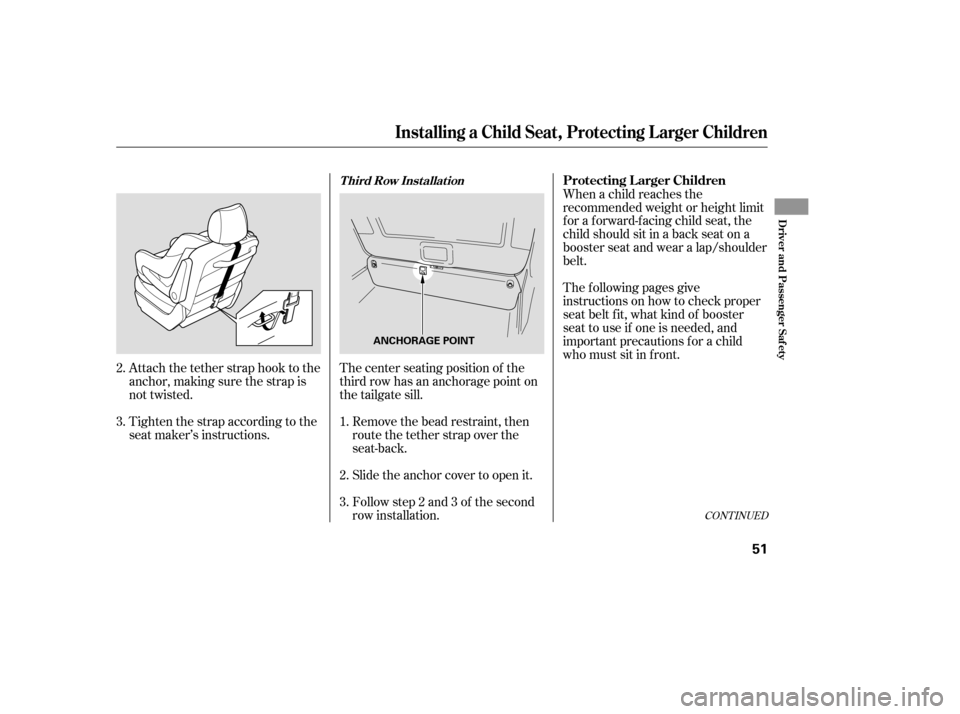
Attach the tether strap hook to the
anchor, making sure the strap is
not twisted.
Tighten the strap according to the
seat maker’s instructions.The center seating position of the
third row has an anchorage point on
the tailgate sill.
Remove the bead restraint, then
route the tether strap over the
seat-back.
Slide the anchor cover to open it. When a child reaches the
recommended weight or height limit
for a forward-facing child seat, the
child should sit in a back seat on a
booster seat and wear a lap/shoulder
belt.
The f ollowing pages give
instructions on how to check proper
seat belt f it, what kind of booster
seat to use if one is needed, and
important precautions f or a child
who must sit in f ront.
Follow step 2 and 3 of the second
row installation.
2.
1.
3.
2.
3.
CONT INUED
T hird Row Inst allat ionProtecting L arger Children
Installing a Child Seat, Protecting L arger Children
Driver and Passenger Saf ety
51
ANCHORAGE POINT
Page 53 of 414
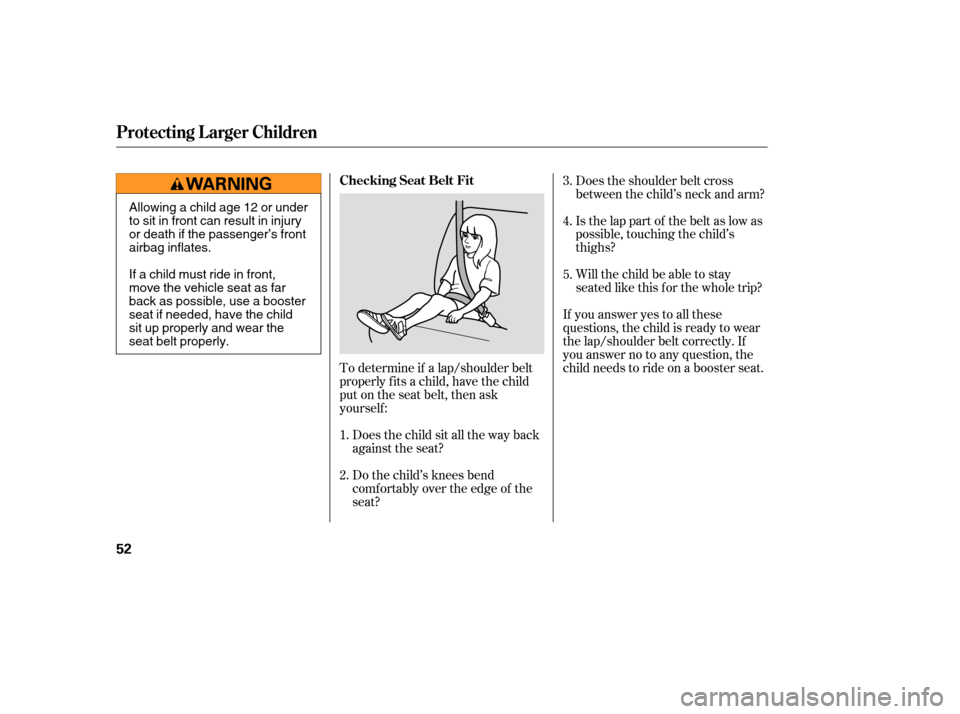
To determine if a lap/shoulder belt
properly f its a child, have the child
put on the seat belt, then ask
yourself :Does the child sit all the way back
against the seat?
Do the child’s knees bend
comf ortably over the edge of the
seat? Does the shoulder belt cross
between the child’s neck and arm?
Is the lap part of the belt as low as
possible, touching the child’s
thighs?
Will the child be able to stay
seated like this f or the whole trip?
If you answer yes to all these
questions, the child is ready to wear
the lap/shoulder belt correctly. If
you answer no to any question, the
child needs to ride on a booster seat.
1.
2. 3.
4.
5.
Protecting L arger Children
Checking Seat Belt Fit
52
Allowing a child age 12 or under
to sit in front can result in injury
or death if the passenger’s front
airbag inflates.
If a child must ride in front,
move the vehicle seat as far
back as possible, use a booster
seat if needed, have the child
sit up properly and wear the
seat belt properly.
Page 54 of 414
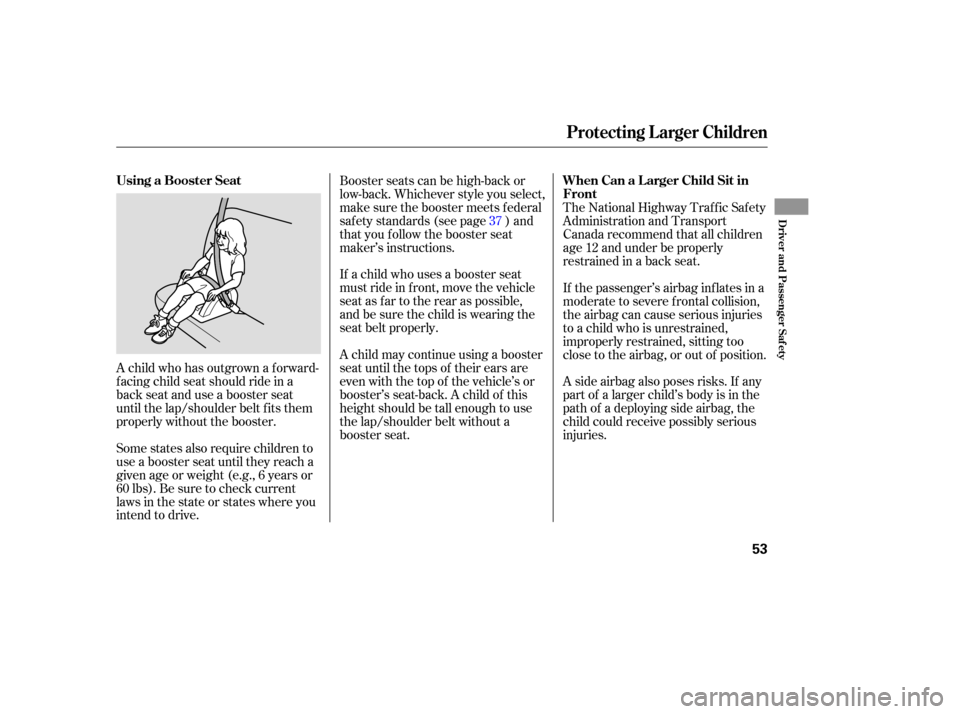
A child who has outgrown a forward-
f acing child seat should ride in a
back seat and use a booster seat
until the lap/shoulder belt f its them
properly without the booster.
Some states also require children to
use a booster seat until they reach a
given age or weight (e.g., 6 years or
60lbs).Besuretocheckcurrent
laws in the state or states where you
intend to drive.If a child who uses a booster seat
must ride in f ront, move the vehicle
seat as far to the rear as possible,
and be sure the child is wearing the
seat belt properly.
A child may continue using a booster
seat until the tops of their ears are
even with the top of the vehicle’s or
booster’s seat-back. A child of this
height should be tall enough to use
the lap/shoulder belt without a
booster seat. Booster seats can be high-back or
low-back. Whichever style you select,
make sure the booster meets f ederal
saf ety standards (see page ) and
that you f ollow the booster seat
maker’s instructions.
The National Highway Traffic Safety
Administration and Transport
Canada recommend that all children
age 12 and under be properly
restrained in a back seat.
If the passenger’s airbag inf lates in a
moderate to severe frontal collision,
the airbag can cause serious injuries
to a child who is unrestrained,
improperly restrained, sitting too
close to the airbag, or out of position.
A side airbag also poses risks. If any
part of a larger child’s body is in the
path of a deploying side airbag, the
child could receive possibly serious
injuries.
37
Protecting L arger Children
Using a Booster Seat
When Can a L arger Child Sit in
Front
Driver and Passenger Saf ety
53
Page 55 of 414

If you decide that a child can saf ely
ride up f ront, be sure to:Caref ully read the owner’s manual,
and make sure you understand all
seat belt instructions and all saf ety
inf ormation.
Move the vehicle seat to the rear-
most position.
Have the child sit up straight, back
against the seat, and feet on or
near the f loor.
Check that the child’s seat belt is
properly and securely positioned.
Supervise the child. Even mature
children sometimes need to be
reminded to f asten the seat belts
or sit properly.
Of course, children vary widely. And
while age may be one indicator of
when a child can saf ely ride in the
f ront, there are other important
f actors you should consider.
Physically, a child must be large
enough f or the lap/shoulder belt to
properly f it (see page ). If the seat
belt does not f it properly, with or
without the child sitting on a booster
seat, the child should not sit in f ront.
To saf ely ride in f ront, a child must
be able to f ollow the rules, including
sitting properly, and wearing the seat
belt properly throughout a ride.52
Protecting L arger Children
Physical Size
Maturity
54
Page 65 of 414

This indicator comes on when you
turn the ignition switch to ON (II). If
it comes on at any other time, it
indicates that the passenger’s side
airbag has automatically shut off.
For more inf ormation, see page .
On the Touring model, you will also
see a ‘‘PASSENGER SIDE AIRBAG
OFF’’ message in the multi-
inf ormation display.
On the Touring model, you will also
see a ‘‘CHECK AIRBAG SYSTEM’’
message in the multi-inf ormation
display. This indicator comes on brief ly when
you turn the ignition switch to ON
(II). If it comes on at any other time,
it indicates a potential problem with
your f ront airbags. This indicator will
also alert you to a potential problem
with your side airbags, passenger’s
side airbag automatic cutoff system,
side curtain airbags, automatic seat
belt tensioners, driver’s seat position
sensor, or the f ront passenger’s
weight sensors. For more
inf ormation, see page .
This indicator comes on when you
turn the ignition switch to ON (II). It
reminds you and your passengers to
f asten your seat belts. A beeper also
sounds if you have not f astened your
seat belt.
If you turn the ignition switch to ON
(II) bef ore f astening your belt, the
beeper sounds and the indicator
f lashes. If you do not f asten your
seat belt bef ore the beeper stops, the
indicator stops f lashing but remains
on.
If you continue driving without
f astening your seat belt, the beeper
sounds and the indicator f lashes
again at regular intervals. On the
Touring model, you will also see a
‘‘FASTEN SEAT BELT’’ message in
the multi-information display.
32
33
Instrument Panel Indicators
Side A irbag Of f
Indicator
Supplemental Restraint
System Indicator
Seat Belt Reminder
Indicator
64
U.S. Canada
Page 73 of 414

The odometer shows the total
distance your vehicle has been
driven. It measures miles in U.S.
models and kilometers in Canadian
models. It is illegal under U.S.
federal law and Canadian provincial
regulations to disconnect, reset, or
alter the odometer with the intent to
change the number of miles or
kilometers indicated.This indicator displays the outside
temperature in Fahrenheit (U.S.
models) or Centigrade (Canadian
models). To see the outside
temperature, press and release the
Select/Reset button until the
temperature is displayed.
The temperature sensor is in the
f ront bumper. The temperature
reading can be affected by heat
ref lection f rom the road surf ace,
engine heat, and the exhaust f rom
surrounding traf f ic. This can cause
an incorrect temperature reading
when your speed is under
19 mph (30 km/h). When you start
your trip, the sensor is not f ully
acclimatized, theref ore it may take
several minutes until the proper
temperature is displayed.
This meter shows the number of
miles (U.S.) or kilometers (Canada)
driven since you last reset it.
There are two trip meters: Trip A
and Trip B. Switch between these
displays and the outside temperature
display by pressing the Select/Reset
knob repeatedly.
Each trip meter works independently,
so you can keep track of two
dif f erent distances.
To reset a trip meter, display it and
then press and hold the Select/Reset
knob until the number resets to ‘‘0.0.’’
Both trip meters will reset if the
vehicle’s battery goes dead or is
disconnected.If equipped
Gauges
Odometer
Outside T emperature Indicator
Trip Meter
72
Page 87 of 414
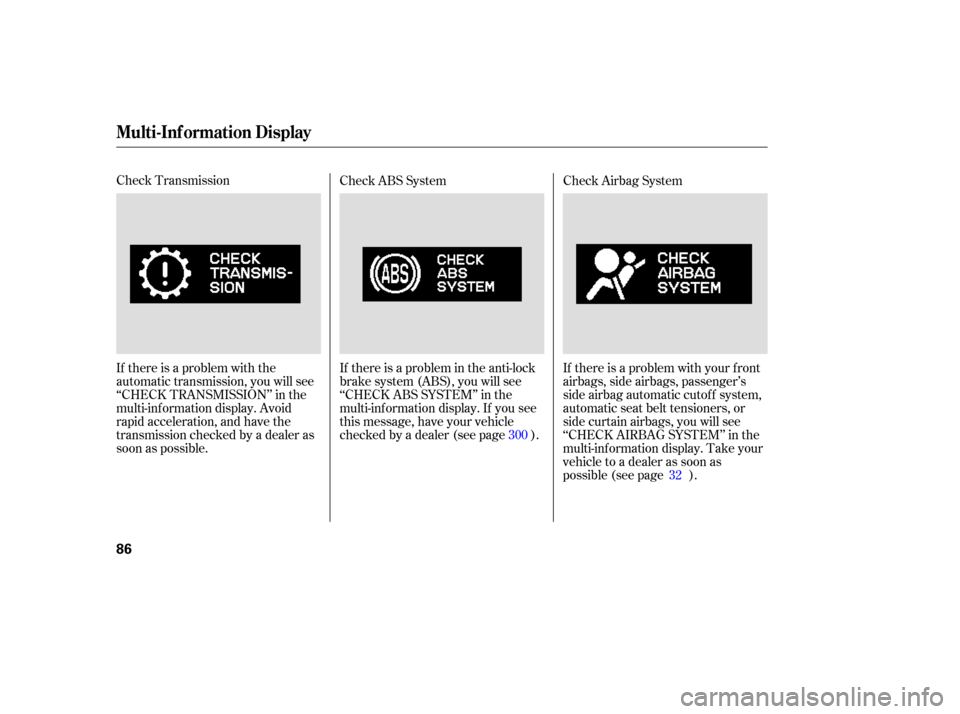
Check Transmission
If there is a problem with the
automatic transmission, you will see
‘‘CHECK TRANSMISSION’’ in the
multi-inf ormation display. Avoid
rapid acceleration, and have the
transmission checked by a dealer as
soon as possible.If there is a problem in the anti-lock
brake system (ABS), you will see
‘‘CHECKABSSYSTEM’’inthe
multi-inf ormation display. If you see
this message, have your vehicle
checked by a dealer (see page ). Check ABS System
Check Airbag System
If there is a problem with your f ront
airbags, side airbags, passenger’s
side airbag automatic cutoff system,
automatic seat belt tensioners, or
side curtain airbags, you will see
‘‘CHECK AIRBAG SYSTEM’’ in the
multi-inf ormation display. Take your
vehicle to a dealer as soon as
possible (see page ).
300
32
Multi-Inf ormation Display
86