Page 30 of 218

Because an inf lating airbag can
seriously injure or kill small children,
we recommend that you do not carry
a small child as a passenger in this
vehicle.
If you decide to transport a small
child in this vehicle, be sure to move
the passenger seat as far to the rear
as possible, and follow the
instructions and guidelines in the
f ollowing pages.We also recommend that a small
child use the child seat as long as
possible, until the child reaches the
weight or height limit f or the seat.
A child who is at least one year old
and who fits within the child seat
maker’s weight and height limits,
should be restrained in a f orward-
f acing, upright child seat.
Of the different seats available, we
recommend those that have a f ive-
point harness system as shown.
Protecting Small Children
Driver and Passenger Saf ety
29
Placing a forward-facing child
seat in the passenger’s seat
can result in serious injury or
death if the airbag inflates.
Ifyoumustplaceaforward-
facing child seat in the
passenger’s seat, move the
vehicle seat as far back as
possible and properly restrain
the child.
Page 35 of 218

When a child reaches the
recommended weight or height limit
for a forward-facing child seat, the
child should sit in a back seat on a
booster seat and wear a lap/shoulder
belt.To determine if a lap/shoulder belt
properly f its a child, have the child
put on the seat belt, then ask
yourself :Does the child sit all the way back
against the seat?
Do the child’s knees bend
comf ortably over the edge of the
seat?
Since this vehicle does not have a
back seat, we recommend that you
do not carry a larger child, age 12 or
under, as a passenger.
However, the following pages
provide guidelines to help you decide
when a given child may ride in this
vehicle, and how to properly protect
the child.
1.
2. Checking Seat Belt Fit
Protecting L arger Children
34
Allowing a larger child age 12 or
under to ride in the vehicle can
result in injury or death if the
passenger’s front airbag inflates.
If a larger child must ride in the
vehicle, move the vehicle seat
as far back as possible, use a
booster seat if needed, have
the child sit up properly and
wear the seat belt properly.
Page 36 of 218
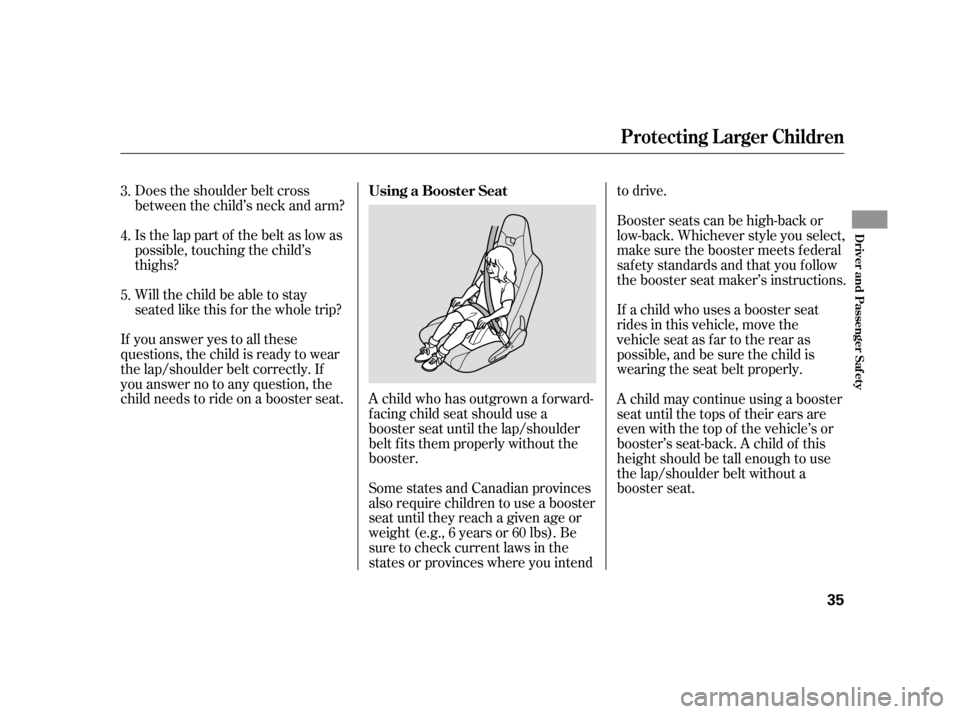
Does the shoulder belt cross
between the child’s neck and arm?
Is the lap part of the belt as low as
possible, touching the child’s
thighs?
Will the child be able to stay
seated like this f or the whole trip?
If you answer yes to all these
questions, the child is ready to wear
the lap/shoulder belt correctly. If
you answer no to any question, the
child needs to ride on a booster seat. A child who has outgrown a f orward- f acing child seat should use a
booster seat until the lap/shoulder
belt fits them properly without the
booster.
Some states and Canadian provinces
also require children to use a booster
seat until they reach a given age or
weight (e.g., 6 years or 60 lbs). Be
sure to check current laws in the
states or provinces where you intendto drive.
Booster seats can be high-back or
low-back. Whichever style you select,
make sure the booster meets f ederal
saf ety standards and that you f ollow
the booster seat maker’s instructions.
If a child who uses a booster seat
ridesinthisvehicle,movethe
vehicle seat as f ar to the rear as
possible, and be sure the child is
wearing the seat belt properly.
A child may continue using a booster
seat until the tops of their ears are
even with the top of the vehicle’s or
booster’s seat-back. A child of this
height should be tall enough to use
the lap/shoulder belt without a
booster seat.
3.
4.
5.
Using a Booster Seat
Protecting L arger Children
Driver and Passenger Saf ety
35
Page 195 of 218

�Î�Î�Î
�Î
�Î
�Î
�Î
�Î
Specif ications
194
Dimensions
Weights
EngineCapacities
66.7 in (1,695 mm)
53.3 in (1,355 mm)
94.5 in (2,400 mm)
56.5 in (1,435 mm)
52.2 in (1,325 mm) 10.6 US gal (40
)
155.0 in (3,938 mm)
0.61 US gal (2.3)
ILZFR5A-11 10.3 : 1 10.8 : 1
60.8 cu-in (995 cm
)
2.8x3.21in(72x81.5mm)
0.11 US gal (0.4
)
4.8 US qt (4.5
)
5.8 US qt (5.5)
3.5 US qt (3.3)
1.7 US qt (1.6
)
1.6 US qt (1.5)
3.2 US qt (3.0
)
2.4 US qt (2.3)
2.6 US qt (2.5)
Length
Width
Height
Wheelbase
Track
Gross vehicle weight rating
Type
BorexStroke
Displacement
Compression ratio
Spark plugs Fuel tank
Engine
coolant
Engine oil
Manual transmission
fluid
Automatic transmission
fluid (CVT)
Windshield washer reservoir
Including the coolant in the reserve tank and that remaining in the
engine.
Reserve tank capacity:
See the certification label attached
to the driver’s doorjamb.
Water cooled 4-strokeSOHC VTEC in line
3-cylinder gasoline engine 1.06 US gal (4.0
)
1.03 US gal (3.9)
Contact your Honda dealer when replacement is necessary. Front
Rear
Approx.
U.S. model
M/T
CVT
1: 2:
3:M/T
CVT
Change
Total
Change
Without filter
Total
Change
Total
Change
Total
4 : Excluding the oil remaining in the engine.
1 32
4
Including filter
Page 199 of 218

�µ
�µ
�µ
�µ�µ
�µ
�µ
�µ�µ
�µ �µ
The tires that came on your vehicle
have a number of markings. Those
you should be aware of are described
below. Rim diameter in inches.
Load index (a numerical code
associated with the maximum
load the tire can carry).
Speed symbol (an
alphabetical code indicating
the maximum speed rating).
Tire Identif ication Number (TIN) is
a group of numbers and letters that
look like the f ollowing example TIN.
This indicates that the tire
meets all requirements of
the U.S. Department of
Transportation.Manuf acturer’s
identification mark.
Tire type code. Date of manufacture.
Whenever tires are replaced, they
should be replaced with tires of the
same size. The f ollowing is an
exampleof tiresizewithan
explanation of what each component
means.
Tire construction code (R
indicates radial). Aspect ratio (the tire’s section
height as a percentage of its
width). Tire width in millimeters. Vehicletype(Pindicates
passenger vehicle).
P
R DOT
B97R
FW6X2202
165
65 14
78
S
Tire Labeling
Tire Size
T ire Ident if icat ion Number
198
DOT B97R FW6X 2202
P165/65R14 78S