Page 156 of 218
Examine the new wiper blades. If
they have no plastic or metal
reinf orcement along the back
edge, remove the metal
reinf orcement strips f rom the old
wiper blade, and install them in
the slots along the edge of the new
blade.Slide the new wiper blade into the
holder until the tabs lock.
Slide the wiper blade assembly
onto the wiper arm. Make sure it
locks in place.
Lower the wiper arm down against
the windshield.
To replace a rear wiper blade:Raise the wiper arm of f the
windshield.
Pull one end of the blade out f rom
the holder.
Slide the blade out of the holder.
Slide the new blade into the holder.
Make sure it is engaged in the slot
along its f ull length.
4. 5.
6.
7.
1.
2.
3.
4.
CONT INUED
Wiper Blades
Maint enance
155
BLADE
REINFORCEMENT
Page 157 of 218

Insert both ends of the blade into
the holder. Make sure they are
secure.
Slide the wiper blade assembly
onto the wiper arm. Make sure it
locks in place.
Lower the wiper arm.To saf ely operate your vehicle, your
tires must be the proper type and
size, in good condition with adequate
tread, and correctly inf lated.
The f ollowing pages give more
detailed inf ormation on how to take
care of your tires and what to do
when they need to be replaced.
Keeping the tires properly inf lated
provides the best combination of
handling, tread lif e, and riding
comf ort.
Underinf lated tires wear unevenly,
adversely af f ect handling and f uel
economy, and are more likely to
fail from being overheated.
Overinf lated tires can make your
vehicleridemoreharshly,are
more prone to damage f rom road
hazards, and wear unevenly.
We recommend that you visually
check your tires every day. If you
think a tire might be low, check it
immediately with a tire gauge.
5.
6.
7.
Wiper Blades, Tires
T ires
Inf lation Guidelines
156
Using tires that are excessively
worn or improperly inflated can
cause a crash in which you can
be seriously hurt or killed.
Follow all instructions in this
owner’s manual regarding tire
inflation and maintenance.
Page 164 of 218

If you need to park your vehicle f or
an extended period (more than one
month), there are several things you
should do to prepare it f or storage.
Proper preparation helps prevent
deterioration and makes it easier to
get your vehicle back on the road. If
possible, store your vehicle indoors.Fill the f uel tank.
Change the engine oil and f ilter.
Wash and dry the exterior
completely.
Cleantheinterior.Makesurethe
carpeting, floor mats, etc., are
completely dry.
Leave the parking brake off. Put
the transmission in Reverse
(manual) or Park (CVT).
Block the rear wheels. If the vehicle is to be stored f or a
longer period, it should be
supported on jackstands so the
tires are of f the ground.
Leave one window open slightly (if
the vehicle is being stored
indoors).
Disconnect the 12 volt battery.
Support the f ront and rear wiper
blade arms with a f olded towel or
ragsotheydonottouchthe
windshield.
To minimize sticking, apply a
silicone spray lubricant to all door
and hatch seals. Also, apply a
vehiclebodywaxtothepainted
surfaces that mate with the door
and hatch seals.
If you store your vehicle f or 1 year or
longer, have your dealer perf orm the
inspections called f or in the 2 years/
30,000 miles (48,000 km)
maintenance schedule (Normal
Conditions) as soon as you take it
out of storage (see page ). The
replacements called f or in the
maintenance schedule are not
needed unless the vehicle has
actually reached that time or mileage.Cover the vehicle with a
‘‘breathable’’ cover, one made
f rom a porous material such as
cotton. Non-porous materials, such
as plastic sheeting, trap moisture,
which can damage the paint.
Reconnect the 12 volt battery and
drive your vehicle every month f or
about 30 minutes. This will keep
the IMA battery charged and in
good condition.
129
Vehicle Storage
Maint enance
163
Page 168 of 218

If you have a f lat tire while driving,
stop in a saf e place to change it.
Drive slowly along the shoulder until
you get to an exit or an area that is
far away from the traffic lanes.Park the vehicle on f irm, level and
non-slippery ground. Put the
transmission in Reverse (5-speed
manual) or Park (CVT). Apply the
parking brake.
Open the hatch. Raise the cargo
area f loor by lif ting up on the back
edge.
Remove the storage box from the
cargo area well.
Take the tool kit f rom the spare
tire well. Remove the jack (in the
jack cover) f rom the inside of the
spare tire.
Unscrew the wing bolt, and take
the spare tire out of its well.
Turn on the hazard warning
indicators, and turn the ignition
switch to LOCK (0). Have your
passenger get out of the vehicle
while you change the tire.
2.
3. 1.
4.
5.
6.
CONT INUED
Changing a Flat T ire
T aking Care of t he Unexpect ed
167
FLOOR BOARDTOOL KIT
STORAGE BOX
SPARE TIRE
JACK
The vehicle can easily roll off
the jack, seriously injuring
anyone underneath.
Follow the directions for
changing a tire exactly, and
never get under the vehicle
when it is supported only by the
jack.
Page 170 of 218
CONT INUED
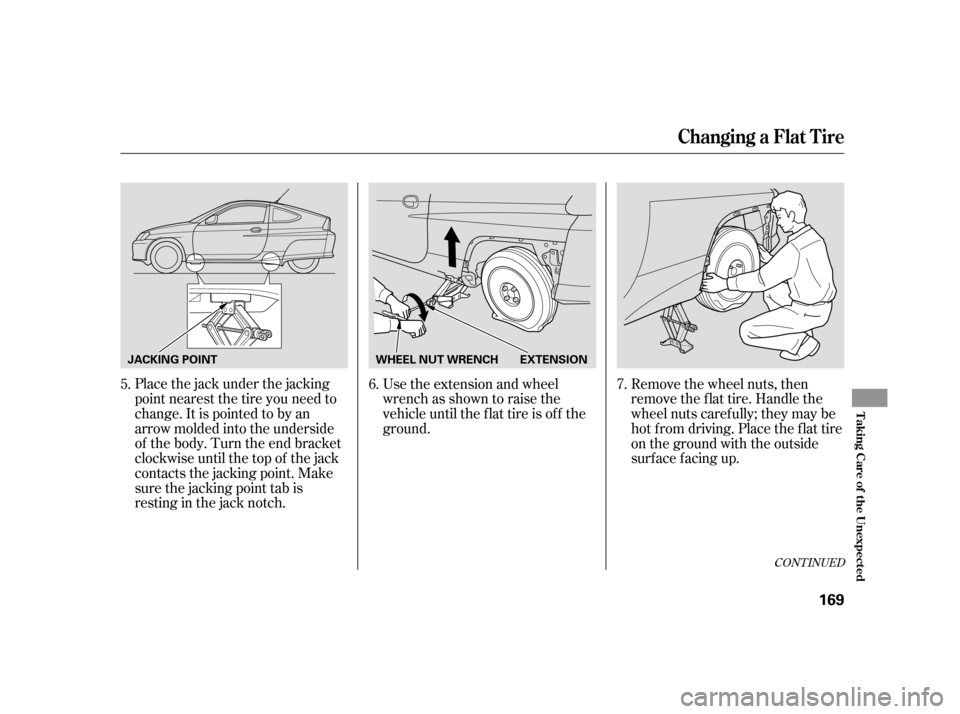
Place the jack under the jacking
point nearest the tire you need to
change. It is pointed to by an
arrow molded into the underside
of the body. Turn the end bracket
clockwise until the top of the jack
contacts the jacking point. Make
sure the jacking point tab is
restinginthejacknotch.Use the extension and wheel
wrench as shown to raise the
vehicle until the f lat tire is of f the
ground.
Remove the wheel nuts, then
remove the f lat tire. Handle the
wheel nuts caref ully; they may be
hot f rom driving. Place the f lat tire
on the ground with the outside
surface facing up.
5.
6.7.
Changing a Flat T ire
T aking Care of t he Unexpect ed
169
JACKING POINT WHEEL NUT WRENCH EXTENSION
Page 174 of 218

CONT INUED
Diagnosing why the engine won’t
start f alls into two areas, depending
on what you hear when you turn the
key to START (III):You hear nothing, or almost
nothing. The engine’s starter
motor does not operate at all, or
operates very slowly.
You can hear the starter motor
operating normally, or the starter
motor sounds like it is spinning
f aster than normal, but the engine
does not start up and run. When you turn the ignition switch to
START (III), you do not hear the
normal noise of the engine trying to
start. You may hear a clicking sound
or series of clicks, or nothing at all.
Check these things:
Check the transmission interlock.
If you have a manual transmission,
the clutch pedal must be pushed
all the way to the f loor or the
starter will not operate. With an
automatic transmission, it must be
in Park or Neutral.
Are you using a properly coded
key? An improperly coded key will
cause the immobilizer system
indicator in the instrument panel
to blink rapidly (see page ). Turn the ignition switch to ON (II).
Turn on the headlights, and check
their brightness. If the headlights
areverydimordonotcomeonat
all, the battery is discharged. See
on page .
Turn the ignition switch to START
(III). If the headlights do not dim,
check the condition of the f uses. If
thefusesareOK,thereis
probably something wrong with
the electrical circuit f or the
ignition switch or starter motor.
You will need a qualif ied
technician to determine the
problem (see
on page ). 175
60 183
If theEngineWon’tStart
Nothing Happens or the Starter
Motor Operates Very Slowly
Jump Starting
Emergency T owing
T aking Care of t he Unexpect ed
173
Page 179 of 218

If you do not f ind an obvious leak,
check the coolant level in the
radiator reserve tank. Add coolant
if the level is below the MIN mark.
If there was no coolant in the
reserve tank, you may need to add
coolant to the radiator. Let the
engine cool down until the reading
reaches the middle of the
temperature gauge, or lower,
bef ore checking the radiator.Using gloves or a large heavy
cloth, turn the radiator cap
counterclockwise, without pushing
down, to the f irst stop. Af ter the
pressure releases, push down on
the cap, and turn it until it comes
off.
Start the engine, and set the
temperature control dial to
maximum. Add coolant to the
radiator up to the base of the f iller
neck. If you do not have the
proper coolant mixture available,
you can add plain water.
Remember to have the cooling
system drained and ref illed with
the proper mixture as soon as you
can.Put the radiator cap back on
tightly. Run the engine, and watch
the temperature gauge. If it goes
back to the red mark, the engine
needs repair (see
on page ).
If the temperature stays normal,
check the coolant level in the
radiator reserve tank. If it has
gone down, add coolant to the
MAX mark. Put the cap back on
tightly.
6.
7.
8.
9.
11.10.
183
If theEngineOverheats
Emergency
Towing
178
Removing the radiator cap
while the engine is hot can
cause the coolant to spray out,
seriously scalding you.
Always let the engine and
radiator cool down before
removing the radiator cap.
Page 186 of 218
The under-hood f use box is in the
engine compartment. To open it,
pushthetabsasshown.If something electrical in your
vehicle stops working, the first thing
youshouldcheckforisablownfuse.
Determine f rom the chart on pages
and , or the diagram on the
fuse box lid, which fuse or fuses
control that device. Check those
f uses f irst, but check all the f uses
bef ore deciding that a blown f use is
the cause. Replace any blown fuses,
andcheckif thedeviceworks.
Turn the ignition switch to LOCK
(0). Make sure the headlights and
all other accessories are of f .
Remove the cover f rom the f use
box.
The interior f use is underneath the
dashboard on the driver’s side.
Remove the storage pocket by
swinging the lid down, pushing up,
and pulling it straight out of its
hinges. 1.
2.188 189
CONT INUED
Checking and Replacing Fuses
Fuses
T aking Care of t he Unexpect ed
185
INTERIOR
TABUNDER-HOOD