Page 196 of 218

�µ�µ�µ
�µ
�µ
�µ
�µ
�µ
�µ
�µ
�µ
�µ
�µ
�µ
�µ
�Î
�Î
Specif ications
T echnical Inf ormation
195
Air Conditioning
Lights
12 Volt Battery Alignment
Tires
Fuses
HFC-134a (R-134a)
17.6 19.4 oz (500 550 g) SP-10
12 V 60/55 W (HB2) 0.00 in (0.0 mm)
0.12 in (3.0 mm)
0°1°
2°
P165/65R14 78S
T115/70D14 88M
12 V 21 W
12 V 5 W
12 V 12 V
21/5 W
21 W
12 V 18 W
12 V
12 V 5W
5W
12 V
12 V
5W
3.4 W
12V 27Ah/5HR 30 Ah/5 HR
12 V
Refrigerant type
Charge quantity
Lubricant type
Headlights (HI/LO)
Front turn signal lights
Front parking lights
Side marker lights
Rear turn signal lights
Brake/Taillights
Back-up lights
Trunk light
License plate light
Interior light
Capacity
Toe-in
Camber
Caster
Size
Pressure
Interior
Under-hood
See page
188or the fuse label
attached to the inside of the fuse
box door under the dashboard.
See page 189or the fuse box
cover. 38 psi (260 kPa , 2.6 kgf/cm
)
35 psi (240 kPa , 2.4 kgf/cm)
60 psi (420 kPa , 4.2 kgf/cm)
Front
Rear
Front
Rear
Front
Front/Rear
Spare
Front
Rear
Spare
U.S. model M/T
CVT
Page 200 of 218

�Î
�ÎThe burning of gasoline in your
vehicle’s engine produces several by-
products. Some of these are carbon
monoxide (CO), oxides of nitrogen
(NOx), and hydrocarbons (HC).
Gasoline evaporating f rom the tank
also produces hydrocarbons.
Controlling the production of NOx,
CO, and HC is important to the
environment. Under certain
conditions of sunlight and climate,
NOx and HC react to f orm
photochemical ‘‘smog.’’ Carbon
monoxide does not contribute to
smog creation, but it is a poisonous
gas. The United States Clean Air Act
sets standards f or automobile
emissions. It also requires that
automobile manufacturers explain to
owners how their emissions controls
workandwhattodotomaintain
them. This section summarizes how
the emissions controls work.
Scheduled maintenance is on page
.
In Canada, Honda vehicles comply
with the Canadian emission
requirements, as specif ied in an
agreement with Environment
Canada, at the time they are
manuf actured.
Your vehicle has a positive
crankcase ventilation system. This
keeps gasses that build up in the
engine’s crankcase f rom going into
the atmosphere. The positive crankcase ventilation valve routes
them from the crankcase back to the
intake manif old. They are then
drawn into the engine and burned.
As gasoline evaporates in the f uel
tank, an evaporative emissions
control canister f illed with charcoal
adsorbs the vapor. It is stored in this
canister while the engine is of f . Af ter
the engine is started and warmed up,
the vapor is drawn into the engine
and burned during driving.
The onboard ref ueling vapor
recovery (ORVR) system captures
the f uel vapors during ref ueling. The
vapors are adsorbed in a canister
f illed with activated carbon. While
driving, the f uel vapors are drawn
into the engine and burned of f .
129
Emissions Cont rols
The Clean Air Act
Crankcase Emissions Control
System Evaporative Emissions Control
System
Onboard Ref ueling Vapor
Recovery
T echnical Inf ormation
199
Page 201 of 218

The exhaust emissions controls
include three systems: PGM-FI,
ignition timing control, and three
way catalytic converter. These three
systems work together to control the
engine’s combustion and minimize
the amount of HC, CO, and NOx that
comes out the tailpipe. The exhaust
emissions control systems are
separate f rom the crankcase and
evaporative emissions control
systems.The PGM-FI system uses sequential
multiport f uel injection. It has three
subsystems: air intake, engine
control, and f uel control. The
powertrain control module (PCM) in
automatic transmission vehicles or
the engine control module (ECM) in
manual transmission vehicles uses
various sensors to determine how
much air is going into the engine. It
then controls how much f uel to inject
under all operating conditions.The emissions control systems are
designed and certif ied to work to-
gether in reducing emissions to
levels that comply with the Clean Air
Act. To make sure the emissions
remain low, you should use only new
Honda replacement parts or their
equivalent f or repairs. Using lower
quality parts may increase the
emissions f rom your vehicle.
The emissions control systems are
covered by warranties separate from
the rest of your vehicle. Read your
warranty manual for more inf orma-
tion.
The three way catalytic converter is
in the exhaust system. Through
chemical reactions, it converts HC,
CO, and NOx in the engine’s exhaust
to carbon dioxide (CO ), nitrogen
(N ), and water vapor. This system constantly adjusts the
ignition timing, reducing the amount
of HC, CO, and NOx produced.
2
2
Emissions Cont rols
Exhaust Emissions Controls Replacement PartsPGM-FI Syst em
Three Way Catalytic Converter
Ignit ion T iming Cont rol Syst em
200
Page 210 of 218
CONT INUED
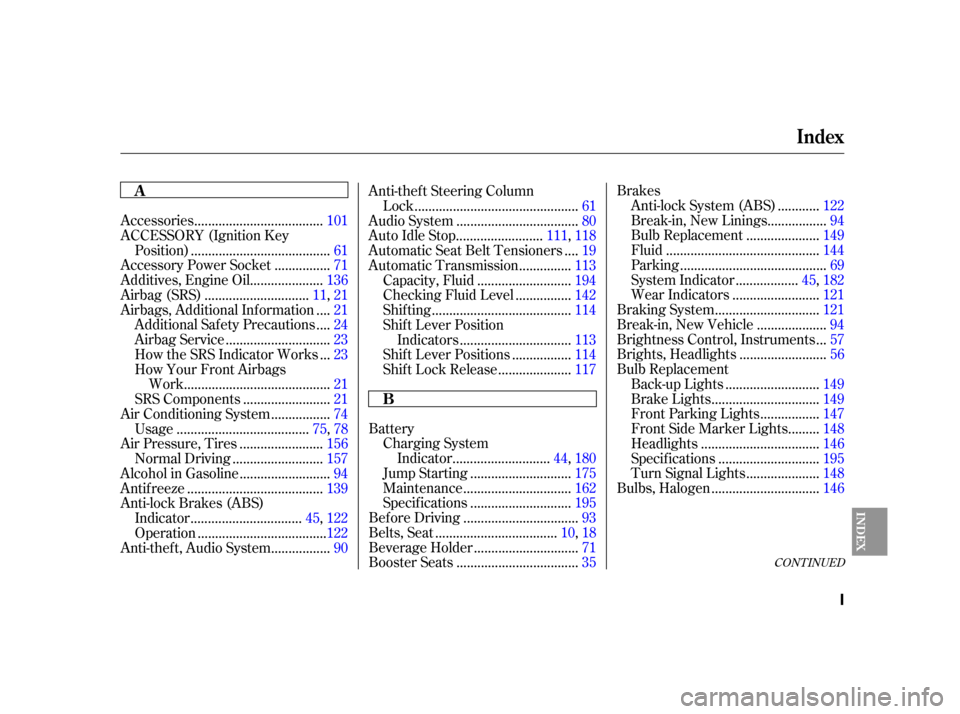
BatteryCharging System ...........................
Indicator .44, 180
............................
Jump Starting .175
..............................
Maintenance .162
............................
Specif ications .195
................................
Bef ore Driving .93
..................................
Belts, Seat .10, 18
.............................
Beverage Holder .71
..................................
Booster Seats .35 Brakes
...........
Anti-lock System (ABS) . 122
................
Break-in, New Linings . 94
....................
Bulb Replacement .149
...........................................
Fluid .144
.........................................
Parking .69
.................
System Indicator . 45,182
........................
Wear Indicators .121
.............................
Braking System .121
...................
Break-in, New Vehicle . 94
..
Brightness Control, Instruments . 57
........................
Brights, Headlights .56
Bulb Replacement ..........................
Back-up Lights .149
..............................
Brake Lights .149
................
Front Parking Lights . 147
........
Front Side Marker Lights . 148
.................................
Headlights .146
............................
Specif ications .195
....................
Turn Signal Lights . 148
..............................
Bulbs, Halogen .146
....................................
Accessories .101
ACCESSORY (Ignition Key .......................................
Position) .61
...............
Accessory Power Socket . 71
....................
Additives, Engine Oil . 136
.............................
Airbag (SRS) .11, 21
...
Airbags, Additional Information . 21
...
Additional Safety Precautions . 24
.............................
Airbag Service .23
..
How the SRS Indicator Works . 23
How Your Front Airbags .........................................
Work .21
........................
SRS Components .21
................
Air Conditioning System . 74
.....................................
Usage .75, 78
.......................
Air Pressure, Tires .156
.........................
Normal Driving .157
.........................
Alcohol in Gasoline .94
......................................
Antif reeze .139
Anti-lock Brakes (ABS) ...............................
Indicator .45, 122
....................................
Operation .122
................
Anti-theft, Audio System . 90Anti-thef t Steering Column
..............................................
Lock .61
..................................
Audio System .80
........................
Auto Idle Stop .111, 118
...
Automatic Seat Belt Tensioners . 19
..............
Automatic Transmission . 113
..........................
Capacity,Fluid .194
...............
Checking Fluid Level . 142
.......................................
Shif ting .114
Shif t Lever Position ...............................
Indicators .113
................
Shif t Lever Positions . 114
....................
Shif t Lock Release . 117
Index
A
B
INDEX
I
Page:
< prev 1-8 9-16 17-24