Page 42 of 205

If you decide that a child can saf ely
ride up f ront, be sure to:Caref ully read the owner’s manual,
and make sure you understand all
seat belt instructions and all saf ety
inf ormation.
Move the vehicle seat to the rear-
most position.
Have the child sit up straight, back
against the seat, and feet on or
near the f loor. This could result in
serious neck injuries during a crash.
This could cause
very serious injuries during a crash.
It also increases the chance that the
child will slide under the belt in a
crash and be injured.
If they do, they could
be very seriously injured in a crash.
Devices intended to improve a
child’s comf ort or reposition the
shoulder part of a seat belt can make
the belt less ef f ective and increase
the chance of serious injury in a
crash.
Of course, children vary widely. And
while age may be one indicator of
when a child can saf ely ride in the
f ront, there are other important
f actors you should consider.
To saf ely ride in f ront, a child must
be able to f ollow the rules, including
sitting properly, and wearing the seat
belt properly throughout a ride.
Physically, a child must be large
enough f or the lap/shoulder belt to
properly f it (see page ). If the seat
belt does not f it properly, with or
without the child sitting on a booster,
the child should not sit in the f ront. Supervise the child. Even mature
children sometimes need to be
reminded to f asten the seat belts
or sit properly.
Check that the child’s seat belt is
properly and securely positioned.
44 Additional Saf ety Precautions
Do not let a child wear a seat belt
across t he neck.
Do not let a child put the shoulderpart of a seat belt behind t he back orunder t he arm.
T wo children should never use t hesame seat belt .
Do not put any accessories on a seatbelt.
Maturity
Physical Size
Protecting L arger Children
46
�����—�����—�
���y�
�������������y���
�(���)�������y���������y
Page 46 of 205
The U.S. instrument panel is shown. Dif f erences f or the Canadian models are noted in thetext.
Instrument Panel Indicators
Inst rument s and Cont rols
51
PARKING BRAKE AND
BRAKE SYSTEM INDICATOR
HATCH-OPEN INDICATOR
CHARGING SYSTEM INDICATOR
LOW OIL PRESSURE
INDICATOR
MALFUNCTION
INDICATOR LAMP
IMMOBILIZER SYSTEM INDICATOR CRUISE CONTROL
INDICATOR
HIGH BEAM INDICATOR
ANTI-LOCK BRAKE SYSTEM INDICATOR ELECTRIC POWER
STEERING INDICATOR
LOW FUEL
INDICATOR
SUPPLEMENTAL
RESTRAINT SYSTEM
INDICATOR
MAINTENANCE
REQUIRED
INDICATOR
(P. 53) (P. 54)
(P. 56) (P. 53)
(P. 54)
(P. 55)
(P. 54)
(P. 52)
(P. 52)
(P. 55)
(P. 53, 179)
(P. 52, 177)
(P. 52, 177)
(P. 53, 178) SIDE AIRBAG OFF
INDICATOR
SEAT BELT REMINDER INDICATOR
(P. 52)
�����—�����—�
���y�
�������������y���
�(���)�������y���������y
Page 47 of 205

The instrument panel has many
indicators to give you important
inf ormation about your vehicle.
This indicator comes on when you
turn the ignition switch to ON (II). It
reminds you and your passengers to
f asten your seat belts. A beeper also
sounds if you have not f astened your
seat belt.
If you turn the ignition switch to ON
(II) bef ore f astening your belt, the
beeper sounds and the indicator
f lashes. If you do not f asten your
seat belt bef ore the beeper stops, the
indicator stops f lashing but remainson.
If you continue driving without
f astening your seat belt, the beeper
sounds and the indicator f lashes
again at regular intervals.This indicator comes on when you
turn the ignition switch to ON (II). If
it comes on at any other time, it
indicates a potential problem with
your f ront airbags or automatic seat
belt tensioners. On models equipped
with side airbags, this indicator will
also alert you to a potential problem
with your side airbags or passenger’s
side airbag automatic cutoff system.
For more inf ormation, see page .
This indicator comes on when you
turn the ignition switch to ON (II). If
it comes on at any other time, it
indicates that the passenger’s side
airbag has automatically shut off.
For more inf ormation, see page .
The engine can be severely damaged
if this indicator f lashes or stays on
when the engine is running. For
more inf ormation, see page .
If this indicator comes on when the
engine is running, the battery is not
being charged. For more inf ormation,
see page .
See page .
177 177 27
178
27
If equipped
Seat Belt Reminder
Indicator Supplemental Restraint
System Indicator
Side Airbag Of f Indicator
L ow Oil Pressure
Indicator
Charging System
Indicator
Malf unction Indicator
Lamp
Instrument Panel Indicators
52
�����—�����—�
���y�
�������������y���
�(���)�������y���������y
Page 68 of 205
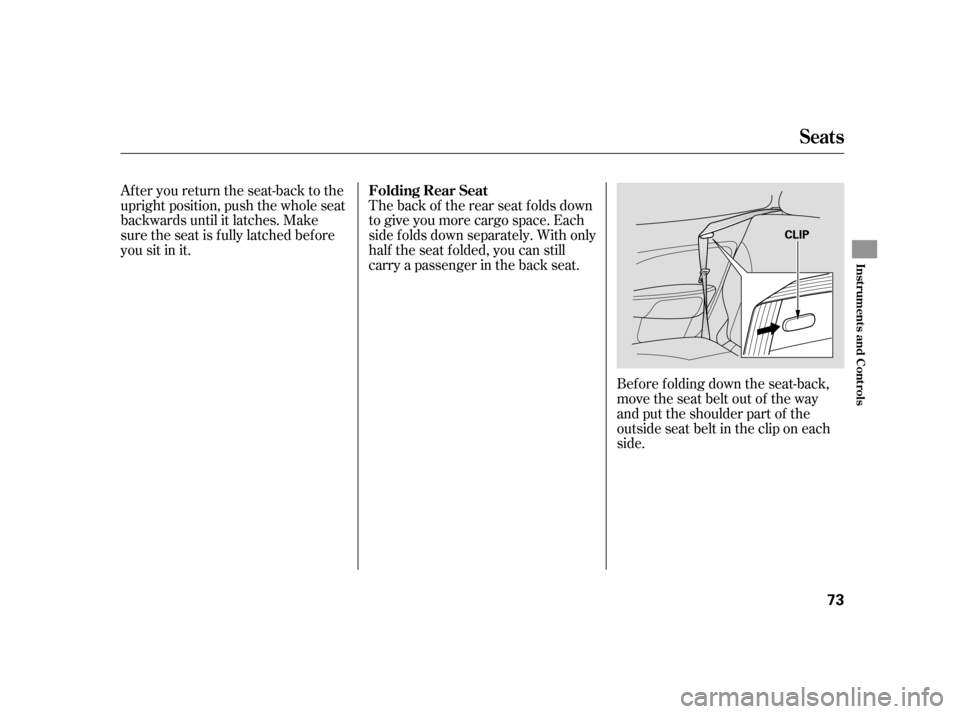
The back of the rear seat folds down
to give you more cargo space. Each
side f olds down separately. With only
half the seat f olded, you can still
carry a passenger in the back seat.Beforefoldingdowntheseat-back,
move the seat belt out of the way
and put the shoulder part of the
outside seat belt in the clip on each
side.
After you return the seat-back to the
upright position, push the whole seat
backwards until it latches. Make
sure the seat is f ully latched bef ore
you sit in it.
Seats
Folding Rear Seat
Inst rument s and Cont rols
73
CLIP
�����—�����—�
���y�
�������������y���
�(���)�������y���������y
Page 69 of 205
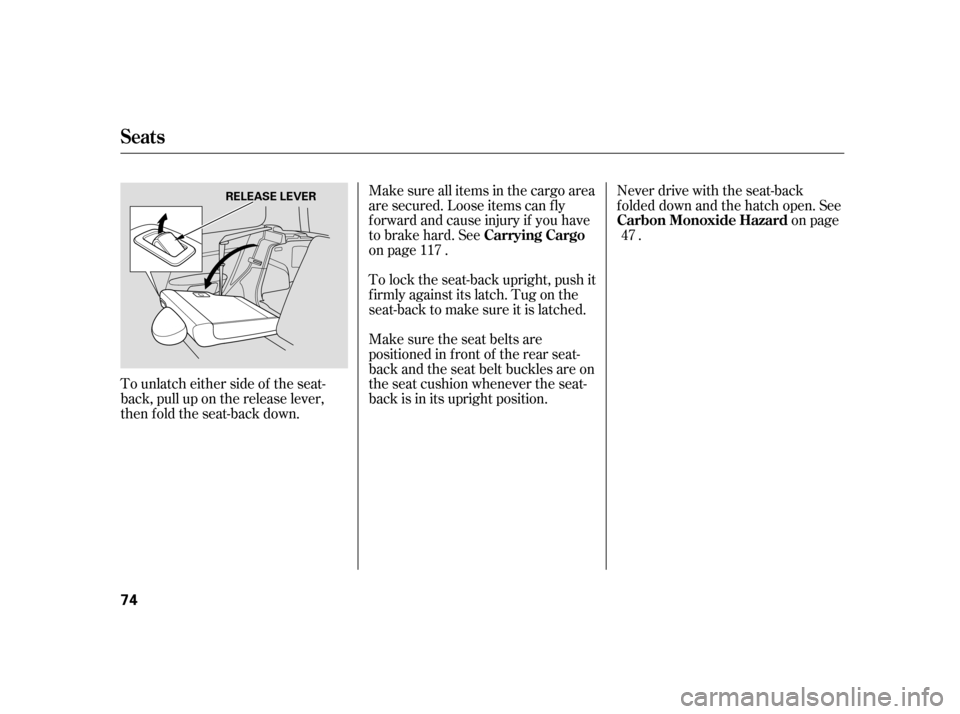
To unlatch either side of the seat-
back, pull up on the release lever,
then fold the seat-back down.Never drive with the seat-back
f olded down and the hatch open. See
on page
.
Make sure all items in the cargo area
are secured. Loose items can f ly
f orward and cause injury if you have
to brake hard. See
on page .
To lock the seat-back upright, push it
firmly against its latch. Tug on the
seat-back to make sure it is latched.
Make sure the seat belts are
positioned in f ront of the rear seat-
back and the seat belt buckles are on
the seat cushion whenever the seat-
back is in its upright position. 47
117
Seats
Carbon Monoxide Hazard
Carrying Cargo
74 RELEASE LEVER
�����—�����—�
���y�
�������������y���
�(���)�������y���������y
Page 78 of 205
Open the glove box by squeezing the
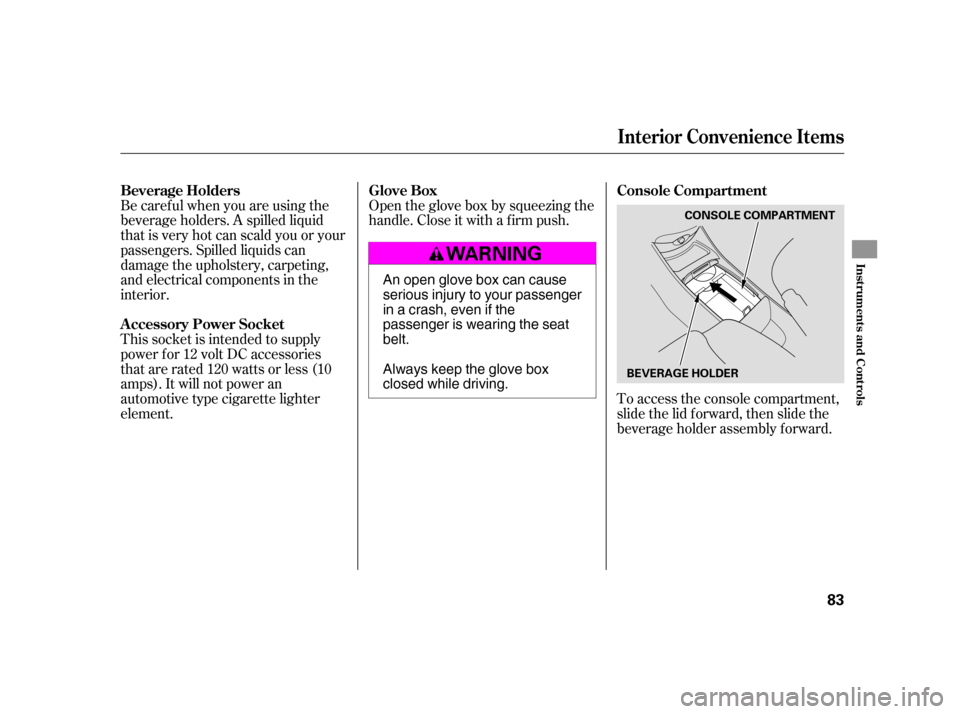
handle. Close it with a f irm push.To access the console compartment,
slide the lid f orward, then slide the
beverage holder assembly forward.
Be caref ul when you are using the
beverage holders. A spilled liquid
that is very hot can scald you or your
passengers. Spilled liquids can
damage the upholstery, carpeting,
and electrical components in the
interior.
This socket is intended to supply
power f or 12 volt DC accessories
that are rated 120 watts or less (10
amps). It will not power an
automotive type cigarette lighter
element. Glove Box Console Compartment
Beverage Holders
A ccessory Power Socket
Interior Convenience Items
Inst rument s and Cont rols
83
CONSOLE COMPARTMENT
BEVERAGE HOLDER
An open glove box can cause
serious injury to your passenger
inacrash,evenifthe
passenger is wearing the seatbelt.
Always keep the glove box
closed while driving.
�����—�����—�
���y�
�������������y���
�(���)�������y���������y
Page 114 of 205
Make sure all windows, mirrors,
and outside lights are clean and
unobstructed. Remove f rost, snow,
or ice.Check the seat adjustment (see
page ).
Check the adjustment of the
inside and outside mirrors (see
page ).
Check the steering wheel
adjustment (see page ).
Make sure the doors and the
hatch are securely closed and
locked.When you start the engine, check
the gauges and indicator lights in the
instrument panel (see page ).
Fasten your seat belt. Check that
your passengers have f astened
their seat belts (see page ).
Youshoulddothefollowingchecks
and adjustments bef ore you drive
your vehicle.
Check that the hood is f ully closed.
Check that the hatch is f ully
closed.
Visually check the tires. If a tire
looks low, use a gauge to check its
pressure.
Check that any items you may be
carrying are stored properly or
f astened down securely.
1. 2. 3. 4. 5. 6. 7. 8. 9.
71
63 51
79
10. 16
Preparing to Drive
122
�����—�����—�
���y�
����
��������y���
�(���)�������y���
�����y
Page 124 of 205

�Ì�Ì
�Ì Follow the Normal Maintenance
Schedule if the severe driving
conditions specif ied in the Severe
Conditions Maintenance Schedule on
the next page do not apply.
NOT E: If you only OCCASIONALLY
drive under a ‘‘severe’’ condition, you
should f ollow the Normal Conditions
Maintenance Schedule.
133
miles x 1,000
km x 1,000
Service the items listed at the indicated distance (or time, if given).
Every 10,000 miles (16,000 km)
((OOrreevveerryy11yyeeaarr,,wwhhiicchheevveerrccoommeessffiirrsstt))
Check inflation and condition once a monthCheck oil and coolant at each fuel stop
10 16
203230484064 5080609670
112 80
128 100160
90
144
((OOrreevveerryy22yyeeaarrss,,wwhhiicchheevveerrccoommeessffiirrsstt))
130 208 140224 150240
((OOrreevveerryy11yyeeaarr,,wwhhiicchheevveerrccoommeessffiirrsstt))
((OOrreevveerryy66yyeeaarrss,,wwhhiicchheevveerrccoommeessffiirrsstt))Every 160,000 miles (256,000 km) 120 192
120,000 miles (192,000 km) or 10 years, then every 60,000 miles (96,000 km) or 5 years
Every 3 years (independent of mileage) 110176
((OOtthheerrwwiisseeaaddjjuussttoonnllyyiiffnnooiissyy))
See information on maintenance and emissions warranty on page .
Check engine oil and coolant
Check tires
Replace engine oil
Rotate tires (follow pattern on page 160)
Replace engine oil filter
Check front and rear brakes
Check parking brake adjustment
Inspect the following items:
Tie rod ends, steering gear box, and boots
Suspension components
Driveshaft boots
Brake hoses and lines (including ABS)
All fluid levels and condition of fluids
Exhaust system
Fuel lines and connections
Inspect drive belts
Replace Dust and Pollen Filter
Replace air cleaner element
Replace spark plugs
Inspect valve clearance
Replace manual transmission fluid
Inspect idle speed
Replace engine coolant
Replace brake fluid
: 132
Maintenance Schedule for Normal Conditions
�����—�����—�
���y�
����
������
�y���
�(���)�������y���
�����y