Page 141 of 205
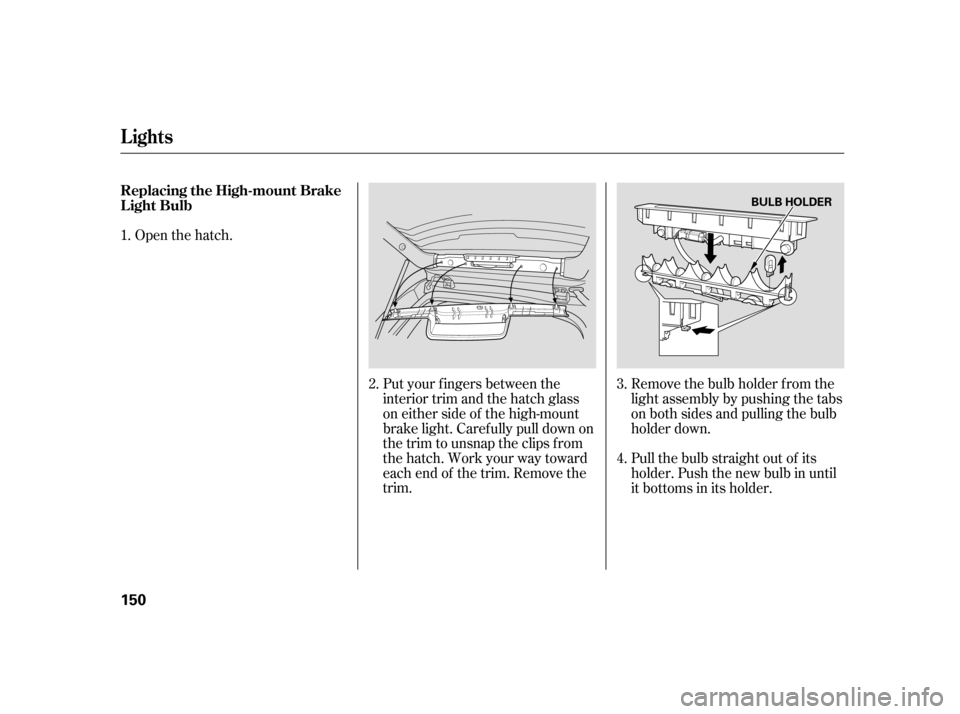
Open the hatch.Put your fingers between the
interior trim and the hatch glass
on either side of the high-mount
brake light. Caref ully pull down on
the trim to unsnap the clips f rom
the hatch. Work your way toward
each end of the trim. Remove the
trim.Remove the bulb holder f rom the
light assembly by pushing the tabs
on both sides and pulling the bulb
holder down.
Pull the bulb straight out of its
holder. Push the new bulb in until
it bottoms in its holder.
1.
3.
2.
4.
Lights
Replacing the High-mount Brake
Light Bulb 150 BULB HOLDER
�����—�����—�
���y�
������
��
���y���
�(���)�������y���
�����y
Page 152 of 205

�´When installing cables, f ollow the
manuf acturer’s instructions, and
mount them as tight as you can.
Make sure they are not contacting
the brake lines or suspension. Drive
slowly with them installed. If you
hear them coming into contact with
the body or chassis, stop and
investigate. Remove them as soon as
you begin driving on cleared roads.
Tires marked ‘‘M S’’ or ‘‘All
Season’’ on the sidewall have an all-
weather tread design suitable for
most winter driving conditions.
For the best perf ormance in snowy
or icy conditions, you should install
snow tires or tire chains. They may
be required by local laws under
certain conditions.
If you mount snow tires on your
vehicle, make sure they are radial
tires of the same size and load range
as original tires. Mount snow tires on
all f our wheels. The traction
provided by snow tires on dry roads
maybelowerthanyouroriginaltires.
Check with the tire dealer f or
maximum speed recommendations. Because your vehicle has limited tire
clearance, mount only SAE Class ‘‘S’’
cable-type traction devices, with
rubber chain tensioners on the f ront
tires. Use traction devices only when
required by driving conditions or
local laws. Make sure they are the
correct size f or your tires. Make link-
type ‘‘chains’’ should not be used.
Tire Chains
Winter Driving
Snow T ires
Tires
Maint enance
161
Traction devices that are the wrong
size or improperly installed can
damage your vehicle’s brake lines,
suspension, body, and wheels. Stop
driving if they are hitting any part of
the vehicle.
�����—�����—�
���y�
�����������
�y���
�(���)�������y���
�����y
Page 154 of 205

If you need to park your vehicle f or
an extended period (more than one
month), there are several things you
should do to prepare it f or storage.
Proper preparation helps prevent
deterioration and makes it easier to
get your vehicle back on the road. If
possible, store your vehicle indoors.Fill the f uel tank.
Change the engine oil and f ilter. Block the rear wheels.
If the vehicle is to be stored f or a
longer period, it should be
supported on jackstands so the
tires are of f the ground.
Leave one window open slightly (if
the vehicle is being stored
indoors).
Cover the vehicle with a
‘‘breathable’’ cover, one made
f rom a porous material such as
cotton. Non-porous materials, such
as plastic sheeting, trap moisture,
which can damage the paint.
Wash and dry the exterior
completely.
Cleantheinterior.Makesurethe
carpeting, floor mats, etc., are
completely dry.
Leave the parking brake off. Put
the transmission in Reverse. Support the f ront and rear wiper
blade arms with a f olded towel or
ragsotheydonottouchthe
windshield.
Disconnect the battery.
To minimize sticking, apply a
silicone spray lubricant to all door
and hatch seals. Also, apply a
vehiclebodywaxtothepainted
surfaces that mate with the door
and hatch seals. If you store your vehicle f or 12
months or longer, have your dealer
perf orm the inspections called f or in
the 24 months/30,000 miles
(48,000 km) maintenance schedule
(Normal Conditions) as soon as you
take it out of storage (see page ).
The replacements called f or in the
maintenance schedule are not
needed unless the vehicle has
actually reached that time or mileage.If possible, periodically run the
engine until it reaches f ull
operating temperature (the
cooling f an cycles twice).
Pref erably, do this once a month.
133
Vehicle Storage
Maint enance
163
�����—�����—�
���y�
�������������y���
�(���)�������y���
�����y
Page 157 of 205
CONT INUED
If you have a f lat tire while driving,
stop in a saf e place to change it.
Drive slowly along the shoulder until
you get to an exit or an area to stop
that is far away from the traffic lanes.Park the vehicle on f irm, level, and
non-slippery ground. Put the
transmission in Reverse. Apply the
parking brake.
Turn on the hazard warning lights,
and turn the ignition switch to
LOCK (0). Have all the
passengers get out of the vehicle
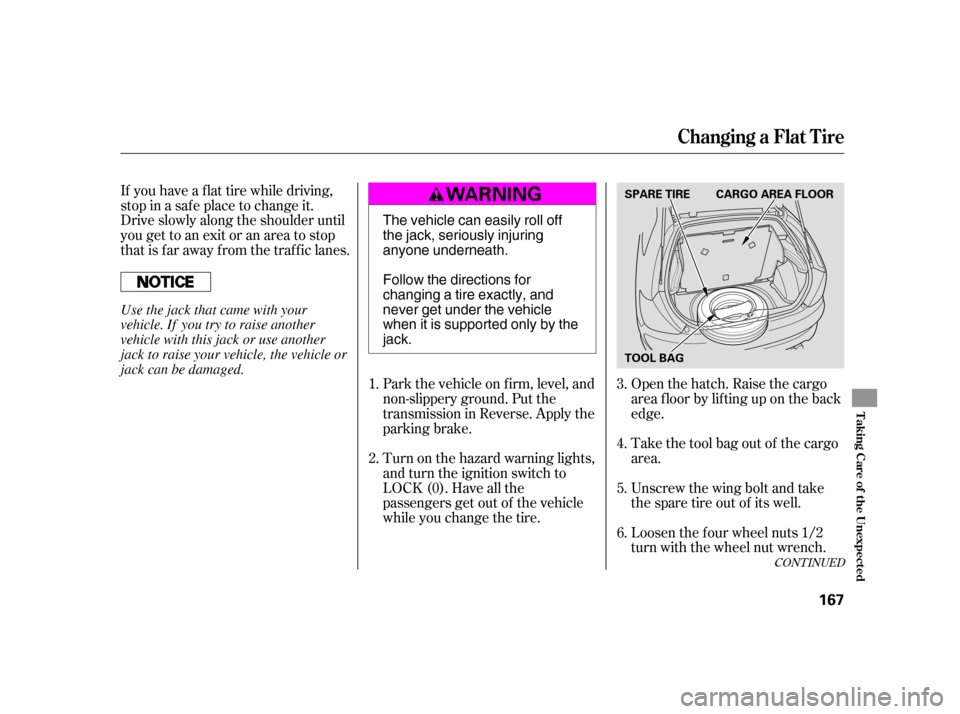
while you change the tire.Open the hatch. Raise the cargo
area floor by lifting up on the back
edge.
Take the tool bag out of the cargo
area.
Unscrew the wing bolt and take
the spare tire out of its well.
Loosen the f our wheel nuts 1/2
turn with the wheel nut wrench.
2.
3.
1.
4. 5.6.
Changing a Flat T ire
T aking Care of t he Unexpect ed
167
SPARE TIRE CARGO AREA FLOOR
TOOL BAG
The vehicle can easily roll off
the jack, seriously injuring
anyone underneath.
Follow the directions for
changing a tire exactly, and
never get under the vehicle
when it is supported only by thejack.
Use the jack that came with your
vehicle. If you try to raise another
vehicle with this jack or use another
jack to raise your vehicle, the vehicle or
jack can be damaged.
�����—�����—�
���y�
���������
���y���
�(���)�������y���
�����y
Page 158 of 205
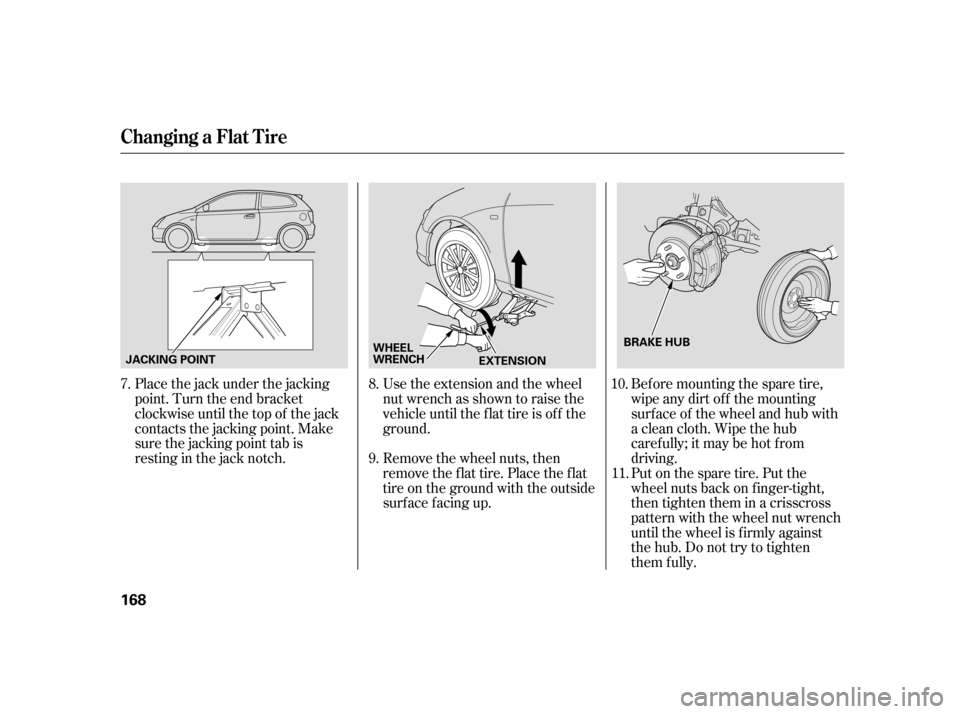
Place the jack under the jacking
point. Turn the end bracket
clockwise until the top of the jack
contacts the jacking point. Make
sure the jacking point tab is
restinginthejacknotch.Use the extension and the wheel
nut wrench as shown to raise the
vehicle until the f lat tire is of f the
ground.
Bef ore mounting the spare tire,
wipeanydirtoff themounting
surface of the wheel and hub with
a clean cloth. Wipe the hub
carefully;itmaybehotfrom
driving.
Put on the spare tire. Put the
wheel nuts back on f inger-tight,
then tighten them in a crisscross
pattern with the wheel nut wrench
until the wheel is f irmly against
the hub. Do not try to tighten
them f ully.
Remove the wheel nuts, then
remove the flat tire. Place the flat
tire on the ground with the outside
surface facing up.
7.
8. 9.10.
11.
Changing a Flat T ire
168 JACKING POINT
WHEEL
WRENCH
EXTENSION BRAKE HUB
�����—�����—�
���y�
�������������y���
�(���)�������y���
���
�y
Page 163 of 205

�µ
�´ �´
Although this seems like a simple
procedure, you should take several
precautions.
Connect the second jumper cable
to the negative ( ) terminal on
the booster battery. Connect the
other end to the grounding strap
as shown. Do not connect this
jumper cable to any other part of
the engine.
Connect one jumper cable to the
positive ( ) terminal on your
battery. Connect the other end to
the positive ( ) terminal on the
booster battery.
Turn of f all the electrical
accessories: heater, A/C, stereo
system, lights, etc. Put the
transmission in Neutral and set
the parking brake.
Open the hood, and check the
physical condition of the battery.
In very cold weather, check the
condition of the electrolyte. If it
seems slushy or f rozen, do not try
jump starting until it thaws.
To jump start your vehicle:1. 2. 3. 4.
Jump Starting
T aking Care of t he Unexpect ed
173
A battery can explode if you do
not follow the correct procedure,
seriously injuring anyonenearby.
Keep all sparks, open flames,
and smoking materials away
from the battery.
If a battery sits in extreme cold, the
electrolyte inside can f reeze.
Attempting to jump start with a f rozen
battery can cause it to rupture.
�����—�����—�
���y�
�������������y���
�(���)�������y���
�����y
Page 165 of 205

Look f or any obvious coolant leaks,
such as a split radiator hose.
Everything is still extremely hot,
so use caution. If you f ind a leak, it
must be repaired bef ore you
continue driving (seeon page ).
If you do not f ind an obvious leak,
check the coolant level in the
radiator reserve tank. Add coolant
if the level is below the MIN mark.
If you do not see steam or spray,
leave the engine running, and
watch the temperature gauge. If
the high heat is due to overloading,
the engine should start to cool
down almost immediately. If it
does, wait until the temperature
gauge comes down to the midpoint,
then continue driving.
If you see steam and/or spray
coming f rom under the hood, turn
of f the engine. Wait until you see
no more signs of steam or spray,
then open the hood.
If the temperature gauge stays at
the red mark, turn of f the engine.
Saf ely pull to the side of the road.
Put the transmission in Neutral,
and set the parking brake. Turn
of f the all accessories, and turn on
the hazard warning indicators.
1. 2.3. 4. 5. 6.
186
Emergency
Towing
If theEngineOverheats
T aking Care of t he Unexpect ed
175
Steam and spray from an
overheated engine can
seriously scald you.
Do not open the hood if steam
is coming out.
�����—�����—�
���y�
�������������y���
�(���)�������y���
�����y
Page 169 of 205

However, if the brake pedal does not
f eel normal, you should take
immediate action. A problem in one
part of the system’s dual circuit
design will still give you braking at
two wheels. You will f eel the brake
pedal go down much f arther bef ore
the vehicle begins to slow down, and
you will have to press harder on the
pedal.
Slow down by shif ting to a lower
gear, and pull to the side of the road
when it is saf e. Because of the long
distance needed to stop, it is
hazardous to drive the vehicle. You
should have it towed and repaired as
soon as possible (seeon page ).
If you must drive the vehicle a short
distance in this condition, drive
slowly and caref ully.
If the brake system indicator comes
on while driving, the brake f luid level
is probably low. Press lightly on the
brake pedal to see if it f eels normal.
If it does, check the brake f luid level
thenexttimeyoustopataservice
station (see page ).
If the f luid level is low, take your
vehicle to a dealer, and have the
brake system inspected f or leaks or
worn brake pads. The brake system indicator
normally comes on when
you turn the ignition switch
to ON (II), and as a
reminder to check the
parking brake. It will stay
on if you do not f ully
release the parking brake.
144 186Emergency
Towing
Brake System Indicator
T aking Care of t he Unexpect ed
179
Canada
U.S.
�����—�����—�
���y�
�������������y���
�(���)�������y���
�����y