Page 50 of 205

This indicator normally comes on
when you turn the ignition to ON (II)
and goes off after the engine starts.
If it comes on at any other time,
there is a problem in the Electric
Power Steering system. If this
happens, stop the vehicle in a saf e
place and turn of f the engine. Reset
the system by restarting the engine.
The indicator will not turn of f
immediately. If it does not go of f
after driving a short distance, or
comes back on again while driving,
take the vehicle to your dealer to
have it checked. With the indicator
on, the EPS may be turned of f ,
making the vehicle harder to steer.
If the power steering system
overheats while driving, the assisting
power is reduced and steering may
f eel slightly harder.This indicator also blinks several
times when you turn the ignition
switch f rom ON (II) to ACCESSORY
(I) or LOCK (0).
This indicator comes on f or a f ew
seconds when you turn the ignition
switch to ON (II). It will then go of f
if you have inserted a properly-coded
ignition key. If it is not a properly-
coded key, the indicator will blink,
and the engine will not start (see
page ).
65
Electric Power Steering
(EPS) Indicator
Immobilizer System
Indicator
Instrument Panel Indicators
Inst rument s and Cont rols
55
�����—�����—�
���y�
�������������y���
�(���)�������y���������y
Page 54 of 205
�Î
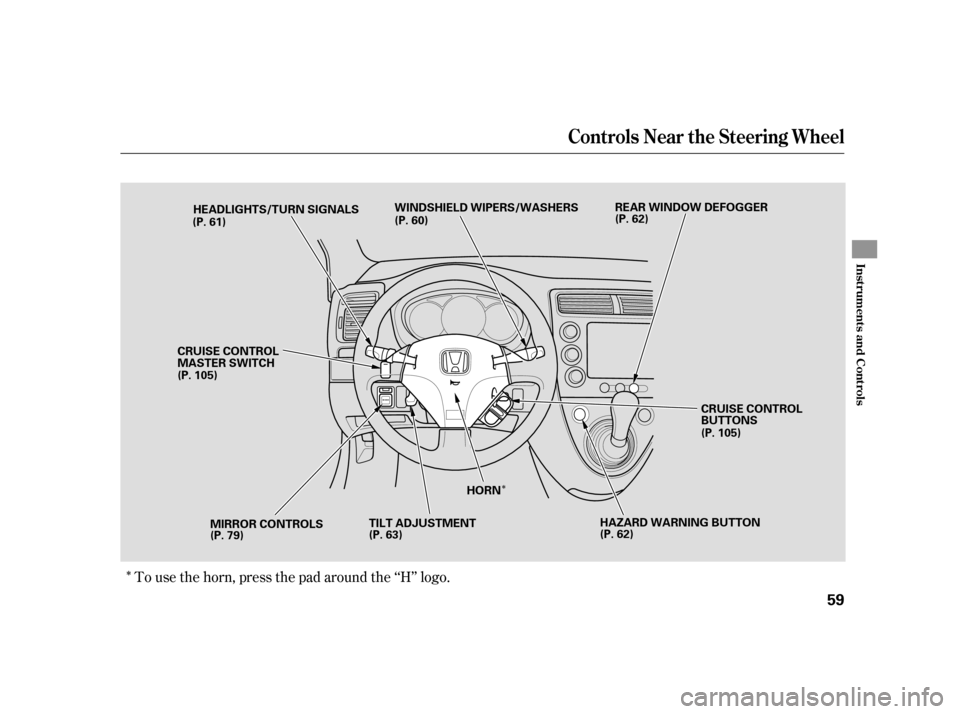
�Î To use the horn, press the pad around the ‘‘H’’ logo.
Controls Near the Steering Wheel
Inst rument s and Cont rols
59
REAR WINDOW DEFOGGER
MIRROR CONTROLS TILT ADJUSTMENTHORN
HEADLIGHTS/TURN SIGNALS
WINDSHIELD WIPERS/WASHERS
(P. 61) (P. 60)
(P. 62)
(P. 105)
(P. 79) (P. 63)
(P. 62)
CRUISE CONTROL
MASTER SWITCH
(P. 105)
HAZARD WARNING BUTTONCRUISE CONTROL
BUTTONS
�����—�����—�
���y�
���������
���y���
�(���)�������y���������y
Page 58 of 205

Make sure the rear window is clear
and you have good visibility bef ore
starting to drive.
Thedefoggerwiresontheinsideof
the rear window can be accidentally
damaged. When cleaning the glass,
always wipe side-to-side.Push the lever up to lock the
steering wheel in that position.
Make sure you have securely
locked the steering wheel in place
by trying to move it up and down.
Move the steering wheel up or
down to the desired position.
Make sure you can see the
instrument panel gauges and the
indicators.
Make any steering wheel adjustment
bef ore you start driving.
To adjust the steering wheel upward
or downward:
Push the lever under the steering
column all the way down.
1.
4.
3.
2.
Rear Window Def ogger, Steering Wheel A djustment
Steering Wheel A djustment
Inst rument s and Cont rols
63
Adjusting the steering wheel
position while driving may
cause you to lose control of the
vehicle and be seriously injured
inacrash.
Adjust the steering wheel only
when the vehicle is stopped.
�����—�����—�
���y�
�������������y���
�(���)�������y���������y
Page 61 of 205
�µ
�µ
�µ �µ
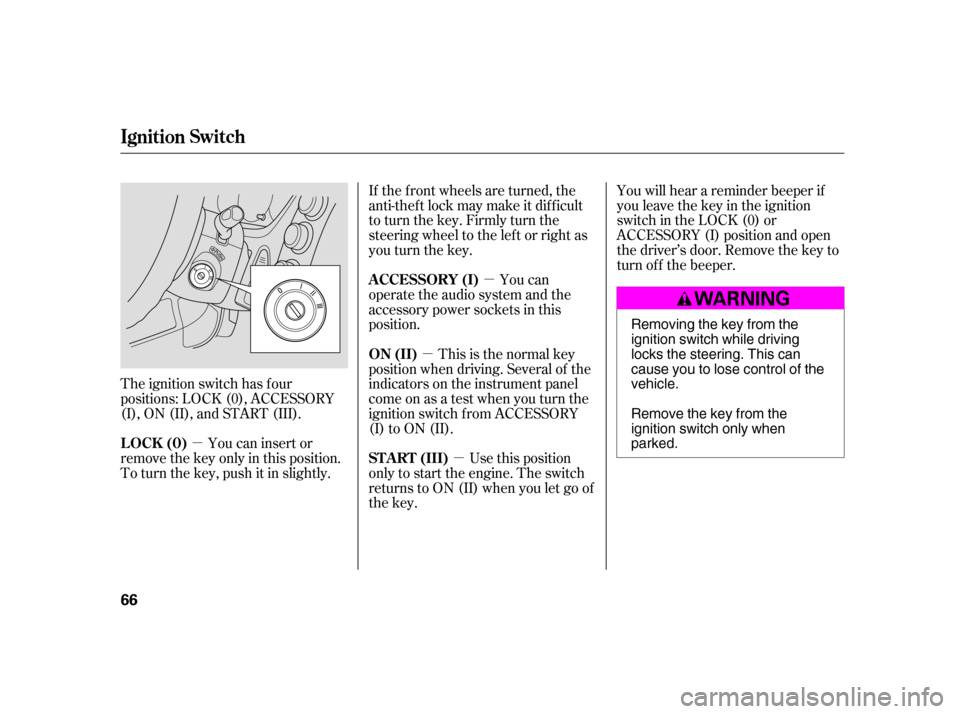
The ignition switch has f our
positions: LOCK (0), ACCESSORY
(I), ON (II), and START (III). If the f ront wheels are turned, the
anti-thef t lock may make it dif f icult
to turn the key. Firmly turn the
steering wheel to the lef t or right as
you turn the key.
You can
operate the audio system and the
accessory power sockets in this
position.
Use this position
only to start the engine. The switch
returns to ON (II) when you let go of
the key. You will hear a reminder beeper if
you leave the key in the ignition
switch in the LOCK (0) or
ACCESSORY (I) position and open
thedriver’sdoor.Removethekeyto
turn of f the beeper.
You can insert or
remove the key only in this position.
To turn the key, push it in slightly. This is the normal key
position when driving. Several of the
indicators on the instrument panel
come on as a test when you turn the
ignition switch f rom ACCESSORY
(I) to ON (II).
A CCESSORY (I)
ST A RT (III)
LOCK (0) ON (II)
Ignition Switch
66 Removing the key from the
ignition switch while driving
locks the steering. This can
cause you to lose control of thevehicle.
Remove the key from the
ignition switch only whenparked.
�����—�����—�
���y�
�������������y���
�(���)�������y���������y
Page 99 of 205
Cruise control allows you to maintain
asetspeedabove25mph(40km/h)
without keeping your f oot on the
accelerator pedal. It should be used
f or cruising on straight, open
highways. It is not recommended f or
city driving, winding roads, slippery
roads, heavy rain, or bad weather.Accelerate to the desired cruising
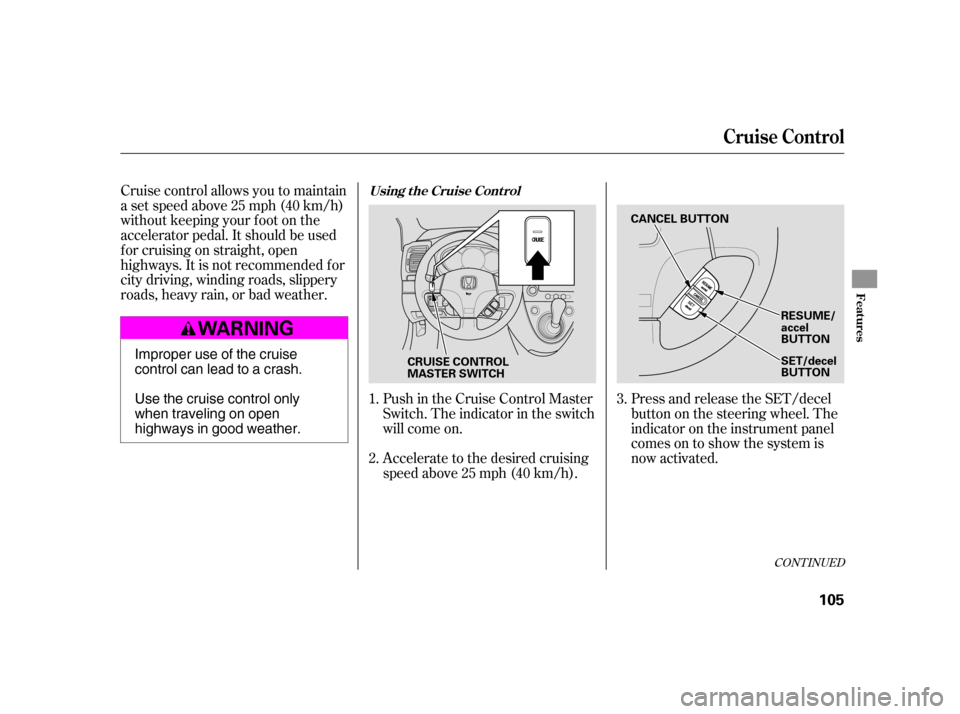
speedabove25mph(40km/h).Press and release the SET/decel
buttononthesteeringwheel.The
indicator on the instrument panel
comes on to show the system is
now activated.
Push in the Cruise Control Master
Switch. The indicator in the switch
will come on.
1. 2. 3.
CONT INUED
Cruise Control
Using t he Cruise Cont rol
Features
105
RESUME/ accel
BUTTON
SET/decel
BUTTON
CANCEL BUTTON
CRUISE CONTROL
MASTER SWITCH
Improper use of the cruise
control can lead to a crash.
Use the cruise control only
when traveling on open
highways in good weather.
�����—�����—�
���y�
����
����
���y���
�(���)�������y���
�����y
Page 101 of 205

Even with the cruise control turned
on, you can still use the accelerator
pedal to speed up f or passing. Af ter
completing the pass, take your foot
of f the accelerator pedal. The vehicle
will return to the set cruising speed.
Resting your f oot on the brake or
clutch pedal causes the cruise
control to cancel.Youcancancelthecruisecontrolin
any of these ways:
Tap the brake or clutch pedal.
Push the CANCEL button on the
steering wheel.
Push the Cruise Control Master
Switch. When you push the CANCEL
button, or tap the brake or clutch
pedal, the system remembers the
previously-set cruising speed. To
return to that speed, accelerate to
above25mph(40km/h)andthen
press and release the RESUME/
accel button. The CRUISE
CONTROL indicator comes on.
The vehicle will accelerate to the
same cruising speed as bef ore.
Pressing the Cruise Control Master
Switch turns the system completely
of f and erases the previous cruising
speed.
Cruise Control
Cancelling t he Cruise Cont rolResuming the Set Speed
Features
107
�����—�����—�
���y�
����
��������y���
�(���)�������y���
�
���y
Page 109 of 205

Some examples are:If you plan to modif y your vehicle,
consult your dealer.
Removing parts f rom your vehicle,
or replacing components with
non-Honda components could
seriously af f ect your vehicle’s
handling, stability, and reliability.
Lowering your vehicle with a
non-Honda suspension kit that
signif icantly reduces ground
clearance can allow the
undercarriage to hit speed bumps
or other raised objects, which
could cause the airbags to deploy.
Raising your vehicle with a
non-Honda suspension kit can
af f ect the handling and stability.
Non-Honda wheels, because they
are a universal design, can cause
excessive stress on suspension
components. Larger or smaller wheels and tires
can interf ere with the operation of
your vehicle’s anti-lock brakes and
other systems.
Modif ying your steering wheel or
any other part of your vehicle’s
saf ety systems could make the
systems inef f ective.
Modif ying Your Vehicle
A ccessories and Modif ications
116
�����—�����—�
���y�
����
��������y���
�(���)�������y���
�
���y
Page 114 of 205
Make sure all windows, mirrors,
and outside lights are clean and
unobstructed. Remove f rost, snow,
or ice.Check the seat adjustment (see
page ).
Check the adjustment of the
inside and outside mirrors (see
page ).
Check the steering wheel
adjustment (see page ).
Make sure the doors and the
hatch are securely closed and
locked.When you start the engine, check
the gauges and indicator lights in the
instrument panel (see page ).
Fasten your seat belt. Check that
your passengers have f astened
their seat belts (see page ).
Youshoulddothefollowingchecks
and adjustments bef ore you drive
your vehicle.
Check that the hood is f ully closed.
Check that the hatch is f ully
closed.
Visually check the tires. If a tire
looks low, use a gauge to check its
pressure.
Check that any items you may be
carrying are stored properly or
f astened down securely.
1. 2. 3. 4. 5. 6. 7. 8. 9.
71
63 51
79
10. 16
Preparing to Drive
122
�����—�����—�
���y�
����
��������y���
�(���)�������y���
�����y