Page 35 of 205
Whatever type you have, f ollow
the child seat maker’s instructions
f or adjusting or tightening the f it.Lif t the rear head restraint (see
page ), then route the tether
strap over the seat-back between
the legs of the head restraint,
making sure the strap is not
twisted.
Attach the tether strap hook to the
tether anchor, then tighten the
strap as instructed by the child
seat maker.Pushandpullthechildseat
f orward and f rom side to side to
verif y that it is secure.
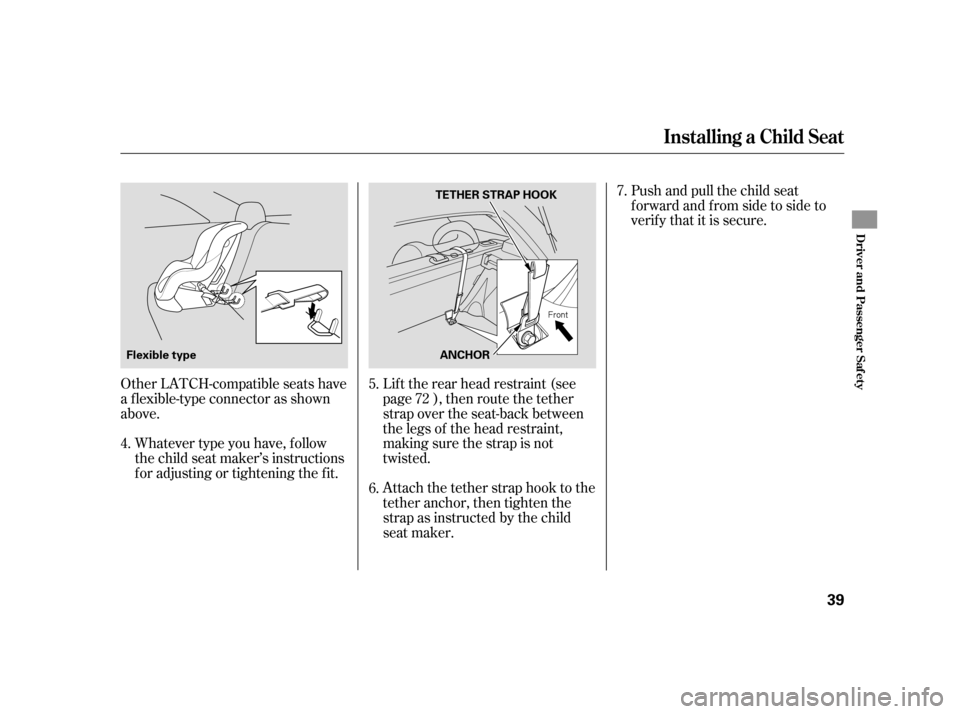
Other LATCH-compatible seats have
a f lexible-type connector as shown
above. 6.
5.
4. 7.
72
Installing a Child Seat
Driver and Passenger Saf ety
39
Flexible type
TETHER STRAP HOOK
ANCHOR
�����—�����—�
���y�
�������������y���
�(���)�������y���������y
Page 36 of 205
When not using the LATCH system,
all child seats must be secured to the
vehicle with the lap part of a lap/
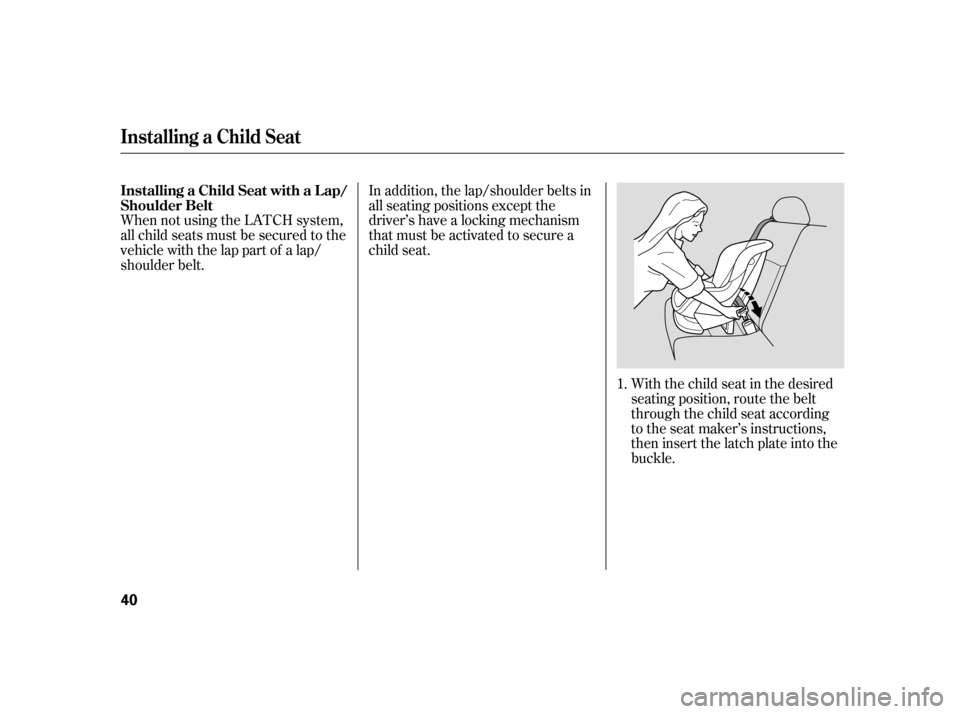
shoulder belt.With the child seat in the desired
seating position, route the belt
through the child seat according
to the seat maker’s instructions,
then insert the latch plate into the
buckle.
In addition, the lap/shoulder belts in
all seating positions except the
driver’s have a locking mechanism
that must be activated to secure a
child seat.
1.
Installing a Child Seat
Installing a Child Seat with a L ap/
Shoulder Belt 40
�����—�����—�
���y�
�������������y���
�(���)�������y���������y
Page 37 of 205
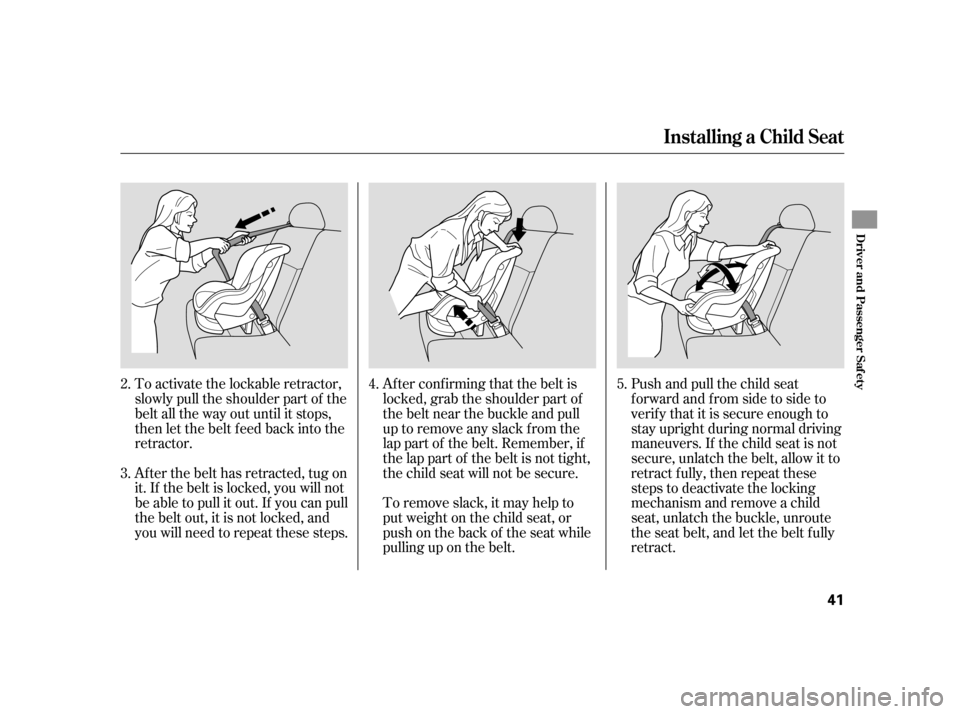
To activate the lockable retractor,
slowly pull the shoulder part of the
belt all the way out until it stops,
then let the belt f eed back into the
retractor.
Af ter the belt has retracted, tug on
it. If the belt is locked, you will not
be able to pull it out. If you can pull
thebeltout,itisnotlocked,and
you will need to repeat these steps.Af ter conf irming that the belt is
locked, grab the shoulder part of
the belt near the buckle and pull
up to remove any slack from the
lap part of the belt. Remember, if
the lap part of the belt is not tight,
the child seat will not be secure.
To remove slack, it may help to
putweightonthechildseat,or
push on the back of the seat while
pulling up on the belt.Pushandpullthechildseat
f orward and f rom side to side to
verif y that it is secure enough to
stay upright during normal driving
maneuvers. If the child seat is not
secure, unlatch the belt, allow it to
retract f ully, then repeat these
steps to deactivate the locking
mechanism and remove a child
seat, unlatch the buckle, unroute
the seat belt, and let the belt f ully
retract.
2. 3.
4.
5.
Installing a Child Seat
Driver and Passenger Saf ety
41
�����—�����—�
���y�
�������������y���
�(���)�������y���������y
Page 38 of 205
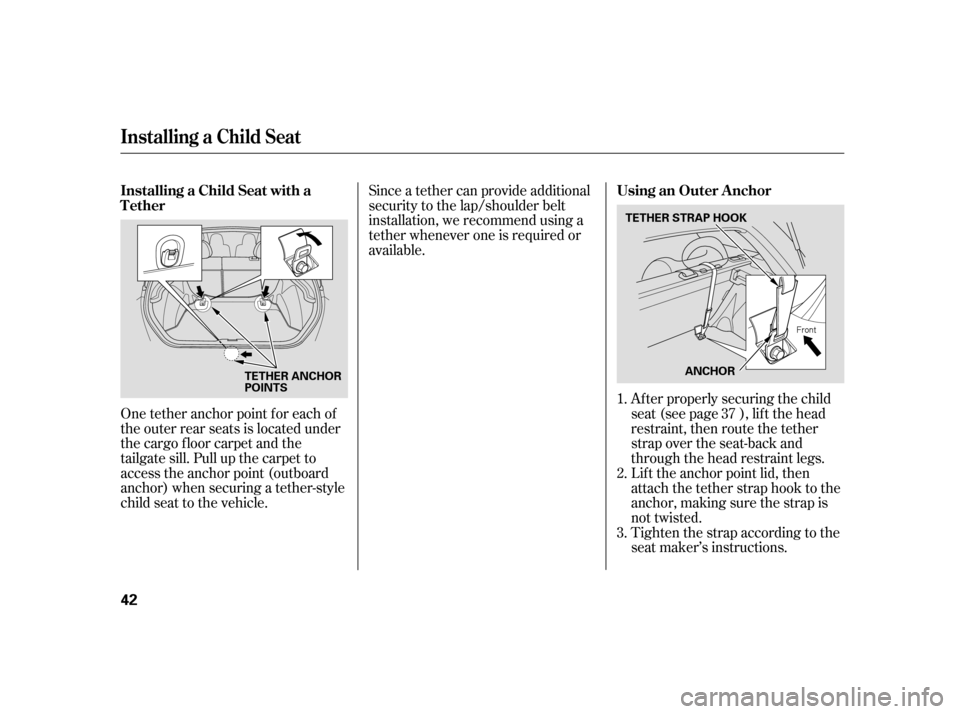
Onetetheranchorpointforeachof
the outer rear seats is located under
the cargo f loor carpet and the
tailgate sill. Pull up the carpet to
access the anchor point (outboard
anchor) when securing a tether-style
child seat to the vehicle.Since a tether can provide additional
security to the lap/shoulder belt
installation, we recommend using a
tether whenever one is required or
available.
Af ter properly securing the child
seat (see page ), lif t the head
restraint, then route the tether
strap over the seat-back and
through the head restraint legs.
Lif t the anchor point lid, then
attach the tether strap hook to the
anchor, making sure the strap is
not twisted.
Tighten the strap according to the
seat maker’s instructions.
2. 3.
1.
37
Installing a Child Seat
Installing a Child Seat with a
Tether Using an Outer A nchor
42 TETHER STRAP HOOK
TETHER ANCHOR
POINTS ANCHOR
�����—�����—�
���y�
���������
���y���
�(���)�������y���������y
Page 39 of 205
When a child reaches the
recommended weight or height limit
for a forward-facing child seat, the
child should sit in a back seat on a
booster seat and wear a lap/shoulder
belt.
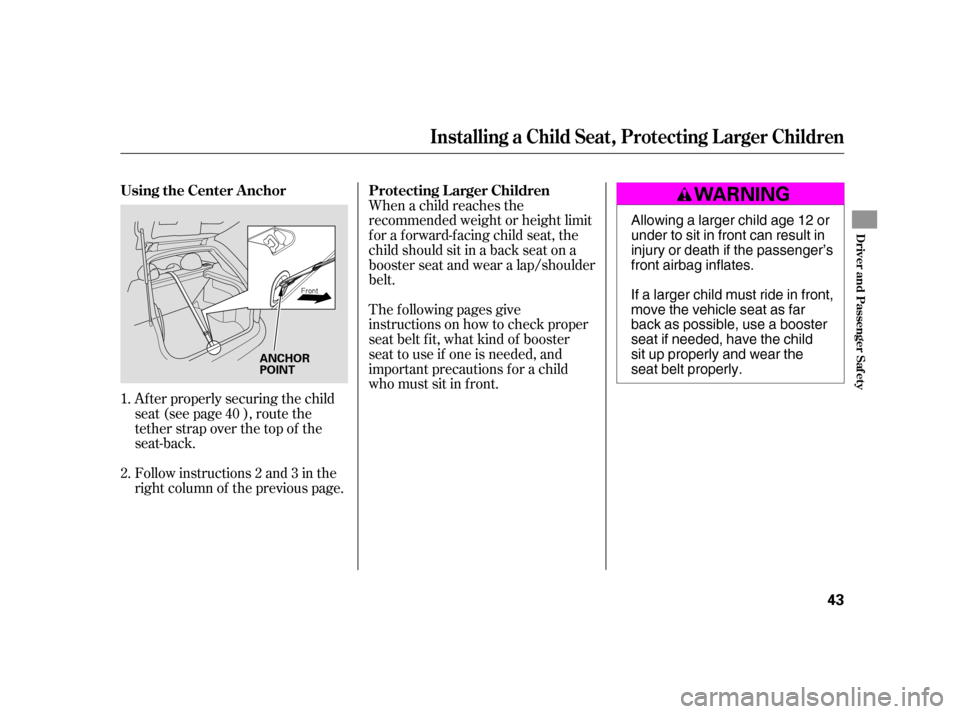
Af ter properly securing the child
seat (see page ), route the
tether strap over the top of the
seat-back.
Follow instructions 2 and 3 in the
right column of the previous page. The f ollowing pages give
instructions on how to check proper
seat belt f it, what kind of booster
seat to use if one is needed, and
important precautions f or a child
who must sit in f ront.
1. 2. 40
Installing a Child Seat, Protecting L arger Children
Protecting L arger Children
Using the Center A nchor
Driver and Passenger Saf ety
43
ANCHOR
POINT
Allowing a larger child age 12 or
under to sit in front can result in
injury or death if the passenger’s
front airbag inflates.
If a larger child must ride in front,
move the vehicle seat as far
back as possible, use a booster
seat if needed, have the child
sit up properly and wear the
seat belt properly.
�����—�����—�
���y�
�������������y���
�(���)�������y���������y
Page 42 of 205

If you decide that a child can saf ely
ride up f ront, be sure to:Caref ully read the owner’s manual,
and make sure you understand all
seat belt instructions and all saf ety
inf ormation.
Move the vehicle seat to the rear-
most position.
Have the child sit up straight, back
against the seat, and feet on or
near the f loor. This could result in
serious neck injuries during a crash.
This could cause
very serious injuries during a crash.
It also increases the chance that the
child will slide under the belt in a
crash and be injured.
If they do, they could
be very seriously injured in a crash.
Devices intended to improve a
child’s comf ort or reposition the
shoulder part of a seat belt can make
the belt less ef f ective and increase
the chance of serious injury in a
crash.
Of course, children vary widely. And
while age may be one indicator of
when a child can saf ely ride in the
f ront, there are other important
f actors you should consider.
To saf ely ride in f ront, a child must
be able to f ollow the rules, including
sitting properly, and wearing the seat
belt properly throughout a ride.
Physically, a child must be large
enough f or the lap/shoulder belt to
properly f it (see page ). If the seat
belt does not f it properly, with or
without the child sitting on a booster,
the child should not sit in the f ront. Supervise the child. Even mature
children sometimes need to be
reminded to f asten the seat belts
or sit properly.
Check that the child’s seat belt is
properly and securely positioned.
44 Additional Saf ety Precautions
Do not let a child wear a seat belt
across t he neck.
Do not let a child put the shoulderpart of a seat belt behind t he back orunder t he arm.
T wo children should never use t hesame seat belt .
Do not put any accessories on a seatbelt.
Maturity
Physical Size
Protecting L arger Children
46
�����—�����—�
���y�
�������������y���
�(���)�������y���������y
Page 58 of 205

Make sure the rear window is clear
and you have good visibility bef ore
starting to drive.
Thedefoggerwiresontheinsideof
the rear window can be accidentally
damaged. When cleaning the glass,
always wipe side-to-side.Push the lever up to lock the
steering wheel in that position.
Make sure you have securely
locked the steering wheel in place
by trying to move it up and down.
Move the steering wheel up or
down to the desired position.
Make sure you can see the
instrument panel gauges and the
indicators.
Make any steering wheel adjustment
bef ore you start driving.
To adjust the steering wheel upward
or downward:
Push the lever under the steering
column all the way down.
1.
4.
3.
2.
Rear Window Def ogger, Steering Wheel A djustment
Steering Wheel A djustment
Inst rument s and Cont rols
63
Adjusting the steering wheel
position while driving may
cause you to lose control of the
vehicle and be seriously injured
inacrash.
Adjust the steering wheel only
when the vehicle is stopped.
�����—�����—�
���y�
�������������y���
�(���)�������y���������y
Page 69 of 205
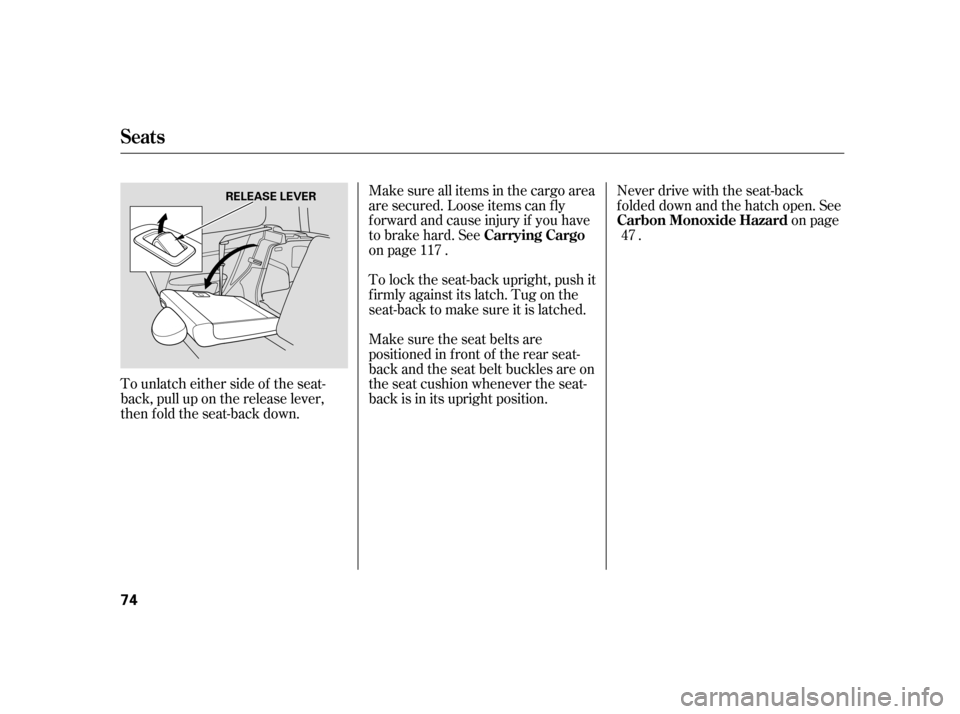
To unlatch either side of the seat-
back, pull up on the release lever,
then fold the seat-back down.Never drive with the seat-back
f olded down and the hatch open. See
on page
.
Make sure all items in the cargo area
are secured. Loose items can f ly
f orward and cause injury if you have
to brake hard. See
on page .
To lock the seat-back upright, push it
firmly against its latch. Tug on the
seat-back to make sure it is latched.
Make sure the seat belts are
positioned in f ront of the rear seat-
back and the seat belt buckles are on
the seat cushion whenever the seat-
back is in its upright position. 47
117
Seats
Carbon Monoxide Hazard
Carrying Cargo
74 RELEASE LEVER
�����—�����—�
���y�
�������������y���
�(���)�������y���������y