Page 177 of 226

If you need to park your vehicle f or
an extended period (more than one
month), there are several things you
should do to prepare it f or storage.
Proper preparation helps prevent
deterioration and makes it easier to
get your vehicle back on the road. If
possible, store your vehicle indoors.Fill the f uel tank.
Change the engine oil and f ilter. Block the rear wheels.
If the vehicle is to be stored f or a
longer period, it should be
supported on jackstands so the
tires are of f the ground.
Wash and dry the exterior
completely.
Cleantheinterior.Makesurethe
carpeting, floor mats, etc., are
completely dry. Cover the vehicle with a
‘‘breathable’’ cover, one made
f rom a porous material such as
cotton. Non-porous materials, such
as plastic sheeting, trap moisture,
which can damage the paint.
Leave the parking brake off. Put
the transmission in Reverse
(manual) or Park (automatic). Leave one window open slightly (if
the vehicle is being stored
indoors).
If possible, periodically run the
engine until it reaches f ull
operating temperature (the
cooling f ans cycle on and of f
twice). Pref erably, do this once a
month.
If you store your vehicle f or 1 year or
longer, have your dealer perf orm the
inspections called f or in the 2 years/
30,000 miles (48,000 km)
maintenance schedule (Normal
Conditions) as soon as you take it
out of storage (see page ). The
replacements called f or in the
maintenance schedule are not
needed unless the vehicle has
actually reached that time or mileage.
To minimize sticking, apply a
silicone spray lubricant to all door
and trunk seals. Also, apply a
vehiclebodywaxtothepainted
surfaces that mate with the door
and trunk seals.
Support the f ront wiper blade
arms with a f olded towel or rag so
they do not touch the windshield.
Disconnect the battery.
153
Vehicle Storage
Maint enance
185
�����—�����—�����y�
�������������y���
�(���%�������y���
�����y
Page 190 of 226

Using gloves or a large heavy
cloth, turn the radiator cap
counterclockwise, without pushing
down, to the f irst stop. Af ter the
pressure releases, push down on
the cap, and turn it until it comes
off.Put the radiator cap back on
tightly. Run the engine, and watch
the temperature gauge. If it goes
back to the red mark, the engine
needs repair (see
on page ).
If the temperature stays normal,
check the coolant level in the
radiator reserve tank. If it has
gone down, add coolant to the
MAX mark. Put the cap back on
tightly.
Start the engine, and set the
temperature control dial to
maximum heat. Add coolant to the
radiator up to the base of the f iller
neck. If you do not have the
proper coolant mixture available,
you can add plain water.
Remember to have the cooling
system drained and ref illed with
the proper mixture as soon as you
can.
If there was no coolant in the
reserve tank, you may need to add
coolant to the radiator. Let the
engine cool down until the pointer
reaches the middle of the
temperature gauge or lower
bef ore checking the radiator.
7.
8. 9.10. 11.
209
Emergency
Towing
If theEngineOverheats
T aking Care of t he Unexpect ed
199
Removing the radiator cap
while the engine is hot can
cause the coolant to spray out,
seriously scalding you.
Always let the engine and
radiator cool down before
removing the radiator cap.
�����—�����—�����y�
�������������y���
�(���%�������y���������y
Page 198 of 226
�µ
�µ
�µ
CONT INUED
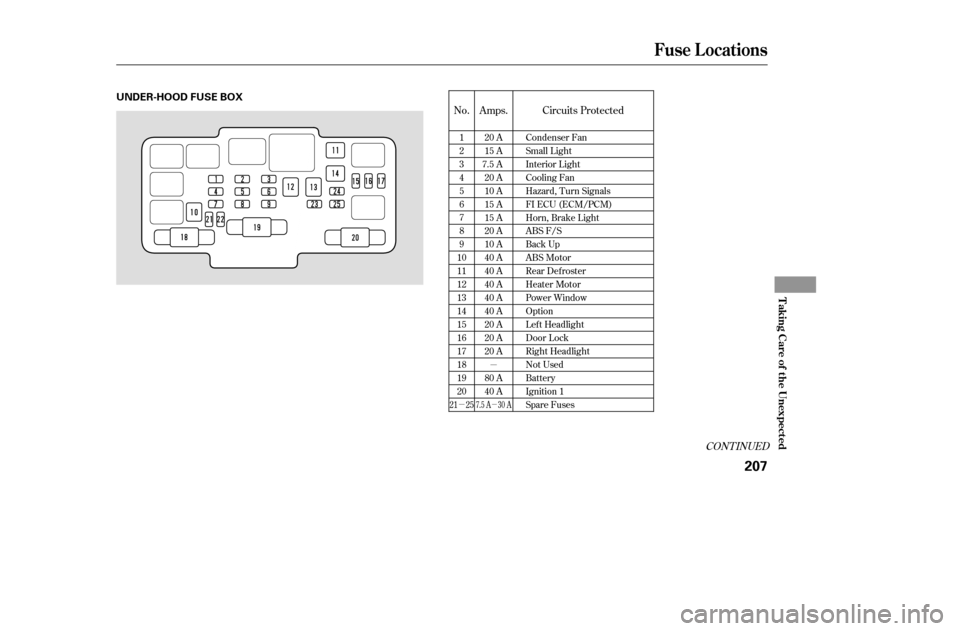
No. Amps. Circuits Protected
1 23456789
1011121314151617181920 20 A
15 A
7.5 A
20 A
10 A
15 A
15 A
20 A
10 A
40 A
40 A
40 A
40 A
40 A
20 A
20 A
20 A
80 A
40 A Condenser Fan
Small Light
Interior Light
Cooling Fan
Hazard, Turn Signals
FI ECU (ECM/PCM)
Horn, Brake Light
ABS F/S
Back Up
ABS Motor
Rear Defroster
Heater Motor
Power Window
Option
Lef t Headlight
Door Lock
Right Headlight
Not Used
Battery
Ignition 1
Spare Fuses
21 257.5 A 30 A
Fuse Locations
T aking Care of t he Unexpect ed
207
UNDER-HOOD FUSE BOX
�����—�����—�����y�
�������������y���
�(���%�������y�����
���y
Page 221 of 226

.............
Halogen Headlight Bulbs . 170
..............
Hazard Warning Flashers . 64
Headlights
........................................
Aiming . 170
............
Daytime Running Lights . 62
..................
High Beam Indicator . 55
...........................
Reminder Tone . 62
........
Replacing Halogen Bulbs . 170
...................................
Turning on . 62
..............................
Head Restraints . 75
...............................
Heated Mirrors . 81
.......................
Heating and Cooling . 88 .............
High Altitude, Starting at . 135
............................
High Beam Lever . 62
..............
High-mount Brake Light . 174
..
Hood, Opening and Closing the . 124
..................................................
Horn . 60
...........................
Hydraulic Clutch . 168
..........................
Four-way Flashers . 64
..............................
Front Airbags . 9, 22
Front Seat
......................................
Adjusting . 73
.....................................
Airbags . 9, 22
.................................................
Fuel . 122
....................................
Economy . 127
......................
Fill Door and Cap . 123
...........................................
Gauge . 58
.....................
Low Fuel Indicator . 56
................
Octane Requirement . 122
...............................
Oxygenated . 122
........................
Tank, Ref ueling . 123
..............................
Fuse Locations . 207
.....................
Fuses, Checking the . 204
...............
Gas Mileage, Improving . 127
..........................................
Gasohol . 122
.........................................
Gasoline . 122
...........................................
Gauge . 58
.....................
Low Fuel Indicator . 56
................
Octane Requirement . 122
........................
Tank, Ref ueling . 123
................
Gas Station Procedures . 123 Gauges
...
Engine Coolant Temperature . 59
...............................................
Fuel . 58
Gearshif t Lever Positions ..........
Automatic Transmission . 138
..............
Manual Transmission . 136
........................................
Glove Box . 84
Gross Axle Weight Rating
.....................................
(GAWR) . 131
Gross Vehicle Weight Rating .....................................
(GVWR) . 131 ...
Identif ication Number, Vehicle . 212
..............
If the Engine Overheats . 197
..............
If the Engine Wont Start . 194
Ignition
..............................................
Keys . 66
...........................................
Switch . 68
............
Timing Control System . 220
........................
Immobilizer System . 67
.........
Important Safety Precautions . 6
Indicators
..............
ABS (Anti-Lock Brake) . 55
Brake (Parking and Brake
....................................
System) . 55
................
Charging System . 54, 200
.............................
Cruise Control . 56
DRL (Daytime Running
......................................
Lights) . 55
Index
G H I
IV
�����—�����—�����y�
�����������
�y���
�(���%�������y���������y