Page 167 of 289
Youshoulddothefollowingchecks
and adjustments bef ore you drive
your vehicle.Make sure all windows, mirrors,
and outside lights are clean and
unobstructed. Remove f rost, snow,
or ice.
Check that the hood is f ully closed. Check the seat adjustment (see
page ).
Check the adjustment of the
inside and outside mirrors (see
page ).
Check the steering wheel
adjustment (see page ).
Make sure the doors and the
trunk are securely closed and
locked.
Fasten your seat belt. Check that
your passengers have f astened
their seat belts (see page ).
When you start the engine, check
the gauges and indicators in the
instrument panel (see page ).
Check that the trunk is f ully
closed.
Visually check the tires. If a tire
looks low, use a gauge to check its
pressure.
Check that any items you may be
carrying are stored properly or
f astened down securely.
2.
1.
6. 7. 8. 9.
14
3.4. 5.
10.
11. 81
93 72
55
Preparing to Drive
174
�����—�����—�����y�
�
�����������y���
�(���%�������y���
�����y
Page 176 of 289

Always use the parking brake when
you park your vehicle. Make sure
the parking brake is set f irmly or
your vehicle may roll if it is parked
on an incline.
If your vehicle has an automatic
transmission, set the parking brake
bef ore you put the transmission in
Park. This keeps the vehicle f rom
moving and putting pressure on the
parking mechanism in the
transmission.If the vehicle is f acing uphill, turn
the f ront wheels away f rom the
curb. If you have a manual
transmission, put it in f irst gear.
If the vehicle is f acing downhill,
turn the front wheels toward the
curb. If you have a manual
transmission, put it in reverse gear.
Make sure the parking brake is
f ully released bef ore driving away.
Driving with the parking brake
partially set can overheat or
damage the rear brakes.
Make sure the moonroof (if
equipped) and the windows are
closed.
Turn of f the lights.
Place any packages, valuables, etc.,
in the trunk or take them with you.
Lock the doors.
Check the indicator on the
instrument panel to verif y that the
security system is set.
Never park over dry leaves, tall
grass, or other f lammable
materials. The hot three way
catalytic converter could cause
these materials to catch on fire.
On vehicles with security system
Parking T ips
Parking
Driving
183
�����—�����—�����y�
�
�����������y���
�(���%�������y���
�����y
Page 220 of 289
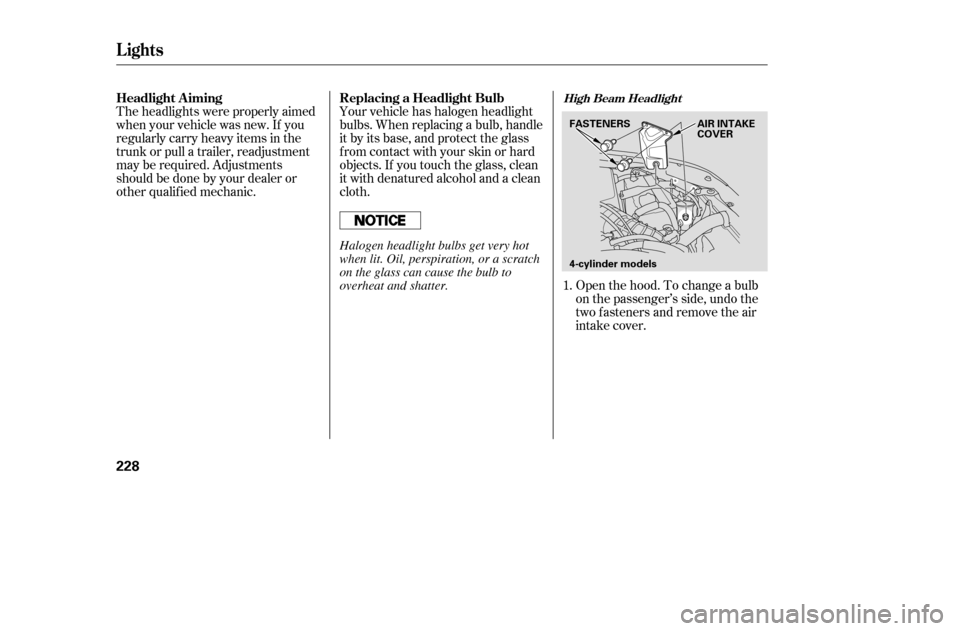
Open the hood. To change a bulb
on the passenger’s side, undo the
two fasteners and remove the air
intake cover.
Theheadlightswereproperlyaimed
when your vehicle was new. If you
regularly carry heavy items in the
trunk or pull a trailer, readjustment
may be required. Adjustments
should be done by your dealer or
other qualif ied mechanic.
Your vehicle has halogen headlight
bulbs. When replacing a bulb, handle
it by its base, and protect the glass
f rom contact with your skin or hard
objects. If you touch the glass, clean
it with denatured alcohol and a clean
cloth.
1.
Headlight A iming Replacing a Headlight Bulb
High Beam Headlight
Lights
228
4-cylinder models
FASTENERS AIR INTAKE
COVER
Halogen headlight bulbs get very hot
when lit. Oil, perspiration, or a scratch
on the glass can cause the bulb to
overheat and shatter.
�����—�����—�����y�
�
��
������
�y���
�(���%�������y�������
�y
Page 224 of 289
Remove the burned out bulb f rom
thesocketbypushingitinand
turning the bulb counterclockwise
until it unlocks.
Install the new bulb in the socket.
Turn it clockwise to lock it in place.
Insert the socket back into the
headlight assembly. Turn it
clockwise to lock it in place.
Turn on the lights to make sure
the new bulb is working.
Put the inner f ender cover in place.
Install and lock each holding clip
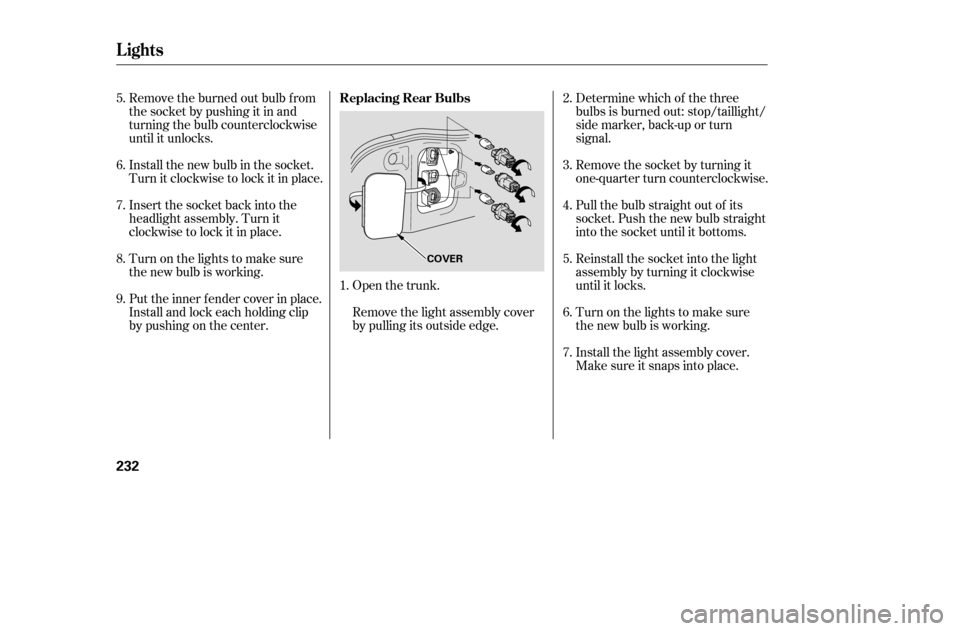
bypushingonthecenter.Open the trunk.
Remove the light assembly cover
by pulling its outside edge.Determine which of the three
bulbs is burned out: stop/taillight/
side marker, back-up or turn
signal.
Remove the socket by turning it
one-quarter turn counterclockwise.
Pull the bulb straight out of its
socket. Push the new bulb straight
into the socket until it bottoms.
Reinstall the socket into the light
assembly by turning it clockwise
until it locks.
Turn on the lights to make sure
the new bulb is working.
Install the light assembly cover.
Make sure it snaps into place.
1. 3.
2. 4. 5.6. 7.
5. 6. 7. 8. 9.
Lights
Replacing Rear Bulbs
232
COVER
�����—�����—�����y�
�
��
��������y���
�(���%�������y���������y
Page 225 of 289
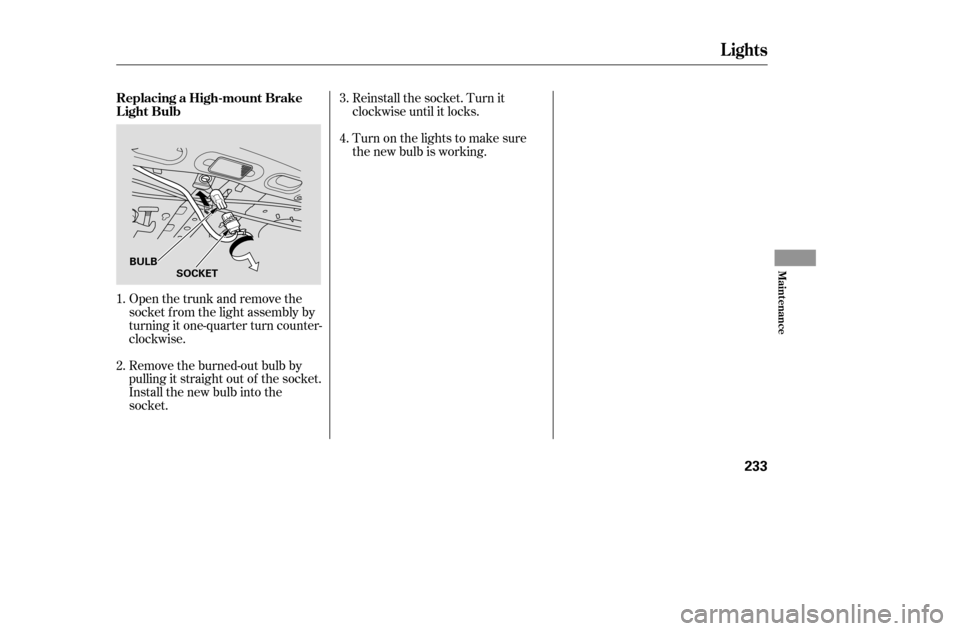
Open the trunk and remove the
socket f rom the light assembly by
turning it one-quarter turn counter-
clockwise.
Remove the burned-out bulb by
pulling it straight out of the socket.
Install the new bulb into the
socket.Reinstall the socket. Turn it
clockwise until it locks.
Turn on the lights to make sure
the new bulb is working.
1. 2. 3. 4.
Lights
Replacing a High-mount Brake
Light Bulb
Maint enance
233
BULB
SOCKET
�����—�����—�����y�
�
��
��������y���
�(���%�������y���������y
Page 238 of 289

Leave the parking brake off. Put
the transmission in Reverse
(manual) or Park (automatic).
Block the rear wheels.
If the vehicle is to be stored f or a
longer period, it should be
supported on jackstands so the
tires are of f the ground.
Leave one window open slightly (if
the vehicle is being stored
indoors).
Disconnect the battery.
Support the f ront wiper blade
arms with a f olded towel or rag so
they do not touch the windshield.To minimize sticking, apply a
silicone spray lubricant to all door
and trunk seals. Also, apply a
vehiclebodywaxtothepainted
surfaces that mate with the door
and trunk seals.
Cover the vehicle with a
‘‘breathable’’ cover, one made
f rom a porous material such as
cotton. Non-porous materials, such
as plastic sheeting, trap moisture,
which can damage the paint.
If possible, periodically run the
engine until it reaches f ull
operating temperature (the
cooling f an cycles twice).
Pref erably, do this once a month.
If you store your vehicle f or 1 year or
longer, have your dealer perf orm the
maintenance inspections as soon as
youtakeitoutof storage(seepages
and ). The 6-cylinder model
needs the inspections called f or in
the 2 years/30,000 miles (48,000 km)
maintenance schedule (normal
conditions) and the 4-cylinder model
needs the inspections called f or in
the 2 years/40,000 miles (64,000 km)
maintenance schedule (normal
nonditions). The replacements called
f or in the maintenance schedule are
not needed unless the vehicle has
actually reached that time or mileage. 201 206
Vehicle Storage
Maint enance246
�����—�����—�����y�
�
��
��������y���
�(���%�������y���������y
Page 240 of 289
CONT INUED
If you have a f lat tire while driving,
stop in a saf e place to change it.
Drive slowly along the shoulder until
you get to an exit or an area that is
far away from the traffic lanes.If you are towing a trailer, unhitch
the trailer.
Turn on the hazard warning
indicators, and turn the ignition
switch to LOCK (0). Have all the
passengers get out of the vehicle
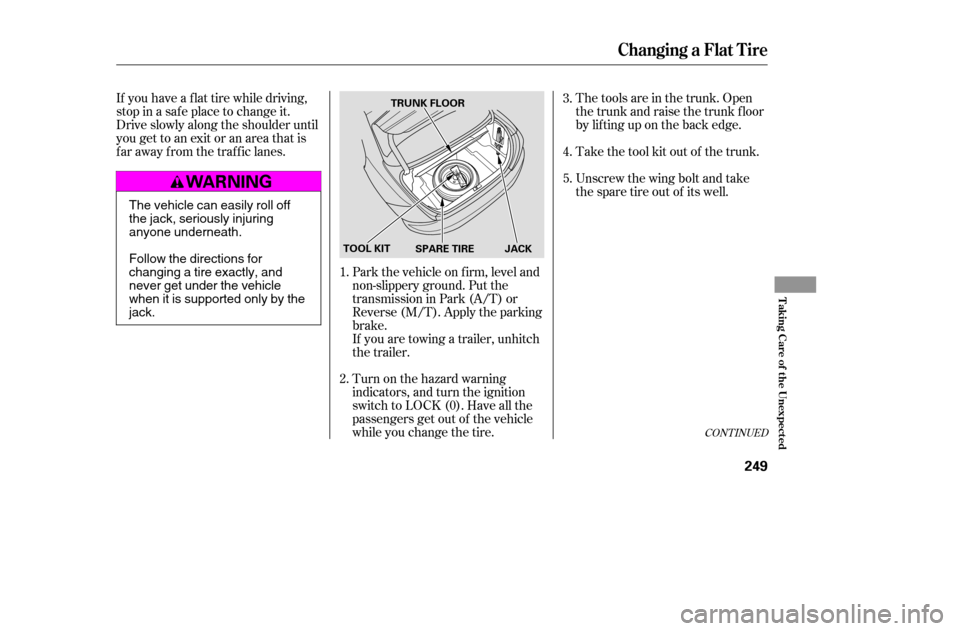
while you change the tire.The tools are in the trunk. Open
the trunk and raise the trunk f loor
by lif ting up on the back edge.
Take the tool kit out of the trunk.
Unscrew the wing bolt and take
the spare tire out of its well.
Park the vehicle on f irm, level and
non-slippery ground. Put the
transmission in Park (A/T) or
Reverse (M/T). Apply the parking
brake. 5.
4.
3.
2. 1.
Changing a Flat T ire
T aking Care of t he Unexpect ed
249
TRUNK FLOOR
SPARE TIRE JACK
TOOL KIT
The vehicle can easily roll off
the jack, seriously injuring
anyone underneath.
Follow the directions for
changing a tire exactly, and
never get under the vehicle
when it is supported only by thejack.
�����—�����—�����y�
�
��
��������y���
�(���%�������y���������y
Page 244 of 289
CONT INUED
Remove the center cap before
storing the f lat tire in the trunk
well.Place the flat tire face down in the
spare tire well.
Remove the spacer cone f rom the
wing bolt, turn it over, and put it
back on the bolt.
Securetheflattirebyscrewing
the wing bolt back into its hole.
Tighten the wheel nuts securely in
the same crisscross pattern. Have
the wheel nut torque checked at
the nearest automotive service
f acility.
Tighten the wheel nuts to:
15. 16. 17.
18.
19.
EX and EX-V6 models
Changing a Flat T ire
T aking Care of t he Unexpect ed
253
WING BOLT
SPACER CONEFor
sparetire
For
normaltire
80 lbf·ft (108 N·m , 11 kgf·m)
�����—�����—�����y�
�
��
��������y���
�(���%�������y���������y